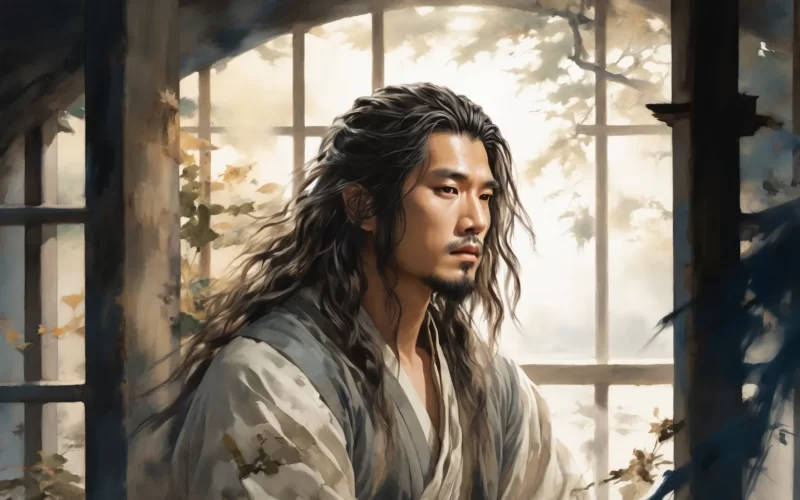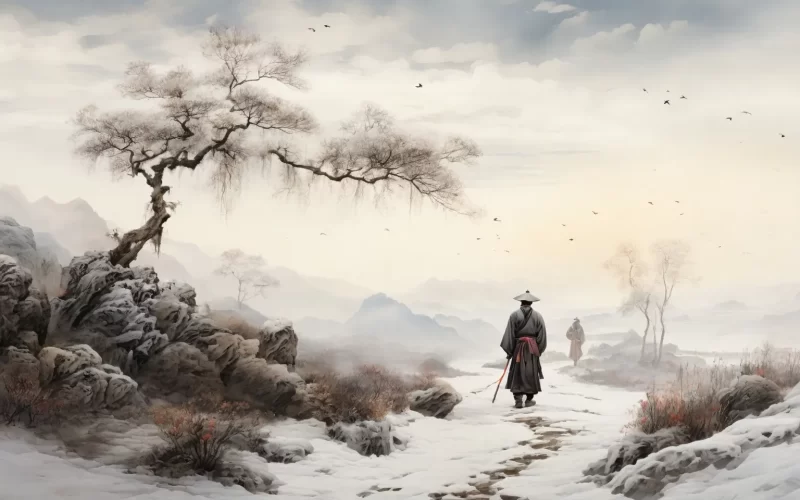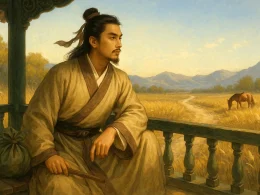

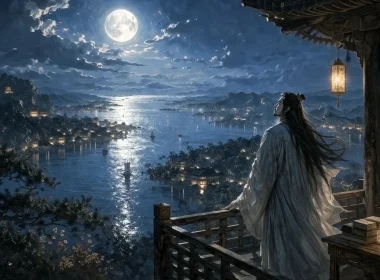
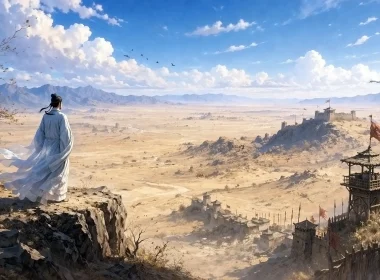
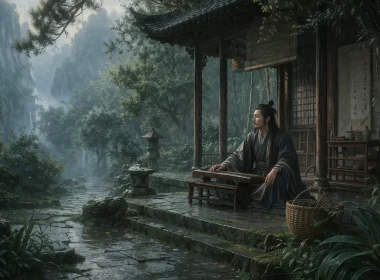
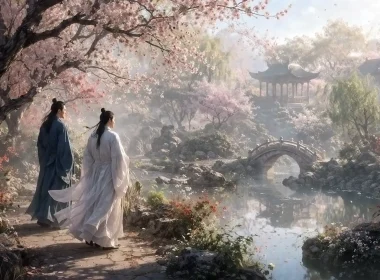
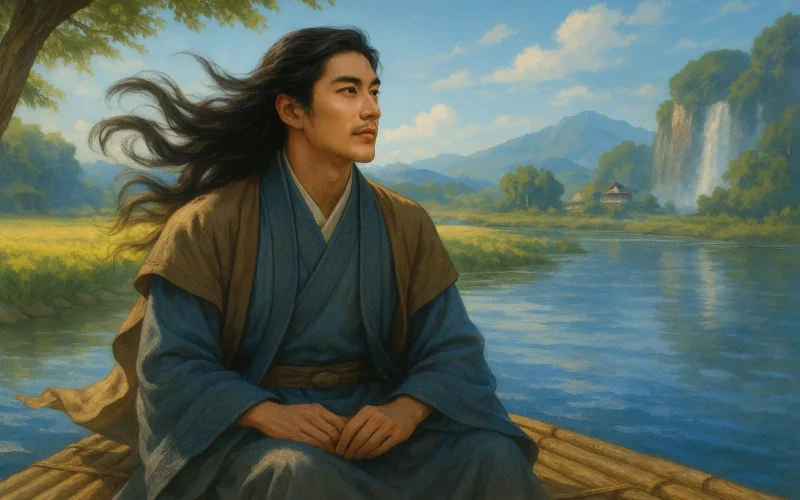
Meng Haoran (孟浩然 689 - 740), a native of Xiangyang, Hubei Province, was a renowned landscape and pastoral poet of the Tang Dynasty. In his early years, he lived in seclusion on Mount Lumen, reading for his own pleasure. At the age of forty, he traveled to the capital to take the jinshi examination but failed. Thereafter, he remained a commoner for the rest of his life, roaming the Wu and Yue regions and finding contentment in poetry and wine. He excelled in five-character verse, with a style that is light and natural, often depicting the pleasures of landscapes and reclusion. He is regarded as a representative of the High Tang landscape and pastoral poetry school. His collected works, Meng Haoran Ji, have been handed down, and his poetry exerted a profound influence on later hermitic poetic traditions.
Major Works




Life
Meng Haoran was born in Jiannan Garden, near the confluence of the Xiang River and the Han River, south of Xiangyang City. His family owned a modest amount of property and was a well‑off, scholarly local household. Intelligent and studious from childhood, he was deeply influenced by Confucianism and early on harbored aspirations to serve the state. In his own poem he wrote, “为文三十载,闭户江汉阴” – meaning he had spent thirty years studying behind closed doors, hoping to enter officialdom through the imperial examinations. As a young man he retreated to Mount Lumeng, but this retreat was not a total withdrawal from the world. Rather, it followed the High Tang fashion of “seeking office through reclusion” – a kind of performance art aimed at gaining reputation and recommendation.
Although known as a “reclusive poet”, Meng Haoran was never a solitary hermit. He valued friendship above all else, was open‑hearted and generous, and made friends with everyone from court chancellors to village farmers. He traveled widely, leaving footprints across the land. In the fifth year of the Kaiyuan era (717 AD), at the age of twenty‑eight, he visited Lake Dongting and wrote the powerful poem “On Yueyang Tower” (also titled “Viewing Lake Dongting, Presented to Chancellor Zhang”), with the famous couplet “气蒸云梦泽,波撼岳阳城” – lines full of soaring ambition and regarded as a quintessential expression of his early desire for public service. Later, he cultivated a friendship with Li Bai, who held him in the highest esteem. Li Bai wrote the immortal “Farewell to Meng Haoran at Yellow Crane Tower on His Way to Guangling” and, in “Presented to Meng Haoran”, expressed his deep admiration: “吾爱孟夫子,风流天下闻……高山安可仰,徒此揖清芬.”
In the sixteenth year of the Kaiyuan era (728 AD), at age forty, Meng Haoran finally traveled north to Chang’an to take the jinshi examination – the most important attempt of his life to gain an official post. Yet fate played a cruel trick: he failed. Legend has it that during this trip he happened to recite “不才明主弃,多病故人疏” (“Unworthy, I am abandoned by the enlightened ruler; often ill, I am neglected by old friends”) in the presence of Emperor Xuanzong. The emperor was displeased and replied, “You never sought office, yet I never abandoned you. Why do you slander me?” He then dismissed Meng Haoran back to Xiangyang. Though the story may be apocryphal, it became a much‑talked‑about literary anecdote. Disappointed, Meng left the capital and traveled south to the Wu and Yue region to find solace among mountains and waters. In the eighteenth year of the Kaiyuan era (730 AD), he went from Luoyang to Hangzhou, ascended West Lake, and watched the Qiantang River bore, writing, “鹭涛来似雪,一坐凛生寒”. After two years of wandering, on New Year’s Eve of the nineteenth year (731 AD), he met his old friend Zhang Zirong at Lecheng and returned north after the holiday.
In the twenty‑second year of the Kaiyuan era (734 AD), Meng Haoran went to the capital again in search of an official position, but again failed. He wrote “On Returning to the South Mountain at the End of the Year”, with the lines “北阙休上书,南山归敝庐”, expressing his helplessness. In the end, the only official work he ever did was a few months as a clerk in the secretariat of Zhang Jiuling, when the latter was Chief Secretary of Jingzhou. His dream of an official career never came true.
The final period of Meng Haoran’s life is marked by tragic drama. In the twenty‑fifth year (737 AD), Zhang Jiuling was demoted to be Chief Secretary of the Grand Protectorate of Jingzhou. Despite his own adversity, he remembered his old friend and appointed Meng Haoran as a clerk in his secretariat. Yet Meng’s career was always rough; he did not stay long in office and soon returned to a leisurely life. Illness plagued this unranked poet. In the summer of the twenty‑seventh year (739 AD), he suffered a carbuncle on his back and lay sick in his old house in Xiangyang. The following year, Wang Changling, pardoned from exile in Lingnan, passed through Xiangyang on his way north. Despite his illness, Meng Haoran welcomed him and they drank merrily together. During the feast, he ate fresh fish that was forbidden for his condition, which caused his old illness to relapse and the carbuncle to worsen. In the twenty‑eighth year of the Kaiyuan era (740 AD), Meng Haoran, the great master of landscape poetry, passed away in his residence in Jiannan Garden, Xiangyang, at the age of fifty‑two. After his death, friends buried him at the southern foot of Mount Lumeng east of Xiangyang. Later generations honoured him as the “Star of Poetry”, and for a thousand years he has been revered by literary giants. Though he never attained official rank, he left a lasting legacy of pure poetry and proud integrity.
Style and Characteristics
Meng Haoran has 263 extant poems – not a large number, yet his unique artistic charm makes him stand out in the High Tang poetic scene. Most of his poems are in five‑character form, mostly short pieces, describing landscapes, the joy of reclusion, and the mood of travel. He often chooses everyday objects and episodes, such as “Spring Dawn” (春晓), which captures the instant feeling of waking up in the morning in just twenty characters. In the words of Wen Yiduo, his poetry is “so light that one hardly sees the poem” – the ultimate in simplicity, naturalness, and clarity. His main stylistic features are as follows:
“So light that one hardly sees the poem”: the pursuit of simplicity and naturalness
The core characteristic of Meng Haoran’s style is his simple, natural, unadorned artistic realm. Wen Yiduo’s remark that his poetry is “so light that one hardly sees the poem” captures it perfectly – Meng’s verses seem to flow naturally from the heart, without deliberate craft. Because he lived long in seclusion, sharing the company of woodcutters and fishermen, his works lack those courtly poems written to order, but possess instead the fragrance of the countryside, sincere and warm. He prefers elegant, simple language and sparse, tranquil images to express fresh artistic conceptions and a sense of spiritual detachment and quiet contentment. He pursues a leisurely feeling of unity with heaven and earth, subtly blending his innermost feelings into the flowing lines. Take the widely loved “Visiting an Old Friend’s Cottage”. Not a single line is unusual, not a single word striking; it is plain narrative, like an invitation from an old friend, yet between the lines flows a rich pastoral sentiment and a charming rustic delight. Even a common friendship is made extraordinarily sincere and moving. Or take “Spring Dawn”: the poet chooses the daily moment of waking to bird songs and thoughts of falling blossoms, and in a twenty‑character quatrain vividly expresses his leisurely life and regret for spring’s passing. Singing birds and fallen petals are common spring sights, and hearing and thinking are everyday activities; but through the poet’s detailed, typical portrayal of such a small episode, the whole poem is filled with boundless feeling.
Perfect fusion of landscape and pastoral poetry
Before Meng Haoran, landscape poetry and pastoral poetry belonged to different traditions: landscape poetry (represented by Xie Lingyun) focused on natural scenery, while pastoral poetry (represented by Tao Yuanming) focused on country life and reclusive pleasures. Xie Lingyun and Xie Tiao excelled at describing landscapes, but their poems often lacked human presence. Meng Haoran was the first poet to consciously merge the two genres and write copiously in the combined style. Building on the two Xies, he explored ways to integrate the two traditions, pouring his sincere, deep feelings into depictions of nature and the countryside, creating a new poetic realm where emotion and scene blend and the flavour lingers. He became a key figure linking the Southern Dynasties with the High Tang landscape‑pastoral tradition.
He painted scenes of life that combine the smoke of human dwellings with an ethereal, unworldly quality. In his poems, tilling the fields and sea of clouds, leisure and worry often coexist. He opened a new dimension of landscape‑pastoral poetry that had not existed since the Southern Dynasties. As the leading figure of the High Tang landscape‑pastoral school, he greatly expanded the aesthetic breadth and depth of classical Chinese landscape literature. He does not merely write about the stillness of mountains or the freshness of fields; he subtly merges his feelings of being unrecognized, the sorrows of travel, and the faint bitterness of failed official ambitions into the landscape and pastoral scenes. Emotion and scene blend seamlessly, self and object are forgotten, so that his landscapes are both pleasing to the eye and rich in evocative meaning. For instance, in “Mooring on the River at Jiande”, the line “野旷天低树,江清月近人” fuses scenery with the mood of travel. In “Returning at Night to Lumeng Mountain”, he blends description of scenery with feelings of reclusion all the way. These poems have both the otherworldly painting‑like quality of the two Xies and the intimate, realistic pastoral charm of Tao Yuanming.
Vigour within blandness – a clear, robust energy
Meng Haoran’s temperament gave half to the open landscapes and half to a lofty, unyielding spirit. Although his style is basically bland, distant, and leisurely, there is hidden within it a strong, vigorous energy. It is by no means like Liu Zongyuan’s solitary coldness; rather, it is a feeling of majestic vitality, as if the power of life itself is at work. The uplifting spirit of the High Tang era and the poet’s own open‑heartedness make his poems not just purely beautiful in the manner of the two Xies, but also expansive, vigorous, and uplifting. They are the most realistic and unrestrained spiritual portrait of the High Tang landscape school.
“Viewing Lake Dongting, Presented to Chancellor Zhang” provides the clearest example. In the first four lines describing the grandeur of Lake Dongting, a few strokes create a macrocosmic atmosphere that swallows heaven and earth, forming a sweeping momentum with the couplet “气蒸云梦泽,波撼岳阳城”. The words “气蒸” (steaming) and “波撼” (shaking) give the lake an extraordinary vitality; its majestic force is rare in the entire High Tang poetic scene. In another scenic piece, “Watching the Bore with Yan Qiantang from Zhangting Pavilion”, the light touch turns into thunderous, towering waves – powerful yet effortless, surging with passion, not inferior to any master of bold poetry. Even in slightly melancholy works like “Early Cold, a Feeling from the River”, there is no trace of vulgarity; the strokes are restrained but the spirit remains high. His writing style is a genuine gathering of the spirit of his age. From the Southern Dynasties to the High Tang, few could match Meng Haoran in infusing a word like “pure” with a joyful and proud spirit within plain words, making his verse never forgotten. He is especially good at injecting a distinct, self‑confident pride into plain and easy lines; even when he laments his frustrated later years, he always exudes an integrity that refuses to go with the tide.
Aesthetic pursuit: bland, leisurely, simple, and sincere
Meng Haoran took the five‑character line as the norm, mainly using short five‑character pieces, excelling in five‑character ancient verse and five‑character regulated verse. He skillfully combined the techniques of ancient and modern poetry, “using ancient style within regulated verse”, so that his works inherit the natural, unforced quality of Han‑Wei poetry while incorporating the meticulous prosody of modern verse since the Early Tang. Thus his poems have a harmonious, complete momentum and smooth, beautiful rhythm, satisfying the High Tang poetic reform’s admiration for and surpassing of Han‑Wei style. His creations greatly contributed to the expansion of subject matter, atmosphere, and technique in High Tang poetry, and provided valuable inspiration and paradigms for the later development of the landscape‑pastoral school.
Literary Influence
Although Meng Haoran never held official office, he held a significant position in the High Tang poetic world. His influence spanned the High Tang and the following thousand years, writing an irreplaceable brilliant chapter in the history of Chinese poetry.
Founding father of the landscape‑pastoral school and the pairing “Wang‑Meng”
Meng Haoran was the core founder of the High Tang landscape‑pastoral school. He was the first to fuse the beauty of mountains and waters with the flavour of fields, achieving great distinction in this field and laying the foundation for the entire school. He is known together with Wang Wei as “Wang‑Meng”. Both are regarded by literary historians as twin peaks of this school. Although their styles differ – Wang Wei’s poetry is like fine brushwork in bright colours, Meng Haoran’s like freehand sketches – both are insurmountable artistic summits. Moreover, together with Wang Wei, Wei Yingwu, and Liu Zongyuan, he is counted among the four great representatives of the landscape‑pastoral school, jointly constructing its most magnificent edifice. He was honoured by later generations as the “Star of Poetry”, a unique genius.
An idol for generations of top poets
Meng Haoran’s personal charm and poetic art earned him enthusiastic admiration from many contemporaries. Even Li Bai and Du Fu, the two “top‑tier” poets of the High Tang, revered him. In “Presented to Meng Haoran”, Li Bai wrote: “吾爱孟夫子,风流天下闻。红颜弃轩冕,白首卧松云。醉月频中圣,迷花不事君。高山安可仰,徒此揖清芬.” Li Bai praised Meng’s life of drinking to the moon and delighting in flowers, regarding him as an ideal figure of pure, unworldly character. The line “高山安可仰” suggests that Li Bai felt he could never reach Meng’s height, and “徒此揖清芬” shows his bowing in admiration of his friend’s nobility. Du Fu also wrote with deep feeling: “复忆襄阳孟浩然,清诗句句尽堪传.” Judging from these lines, the two most prominent stars of the High Tang poetic world both regarded Meng Haoran as a model, which shows the profound charm of his poetry and personality.
The thousand‑year laurel of “Ancestor of Reclusive Poets”
Because Meng Haoran never entered official life and wrote many poems about quiet withdrawal and reclusion, later literati honoured him as the “Ancestor of Reclusive Poets”, a title that has lasted a thousand years. In traditional Chinese culture, the tension between serving the state and retiring from it has always been deep. Most scholar‑officials were more concerned with their ambitions in court, and very few could completely forget the rivers and lakes. Using the clear, pure quality of his poetry and character, Meng Haoran provided a spiritual home for later frustrated literati, a place where they could transcend the mundane and soothe their souls. His choice “not to flatter the vulgar, to keep clean through reclusion”, his integrity, and his open uprightness brought the aesthetics of traditional reclusion to a more humane and spiritually luminous historical level.
The cultural symbol “Meng Xiangyang”
Because Meng Haoran took Xiangyang as his hometown and drew creative inspiration from its long rivers and hills, the city of Xiangyang, thanks to the writing of such a literary giant, became the best cultural symbol of a city complementing a poet. In his poems he repeatedly described the landscapes of Xiangyang with deep affection, pouring into the land the purest poetic soul. He was regarded as the first person to use poetry so vigorously to promote his native scenery. Tang and Song people, moved by his poetic virtue, called him “Meng Xiangyang”.
In summary, Meng Haoran was one of the most important founders of the High Tang landscape‑pastoral school and the key figure who first perfectly fused landscape poetry with pastoral poetry. Although he never held office, with his pure and affectionate poetic heart he bequeathed to later generations a style that is “bland, leisurely, simple, and sincere”, creating a quiet, far‑reaching artistic world where self and object are forgotten. A lifelong commoner, he nevertheless befriended half of the Tang literary circle. He was seen by Li Bai as an unattainable ideal and praised by Du Fu as a master whose “every line deserves to be transmitted”. His “Spring Dawn” is known to every household, his “Visiting an Old Friend’s Cottage” became a model of pastoral poetry, and “Viewing Lake Dongting, Presented to Chancellor Zhang” is filled with heroic vigour. Wen Yiduo’s remark that his poetry is “so light that one hardly sees the poem” hits the mark – all his charm and truth lie in that perfect, unadorned simplicity. The poet and his works are like a river moon before Xiangyang city, like a wisp of mist over Mount Lumeng – a faint fragrance floating forever in the poetic sky of the Tang.