
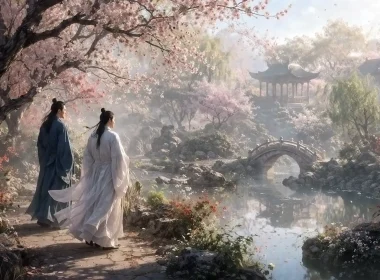
I petition no more at the north palace-gate.
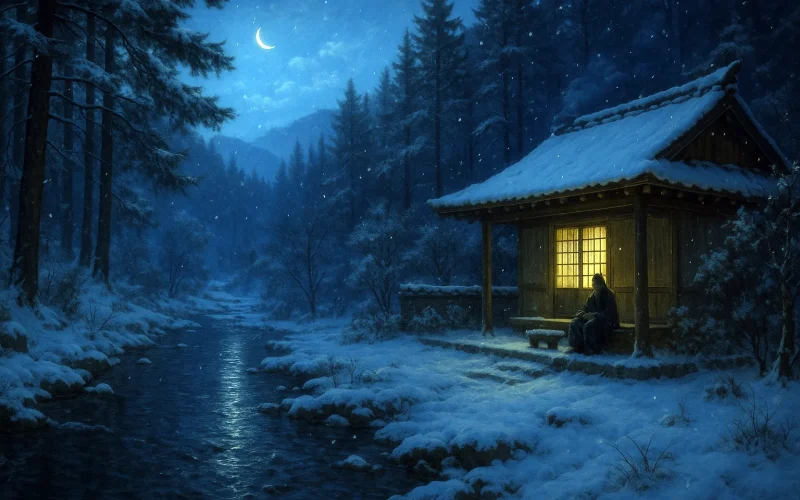
...To this tumble-down hut on Zhongnan Mountain
I was banished for my blunders, by a wise ruler.
I have been sick so long I see none of my friends.

My white hairs hasten my decline,
Like pale beams ending the old year.
Therefore I lie awake and ponder
On the pine-shadowed moonlight in my empty window.
Original Poem
「岁暮归南山」
孟浩然
北阙休上书,南山归敝庐。
不才明主弃,多病故人疏。
白发催年老,青阳逼岁除。
永怀愁不寐,松月夜窗墟。
Interpretation
This poem was composed in the 16th year of the Kaiyuan era (728 AD), when Meng Haoran was forty years old. This was a pivotal and brutal year in his life. In this year, Meng Haoran traveled to Chang'an to take the jinshi examination—his first and only formal attempt at the civil service exams. By this time, he had already lived in reclusion in Xiangyang for many years, was famous for his landscape poetry, and had cultivated friendships with literary giants such as Wang Wei and Zhang Jiuling. On the surface, he appeared to be a hermit content with his forest springs. But at forty, Meng Haoran had never truly let go of his expectations for fame and office. The Tang scholar-official class regarded forty as the "age of strength for service"; the Book of Rites states, "At forty, one is strong, and fit for office." This year, he felt he could wait no longer. And then he failed the exams.
The blow of this failure was far heavier than we might imagine. He was not an obscure candidate—he had already made a name for himself in literary circles and exchanged poems and wine with powerful court officials. He was not without connections—Wang Wei and Zhang Jiuling could both have served as patrons. He was not even without talent—posterity pairs him with Wang Wei as "Wang-Meng," the twin peaks of High Tang landscape and pastoral poetry. And yet he failed. Even more poignantly, the New Book of Tang records the following anecdote: One day, Wang Wei secretly invited Meng Haoran to his government office, when Emperor Xuanzong happened to arrive. Meng Haoran, startled, hid under a bed. Wang Wei dared not conceal the matter and reported truthfully. The emperor ordered Meng Haoran to come out and asked to hear his poetry. Meng Haoran recited this very poem. When he reached the line "My unworthiness the wise ruler spurns," the emperor was displeased and said, "You never sought office, and I never abandoned you. Why do you slander me?" He then ordered Meng Haoran sent back to his hometown. This story may not be historically accurate, but it has circulated widely, because it captures precisely the impression this poem left on its contemporaries: this is not self-deprecation, but irony; not acceptance of fate, but accusation. Even before the Son of Heaven, Meng Haoran refused to speak a single insincere word in his poetry.
This poem therefore stands as the most singular piece in Meng Haoran's collected works. It lacks the serene clarity of his landscape and pastoral poems, the restraint of his recommendation poems, the warmth of his farewell poems. It possesses only honesty—an honesty bordering on pain. The forty-year-old Meng Haoran, having failed the exams, shed the mask of the hermit, the posture of the celebrated scholar, the discretion of the petitioner, and poured all his grief and indignation into this poem—the "least Meng Haoran-like" of all his works. And yet, paradoxically, it was this poem that made him the true Meng Haoran. After this, he retreated into permanent reclusion, remaining a commoner for the rest of his life, never setting foot in Chang'an again. This admission of defeat became the most important watershed of his life.
First Couplet: "北阙休上书,南山归敝庐。"
Běi què xiū shàng shū, nán shān guī bì lú.
To the Northern Palace, no more petitions I send;
To the South Mountain, to my humble hut I wend.
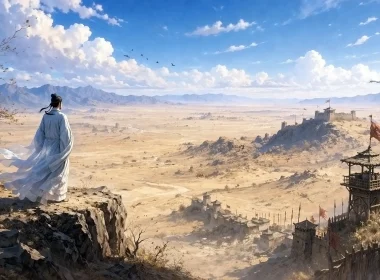
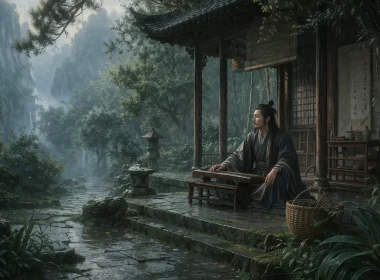
Explication: The opening is a gesture of absolute finality. "Northern Palace" is the imperial court, the symbol of fame and office, the direction toward which Meng Haoran had oriented himself for forty years. The word "no more" is decisive, leaving no room for negotiation, no intention of turning back. This is less a statement than a vow made to himself. "South Mountain" refers to the area south of Xian Mountain in Xiangyang, where Meng Haoran's garden south of the stream was located. The phrase "humble hut" carries immense weight—it is not false modesty, but a truthful description of his circumstances, and more than that, a mixture of self-respect and self-mockery. He could have used neutral terms like "old cottage" or "former garden," but he deliberately chose "humble." This reflects both a clear-eyed assessment of his situation and a preemptive response to any judgment from the outside world: do not pity me; I know exactly how destitute I am. Between these two lines, from "north" to "south," from "palace" to "hut," from "send petitions" to "wend home," a dual shift in both space and state of mind is completed. Yet this shift is not composed; it is forced. It is not peaceful; it is resentful.
Second Couplet: "不才明主弃,多病故人疏。"
Bù cái míng zhǔ qì, duō bìng gù rén shū.
My unworthiness the wise ruler spurns;
My frequent illness keeps old friends away.
Explication: These are the most famous lines of the entire poem, and the most painful confession of Meng Haoran's life. On the surface, they are self-deprecation: "unworthiness" is his own lack of talent; "frequent illness" is his own burden. Yet in the very juxtaposition of "unworthiness" with "wise ruler," and "frequent illness" with "old friends," a vast ironic tension is generated. If the ruler is truly "wise," why would he spurn one who is merely "unworthy"? If "old friends" are true friends, why would they distance themselves because of illness? The logical fissure here is precisely the grievance the poet buries beneath the surface. What makes it even more heartbreaking is that both statements may be literally true. Meng Haoran indeed never held office; he indeed drifted apart from certain powerful acquaintances after his failure. The deepest pain is not being wronged, but being accurately described. When a person uses self-deprecation to state a fact, and that fact happens to be irrefutable, the humiliation and helplessness are more suffocating than any accusation.
Third Couplet: "白发催年老,青阳逼岁除。"
Bái fà cuī nián lǎo, qīng yáng bī suì chú.
White hairs hasten on the years of old;
Green spring presses close, the old year's told.
Explication: The poem shifts from human affairs to the passage of time, the emotion turning from outward grievance to inward sigh. "White hairs" and "green spring" are juxtaposed—white and green, old and new, departing and arriving—creating a vast temporal tension. The poet is caught between these two forces: chased from behind by white hairs, pressed from ahead by green spring, with nowhere to flee. The word "hasten" conveys the speed of aging, a fear; the word "presses" conveys the end of the year, a pressure. This is no longer a lament; it is the suffocation of being besieged by time. To fail the exams at forty was not a dead end in the Tang Dynasty. But for Meng Haoran, this was the last window of opportunity. He knew he would not come again.
Fourth Couplet: "永怀愁不寐,松月夜窗墟。"
Yǒng huái chóu bù mèi, sōng yuè yè chuāng xū.
Filled with endless sorrow, I lie awake;
Pine-shadowed moonlight fills my window's empty ache.
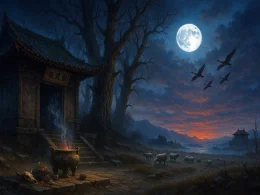
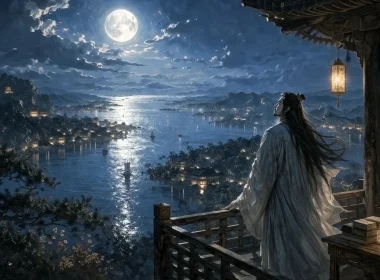
Explication: The poem concludes with scene carrying emotion, the technique Meng Haoran handled best. Yet the scene here lacks the serene clarity of "Missing Xin the Elder on a Summer Day" or the quiet peace of "Returning at Night to Deer-Gate Mountain." The word "empty ache" is the coldest character in the entire poem—it is not merely "emptiness" or "void," but the emptiness of ruins, the desolation of rubble. The moonlight is the same, the pine shadows are the same, the night window is the same, but the person sitting before the window has become a ruin. "Endless sorrow" is a gnawing that will not let go, a grief that cannot be released. The poet does not say what he is thinking about. The shame of failure? The wise ruler's rejection? The distance of old friends? The urging of white hairs? Or the road home he must take tomorrow? Perhaps all of these, perhaps none. He is simply awake, watching the moonlight turn everything outside the window into the color of ruins.
Holistic Appreciation
This is the most painful poem in Meng Haoran's collected works. Its pain lies in the necessity of admitting defeat, in having no one to blame, in every word being literally true. The poem's unique value lies in its complete tearing away of the veil of "indifference to fame and fortune" that had been draped over the figure of the reclusive poet. Throughout his life, Meng Haoran styled himself as a hermit, and posterity has been happy to shape him into an image of one who was aloof from worldly strife and intoxicated by mountains and waters. But the real Meng Haoran, in this poem, reveals all his unwillingness to accept, all his resentment, all his reluctance to let go, all his refusal to yield. He did not want to live in reclusion as much as he seemed to. He lived in reclusion because he failed the exams, because no one wanted him, because he could not afford to wait any longer, because he had nowhere else to go.
Structurally, the four couplets progress layer by layer in emotional intensity: the first couplet is the finality of resentment; the second is the grievance of self-justification; the third is the sigh of fear; the fourth is the emptiness of despair. From the outer to the inner, from resentment to grief, from anger to exhaustion, from exhaustion to nothingness. Meng Haoran does not find an answer in the poem, nor does he grant himself an exit into relief. He simply records the truth of this one night, and then, when dawn comes, takes the road home to the South Mountain. It is not a triumphant return. It is a rout. But it was precisely this rout that made him a true recluse—not because he had no desires, but because when his desires were shattered, he did not choose to complain about his era or blame others. He swallowed all his grief and turned it into that cold moonlight on his window lattice.
Thematically, the poem's core lies in the double blow of the words "spurns" and "keeps away." The "wise ruler spurns" is a denial from above; "old friends keep away" is a coldness from one's peers. Above, rejection; beside, estrangement; within, aging; ahead, the pressing year—besieged on all sides, with nowhere to flee. The poet attributes all of this to "unworthiness" and "frequent illness." On the surface, this is self-acceptance; in reality, it is the bitterness of having nowhere to appeal for justice.
Artistically, the poem's most moving feature lies in its double register of irony and self-deprecation. Phrases like "unworthiness" and "the wise ruler spurns" appear on the surface to be self-critical, yet they implicitly carry critique and resentment. This discursive tension between surface and depth allows the poem to surge with undercurrents beneath its calm tone. And the concluding line, "Pine-shadowed moonlight fills my window's empty ache," crystallizes the poem's entire sorrow into a single image, its aftertaste like cold moonlight over ruins—silent and desolate.
Artistic Merits
- Double Register of Irony and Self-Deprecation: Lines such as "unworthiness," "the wise ruler spurns," "frequent illness," and "old friends keep away" appear on the surface to be self-critical, yet they implicitly carry critique and resentment. This discursive tension between surface and depth allows the poem to surge with undercurrents beneath its calm tone.
- Oppressive Force of Temporal Juxtaposition: In the third couplet, "white hairs" and "green spring," "hasten" and "presses," "years of old" and "old year's told" form multiple temporal oppositions, juxtaposing the passage of an individual life against the cycle of natural rhythms, highlighting human powerlessness before time.
- Image Shift in the Concluding Line: The final couplet moves from direct emotional expression to imagistic presentation, closing the poem with the five characters "Pine-shadowed moonlight fills my window's empty ache." This image does not "relieve" the emotion of the preceding lines; it materializes that emotion—the poet's entire store of sorrow is frozen into this patch of cold, still moonlight.
- Narrative Rupture and Omission: The poem does not describe the specific process of failing the exams, nor the specific journey home. It jumps directly from "no more petitions" to "to my humble hut I wend." This narrative leap is precisely a faithful record of traumatic psychology—the most painful details are often automatically deleted by memory.
Insights
Meng Haoran's greatness lies not in his indifference to fame and fortune, but in his honest admission that he could not be indifferent. Chinese literati have long possessed a sophisticated discursive system for dealing with disappointment in official careers: either dismissing fame as a "dusty net" and elevating reclusion as "lofty purity," or attributing failure to "heaven's decree" and dissolving resentment with "contentment." In this poem, Meng Haoran refuses to use this system. He does not say the court is corrupt; he says "the wise ruler spurns." He does not claim to be transcendent; he says he is "unworthy." He does not pretend reclusion makes him happy; he speaks of "humble huts," "frequent illness," and "sorrow that keeps him awake."
This is a terrifying kind of honesty. It tears open the most hidden wound of the Chinese scholar-official: it is not that I do not want it; it is that I could not get it. It is not that I did not compete; it is that I could not win. This poem tells us: true dignity is never having to bow your head; it is, after bowing your head, still acknowledging that you once wished to hold it high. True magnanimity is never having regrets; it is, in the depths of regret, still choosing to face yourself honestly.
Twelve hundred years later, we no longer care who became chancellor or who topped the imperial examinations. Yet we still read the poem of this failed candidate. Not because his failure is more fascinating than the achievements of the successful, but because every word he wrote in his failure speaks, on behalf of countless others who came after him and stood "wishing to cross but finding no boat," the words they never spoke aloud: I, too, once believed I could make it across.
Poem translator
Kiang Kanghu
About the poet
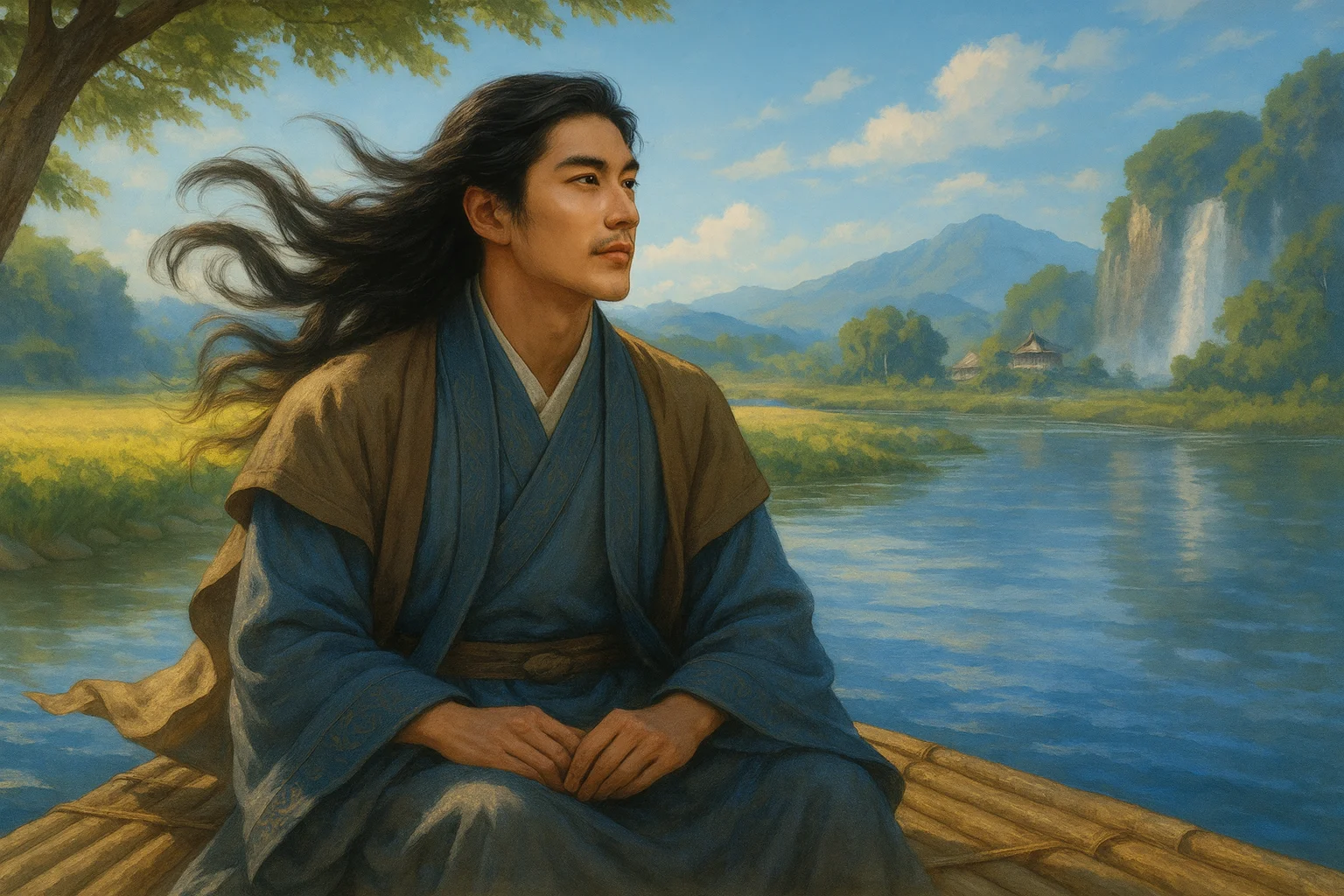
Meng Haoran (孟浩然 689 - 740), a native of Xiangyang, Hubei Province, was a renowned landscape and pastoral poet of the Tang Dynasty. In his early years, he lived in seclusion on Mount Lumen, reading for his own pleasure. At the age of forty, he traveled to the capital to take the jinshi examination but failed. Thereafter, he remained a commoner for the rest of his life, roaming the Wu and Yue regions and finding contentment in poetry and wine. He excelled in five-character verse, with a style that is light and natural, often depicting the pleasures of landscapes and reclusion. He is regarded as a representative of the High Tang landscape and pastoral poetry school. His collected works, Meng Haoran Ji, have been handed down, and his poetry exerted a profound influence on later hermitic poetic traditions.