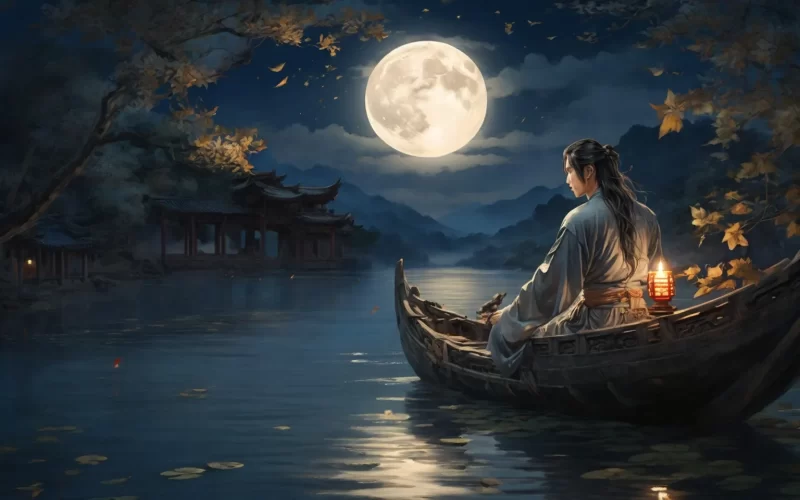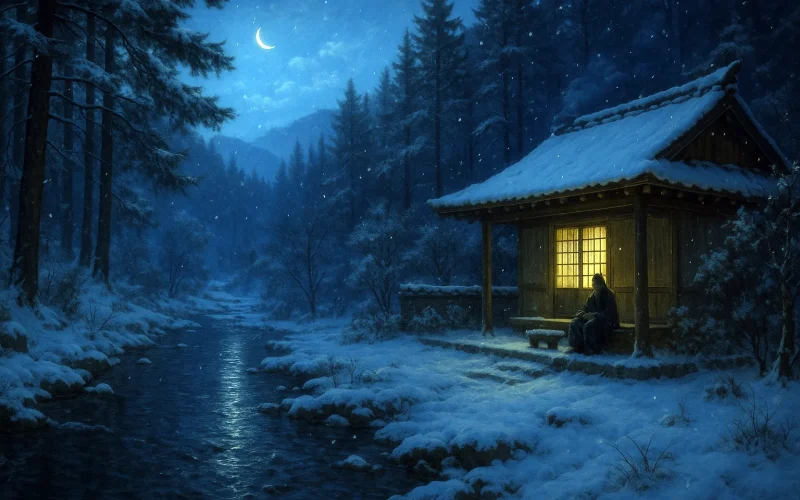

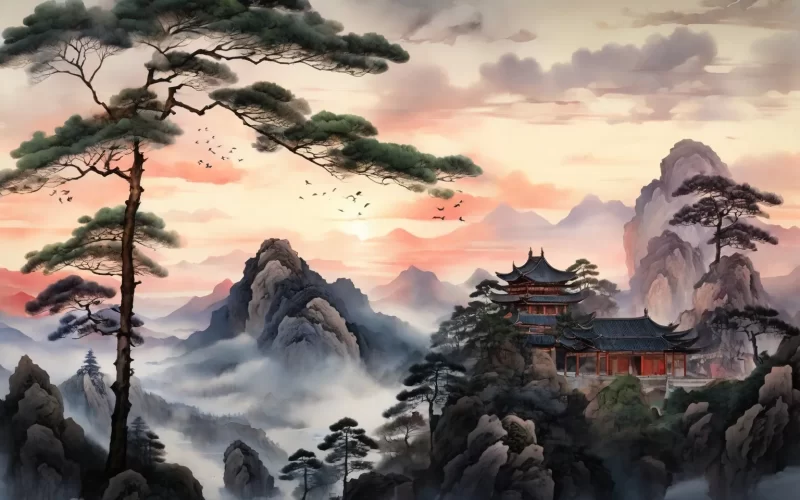
Now that the sun has set beyond the western range,
Valley after valley is shadowy and dim….
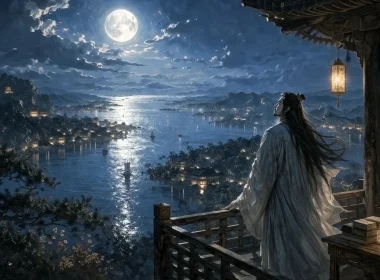
And now through pine-trees come the moon and the chill of evening,
And my ears feel pure with the sound of wind and water
Nearly all the woodsmen have reached home,
Birds have settled on their perches in the quiet mist….
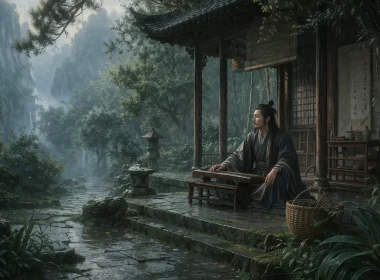
And still -- because you promised -- I am waiting for you, waiting,
Playing lute under a wayside vine.
Original Poem
「宿业师山房期丁大不至」
孟浩然
夕阳度西岭,群壑倏已暝。
松月生夜凉,风泉满清听。
樵人归欲尽,烟鸟栖初定。
之子期宿来,孤琴候萝径。
Interpretation
This poem was composed during Meng Haoran's period of reclusion at Deer-Gate Mountain. The exact year cannot be determined, but judging from the poem's mood, it must date from after 729 AD, the latter half of his life when, having failed the imperial examinations in Chang'an, he had permanently abandoned all hope of an official career. The "reverend master" mentioned in the title is a monk living in the mountain temple; Ding the Elder refers to Ding Feng, the eldest son of his family, a fellow townsman and close friend of the poet, with whom he often traveled, feasted, and exchanged verses. The phrase "promised to stay the night" reveals that this was a prearranged meeting—a planned overnight conversation in the mountain dwelling. The friend had promised to come and stay at the mountain temple, and the poet began waiting from dusk onward. Yet this expectation was ultimately left unfulfilled.
What is worth savoring is that the figure of the "waiter" in this poem is markedly different from the "one longing for a friend" in "Missing Xin the Elder on a Summer Day." On that summer night in the Southern Pavilion, he was a solitary man who "longed to take his lute and play, but mourned that no kindred spirit heard it"; the beauty of the scene only amplified the regret of the friend's absence. Here, on this mountain night, he waits just as long, and the friend still does not come, yet there is not a trace of impatience or resentment. He simply sits quietly beneath the pines and moonlight, beside the ivy-covered path, holding his lute, turning a broken appointment into a scene of beauty. This transformation marks the spiritual divide between two stages of Meng Haoran's life. When he missed Xin the Elder in the Southern Pavilion, he was still hesitating between official service and reclusion; the regret of a missing "kindred spirit" still lingered in his heart. But the man of Deer-Gate Mountain has already made his peace with fate. He no longer anxiously awaits anyone's arrival, because he himself has become the most composed master of this mountain forest.
First Couplet: "夕阳度西岭,群壑倏已暝。"
Xī yáng dù xī lǐng, qún hè shū yǐ míng.
The setting sun crosses the western ridge;
In a flash, the valleys are lost in darkness.
Explication: The poem opens with the arrival of dusk, yet uses two highly dynamic words. The word "crosses" personifies the setting sun—it does not simply "set" or "go down," but "crosses" over the mountain ridge with composure, like a traveler completing the day's journey. Then the word "flash" pivots sharply, capturing the swift transition of the valleys from light to dark—an instantaneous shift of vision, and a poetic perception of time's velocity. The poet has not yet appeared, but his gaze has already followed the sun across the mountain; his sigh has already descended with the darkness. The opening ten characters draw the reader into that mountain forest, inch by inch being reclaimed by the night.
Second Couplet: "松月生夜凉,风泉满清听。"
Sōng yuè shēng yè liáng, fēng quán mǎn qīng tīng.
From pines the moon brings forth night's cooling breath;
Wind and spring fill the ears with a pure sound.
Explication: This is the most famous couplet in the poem and a classic example of Meng Haoran's landscape style. The word "brings forth" is exquisite—the night's coolness is not an invasion from outside, but is "born" from the moonlight filtering through the pines, the lingering trace of warmth carried by the moonlight as it fades. This single verb gives an abstract change in temperature a concrete origin, and endows the still moonlit night with a sense of life. The phrase "fill the ears with a pure sound" is a stroke of genius. "Fill" suggests a spatial fullness—the wind is here, the spring is here, the entire mountain night is saturated with this clear, resonant sound. "Pure sound" is both a quality of hearing and a reflection of the poet's state of mind. He does not say he is listening, but his presence has dissolved into that "fullness"—he is not a visitor to the mountain night; he is its vessel. This couplet forms a delicate temporal progression with the first: the setting sun is departing light; the moon among the pines is arriving light. Dusk is the sinking of sight; wind and spring are the awakening of hearing. From dusk to night, from vision to sound, the poet steps deeper and deeper into the heart of the mountain night.
Third Couplet: "樵人归欲尽,烟鸟栖初定。"
Qiáo rén guī yù jǐn, yān niǎo qī chū dìng.
The woodcutters have nearly all returned;
Misty birds have just settled into their roosts.
Explication: This couplet describes the fading of human traces and the silencing of birds. The woodcutters are the last daytime actors in the mountain; their "return" means the mountain forest is completely surrendered to the night. The misty birds are the last creatures to come home at dusk; their "settling" means all sounds are about to fall into silence. The poet is still waiting, but he writes only of things outside his waiting. He does not write "Ding the Elder has not arrived"; he writes only that the woodcutters have returned and the misty birds have settled—people and birds that have nothing to do with him, all completing their own dusk rituals according to their own rhythms. Only the one who waits is suspended outside all rhythms. Yet there is no trace of anxiety in the poem. This "writing by not writing" is precisely Meng Haoran's deepest composure.
Fourth Couplet: "之子期宿来,孤琴候萝径。"
Zhī zǐ qī sù lái, gū qín hòu luó jìng.
He promised to stay the night here with me;
Lute in hand, I wait alone on the ivy path.
Explication: The poem waits until its very last line to reveal the subject of the waiting. The phrase "lute in hand" is the poetic eye of the entire poem. The lute is the symbol of the kindred spirit—the same lute that "longed to play but mourned that no kindred spirit heard it," the lute that remained unplayed on that summer night in the Southern Pavilion. Tonight, the poet has brought his lute again, and waits alone again. But tonight's "alone" and that night's "mourned" belong to two entirely different states of mind. The "mourned" of the Southern Pavilion was the regret of expecting something that did not come, the silence of the lute when the kindred spirit was absent. Tonight's "alone" is the composure of expecting without resentment, the lute in his arms, himself on the path—whether the friend comes or not, it does not diminish the moonlight and the wind in the pines. The word "wait" is the emotional destination of the entire poem. It is not "wait" in the sense of passive, anxious expectation. It is an active, serene waiting—placing oneself at the appointed place with reverence and sincerity, and then letting time flow by on its own. The poet is not only waiting for Ding the Elder; he is waiting for his own complete communion with the mountain night, with his lute, with solitude itself.
Holistic Appreciation
This poem is the ultimate expression of the theme of "waiting" in Meng Haoran's reclusive poetry. It turns a broken appointment into a form of completeness. The friend does not come, yet the poet feels no loss. He waits alone with his lute, yet he feels no resentment. He simply sits quietly on the ivy path, letting the setting sun cross the ridge, letting the valleys sink into darkness, letting the moon bring forth the night's coolness, letting the wind and spring fill his ears, letting the woodcutters return, letting the misty birds settle. In his waiting, he completes his fusion with the entire mountain night. Waiting itself becomes the goal, not a means to a goal.
Structurally, the poem uses time as its invisible thread. From the setting sun to the moon among the pines, from the return of the woodcutters to the settling of the birds, the entire progression from dusk to deep night unfolds quietly through the changing scenes. The first three couplets contain not a single word about "I." The poet hides behind the landscape, observing all things through the eyes of all things. Only in the final line, "Lute in hand, I wait alone on the ivy path," does the poet make his first and only appearance. This postponement of the subject allows the poet's image to emerge not as an "observer" intruding into the mountain forest, but as a "being" growing organically out of the mountain forest itself.
Thematically, the poem's core lies in the word "wait." This is not the anxious waiting of anticipation, but the serene waiting of self-composure. It is not a fixation on the outcome, but an immersion in the process. The "mourned" of the Southern Pavilion was the regret of a kindred spirit's absence; the "alone" of this night is the self-sufficiency that needs no kindred spirit. This is not a deliberate pose of magnanimity; it is a fundamental transformation of being. The Meng Haoran of that summer night in the Southern Pavilion was still trapped in the obsession with a "kindred spirit"—he needed another person to validate his existence. The Meng Haoran of Deer-Gate Mountain no longer needs this. He brings his lute because the lute is already part of himself. He waits on the ivy path because waiting itself is his way of being with the world.
Artistically, the poem's most moving quality is its unique spiritual realm of "turning a broken appointment into completeness." The poet does not write of the anxiety of waiting, nor of the disappointment of the unfulfilled promise. He devotes all his brushwork to the beauty of the mountain night itself—the setting sun, the moon among the pines, the wind and spring, the returning woodcutters, the settling birds. These scenes have nothing to do with the friend, yet they acquire meaning through the poet's act of waiting. When the friend ultimately does not arrive, the night is not wasted, because the poet has found, in his complete communion with the mountain night, a deeper fulfillment than the keeping of an appointment.
Artistic Merits
- Implicit Temporal Narration: The poem uses "setting sun—moon among the pines—woodcutters returning—birds settling" as its invisible temporal coordinates, clearly marking the complete progression from dusk to deep night. The poet does not tell us how long he waited; the passage of time is fully contained in the changing scenes.
- Gradual Deepening of the Senses: The first couplet appeals to sight (setting sun, valleys); the second to touch and hearing (night's coolness, wind and spring); the third to the fading of human voices and bird calls; the fourth to the settling of the heart. The poem moves from the outer to the inner, from motion to stillness, guiding the reader step by step into the core of the poet's communion with the mountain night.
- Postponement and Suspension of the Subject: The first three couplets contain not a single word about "I." Only in the final line, "Lute in hand, I wait alone on the ivy path," does the poet make his first and only appearance. This postponement of the subject allows the poet's image to emerge not as an "observer" intruding into the mountain forest, but as a "being" growing organically out of the mountain forest itself.
- Emotional Transformation of the Lute Image: From "I long to take my lute and play, but mourn—no kindred spirit hears it soon" in "Missing Xin the Elder on a Summer Day," to "Lute in hand, I wait alone on the ivy path" in this poem, the same lute completes an emotional journey from "regret" to "serenity." This is not merely a thematic echo between two poems; it is the complete arc of the poet's attitude toward life.
Insights
This poem teaches us not how to wait for a friend, but how to wait for life itself. Each of us is, in some sense, a "waiter"—waiting for opportunity, waiting for recognition, waiting for someone to arrive, waiting for life to give us what we deserve. Most waiting is anxious, because we invest all meaning in the endpoint of waiting. We fear disappointment, fear the broken promise, fear that all our preparations will ultimately amount to nothing but a "did not come." Meng Haoran, in this poem, offers another possibility for waiting: to live waiting itself as meaning.
He waits on the ivy path, not to prove that Ding the Elder will come, but to allow himself to experience this mountain night completely. The moon among the pines exists for him; the wind and spring sound for him; the woodcutters and misty birds complete their dusk rituals for him. Even if Ding the Elder never appears, this night is not wasted. So it is with life. The goals we rush toward may never be reached; the people we wait for may never come. But the rushing and the waiting themselves constitute the truest content of our lives. What matters is not whether we cross, but what kind of person we become while standing on the shore.
Whether Ding the Elder finally came that night, a thousand years ago, we will never know. But that lone lute, that ivy path, that moonlight through the pines—have become the gentlest evidence in Chinese literary history: there is a kind of fulfillment that lies not in the outcome, but in the journey itself.
Poem translator
Kiang Kanghu
About the poet
Meng Haoran (孟浩然 689 - 740), a native of Xiangyang, Hubei Province, was a renowned landscape and pastoral poet of the Tang Dynasty. In his early years, he lived in seclusion on Mount Lumen, reading for his own pleasure. At the age of forty, he traveled to the capital to take the jinshi examination but failed. Thereafter, he remained a commoner for the rest of his life, roaming the Wu and Yue regions and finding contentment in poetry and wine. He excelled in five-character verse, with a style that is light and natural, often depicting the pleasures of landscapes and reclusion. He is regarded as a representative of the High Tang landscape and pastoral poetry school. His collected works, Meng Haoran Ji, have been handed down, and his poetry exerted a profound influence on later hermitic poetic traditions.