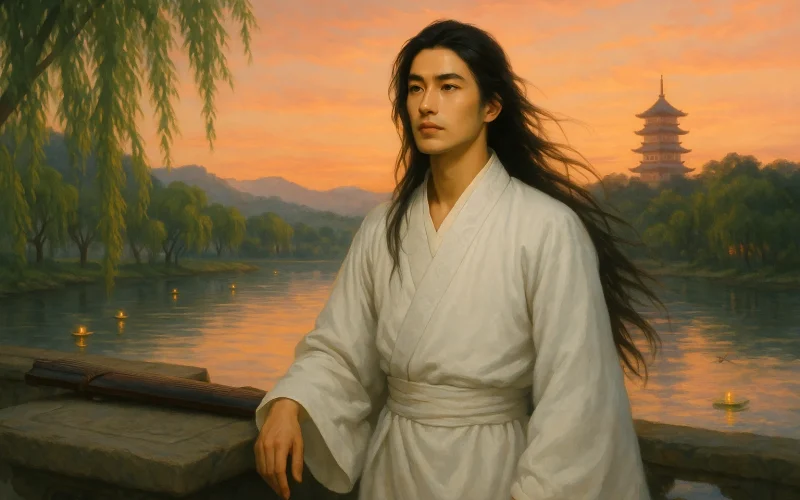

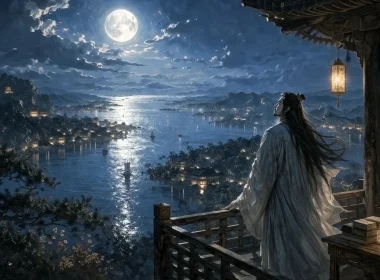
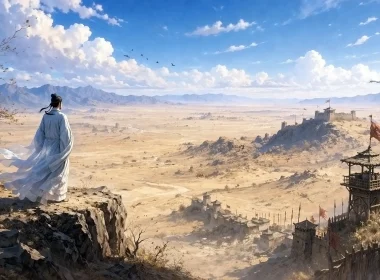

Here in the Eighth-month the waters of the lake
Are of a single air with heaven,
And a mist from the Yun and Meng valleys
Has beleaguered the city of Youzhou.

I should like to cross, but I can find no boat.
...How ashamed I am to be idler than you statesmen,
As I sit here and watch a fisherman casting
And emptily envy him his catch.
Original Poem
「望洞庭赠张丞相」
孟浩然
八月湖水平,涵虚混太清。
气蒸云梦泽,波撼岳阳城。
欲济无舟楫,端居耻圣明。
坐观垂钓者,空有羡鱼情。
Interpretation
This poem was composed in the 21st year of the Kaiyuan era (733 AD), when Meng Haoran was forty-four years old and traveling in Chang'an. This was his last active attempt to secure an official position. Nine years earlier, in 725, he had wandered through the Wu-Yue region, and in 728 he had entered the capital to take the imperial examinations—both ended in failure. His well-known lines, "Lonely and still, what am I waiting for? / Morning after morning, I return empty-handed," capture his state of mind at that time. Yet Meng Haoran had not completely given up. In 733, he came to Chang'an once more, hoping to obtain a post through presenting poems to influential figures and recommending himself.
The recipient of this poem was Zhang Jiuling, then Vice Director of the Imperial Secretariat and a respected chancellor known for his literary talent and moral integrity. Choosing Zhang was no accident. Zhang himself came from a humble background in Lingnan and had entered officialdom through his literary skills. He had a reputation for promoting talented scholars. More importantly, he had a poetic friendship with Meng Haoran; the two had exchanged verses. In the Tang officialdom, where ties between examiners and candidates mattered greatly, such literary closeness was the most natural opening for a request of recommendation. Yet poems of recommendation have always been notoriously difficult to write. Too direct, and they lapse into begging; too obscure, and they become unintelligible. Meng Haoran's brilliance lies in his discovery of a mode of address that is neither servile nor arrogant: he transforms his political aspirations entirely into a depiction of Lake Dongting. The plea for office hides within the lake waters; the request for patronage rides upon the boat and oar. Not a single word in the poem asks for anything, yet every word touches upon the matter of recommendation. This is not merely a rhetorical technique; it is the presentation of a personality—even when he is in need, he still maintains the dignity and composure of a scholar.
Lake Dongting, in the Tang Dynasty, belonged to the circuit of Shannan East, precisely the region where Zhang Jiuling had served as prefect of Yuezhou. The poem's vivid portrayal of Dongting's grandeur is both a realistic description and a subtle tribute to the achievements of Zhang's governance in that very area. This keen awareness of his audience elevates the poem beyond the utilitarian purpose of personal recommendation, making it the most perfectly balanced example among High Tang recommendation poems between artistic achievement and political诉求.
First Couplet: "八月湖水平,涵虚混太清。"
Bā yuè hú shuǐ píng, hán xū hùn tài qīng.
In the eighth moon the lake's water is level with the shores;
Its vastness merges with the void, mingling with the azure skies.
Explication: The opening is remarkably steady. The poet does not write of dangerous waves or turbulent winds; he writes instead of "water level"—the static fullness of autumn floodwaters at their peak, a brimming poised for release. The word "level" conveys the lake's breadth and, more importantly, the calmness of the poet's vision. The line "Its vastness merges with the void, mingling with the azure skies" pushes the scene of lake and sky merging to its extreme. "Void" is space; "azure skies" is the heavens; "mingling" is seamless fusion. This line not only describes Dongting's vastness but creates a sense of cosmic openness. The poet has not yet stated his ambition, yet it already spreads out boundlessly like the lake waters.
Second Couplet: "气蒸云梦泽,波撼岳阳城。"
Qì zhēng yún mèng zé, bō hàn yuè yáng chéng.
Its vapor steams the ancient Cloud-Dream Marsh;
Its billows shake the walls of Yueyang City.
Explication: This is the most powerful couplet in the entire poem, and a rare display of vigorous brushwork in Meng Haoran's oeuvre. "Steams" is a force gathering inward; "shakes" is energy released outward. One is still, the other active; one contains, the other unleashes. Together they capture Lake Dongting's dual character—nurturing all things on one hand, commanding awe on the other—with extraordinary vividness. Cloud-Dream Marsh and Yueyang City were both places where Zhang Jiuling had served. This couplet appears to be a pure description of the lake, yet it subtly echoes the political influence of the poem's recipient. The lake's "steaming" suggests the breadth of his benevolence; the waves' "shaking" suggests the reach of his virtuous authority. This is Meng Haoran's most concealed compliment, and his most graceful flattery.
Third Couplet: "欲济无舟楫,端居耻圣明。"
Yù jì wú zhōu jí, duān jū chǐ shèng míng.
I wish to cross, but find no boat, no oar;
To idle in this sage reign fills me with shame.
Explication: The poem shifts from scene to feeling, the turn as natural as a branch of lake water splitting from the main current. "I wish to cross" follows directly from the lake described above—facing such an expanse of water, anyone would feel the desire to cross. This "crossing" is both a geographical crossing and a life-crossing: from the rivers and lakes to the court, from commoner to official. The three words "find no boat, no oar" are the poetic eye of the entire poem. They do not blame heaven, do not resent others; they simply state a fact with calmness: crossing a lake requires a boat, entering office requires a patron; the boat is not in my hands, the patronage is not within my power. This calmness is more moving than indignation. The line "To idle in this sage reign fills me with shame" elevates the personal desire for office to the height of a sense of duty to one's era. The word "shame" carries great weight, yet contains not a trace of resentment. The poet does not pity himself for unrecognized talent; he reproaches himself for wasting a sage era. This is the distinctive spiritual temperament of High Tang scholars—it is not that the court owes me a position, but that I owe this era a contribution.
Fourth Couplet: "坐观垂钓者,空有羡鱼情。"
Zuò guān chuí diào zhě, kōng yǒu xiàn yú qíng.
I sit and watch those fishing by the shore,
And vainly envy the fish they take ashore.
Explication: The final couplet uses an allusion, adapting the saying from the Huainanzi: "Standing by the river and envying the fish is not as good as going home and weaving a net." Meng Haoran reverses its meaning: instead of writing about the determination to "weave a net," he writes only of the feeling of "envying the fish." The word "vainly" expresses the full weight of helpless longing. "Those fishing" refers to those already in office, and may specifically point to Zhang Jiuling and other virtuous ministers in power. The poet positions himself as one who "sits and watches"—not unwilling to participate, not unable to participate, but temporarily standing on the shore. This posture is humble without being base, expectant without being urgent; the sense of proportion is exquisitely calibrated. The poem ends here, its emotions fully conveyed, yet not a single word directly states a "request." This is the highest realm of the High Tang recommendation poem: the thing requested is fully contained in what is left unsaid; the integrity preserved is fully evident in what is spoken.
Holistic Appreciation
This poem is both an anomaly and a solitary peak in Meng Haoran's collected works. An anomaly, because Meng Haoran is known for landscape and pastoral poetry, his style characterized by "clarity," "understatement," "seclusion," and "distance," yet this poem displays a rare vigor and grandeur. The first four lines describe Dongting with steaming vapors and shaking billows, swallowing the cosmos—placed among the finest frontier poems of the High Tang, they would not be out of place. A solitary peak, because this is the only work in his lifetime that so perfectly fuses political诉求 with landscape writing—before this, his poems on Xiangyang's mountains and waters were purely expressions of reclusive intent; after this, he completely abandoned the pursuit of office, and the moon over Deer-Gate Mountain became his final home.
Structurally, the poem presents a progression from object to person, from scene to feeling. The first four lines give full expression to Dongting's grandeur, pushing the lake's vastness and the power of its waves to their extreme. The last four lines turn to the poet's own predicament, using "I wish to cross, but find no boat, no oar" as the pivot, and concluding with "sit and watch those fishing." The four couplets move from the outer to the inner, from object to heart, each layer deepening, forming an organic whole.
Thematically, the poem's core lies in the three words "find no boat, no oar." The grandeur of "the lake's water is level" is the poet's praise of his era; the power of "its vapor steams the ancient Cloud-Dream Marsh" is his longing for achievement; and "I wish to cross, but find no boat, no oar" is the unbridgeable gap between ideal and reality. This "no" does not mean absence, but deprivation—not the absence of the desire to cross, but the absence of the means to cross; not the absence of talent to serve the age, but the absence of opportunity to serve. The poet uses the calmest language to write the deepest helplessness.
Artistically, the poem's greatest achievement lies in rendering an act that could easily seem humble into something so dignified, so noble. The essence of a recommendation poem is "asking a favor." One who asks inevitably stoops, inevitably suffers indignity, inevitably reveals anxiety and urgency between the lines. But Meng Haoran maintains a posture of equality throughout: his relationship with Zhang Jiuling is not a supplicant begging from a superior, but a dialogue between poet and poet, a spiritual exchange between one who has witnessed Lake Dongting and one who has governed it. He uses the lake to write his aspirations, the boat and oar to write his predicament, the envious fish to write his hopes—every metaphor is precise, restrained, and elegant. He asked for a favor. But he did not kneel.
Artistic Merits
- Genre Fusion of Landscape Poetry and Recommendation Poetry: Meng Haoran transplants the entire discourse system of landscape and pastoral poetry into the writing of a recommendation poem. Lake Dongting is not merely a real scene; it is a symbolic system for political ambition. The boat and oar are not merely ferry tools; they are metaphorical vehicles for the path to office. This genre fusion created a new aesthetic paradigm for the recommendation poem.
- Isomorphic Relationship Between Natural Grandeur and Inner State: The first four lines describe the lake, expanding outward; the last four lines describe the self, contracting inward. This structural movement from outer to inner, from object to person, is precisely a reverse intensification of emotional density. The vaster the lake, the smaller the person; the more magnificent the scene, the more somber the feeling. The extremity of natural grandeur sets off the extremity of inner state.
- Invisible Handling of Allusion: The allusion to "envying the fish" melts into the everyday image of "those fishing by the shore," its meaning self-evident without annotation. This technique of dissolving allusion without a trace gives the poem both cultural depth and natural fluency of language—a hallmark of mature allusion usage in High Tang poetry.
- Ultimate Pursuit of Balance: The poem is balanced in every respect—balance between "water level" and "billows shake," between "wish to cross" and "idle in shame," between "sit and watch" and "envy the fish," between seeking office and preserving integrity. This sense of balance is both rhetorical craftsmanship and the externalization of personality. In this poem, Meng Haoran found the golden ratio between ambition and equanimity.
Insights
Meng Haoran ultimately did not receive a response from Zhang Jiuling. A few years later, he retreated into permanent reclusion, remaining a commoner for the rest of his life. This poem, "To Premier Zhang from Gazing at Lake Dongting," became the final, most splendid curtain call of his aspirations for an official career. But interestingly, history has not recorded whether Zhang Jiuling recommended anyone that year. What it has firmly remembered is this "poem asking for an official post." It was included in Three Hundred Tang Poems, recited by generations of readers, and silently repeated by countless people waiting for a boat at the ferry of life.
This tells us a cruel yet gentle truth: the outcome of a life is often less worth remembering than the scenery along the way. Meng Haoran did not obtain an official post, but he obtained this poem. He was not employed by his era, but he was remembered by it. That "boat and oar" he never managed to board ferried him to a place farther than any official career could have taken him.
"I wish to cross, but find no boat, no oar"—in every era, countless people stand by their own Lake Dongting, gazing at the opposite shore, unable to find a boat. This poem was written for them, and it has been passed down for them. It cannot provide a boat, but it provides a posture: even without a boat, there is nothing stopping you from looking at this lake with full attention, and speaking aloud your wish to cross.
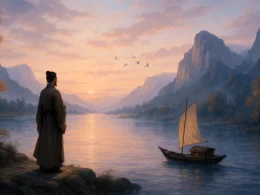
A thousand years later, we have long forgotten whether Chancellor Zhang responded. But we still remember that eighth month, when Lake Dongting was full, and a commoner poet stood on the shore, gazing at the distant horizon where water and sky merged, and wrote his heart into the most dignified letter of recommendation in Chinese history. He did not cross. But the way he stood on the shore became a scene in itself.a commoner poet standing on the shore, gazing at the distant merging of water and sky, writing his heart's concern into the most dignified letter of request in Chinese history. He did not make the crossing. But he stood on the shore and became a landscape.
Poem translator
Kiang Kanghu
About the poet

Meng Haoran (孟浩然 689 - 740), a native of Xiangyang, Hubei Province, was a renowned landscape and pastoral poet of the Tang Dynasty. In his early years, he lived in seclusion on Mount Lumen, reading for his own pleasure. At the age of forty, he traveled to the capital to take the jinshi examination but failed. Thereafter, he remained a commoner for the rest of his life, roaming the Wu and Yue regions and finding contentment in poetry and wine. He excelled in five-character verse, with a style that is light and natural, often depicting the pleasures of landscapes and reclusion. He is regarded as a representative of the High Tang landscape and pastoral poetry school. His collected works, Meng Haoran Ji, have been handed down, and his poetry exerted a profound influence on later hermitic poetic traditions.