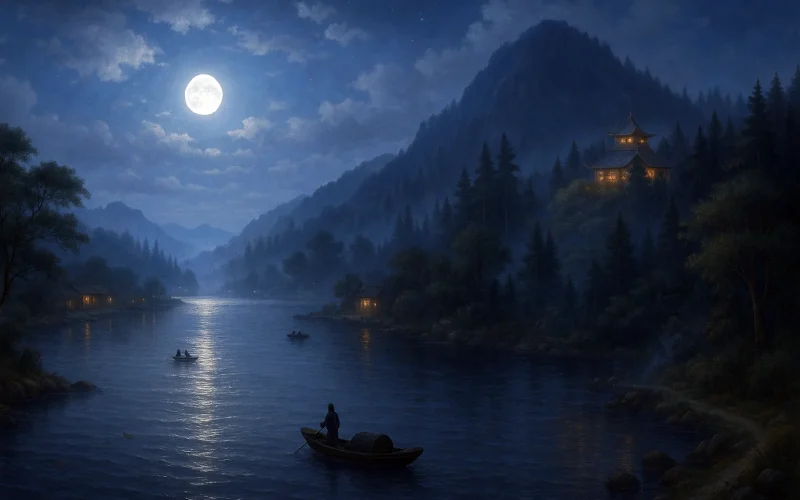
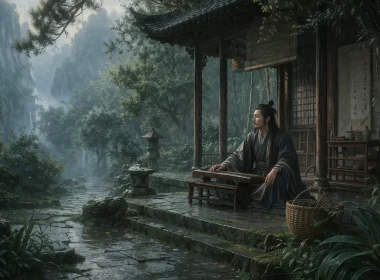
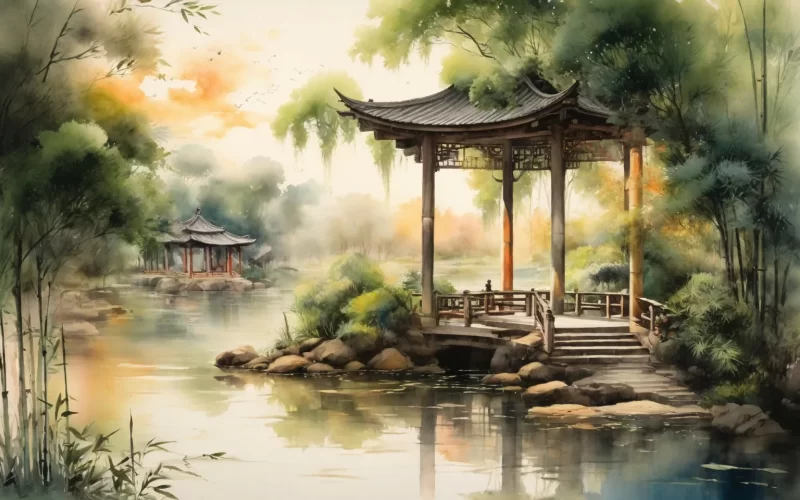
The mountain-light suddenly fails in the west,
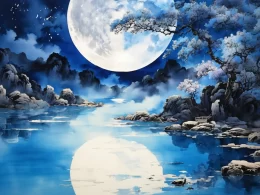
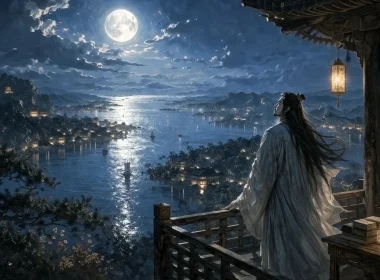
In the east from the lake the slow moon rises.
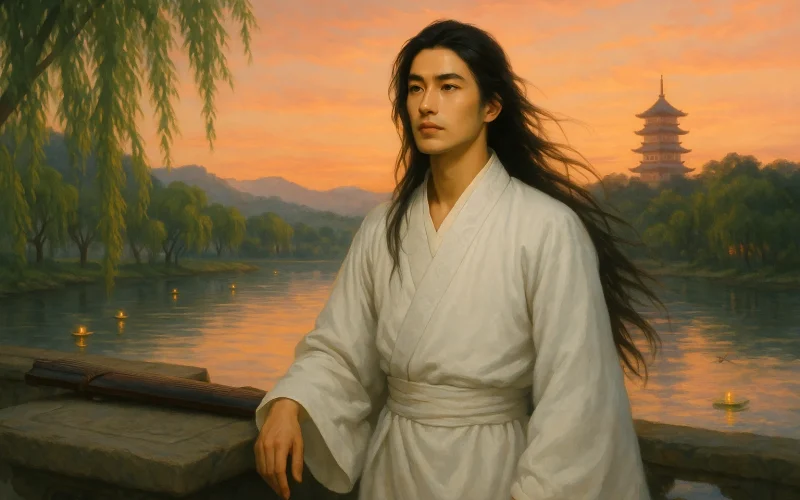
I loosen my hair to enjoy the evening coolness
And open my window and lie down in peace.

The wind brings me odours of lotuses,
And bamboo-leaves drip with a music of dew…

I would take up my lute and I would play,
But, alas, who here would understand?
And so I think of you, old friend,
O troubler of my midnight dreams!
Original Poem
「夏日南亭怀辛大」
孟浩然
山光忽西落,池月渐东上。
散发乘夜凉,开轩卧闲敞。
荷风送香气,竹露滴清响。
欲取鸣琴弹,恨无知音赏。
感此怀故人,中宵劳梦想。
Interpretation
This poem was composed during Meng Haoran's period of reclusion in Xiangyang. Xin the Elder refers to Xin E, a fellow townsman and close friend of the poet. The two would often spend summer nights together in the Southern Pavilion, enjoying the cool air, playing the qin, and discussing poetry. As we know from another of Meng's poems, "Seeking Xin E in the Western Hills," they were intimate companions who shared kindred spirits. On this occasion, Xin was traveling far away. The poet, staying alone in the Southern Studio, found himself amidst the pure scenery of a summer night with no one to join him in playing the qin, and feelings of longing for his friend arose unbidden.
By this time, Meng Haoran had long since relinquished his obsession with seeking an official career in Chang'an. He was living the life of a commoner between Deer-Gate Mountain and his garden south of the stream, a life captured in his own lines: "I should just keep to solitude, / And close again my rustic garden gate." On the surface, he seemed content with farming, reading, and keeping company with the landscape. Yet this "contentment" was not without its ripples—when the lotus breeze carried a fragrance once shared, when bamboo dew dripped with a clear sound once heard together, when the qin lay upon the desk but the companion who would appreciate it was far away, the loneliness veiled by the tranquil routines of daily life surfaced quietly in this very moment.
It is worth savoring that the poet does not directly state the depth of his longing. Instead, he first elaborates on the beauty of the summer night: the mountain light, the pond's moon, the lotus breeze, the bamboo dew—each element profoundly serene, profoundly still. It is precisely within this realm of ultimate beauty and tranquility that the sense of absence becomes most acute. The poem's most moving secret lies here: it is not that he remembers his friend because he is lonely, but because all of this is so beautiful that he regrets all the more your absence.
First Couplet: "山光忽西落,池月渐东上。"
Shān guāng hū xī luò, chí yuè jiàn dōng shàng.
The mountain's glow suddenly fades in the west;
Over the pond, the moon begins her climb east.
The poem opens with a precise temporal juxtaposition. The word "suddenly" describes the swift passing of daylight, fleeting as a white colt glimpsed through a crack; the word "begins" describes the slow arrival of night, gradual as ink spreading on paper. Between this haste and this slowness, the summer night completes its ritual transition from day. This is not merely an objective description of dusk; it is the poet's perception of time's dual rhythm: the setting sun is the end of daytime, the retreat of clamor; the rising moon is the opening of the clear night, the entrance of leisure. With the most economical brushstrokes, the poet condenses the entire process of withdrawing his whole being from the day's worldly affairs into this instant of "suddenly" and "begins."
Second Couplet: "散发乘夜凉,开轩卧闲敞。"
Sàn fà chéng yè liáng, kāi xuān wò xián chǎng.
Hair unbound, I enjoy the evening's cool;
Windows open, I recline in spacious ease.
"Hair unbound" is to remove the cap, and more so, to cast off all bonds. "Windows open" is to welcome the breeze, and more so, to open the heart. With these two actions, Meng Haoran sketches a portrait of the self that has completely shed its social role—hair unbound, no guests to receive, not sitting formally, unconstrained by ritual. This is the recluse's most private, most relaxed moment, with no need to present himself to anyone, only to coexist with heaven and earth. The phrase "recline in spacious ease" is especially evocative. "Ease" is the leisure of having no tasks; "spacious" is the openness of expanse. Body and mind are like this Southern Studio—unobstructed and clear. At this point, the poet is completely immersed in the freedom of the summer night.
Third Couplet: "荷风送香气,竹露滴清响。"
Hé fēng sòng xiāng qì, zhú lù dī qīng xiǎng.
A breeze from the lotus brings wafts of scent;
Dew from the bamboo drips with a sound clear.
This couplet represents the pinnacle of sensory description in Tang poetry. The poet simultaneously engages smell and hearing, yet does not use the words "smell" or "hear." Instead, he lets the fragrance be "brought" on its own, lets the clear sound "drip" of its own accord. The subjects are the lotus breeze and the bamboo dew, not the poet—he has already merged into this nightscape, becoming a silent part of all things. The word "brings" is soft and lingering, the scent carried on the breeze, now present, now absent. The word "drips" is crisp and short, the dew falling with a sound like pearls dropping onto a jade plate. One lingering, the other crisp; one hidden, the other clear—together they weave the unique sonic texture of a summer night. The Southern Pavilion is no longer merely a building; it has become a vessel containing the pure sounds of the cosmos.
Fourth Couplet: "欲取鸣琴弹,恨无知音赏。"
Yù qǔ míng qín tán, hèn wú zhī yīn shǎng.
I long to take my lute and play a tune,
But mourn—no kindred spirit hears it soon.
The first six lines describe the beauty of leisure, building it to a peak that almost makes one forget the human world. Yet it is precisely this ultimate beauty that awakens the desire to share. The poet's impulse to "take my lute and play" is not a pastime for boredom; it is a creative impulse born of beauty itself—the lotus breeze, bamboo dew, moonlight, and clear night are all inviting a melody. Yet the lute is here, the mat is here, only the "kindred spirit" is absent. The word "mourn" carries immense weight. This is not blame toward the friend, but a recognition of the "loneliness of beauty." The deepest longing often arises not in moments of sorrow, but in the instant one faces ultimate beauty with no one to share it.
Fifth Couplet: "感此怀故人,中宵劳梦想。"
Gǎn cǐ huái gù rén, zhōng xiāo láo mèng xiǎng.
Moved by this scene, I think of you, old friend.
Past midnight, dreams for you still toil and tend.
From "mourn" arises "think of," and from "think of" enters "dreams"—the ripples of emotion spread outward layer by layer. The words "Moved by this scene" gather the preceding lines—what moves him is the mountain light and pond moon, the lotus breeze and bamboo dew, the lute he wishes to play with no one to hear, the fine night with no one to share. All this converges into a stream flowing toward where the friend resides. The line "Past midnight, dreams for you still toil and tend" is profoundly plain and profoundly deep. The word "dreams" originally implies effort; here it describes a longing so willing that even dreams labor diligently on its behalf. The poet does not say "I dreamt of my old friend"; he says his "dreams" toil for him, turning passive dreams into an active force of feeling—a conception both lofty and far-reaching.
Holistic Appreciation
This is the most "warm-blooded" work among Meng Haoran's reclusive poems. Unlike "Returning at Night to Deer-Gate Mountain," which accomplishes a complete spiritual homecoming, or "On Climbing Xian Mountain," which confronts the tragic nature of fate, it trains its lens on an ordinary summer night, recording a small, yet genuine, emotional tremor within the life of a recluse.
Structurally, the poem presents a progression from scene to emotion, from stillness to thought. The first six lines describe the scene, layering detail upon detail to elevate the beauty of the Southern Pavilion's summer night to its zenith—the flow of mountain light and pond moon marks the passage of time; the spacious ease of unbound hair and open windows is the relaxation of the body; the scents and sounds of lotus breeze and bamboo dew are the immersion of the senses. The last four lines describe emotion, deepening step by step—from "long to play" to "mourn," from "mourn" to "think of," from "think of" to "dreams." The more beautiful the scene, the deeper the regret; the stiller the realm, the farther the thoughts reach. This technique of using supreme joy to underscore supreme sorrow, of using supreme stillness to support profound movement, creates astonishing emotional tension within just ten lines.
The poem's unique value lies in this: it reveals that the life of reclusion is not monolithic. The recluse, too, knows loneliness, regret, moments of "wishing to play with no one to hear." But Meng Haoran does not see these emotions as a failure of reclusion; he calmly writes them into his poem. Thus we see: the recluse is not an emotionless immortal, but a real person who, amidst all human feelings, still chooses to keep company with mountains and waters.
Artistic Merits
- Composite Sensory Orchestration: Sight (mountain light, pond moon), touch (evening cool, spacious ease), smell (lotus fragrance), and hearing (bamboo dew's clear sound) are presented in sequence, creating a synesthetic aesthetic experience that makes the Southern Pavilion's summer night audible, tangible, fragrant, and visible.
- Lyrical Transformation of Narrative Language: Words that seem primarily narrative—"suddenly," "begins," "long to take," "mourn—no," "Moved by this," "dreams"—become, in Meng Haoran's hands, engines that propel emotion forward. The entire poem flows like a boat on a stream, carried downstream by the current, its turns seamless, its moments of intensity quiet.
- The Personalization of the "Kindred Spirit" Motif: Since the legendary friendship of Bo Ya and Zhong Ziqi, the "kindred spirit" motif has often pointed to fateful political or existential encounters. Meng Haoran, however, completely personalizes and domesticates this theme. What he regrets is merely a lute melody with no one to appreciate it, the absence of a single friend. This "reduction in scale" in writing, paradoxically, allows the sentiment to resonate more widely.
- The Blurring of Dream and Reality in the Conclusion: "Past midnight, dreams for you still toil and tend" dissolves the boundary between the waking world and sleep. The poet does not describe the dream's content, only that his dreams "toil" with longing. Between reality and dream, the feeling of missing his friend is infinitely prolonged into the liminal space between sleeping and waking; the aftertaste is like the lotus breeze, there and yet not there.
Insights
This poem has moved readers for a millennium because it captures a universal, yet often private, human state: beautiful loneliness. We often mistakenly assume loneliness must be sorrowful, desolate, a condition to be urgently escaped. But Meng Haoran reveals that loneliness can also be beautiful, cool, and richly fulfilling. He faces the mountain light and pond moon alone, senses the lotus breeze and bamboo dew alone, feels the impulse to play his lute alone—and finds it all profoundly good. It would simply be even better if you, his friend, were there. This is not a negation of solitude, but a tribute to companionship. True independence is not needing no one; it is the ability to be wholly, contentedly with oneself, even in moments of longing.
In an age of social saturation, surrounded by countless connections, we often feel a deeper, more puzzling loneliness. Meng Haoran's summer night in the Southern Pavilion offers an alternative paradigm: it neither flees the crowd nor clings to it; it acknowledges longing without being consumed by it; it treasures the kindred spirit, yet in that friend's absence, it can still listen to the lotus breeze, count the falling dew, and play its lute beneath the moon.
The lute's notes from that night a thousand years ago have long faded; the Southern Pavilion has left no physical trace. But what Meng Haoran bequeathed to posterity is not a record of regret, but a tender testament: a person can find profound abundance in solitude, can maintain serenity in waiting, and can, under a moon with no one to share it, still play a song through to the end for oneself alone.
Poem translator
Kiang Kanghu
About the poet
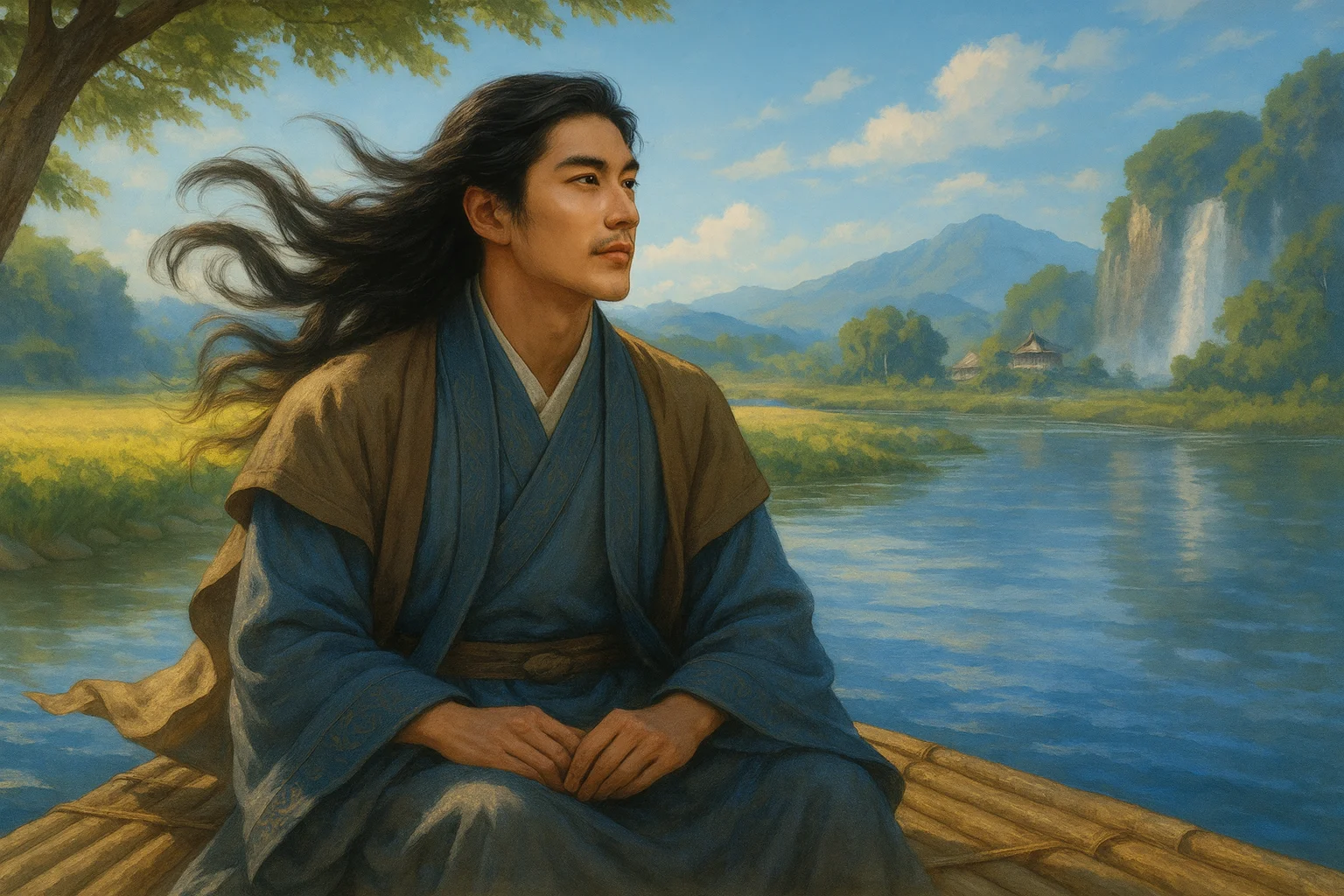
Meng Haoran (孟浩然 689 - 740), a native of Xiangyang, Hubei Province, was a renowned landscape and pastoral poet of the Tang Dynasty. In his early years, he lived in seclusion on Mount Lumen, reading for his own pleasure. At the age of forty, he traveled to the capital to take the jinshi examination but failed. Thereafter, he remained a commoner for the rest of his life, roaming the Wu and Yue regions and finding contentment in poetry and wine. He excelled in five-character verse, with a style that is light and natural, often depicting the pleasures of landscapes and reclusion. He is regarded as a representative of the High Tang landscape and pastoral poetry school. His collected works, Meng Haoran Ji, have been handed down, and his poetry exerted a profound influence on later hermitic poetic traditions.