
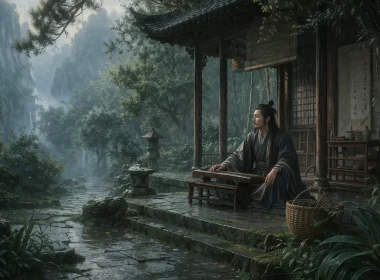
Preparing me chicken and rice, old friend,
You entertain me at your farm.
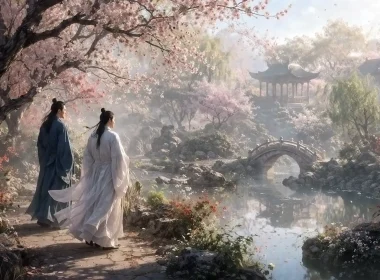
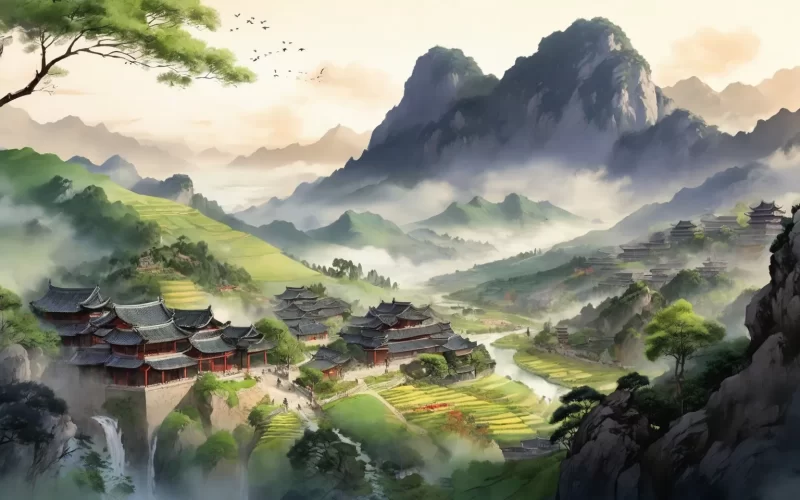
We watch the green trees that circle your village
And the pale blue of outlying mountains.

We open your window over garden and field,
To talk mulberry and hemp with our cups in our hands.
...Wait till the Mountain Holiday --
I am coming again in chrysanthemum time.
Original Poem
「过故人庄」
孟浩然
故人具鸡黍,邀我至田家。
绿树村边合,青山郭外斜。
开轩面场圃,把酒话桑麻。
待到重阳日,还来就菊花。
Interpretation
This poem was composed after Meng Haoran had permanently retired to Xiangyang, though the exact year cannot be determined with certainty. Judging from its mood, it likely dates from after the eighteenth year of the Kaiyuan era (730 CE)—the final phase of his life, following his failure in the Chang'an examination, his wanderings through Wu and Yue, and his eventual return to Lumen Mountain.
This was a Meng Haoran who no longer harbored thoughts of "the Northern Palace," nor wrote laments of "longing to cross." He was no longer the office-seeker of "寂寂竟何待", no longer the wandering guest of "还将两行泪", no longer the destitute man of "黄金燃桂尽". He was simply a commoner in plain clothes, outside Xiangyang city, among the hills of Lumen. An old friend lived in a neighboring village; he had prepared chicken and millet and invited Meng Haoran to visit. The name of this "old friend" is not recorded. From the allusion "具鸡黍" (preparing chicken and millet), we know that Meng Haoran was likening this friendship to that of Fan Shi and Zhang Shao of the Eastern Han—Fan and Zhang had promised to visit each other two years later; Zhang Shao asked his mother to "kill a chicken and cook millet" in preparation, and when the appointed time came, Fan Shi arrived as promised. This is the oldest covenant of friendship in Chinese literary history, with "chicken and millet" as its token and "trust" as its foundation. Meng Haoran infused this weighty cultural memory into an ordinary invitation to a country home.
He accepted the invitation, drank and talked merrily, and before parting, made another appointment—on the Double Ninth Festival, he would return to enjoy the chrysanthemums. The poem ends, and the promise is made. This is not a parting poem, not a poem of longing, not a poem of self-recommendation, not a historical meditation. It is simply a record of a visit, a testimony to a meal. Yet this very poem became the pinnacle of Chinese pastoral poetry and the terminus of Meng Haoran's lifelong spiritual journey.
First Couplet: "故人具鸡黍,邀我至田家。"
Gù rén jù jī shǔ, yāo wǒ zhì tián jiā.
My old friend has prepared chicken and millet,
And invites me to his farmhouse home.
The opening is plain, like everyday talk. "鸡黍" (chicken and millet) is the finest fare a country host can offer—not expensive, but deeply sincere. It is not rare delicacies nor a lavish banquet, but grain grown with one's own hands and poultry raised in one's own yard, cooked into a meal and placed before the guest. This sincerity lies not in extravagance, but in the heart. "邀我至田家"—five characters that tell us everything about the occasion. The poet is the invited guest; yet once inside the poem, he shows none of a guest's reserve, no courtesies like "I'm troubling you" or "I'm ashamed." He simply comes as one who was invited, as if to an appointment that was destined. This couplet uses an allusion so seamlessly that it is invisible. The "chicken and millet covenant" of Fan Shi and Zhang Shao is the most sacred pledge in the history of Chinese friendship; yet in Meng Haoran's hands, it reads like an ordinary visit between neighbors. This is the highest achievement of his late style: transforming a thousand-year-old allusion into a single meal.
Second Couplet: "绿树村边合,青山郭外斜。"
Lǜ shù cūn biān hé, qīng shān guō wài xié.
Green trees gather round the village's edge;
Blue hills slant beyond the outer wall.
This couplet describes the topography of the farmhouse's setting, yet it is the poem's least "realistic" lines. "合" (gather) is the posture of green trees encircling the village—not in a straight line, not scattered, but converging from all directions to enfold the settlement in their embrace. This is a contraction of space—the view draws from afar to near, settling on this land enclosed by greenery. "斜" (slant) is the posture of the blue hills—not towering, not precipitous, but gently and unhurriedly reclining at the horizon. This is an extension of space—the gaze pushes outward from the village to the distant mountains, like a wash of pale ink along the skyline. One "合," one "斜"—one contraction, one release—create the complete atmosphere of this pastoral landscape: a sense of shelter and security, yet also an openness that looks far beyond. The poet has not yet written of human warmth, yet this land already feels like home.
Third Couplet: "开轩面场圃,把酒话桑麻。"
Kāi xuān miàn chǎng pǔ, bǎ jiǔ huà sāng má.
I open the window to face the threshing ground and garden;
Holding wine, we talk of mulberry and hemp.
This couplet is the most classic depiction of lived pastoral life in all of Chinese poetry. "开轩" (open the window) is an action—either the host or the guest pushing open the casement—and also a turn in the poem's spatial logic: the preceding couplet gave us the distant view beyond the village, while this one brings us to the near view before the window; the former was a contemplation of mountains and rivers, this is a living scene of human affairs. "面场圃" (face the threshing ground) uses "面" not as "looking out upon from afar," but directly facing, oriented toward. Once the window is opened, the threshing floor and vegetable garden seem to lie within arm's reach. This is not architectural realism—it is psychological truth: when one is truly immersed in rural life, the distance between person and land dissolves. "话桑麻" (talk of mulberry and hemp) is the true emotional anchor of the poem. They do not discuss official careers, nor poetry, nor old tales of Chang'an. They simply talk about this year's mulberry leaves, the hemp harvest, whether the rains have come in season. These topics may seem trivial to men of ambition, yet in Meng Haoran's hands they become the highest form of spiritual conversation. For the prerequisite of "talking of mulberry and hemp" is to have fully let go of Chang'an. Only one who no longer waits for a ferryman can speak with ease of the crops on the shore.
Fourth Couplet: "待到重阳日,还来就菊花。"
Dài dào chóng yáng rì, hái lái jiù jú huā.
When the Double Ninth Festival comes around,
I shall return again to be with the chrysanthemums.
The closing is a promise. Not the perfunctory courtesy of parting, not a vague "let's meet again sometime." The poet says with genuine intention: on the Double Ninth, I will return. "还来" (shall return again) is an active commitment, not a passive response to an invitation. He is no longer merely a guest; he is already one who belongs to this farmstead. The character "就" is the poem's eye. It is not "look at," not "appreciate," not "observe." It is "be with" —to draw near, to move toward, to place oneself beside. The chrysanthemums are there, and the poet wishes to walk over, sit beside them, sit with them, drink with his old friend. This verb contains Meng Haoran's entire active choice to embrace rural life. He does not come because he has nowhere else to go; he comes because he wants to, because he will come again. The Double Ninth is a festival of climbing high, of longing for absent ones, of wearing dogwood and drinking chrysanthemum wine. Yet in Meng Haoran's promise, there is no climbing high, no gazing afar, no yearning—because the one he yearns for is already sitting on the same mat. All he needs to do, when the next festival comes, is to keep the appointment once more, push open that window, face that threshing ground, and raise that cup again.
Overall Appreciation
This is Meng Haoran's shortest long poem, and the highest peak of Chinese pastoral verse. What is astonishing about this poem is that it contains no conflict whatsoever. No tension between officialdom and reclusion, no friction between ideal and reality, no indignation over unrecognized talent, no sorrow over unfulfilled desires, no pain of definitive departure. It is simply a visit, a meal, a chat, a promise.
In forty characters, Meng Haoran achieves the ultimate transcendence of his lifelong spiritual struggles. He no longer needs to choose, because he has already arrived; he no longer needs to resist, because he has already let go; he no longer needs to prove, because he has already made his home.
This was not written on the road from Chang'an to Xiangyang, not in a boat drifting through Wu and Yue, not on some sleepless night waiting for dawn. It was written on an ordinary day after his retirement, when he accepted an invitation to a country meal, sat by his friend's window, faced the garden, raised his cup, and talked of mulberry and hemp. The green trees and blue hills outside needed no explanation; the chicken and millet and humble wine inside needed no justification; the chrysanthemum appointment on the Double Ninth needed no rationale. He was already living within it.
Artistic Features
- The Ultimate State of "Nothing to Write About": The poem has no dramatic conflict, no emotional climax, no philosophical apotheosis. It merely records an utterly ordinary visit to a country friend. Yet this very "nothing to write about" is the highest achievement of Meng Haoran's art—when life itself is already sufficient, poetry needs only to present it as it is.
- The Emotional Valence of Verbs: "具" (prepare), "邀" (invite), "至" (arrive), "合" (gather), "斜" (slant), "开" (open), "面" (face), "话" (talk), "待" (wait), "来" (come), "就" (be with)—all twelve verbs in the poem are calm, everyday, grounded in concrete life. Not one is passionate or sorrowful. These verbs weave a fine net that binds the poet to his friend, to the countryside, and to the chrysanthemums.
- Layered Contraction of Space: The first couplet gives the action of arriving; the second, the distant view beyond the village; the third, the near view before the window; the fourth, the promise of returning at Double Ninth. Space moves from far to near, from outside to inside, from geography to psychology, finally converging on the tiny act of "being with the chrysanthemums." This is the most classic spatial composition in classical Chinese poetry.
- The Circular Promise of Time: The poem begins with "invites me to come" and ends with "shall return again." Time is not linear but a ring joining end to beginning. This meal is over, but the next has already been arranged. Meng Haoran did not come just once—he would come again and again.
- Seamless Allusion: "鸡黍" is the thousand-year-old symbol of Fan Shi and Zhang Shao's friendship; "重阳" is the festival of climbing high and longing for kin; "菊花" is the spiritual emblem of Tao Yuanming's "picking chrysanthemums by the eastern hedge." Meng Haoran melts all these weighty cultural allusions into an ordinary country date, giving the everyday the weight of tradition and giving tradition the warmth of everyday life.
- The Subtle Reversal of Host-Guest Roles: The title is "Passing the Village of an Old Friend"—the poet is the guest. Yet in the closing couplet, "shall return again to be with the chrysanthemums," the poet is already the one actively returning. From "invited" to "returning," from passive to active, from guest to one who belongs—this transformation is never stated, yet it is fully inscribed within the forty characters.
Insights
This poem teaches us: the highest poetry lies not in distant places, but in the place where you have already arrived. Meng Haoran spent a lifetime searching for a home. He waited in the silence of Chang'an, drifted on the mists of Wu and Yue, lamented in the cool winds of Qin, sat alone under the moonlight of Xiangyang. He thought he was looking for some ultimate answer called "official success" or "reclusion." But when he sat in his old friend's farmhouse, facing the garden, talking of mulberry and hemp, and promising to return at Double Ninth—he suddenly realized that what he had been seeking had been waiting here all along.
There was nothing special about this meal. Chicken and millet were ordinary fare; the green trees and blue hills were ordinary scenery; the threshing ground and mulberry talk were ordinary subjects; the chrysanthemums and Double Ninth were ordinary arrangements. But it was precisely these ordinary things that constituted the completeness he had never dared to hope for. Contemporary life is filled with fantasies of "faraway places." We dream of traveling to more distant lands, finding better jobs, meeting more interesting people, living lives better than the present. We mortgage happiness to the future and project poetry onto the distance, while turning a blind eye to the people and things right before us. Meng Haoran reminds us with this poem: if you cannot find happiness in an ordinary meal, an ordinary window, an ordinary view, then no distant place you reach will ever truly satisfy you.
"待到重阳日,还来就菊花." —This promise is so plain, yet so solemn. It is not a grand plan for the future, but a gentle confirmation of the next reunion. Life does not need so many faraway places—only a few promises like this. On that evening a thousand years ago, Meng Haoran walked out of his old friend's farmhouse and set out on the path back to Lumen Mountain. He took nothing with him but a promise. He knew that in just over twenty days, he would walk the same road again, enter the same door, open the same window, sit in the same place, and raise the same cup.
That was not repetition. That was his finally finding where he belonged. The green trees still gathered at the village's edge; the blue hills still slanted beyond the outer wall. His old friend's chicken and millet were prepared year after year; the Double Ninth chrysanthemums bloomed season after season. He simply kept the appointment, as he always would.
Poem translator
Kiang Kanghu
About the poet
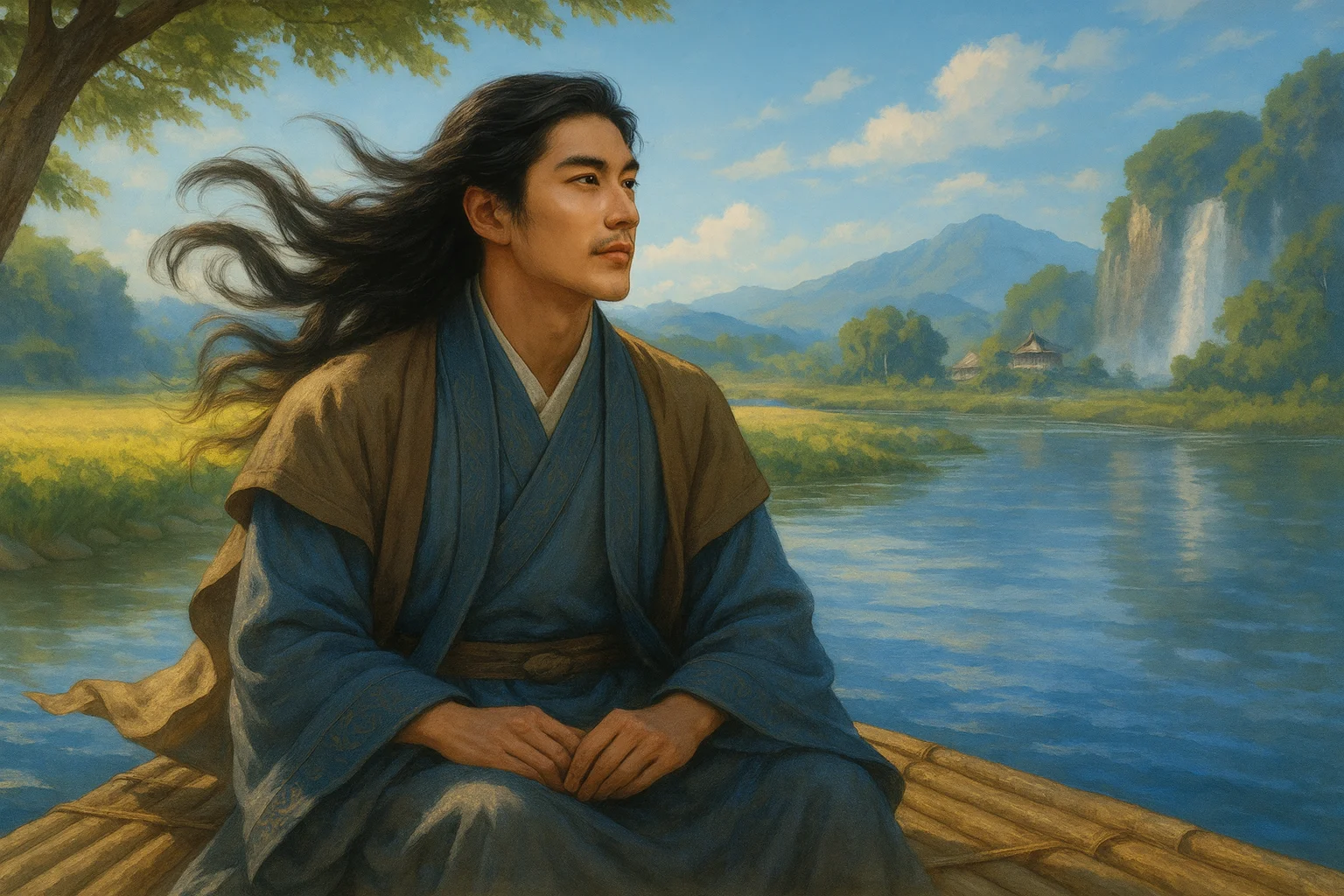
Meng Haoran (孟浩然 689 - 740), a native of Xiangyang, Hubei Province, was a renowned landscape and pastoral poet of the Tang Dynasty. In his early years, he lived in seclusion on Mount Lumen, reading for his own pleasure. At the age of forty, he traveled to the capital to take the jinshi examination but failed. Thereafter, he remained a commoner for the rest of his life, roaming the Wu and Yue regions and finding contentment in poetry and wine. He excelled in five-character verse, with a style that is light and natural, often depicting the pleasures of landscapes and reclusion. He is regarded as a representative of the High Tang landscape and pastoral poetry school. His collected works, Meng Haoran Ji, have been handed down, and his poetry exerted a profound influence on later hermitic poetic traditions.