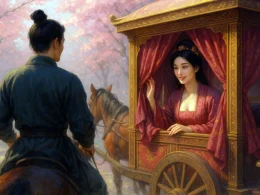

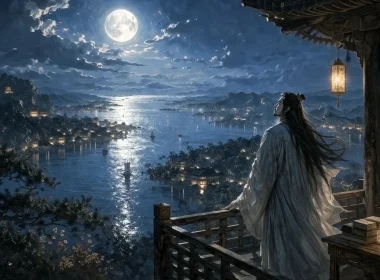
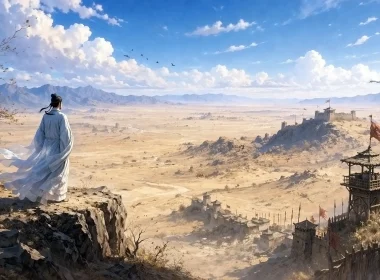
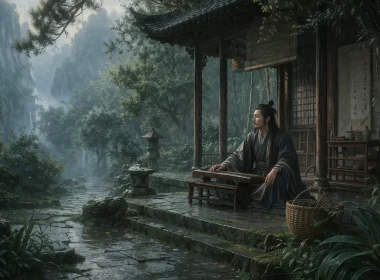
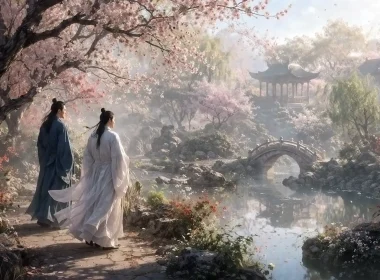
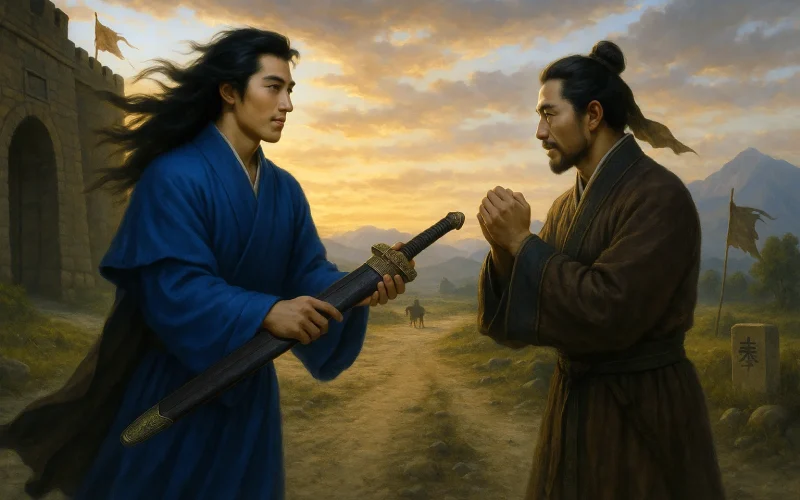
To the Capital you go, where the high tombs stand;
My sword is worth a thousand gold, as you understand.

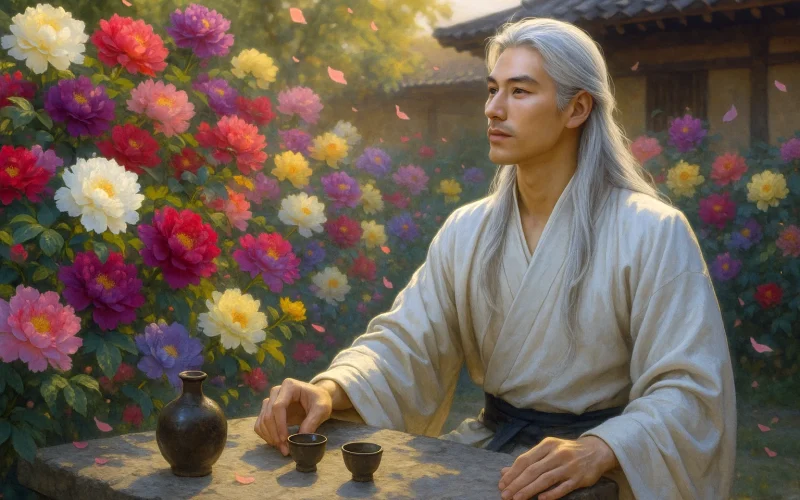
At parting, I ungird it, and give it to you here —
With it, I give the only heart I’ve owned for many a year.
Original Poem
「送朱大入秦」
孟浩然
游人五陵去,宝剑值千金。
分手脱相赠,平生一片心。
Interpretation
This poem was composed during Meng Haoran’s travels in the Wu-Yue region, specifically on a boat journey along the Cao’e and Shanxi rivers towards Mount Tiantai. During the Kaiyuan era, after experiencing the disappointment of his thwarted official ambitions in Chang’an, Meng Haoran redirected the focus of his life towards the mountains and waters of the southeast. This journey to Mount Tiantai stands as a vivid embodiment of his spiritual journey of "seeking truth through landscape."
In the Tang Dynasty, Mount Tiantai held profound and dual cultural significance: it was the ancestral seat of the Buddhist Tiantai school and a sacred Daoist mountain—the legendary site of the immortal encounter of Liu Chen and Ruan Zhao. Consequently, images like the "Stone Bridge" and "Redwall Peak" are imbued with rich layers of religious and mythological meaning. For Meng Haoran, this journey was, on the surface, a geographical excursion, but in essence, it was a pilgrimage to a spiritual symbol. The phrase "to visit the Stone Bridge" in the poem does not denote casual sightseeing; it implies a quest for a transcendent state and a world beyond the mundane.
It is noteworthy that the poet does not directly describe ascending to the famed scenery. Instead, he concentrates his brush on gazing from the boat and imagining along the way. This narrative strategy—"longing for a place not yet reached"—precisely reflects his state of mind. After setbacks in his official career, he projected his ideals onto the landscape. Mount Tiantai, a cultural landmark fused with the spiritual light of both Buddhism and Daoism, became the object of this projection. Thus, the dynamic journey on the water becomes a flowing poem of spiritual seeking.
First Couplet: 挂席东南望,青山水国遥。
Guà xí dōng nán wàng, qīng shān shuǐ guó yáo.
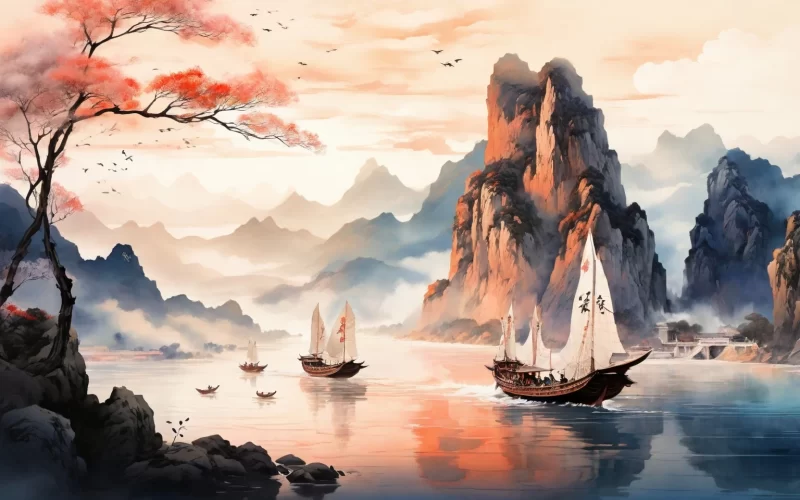
I set my sail and gaze southeast, afar;
Green hills in watery realms distant are.
Explication: The poem opens with a dynamic gesture that initiates both the physical and spiritual journey. "I set my sail" is the act of departure, while "gaze southeast" directs the quest towards Mount Tiantai, a spiritual landmark. This geographical orientation transforms a simple lookout into a symbolic alignment of purpose. The word "gaze" governs the entire poem's perspective, establishing a tone of intentional seeking rather than passive viewing. The second line, "Green hills in watery realms distant are," paints a vast, serene landscape. The word "distant" operates on two levels: it describes the great physical expanse and, more importantly, conveys the psychological remoteness of the ideal realm the poet seeks—an allure that is profound yet perpetually elusive.
Second Couplet: 舳舻争利涉,来往接风潮。
Zhú lú zhēng lì shè, lái wǎng jiē fēng cháo.
Ships, great and small, for gainful passage race,
Coming and going, borne by wind and tide's grace.
Explication: The focus shifts abruptly from the solitary seeker to the bustling world. The image of ships "great and small" in a relentless race "for gainful passage" lays bare the utilitarian drive of worldly life. This creates a stark counterpoint to the poet's own declared purpose. The second line, "borne by wind and tide's grace," is richly ambiguous. On one level, it describes the natural forces governing travel; on another, it serves as a metaphor for a life adrift, dictated by external trends and opportunities rather than inner conviction. The poet, amidst this clamor, assumes the role of a detached observer, his calm gaze affirming his resolve to pursue a different, more solitary course.
Third Couplet: 问我今何适?天台访石桥。
Wèn wǒ jīn hé shì? Tiāntāi fǎng shí qiáo.
You ask where I am bound, and for what cause?
"To visit the Stone Bridge on Mount Tiantai's heights."
Explication: The poem's rhythm and mode change here with the introduction of a self-addressed dialogue. The question "You ask where I am bound?" represents a moment of introspective clarification, a conscious articulation of intent. The answer is definitive and resonant. "To visit the Stone Bridge" is not a sightseeing plan. Within the Tang cultural context, the Stone Bridge of Mount Tiantai was a potent symbol, a sacred site from Buddhist and Daoist lore representing a gateway to transcendent understanding. The choice of the word "visit" is crucial—it carries a weight of reverence and purposeful seeking absent from more casual terms like "see" or "travel." This couplet stands as the clear, declarative heart of the poem, stating its spiritual thesis.
Fourth Couplet: 坐看霞色晓,疑是赤城标。
Zuò kàn xiá sè xiǎo, yí shì Chìchéng biāo.
Sitting, I watch dawn's rosy clouds unfold,
And wonder, could that be Redwall's crest I behold?
Explication: The poem concludes not with arrival, but with a moment of sublime suspension. "Sitting, I watch" indicates a shift from active journeying to receptive contemplation. The glorious spectacle of dawn breaking could be an end in itself, yet the poet's mind moves beyond the sensory beauty. The pivotal phrase, "And wonder, could that be...", transforms the scene. Redwall Peak, the famed gateway to Mount Tiantai, is obscured in the dawn's own red hues. This visual uncertainty births a deeper, poetic certainty. The act of wondering becomes a form of recognition. The physical destination may not be clearly reached, but the spiritual aspiration is vividly confirmed in the heart's eye. The poem ends in this open, resonant space between seeing and knowing, anchoring the journey in the perpetual, watchful orientation towards the ideal.
Holistic Appreciation
This poem maps a spiritual itinerary using the framework of a physical journey. In forty concise characters, it operates on multiple levels: as a record of a dawn river trip, as a chronicle of a mind turning from worldly noise towards sacred symbol, and as a philosophical meditation on seeking itself.
The structure follows a clear, deepening progression: from the initiating gaze, through a contrasting vision of worldly bustle, to a declarative statement of intent, and finally to a contemplative moment where seeking shades into a form of perceptual discovery. This movement from outward action to inward stillness mirrors the soul's journey.
The poem's central tension and beauty reside in the word "wonder" (yi). The realization is not "This is Redwall Peak," but "Could that be...?" This aesthetics of uncertainty is profoundly meaningful. It suggests that the truest spiritual attainment may not be a definitive arrival or possession of truth, but the sustained, watchful orientation towards it—the perpetual condition of being a seeker. The vision in the dawn's glow, born of longing, is ultimately more significant than the geographical landmark itself.
Artistic Merits
- Structural Counterpoint: The poem masterfully employs contrast. The solitary, purposive "gaze" of the first couplet is set against the collective, profit-driven "race" of the second. This juxtaposition of values elevates the poet's quest by defining it against its opposite, creating intellectual and ethical depth.
- Symbolic Density in Brevity: The poem achieves remarkable resonance by leveraging culturally charged symbols like the "Stone Bridge" and "Redwall Peak." These are not mere place names but conceptual portals, allowing the short verse to tap into vast traditions of Buddhist and Daoist thought on transcendence.
- Temporal Poise: The poem captures a specific, fleeting moment—the transition from night to dawn at the start of a journey. This "in-between" time is poetically potent, symbolizing a liminal state of consciousness ripe for insight and reorientation, a moment where one path is left behind and another beckons.
- Integrated Perspective: The poet seamlessly blends the stances of the traveler, the observer, and the thinker. This fusion of action, perception, and reflection creates a complete experiential record, making the philosophical insight feel earned through the narrative of the journey.
Insights
"Gazing at Dawn from the Boat" is ultimately a poem about direction over destination. It presents a powerful metaphor for the life of the spirit: value is found not solely in what summit one reaches, but in the quality of one's gaze and the courage of one's intended "visit." In a world of "ships racing for gain," it asserts the necessity and dignity of the solitary, spiritually-motivated voyage.
The poem's enduring power lies in its final, open question. The "wonder" it expresses is not doubt, but a higher form of attention—a mind and heart fully engaged in interpreting the world in light of its deepest yearning. It suggests that our most profound recognitions of truth or beauty often come in this form: not as incontrovertible facts, but as compelling, transformative possibilities glimpsed on the horizon of our experience.
Thus, the poem redefines the journey. The true discovery is not Mount Tiantai, but the capacity of the seeking self to find meaning and outline ideals in the interplay of dawn light, memory, and longing. It is an invitation to every reader to become the watchful voyager of their own life.
About the poet
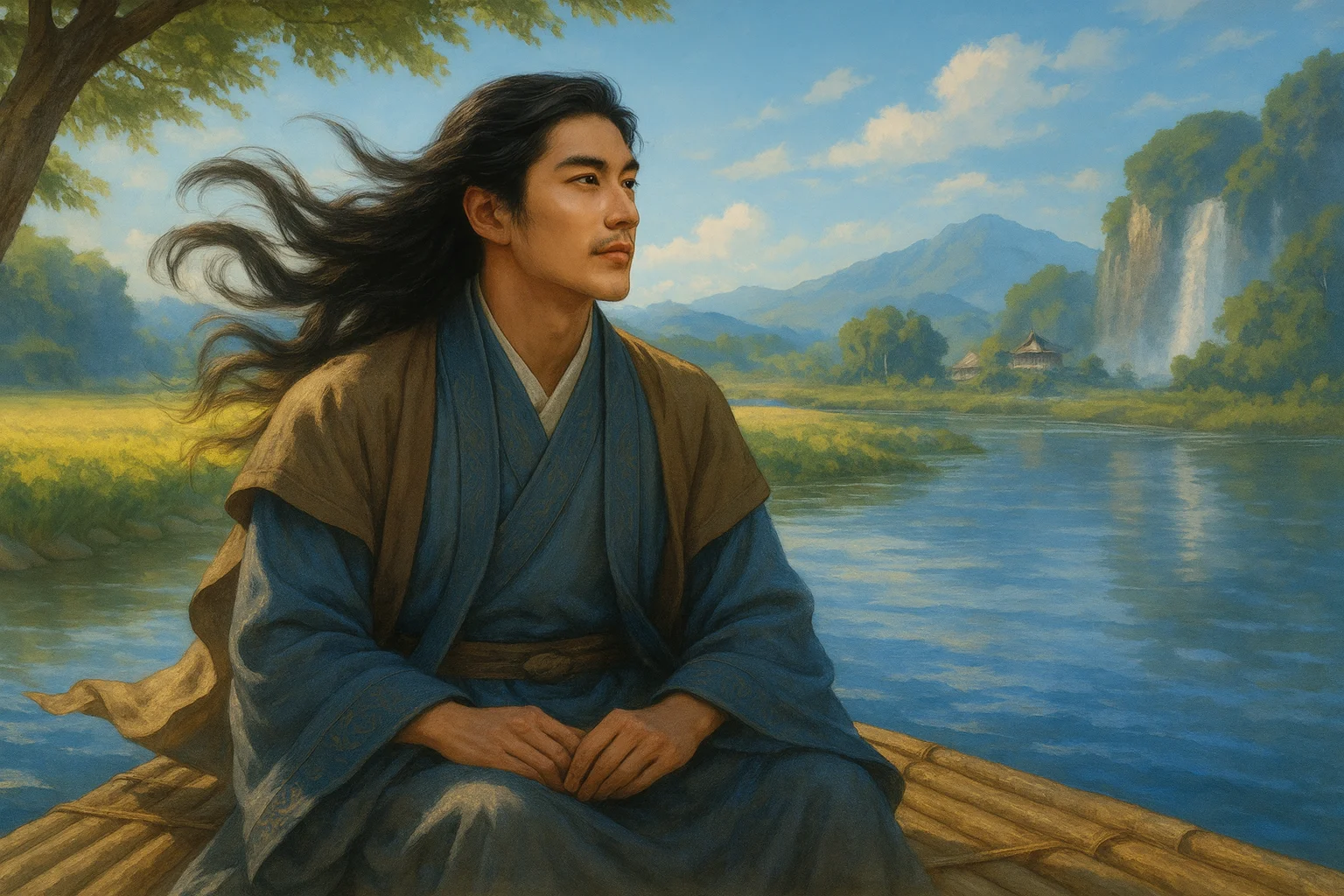
Meng Haoran (孟浩然 689 - 740), a native of Xiangyang, Hubei Province, was a renowned landscape and pastoral poet of the Tang Dynasty. In his early years, he lived in seclusion on Mount Lumen, reading for his own pleasure. At the age of forty, he traveled to the capital to take the jinshi examination but failed. Thereafter, he remained a commoner for the rest of his life, roaming the Wu and Yue regions and finding contentment in poetry and wine. He excelled in five-character verse, with a style that is light and natural, often depicting the pleasures of landscapes and reclusion. He is regarded as a representative of the High Tang landscape and pastoral poetry school. His collected works, Meng Haoran Ji, have been handed down, and his poetry exerted a profound influence on later hermitic poetic traditions.