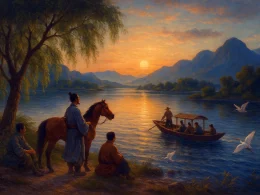
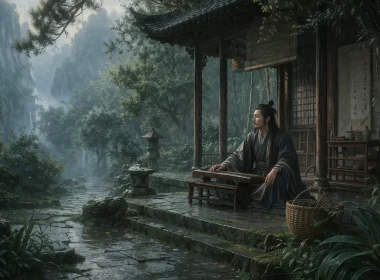
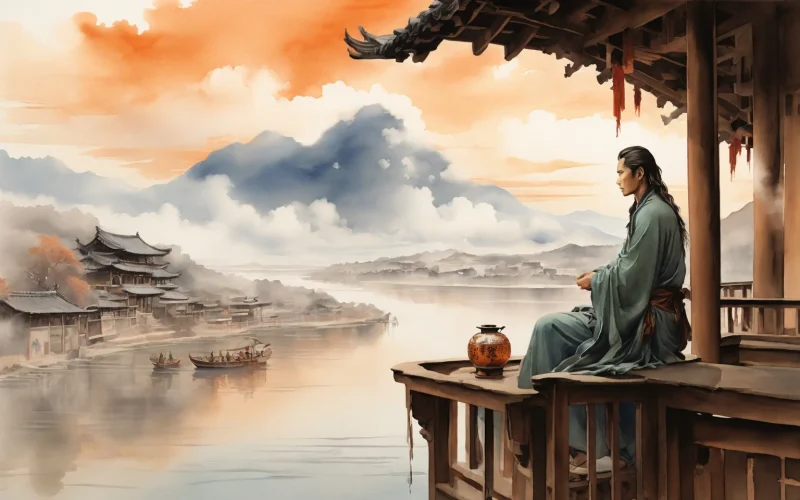
For miles and miles I sail and float;
High famed mountains are hard to seek.
By riverside I moor my boat,
Then I perceive the Censer Peak.

Knowing the hermit's life and way,
I love his solitary dell.
His hermitage not far away,
I hear at sunset but the bell.
Original Poem
「晚泊浔阳望庐山」
孟浩然
挂席几千里,名山都未逢。
泊舟浔阳郭,始见香炉峰。
尝读远公传,永怀尘外踪。
东林精舍近,日暮空闻钟。
Interpretation
This poem was composed in the 21st year of the Kaiyuan era (733 AD). By this time, Meng Haoran was already past forty, having just concluded his wanderings through the Wu and Yue regions and was returning upstream along the Yangtze River. Meng Haoran, a native of Xiangyang, was a leading poet of the Tang Dynasty's Landscape and Pastoral tradition, often paired with Wang Wei as "Wang-Meng." After a period of youthful seclusion at Lumen Mountain, he traveled to Chang'an in his forties seeking an official post, but met with disappointment. He consequently never held office, spending his life traveling and finding solace in poetry and wine. This return journey was tinged with a sense of frustration and melancholy.
Xunyang (modern Jiujiang, Jiangxi) is situated in the middle reaches of the Yangtze River, with the majestic Mount Lu rising beside it. Since ancient times, it has been a cultural crossroads where Buddhism and Taoism intermingled. Mooring his boat here at dusk, the poet's gaze was drawn to the imposing Incense Burner Peak of Mount Lu. This was not merely the sighting of a famous geographical landmark; it was the sudden appearance of a symbol deeply imbued with the tradition of reclusion and religious culture, resonating profoundly with the poet's own yearning for transcendence and an inner anchorage. This "evening mooring" was thus not merely a physical rest after travel; it became a significant moment of spiritual pause and contemplation.
The poem references Master Huiyuan, an eminent Eastern Jin Dynasty monk who founded the East Grove Temple on Mount Lu and established the Pure Land school of Buddhism. His "traces beyond the dust of the world" represented, for traditional scholars, the lofty ideal of spiritual withdrawal. For Meng Haoran, the sight of the mountain naturally evoked this transcendent figure. This was both a cultural echo and an inward projection of his own search for a spiritual path between the worlds of official service and reclusion. Consequently, the poem transcends a simple travelogue, becoming a concise yet profound work of reflection on a life stage and the pursuit of spiritual ideals.
First Couplet: "挂席几千里,名山都未逢。"
Guà xí jǐ qiān lǐ, míng shān dōu wèi féng.
For miles and miles I've sailed beneath my sail;
No famous mountain rose along the trail.
The opening line, "For miles and miles I've sailed," conveys the vast distance of the river journey. The phrase "No famous mountain rose" carries a subtle weariness and unfulfilled expectation. The contrast between the "miles and miles" traveled and the "no famous mountain" encountered lays bare both the physical fatigue of the long journey and a spiritual sense of seeking without finding, effectively building anticipation for the emotional shift marked by "only now do I see" in the following lines.
Second Couplet: "泊舟浔阳郭,始见香炉峰。"
Bó zhōu Xúnyáng guō, shǐ jiàn Xiānglú fēng.
Mooring my boat near the town, I'm glad to see
The Incense Burner Peak soaring in front of me.
Here, the poem's focus turns sharply. "Mooring my boat" signifies the pause in the journey, while "only now do I see" captures the moment of sudden, clear vision. The word "only now" concentrates the long search and accumulated anticipation into this instant of surprise and awe. The emergence of the Incense Burner Peak is not just the appearance of a landscape feature; it is the fulfilling of the poet's ideal of a "famous mountain." This couplet is the pivotal turn in the poem, shifting from seeking to finding, from weariness to awakening.
Third Couplet: "尝读远公传,永怀尘外踪。"
Cháng dú Yuǎn gōng zhuàn, yǒng huái chén wài zōng.
I've often read of the master's life divine;
Long, long have I admired his way benign.
The poem shifts from the physical scene to recollection, moving naturally from "gazing at the mountain" to "recalling the man." By invoking Master Huiyuan and his spiritual connection to Mount Lu, the poet elevates the immediate view into a cultural symbol and an emblem of an exemplary life. The phrase "Long, long have I admired" expresses a profound and enduring yearning for a life of lofty detachment from worldly affairs. This couplet lifts the poem from a landscape sketch to a work of spiritual inquiry and aspiration.
Fourth Couplet: "东林精舍近,日暮空闻钟。"
Dōnglín jīngshè jìn, rì mù kōng wén zhōng.
His Temple of East Wood is not far away;
I hear at dusk its bell, but echoes seem to say.
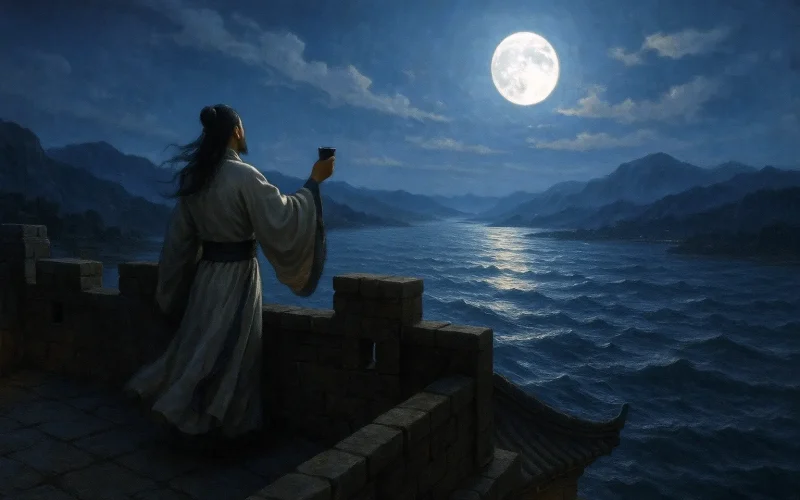
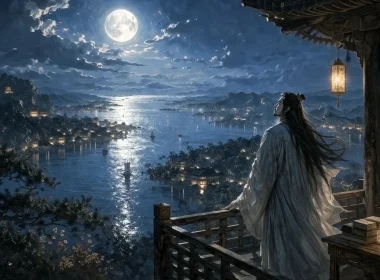
The poem concludes with an auditory image, creating a profoundly resonant artistic realm. "The Temple... is not far away" notes the geographical proximity, while "but echoes seem to say" poignantly acknowledges the present reality: the master is long gone, and the transcendent realm feels distant. The word "but echoes" conveys a dual sense of melancholy: the physical distance of a temple that is visible yet not immediately accessible, and the spiritual distance of an ideal that is glimpsed yet feels ultimately unattainable. The distant tolling of the bell, echoing in the dusk, merges all the poet's gazing and longing into its lingering sound, creating a sense of endless resonance beyond the words.
Holistic Appreciation
The poem begins with sailing a thousand miles and concludes with the empty sound of a dusk bell, sketching a complete spiritual landscape that moves from restlessness to stillness, from seeking to remembering. The poet does not labor to describe Mount Lu's specific grandeur. Instead, using the Incense Burner Peak as a catalyst, he blends natural scenery, cultural memory, and personal reflection, achieving multiple layers of meaning within a framework of simple, understated language.
Structurally, the poem progresses logically from traveling to mooring, from seeing to remembering, and from visual scene to auditory impression. The first couplet describes the lengthy journey and the weariness of the search. The second captures the emotional impact of mooring and finally seeing the peak. The third shifts from the mountain to the man, using Huiyuan to voice the poet's own aspirations. The fourth concludes with the bell, dissolving the quest and its attendant melancholy into the lingering echoes of dusk. The four couplets move seamlessly from the external to the internal, from object to heart, each layer deepening the last to form an organic whole.
Thematically, the poem's core lies in the tension between "only now do I see" and "but echoes seem to say." The sudden joy of "only now do I see" is the momentary fulfillment of a long search. The lingering regret of "but echoes seem to say" is the poignant awareness of an ideal that, though visible, remains just out of reach. Between this "seeing" and "hearing" lies the poet's yearning for a spiritual homeland and his clear-eyed recognition of worldly constraints—one can behold the ideal, yet may not arrive; one can listen for it, yet may not dwell within it.**
Artistically, the poem's most compelling feature is its subtle technique of "conveying complexity through simplicity, and concluding emotion through sound." The poet does not describe Mount Lu's majesty, merely naming the "Incense Burner Peak." He does not directly voice his stirred emotions, but quietly ends with "but echoes seem to say."** That bell sound issues from the real East Grove Temple, yet it also represents the poet's distant gaze toward an ideal realm. The word "but echoes" expresses the melancholy of distance, yet it also suggests a purification of spirit.
Artistic Merits
- Natural Structure, Fluid Progression: The movement from sailing and seeking, to mooring and seeing, to remembering and finally hearing, forms a natural and fluid emotional logic, with each scene and mood transition flowing smoothly into the next.
- Interplay of Reality and Reflection, Blending of Time and Space: The poem realistically depicts the journey while reflectively recalling historical reading. Spatially, it zooms from a vast river to a single peak. Temporally, it connects the present moment with a figure from the Jin Dynasty. Reality and reflection mirror each other; time and space are interwoven.
- Economical Language, Resonant Conception: The poem's diction is remarkably simple and unadorned. Yet, through keywords like "only now," "Long, long have I admired," and "but echoes," it creates an artistic conception that is subtle, profound, and rich in meaning beyond the literal words.
- Emotion Concluded by Sound, with Enduring Resonance: The finale uses the "bell sound" to conclude, transforming the visual act of "gazing" into the auditory experience of "hearing," ultimately merging all contemplation and longing into the lingering, seemingly endless reverberations of the dusk.
Insights
Through a seemingly incidental moment of travel, this poem reveals an eternal pattern of human seeking and encounter. We all sail with "sails unfurled" on life's journey, searching for our own "famous mountains." True encounter, however, often occurs in a moment of pause after long seeking, in that instant when the soul opens itself to the world.
The "Incense Burner Peak" in the poem transcends a specific landscape, becoming a symbol of ideals, conviction, or a spiritual home. It suggests that what may matter most is not the final arrival, but the sense of yearning sustained through the search, and the stirring and cleansing the soul undergoes at the moment of recognition. The bell whose sound one "but hears echoes" of represents both a regret and a solace—it reminds us that some forms of beauty can be listened for, yearned after, and held in the heart forever, without necessarily being fully possessed.
The true horizon often lies not in arrival, but in the reverberation of that "empty sound," in the enduring longing that persists even after the "first glimpse." This is the vitality of poetry: it records Meng Haoran's single evening mooring, yet it speaks to people of all eras—those who, on life's journey, seek, gaze upon, and listen for their ideals.
Poem translator
Xu Yuanchong (许渊冲)
About the poet
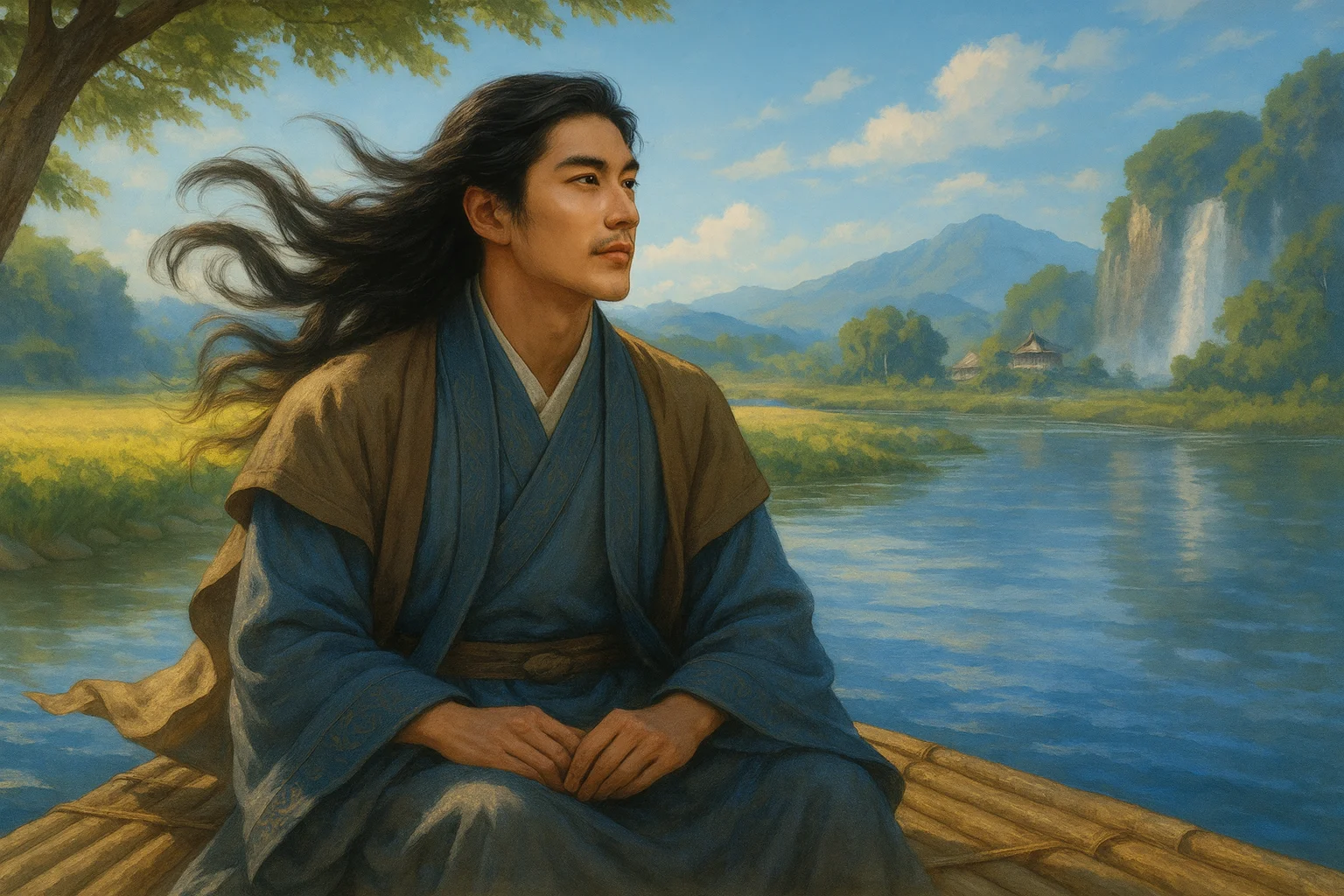
Meng Haoran (孟浩然 689 - 740), a native of Xiangyang, Hubei Province, was a renowned landscape and pastoral poet of the Tang Dynasty. In his early years, he lived in seclusion on Mount Lumen, reading for his own pleasure. At the age of forty, he traveled to the capital to take the jinshi examination but failed. Thereafter, he remained a commoner for the rest of his life, roaming the Wu and Yue regions and finding contentment in poetry and wine. He excelled in five-character verse, with a style that is light and natural, often depicting the pleasures of landscapes and reclusion. He is regarded as a representative of the High Tang landscape and pastoral poetry school. His collected works, Meng Haoran Ji, have been handed down, and his poetry exerted a profound influence on later hermitic poetic traditions.