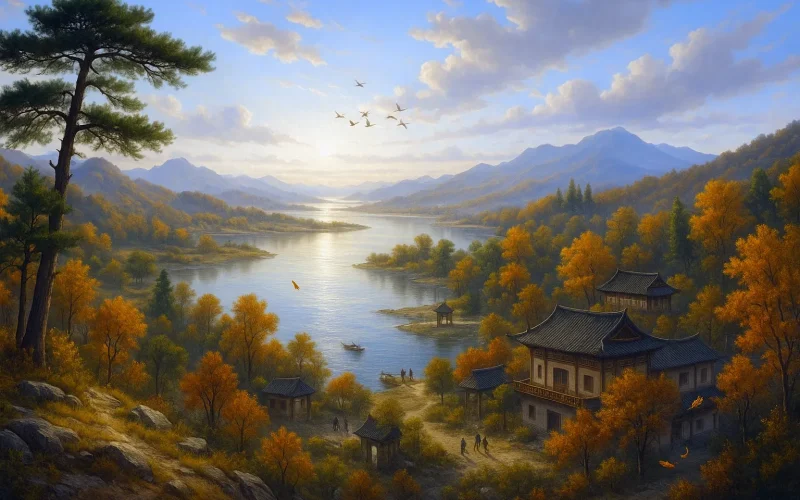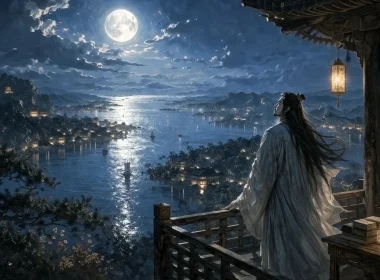
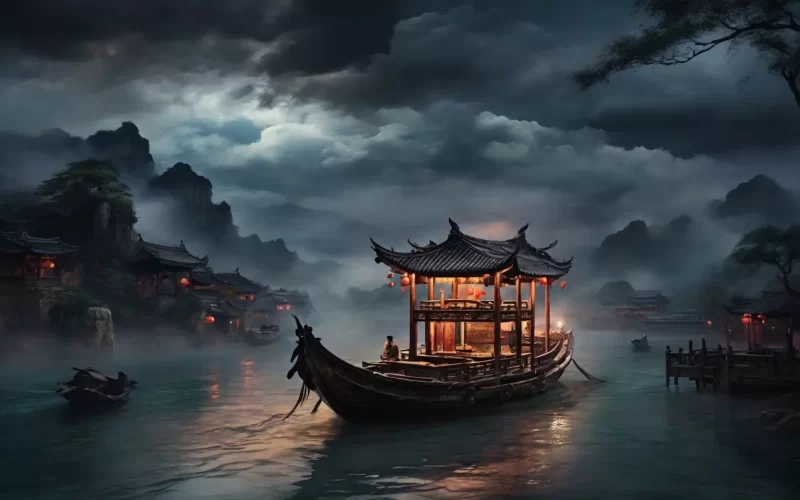
While my little boat moves on its mooring of mist,
And daylight wanes, old memories begin...
How wide the world was, how close the trees to heaven,
And how clear in the water the nearness of the moon!
Original Poem
「宿建德江」
孟浩然
移舟泊烟渚,日暮客愁新。
野旷天低树,江清月近人。
Interpretation
This poem was composed in the autumn of the 18th year of the Kaiyuan era (730 AD), during Meng Haoran's wanderings through the Wu-Yue region. The previous year, he had failed the imperial examinations in Chang'an and written the lines "To the Northern Palace, no more petitions I send; / To the South Mountain, to my humble hut I wend," resolving to retreat into reclusion. Yet after returning to seclusion, Meng Haoran chose instead to travel far from home. He left Xiangyang, traveled down the Han River into the Yangtze, passing through Xunyang and Jiande, all the way eastward to the heart of Yue. This was a self-imposed exile, a spiritual vagrancy—he would use geographical distance to dilute the pain of his failure.
The Jiande River, in present-day Jiande County, Zhejiang Province, is a section of the Xin'an River. The waters here run clear and deep, the mountains on both banks a dark ink-blue—a place where Southern Dynasty poets like Xie Lingyun and Shen Yue had once traveled and sung. Yet when Meng Haoran moored his boat here, he had no heart for tracing the footsteps of ancient worthies. The word "mooring" in the title reveals the constant state of the wanderer: no fixed place to return to, only one night's anchorage after another. His life had become like this little boat—carried by fate's current toward an unknown destination.
What is worth savoring is that this short poem of twenty characters was written at the same time, in the same place, and in the same state of mind as "Sleeping at Night on the Tonglu River, Sent to Old Friends in Guangling." The Tonglu River and the Jiande River both belong to the Xin'an River system; both poems were written in autumn twilight, both describe a solitary boat moored for the night, both find solace in the moon. Yet "Sleeping at Night on the Tonglu River" reaches outward—"I take these two lines of tears / And send them far to the western shore of the sea," sending longing to distant friends. "Mooring at Night on the Jiande River" draws inward—"The river clear, the moon so near," entrusting companionship to the moon of the present moment. One reaches out, the other draws in; one sends, the other approaches. Together, they trace the complete arc of Meng Haoran's spiritual self-healing during his Wu-Yue wanderings.
First Couplet: "移舟泊烟渚,日暮客愁新。"
Yí zhōu bó yān zhǔ, rì mù kè chóu xīn.
I move my boat to moor by the misty isle;
As dusk falls, a stranger's sorrow freshens anew.
Explication: The opening narrates plainly, yet every word sinks deep. "Move my boat" is not a random stop—it is an active choice. Before darkness descends, the poet finds himself a place to anchor for the night. In this action lies the self-awareness of the wanderer: he knows the road ahead is long, and tonight he must settle here. "Misty isle" is a sandbank shrouded in evening mist, hazy and indistinct, seeming there yet not there. This image is both a real scene and an externalization of the poet's inner state: his future, like this misty isle, has no clear boundary, no discernible direction. He moors here, yet does not know where he will moor tomorrow.
"Dusk" is the fixed trigger of sorrow in classical poetry. Yet Meng Haoran does not say "a stranger's sorrow rises" or "a stranger's sorrow is born." He says "a stranger's sorrow freshens anew." This word "new" is the most painful in the entire poem. It means: this is not the first time he has wandered, nor the first time he has felt lonely at dusk. Sorrow has long been there; it simply returns with each evening, like the rising and falling of the tide, like the cycling of the seasons. He is not "giving birth" to sorrow—he is "claiming" the sorrow that has always been his.
Second Couplet: "野旷天低树,江清月近人。"
Yě kuàng tiān dī shù, jiāng qīng yuè jìn rén.
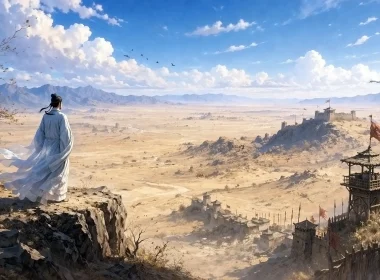
The wilderness is vast, the sky hangs lower than the trees;
The river is clear, the moon draws near to the traveler.
Explication: This couplet represents the pinnacle of scene-painting and emotion-expressing in Tang poetry, recited for a thousand years yet never fully exhausted. "The wilderness is vast, the sky hangs lower than the trees" is an optical illusion, yet it is psychologically true. The boundless plain offers no obstruction to the gaze, so the distant horizon naturally appears lower than the nearby treetops. This is a matter of physical perspective, but in Meng Haoran's hands, it carries a deeper meaning: when a person stands in the midst of vast heaven and earth, a sense of smallness overwhelms everything. The sky is not truly lower; it is the poet who feels himself too small. The trees are not truly taller; it is that the poet has no one and nothing beside him. This line captures the weightlessness and insignificance of the wanderer in the vastness of the world.
Yet Meng Haoran does not let the poem sink into despair. Immediately, he writes, "The river is clear, the moon draws near to the traveler"—this is the gentlest miracle in the entire poem. The river is clear, the moon's reflection shimmers on its surface, as if within arm's reach. The moon is a distant celestial body, yet because of the river's clarity, it becomes close. It is not that the moon actively approaches the poet; it is that the poet, because of the river's clarity, can approach the moon. The word "near" is a shortening of physical distance, but even more, it is the dissolution of spiritual distance. On this unfamiliar river, in this solitary boat, in this boundless twilight and wilderness, he has finally found a presence willing to draw close to him. It is not a person. It is the moon. But what of that? The moon, too, is a kindred spirit.
Holistic Appreciation
This is Meng Haoran's shortest poem, yet it is the most complete presentation of his state of being. Twenty characters, with an extremely clear structure: the first two lines write of human affairs—mooring the boat, dusk, a stranger's sorrow; the last two lines write of heaven and earth—vast wilderness, low-hanging sky, clear river, near moon. The first half is the wanderer's plight; the second half is nature's response. The first half is the separation between "I" and the world; the second half is the reconciliation between "I" and the world. This reconciliation is not achieved by conquering loneliness, but by acknowledging it and learning to live with it. The poet does not find an old friend by the riverbank, does not receive a letter from home at the posting station, does not return to his hometown in a dream. He simply sees that the sky is low, that the moon is near, and writes these two lines on paper. After writing them, he is still the traveler moored by the misty isle, still destined to drift eastward with the current tomorrow. But at this moment, he is no longer facing heaven and earth alone—the moon is with him.
Structurally, the poem presents a visual cycle from near to far, then from far back to near. The first two lines write of nearby scenes—the boat, the isle, the traveler. The last two lines write of distant scenes—the wilderness, the sky, the trees, the river, the moon. Yet "the moon draws near to the traveler" pulls the most distant celestial body back to the poet's side, completing an emotional loop. The first half is the wanderer's plight; the second half is nature's response. This response cannot change the plight, but it is enough to console the one trapped within it.
Thematically, the poem's core lies in the word "near." "The wilderness is vast, the sky hangs lower than the trees" writes of the infinite extension of distance—the sky is far, the earth is far, home is far, old friends are far; the poet is cast into a boundless emptiness. "The river is clear, the moon draws near to the traveler" is a resistance to this "farness"—when everything else has gone far away, at least the moon is near. This word "near" is the only warmth in the entire poem.
Artistically, the poem's most moving quality lies in its restrained technique of "using extreme simplicity to convey extreme depth." Twenty characters exhaust four themes—wandering, loneliness, insignificance, consolation—without a single superfluous word, without a single strained effort. The self-awareness of "move," the temporary respite of "moor," the cyclical return of "new," the consolation of "near"—every verb carries immense weight in silence.
This poem can be read alongside "Sleeping at Night on the Tonglu River, Sent to Old Friends in Guangling." On the Tonglu River night, Meng Haoran sent two lines of tears to the western shore of the sea—that was seeking consolation outward. On the Jiande River night, he drew his gaze back to the side of his boat, sat face to face with the river moon—that was finding sufficiency within. The former is longing; the latter is Chan serenity. The former requires a "you" in the distance; the latter requires only a "moon" in the present. From "send" to "near," from "distant" to "close"—this traces the complete arc of Meng Haoran's spiritual self-healing during his wanderings.
Artistic Merits
- Extreme Simplicity Conveying Extreme Depth: Twenty characters exhaust four themes—wandering, loneliness, insignificance, consolation—without a single superfluous word, without a single strained effort. This is the ultimate realization of Meng Haoran's poetic ideal of "light words, rich flavor."
- Psychological Writing Through Optical Illusion: "The sky hangs lower than the trees" is not physical truth, but psychological truth—when a person feels small, the world feels oppressively large. This subjectivized description of scenery makes the external landscape a precise projection of inner emotion.
- Emotional Weight of Verbs: "Move" is the wanderer's active choice; "moor" is the traveler's temporary respite; "near" is the solitary one's only consolation. Three verbs string together the entire emotional thread of the poem.
- Double Contrast of Space: The first two lines are near scenes—boat, isle, traveler; the last two lines are distant scenes—wilderness, sky, trees, river, moon. From near to far, then from far back to near (the moon draws near), forming a complete visual cycle and completing an emotional loop.
- Beauty of Suspension in the Closing Line: The poem ends on "the moon draws near to the traveler"—a state in progress, not a conclusion. The poet does not write "and so I stopped feeling sad," nor does he write "and so I fell asleep peacefully." He simply records this moment of closeness, and lets the line hang there. The aftertaste lingers like the river moon, long undispersed.
Insights
This poem tells us: a person can find fulfillment in solitude, without waiting for anyone to arrive. This is the greatest difference between Meng Haoran here and the Meng Haoran of "Sleeping at Night on the Tonglu River, Sent to Old Friends in Guangling." On the Tonglu River night, he was still sending tears, still longing, still hoping for an echo from afar. On the Jiande River night, he no longer sends anything. He simply gazes quietly at the moon's reflection on the water, and discovers that it is so close to him. When modern people face loneliness, they habitually seek connection outward: make a phone call, send a message, fill the silent night with social media. Meng Haoran offers another possibility: not connecting does not have to mean being lonely. When the river moon becomes a kindred spirit, when the wilderness becomes a dwelling, when the solitary boat becomes the whole world—then solitude is no longer scarcity, but abundance.
There is a deeper metaphor in this poem: the moon is the eternal Other, yet it is also the most faithful companion. It does not ask about your past, does not plan your future; it simply sits with you, here and now, on this river surface. This is nature's gentlest gift to humanity: it does not solve any problem, but it never fails to show up in any moment of hardship. For a thousand years, countless travelers have moored their boats on the Jiande River, countless people have seen the scene of "the wilderness vast, the sky lower than the trees; the river clear, the moon near." Some among them would remember Meng Haoran's poem; others would not. But whether they remembered the poem or not, the river water and moonlight of that night would console every lonely traveler just as they consoled Meng Haoran. Because the moon is like that—it does not recognize poets, it does not recognize commoners. It simply, equally, quietly draws near to everyone who looks down at the water.
Poem translator
Kiang Kanghu
About the poet
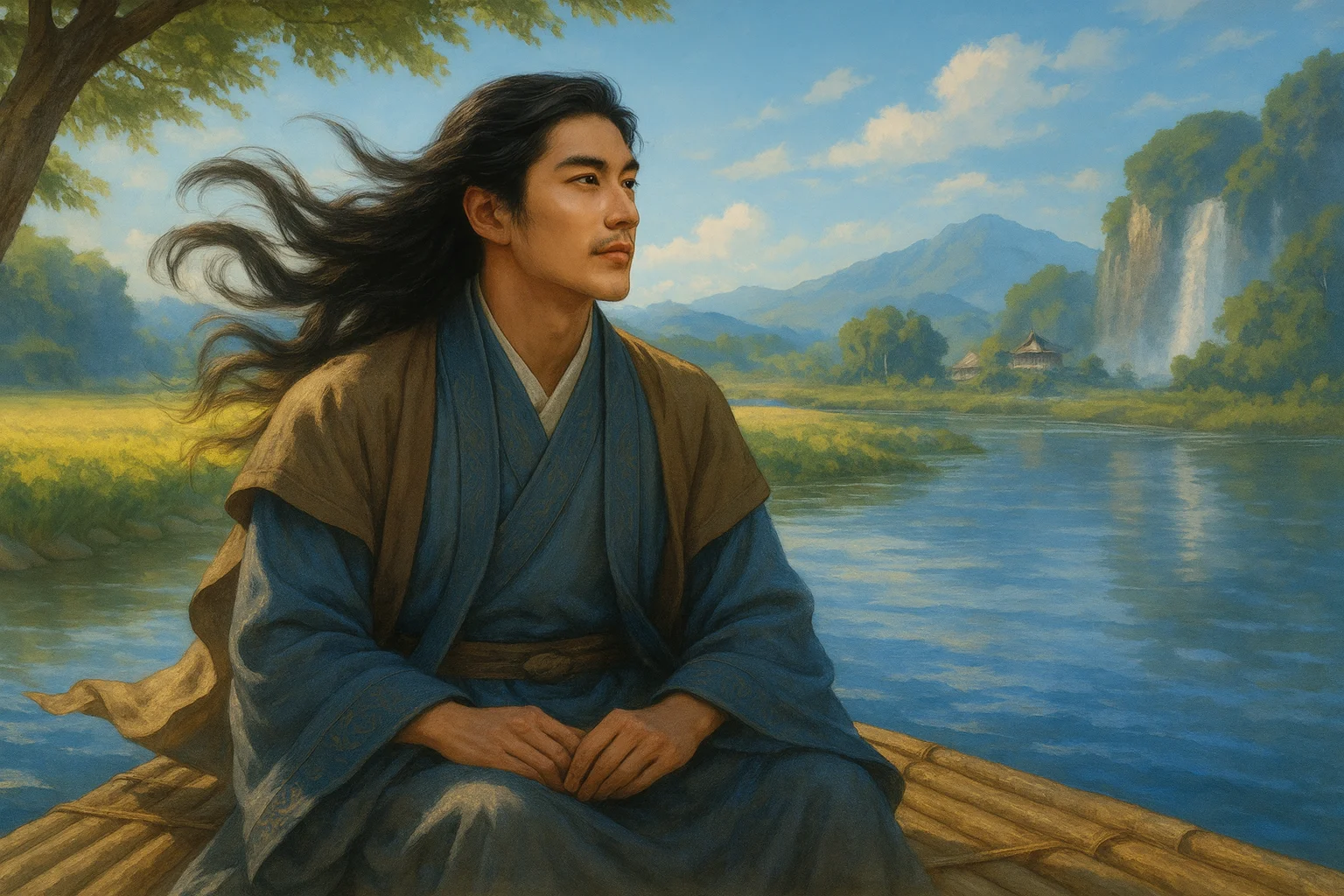
Meng Haoran (孟浩然 689 - 740), a native of Xiangyang, Hubei Province, was a renowned landscape and pastoral poet of the Tang Dynasty. In his early years, he lived in seclusion on Mount Lumen, reading for his own pleasure. At the age of forty, he traveled to the capital to take the jinshi examination but failed. Thereafter, he remained a commoner for the rest of his life, roaming the Wu and Yue regions and finding contentment in poetry and wine. He excelled in five-character verse, with a style that is light and natural, often depicting the pleasures of landscapes and reclusion. He is regarded as a representative of the High Tang landscape and pastoral poetry school. His collected works, Meng Haoran Ji, have been handed down, and his poetry exerted a profound influence on later hermitic poetic traditions.