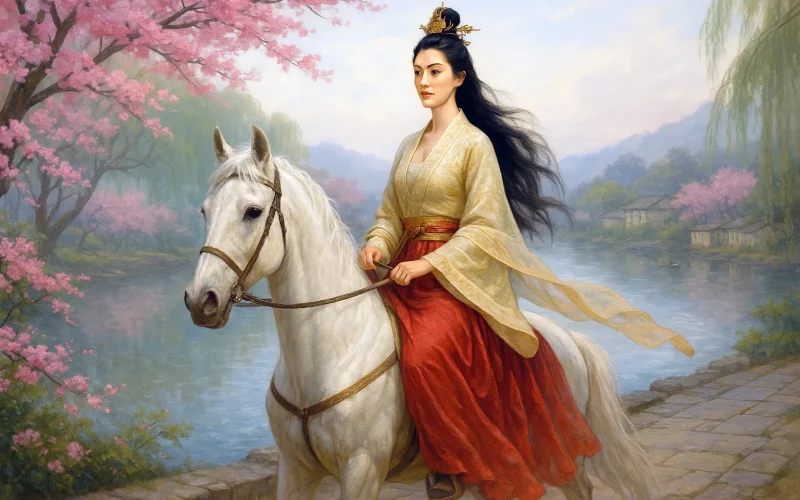



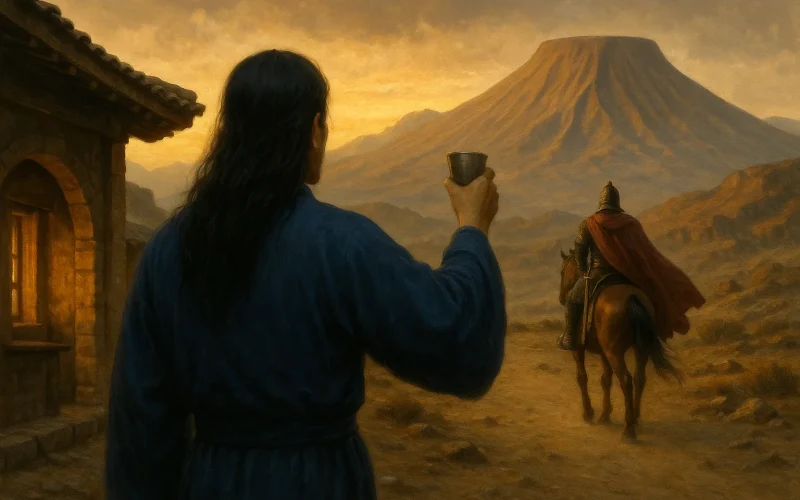
Few pass the Fire Mountains in summer’s blaze;
I see your horse fly swift as bird in haze.
The chief’s camp lies where the day-star goes down;
His horn at one blow wins a Tartar town.
Original Poem
「武威送刘判官赴碛西行军」
岑参
火山五月行人少,看君马去疾如鸟。
都护行营太白西,角声一动胡天晓。
Interpretation
This poem was composed in the fifth month of the tenth year of the Tianbao era (751 CE), during Cen Can's first tour of duty beyond the frontier, serving on the staff of Gao Xianzhi, the Protector-General of Anxi. "Wuwei" (present-day Wuwei, Gansu) in the title was a key stronghold on the Hexi Corridor and a vital thoroughfare for westward travel; "Qixi" refers to the vast region west of the desert in the Western Regions, the destination of Judge Liu's mission. This farewell took place against the grand backdrop of the High Tang's active expansion into the Western Regions; the friend was bound not only for a distant geographical frontier but also for the forefront of national strategy and personal achievement.
Unlike ordinary farewell gatherings, this work by Cen Can is annotated by later commentators as "oral improvisation" (kǒu zhàn), meaning it was composed extemporaneously. This creative state determines the poem's refined, vivid, and unlabored quality. It dispenses with the minutiae of wine-cup farewells and cuts directly to the most characteristically frontier temporal-spatial nodes—the scorching heat of the Volcano and the urgency of military affairs. In this poem, farewell is no longer a sentimental outpouring of private emotion but becomes a dynamic, tension-filled vignette of a hero setting forth, integrated into the grand tableau of the age—embodying the bold style and elevated spirit unique to High Tang frontier farewell poetry.
First Couplet: "火山五月行人少,看君马去疾如鸟。"
Huǒ shān wǔ yuè xíng rén shǎo, kàn jūn mǎ qù jí rú niǎo.
On the Volcano in the fifth month, travelers are few;
I watch your horse gallop away, swift as a bird in flight.
The opening begins with the harsh environment so characteristic of the frontier. "Volcano in the fifth month" establishes the time and place, its heat enough to daunt anyone; "travelers are few" reinforces this with objective statement. Yet against this backdrop that would make ordinary people shrink back, the poet fixes his gaze on a single swift movement: "I watch your horse gallop away, swift as a bird." The character "看" (watch) locks the poet's—and the reader's—gaze firmly on the departing figure. The simile "swift as a bird" is remarkably apt: it conveys the speed of the galloping steed while also investing the scene with a lightness, agility, and forward-thrusting visual beauty and spiritual image. The stark contrast between the scorching environment and the vigorous posture brings the hero's spirit vividly to life.
Final Couplet: "都护行营太白西,角声一动胡天晓。"
Dū hù xíng yíng Tàibái xī, jiǎo shēng yī dòng hú tiān xiǎo.
The Protector's camp lies west of the planet Venus;
At the first blast of the horn, the barbarian sky turns to dawn.
The poet's gaze and thoughts follow the galloping hooves, projecting into a more remote time and space. "The Protector's camp lies west of the planet Venus" uses an astronomical reference (Venus, the Taibai star) to indicate direction, expressing the camp's immense distance and remoteness with a touch of magnificent imagination. "At the first blast of the horn, the barbarian sky turns to dawn" is a line of enduring fame, carrying multiple layers of meaning: first, the realistic depiction of a military camp beginning its day with the morning horn; second, the "horn blast" symbolizes military might and command, while "the barbarian sky turns to dawn" suggests that the majesty and order of the Great Tang can illuminate and awaken the distant borderlands; third, from the poem's internal rhythm, this single horn blast seems to penetrate the text itself, sounding resoundingly in the reader's ear, with a power that electrifies the entire poem. This line closes the poem with sound, extending the farewell scene infinitely, creating a vast and heroic artistic conception.
Overall Appreciation
This seven-character quatrain is a masterpiece of "sketch" among High Tang frontier farewell poems. It does not elaborate or embellish; in just twenty-eight characters, it completes a full artistic creation—from "watching with the eyes" to "soaring with the spirit," from a concrete scene to a grand vision.
Structurally, the poem progresses from reality to imagination, from near to far. The first couplet begins with the harsh environment of "the Volcano in the fifth month," and against this forbidding backdrop focuses on the vigorous figure of "watching your horse gallop away, swift as a bird," using the stillness of the heat to offset the motion of the galloping—capturing the "real scene of farewell" in a single frame. The final couplet, with the astronomical imagination of "the Protector's camp lies west of Venus," projects the gaze into a more remote time and space, and closes with the resounding impact of "at the first blast of the horn, the barbarian sky turns to dawn," moving from watching to imagining, from concrete scene to grand vision. Between the two couplets, from reality to imagination, from near to far, from the departure before one's eyes to the aspiration for achievement afar, layer upon layer in seamless unity.
In terms of theme, the poem pivots on the resonance between "swift as a bird" and "the barbarian sky turns to dawn." The "swiftness" of "watching your horse gallop away, swift as a bird" is the efficiency and passion of action, the embodiment of the High Tang scholar's enterprising spirit; the "dawn" of "at the first blast of the horn, the barbarian sky turns to dawn" is the light and hope brought by conviction, the magnificent echo of the High Tang's far-reaching prestige. Between this "swiftness" and "dawn" lies the poet's admiration for his friend's valor and his sublime vision of the enterprise to which he is committed—the departure is swift, the arrival is bright; the personal journey and the call of the age meet finally in the space between "horn blast" and "barbarian sky."
Artistically, the most striking quality of this poem is the unique technique of improvisational sketch and spatiotemporal hyperbole. As an "oral improvisation," the poet strips away all extraneous elements, selecting only four core images—"Volcano," "flying horse," "camp," and "horn blast"—condensing the strongest impressions and emotions into the simplest form. "West of Venus" uses astronomical imagery to convey distance, a poetic hyperbole of space; "at the first blast of the horn, the barbarian sky turns to dawn" magnifies the power of sound infinitely, as if it possessed the force to alter the heavens. This hyperbole, transcending reality, is not falsehood but the externalization of emotional intensity and conviction. Ending with the penetrating, symbolic image of the "horn blast" breaks the limitations of visual representation, allowing the poem's artistic conception to reverberate and expand in the reader's imagination, producing the lingering artistic effect of "words end but sound does not cease."
Artistic Features
- Improvisational Sketch and Focal Concentration: As an "oral improvisation," the poem exhibits a sketch-like style of capturing the moment and focusing on the core. The poet strips away all digressions, selecting only the four core images of "Volcano," "flying horse," "camp," and "horn blast," and connects them through the visual logic of "watching" and "imagining," condensing the strongest impressions and emotions into the simplest form.
- Vivid and Dynamic Simile: The simile "swift as a bird" is novel and fitting. Unlike common similes for a fast horse (such as "shooting star" or "lightning"), it imparts a sense of lightness, agility, and vitality, complementing the robust character of frontier poetry and showcasing Cen Can's rich imagination.
- Hyperbole in Time and Space, Elevation of Imagery: "West of Venus" uses astronomical imagery to express distance, a poetic hyperbole of space; "at the first blast of the horn, the barbarian sky turns to dawn" magnifies the power of sound infinitely, as if possessing the force to alter the heavens. This hyperbole, transcending reality, is not falsehood but the externalization of emotional intensity and conviction, greatly elevating the poem's realm.
- Lingering Flavor of Sound-Based Closure: Ending with the penetrating, symbolic image of the "horn blast" is the poet's consummate craftsmanship. It breaks the limitations of visual representation, allowing the poem's artistic conception to reverberate and expand in the reader's imagination, producing the lingering artistic effect of "words end but sound does not cease," perfectly matching the wistfulness and heroic spirit of watching a departing figure and letting one's heart follow the distant sound.
Insights
This poem is like a powerful frontier sketch, revealing to us an alternative aesthetics of "farewell" and "moving forward." It tells us that the most elevated form of farewell is sometimes not holding hands and gazing through tears, but watching a figure resolutely merge into a more magnificent landscape. The "watching" in the poem is a gaze full of admiration and trust. When a friend's aspirations move in the same direction as the call of the age, the fareweller's emotions naturally transcend personal sorrow and rise to a witness of heroic deeds and a shared vision for grand designs.
At the same time, this poem demonstrates how to place a personal journey within a cosmic spatiotemporal frame. The remoteness of "west of Venus" and the solemnity of "the barbarian sky turns to dawn" lend a military expedition the quality of epic. This reminds us that the value and brilliance of an individual life are often manifested and made eternal through connection with grand undertakings or historical currents.
Ultimately, Cen Can infuses this short poem with a distinctive High Tang "sense of speed" and "sense of dawn." "Swift as a bird" is the efficiency and passion of action; "the barbarian sky turns to dawn" is the light and hope brought by conviction. It inspires every reader: in facing life's "Volcano" journeys, one should be as swift and fearless as a bird; and believe that every departure will ultimately, with its own "blast of the horn," usher in its own "dawn"—for oneself and for the age.
About the poet
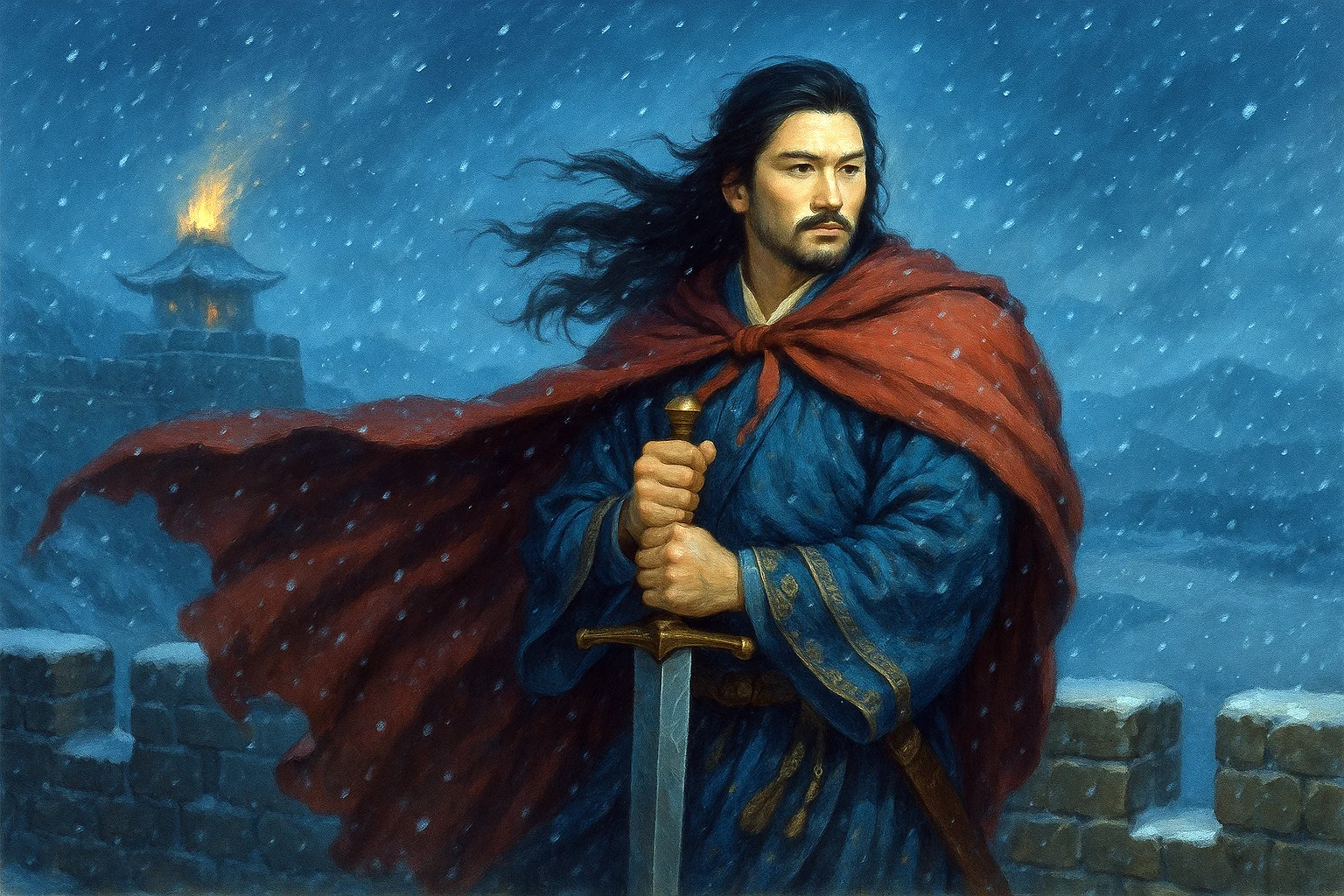
Cén Cān(岑参), 715 - 770 AD, was a native of Jingzhou, Hubei Province. He studied at Mt. Songshan when he was young, and later traveled to Beijing, Luoyang and Shuohe. Cén Cān was famous for his border poems, in which he wrote about the border scenery and the life of generals in a majestic and unrestrained manner, and together with Gao Shi, he was an outstanding representative of the border poetry school of the Sheng Tang Dynasty.