




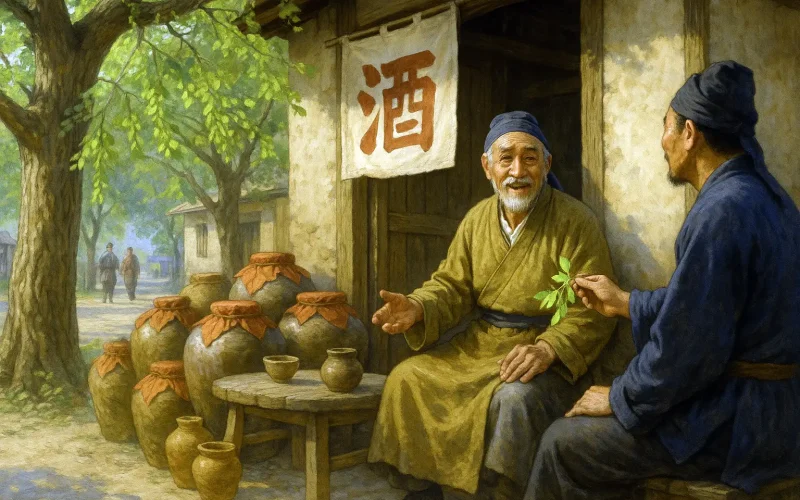
The greybeard, seventy, still deals in wine;
A thousand jars, a hundred urns, at Huamen’s gate in line.

The roadside elm seeds look like cash, you know;
If I pick them to buy your drink, will you let them go?
Original Poem
「戏问花门酒家翁」
岑参
老人七十仍沽酒,千壶百瓮花门口。
道傍榆荚仍似钱,摘来沽酒君肯否?
Interpretation
This poem was composed in the spring of the tenth year of the Tianbao era (751 CE), when Cen Can was serving on the staff of Gao Xianzhi, the Protector-General of Anxi, and made a temporary stop at Liangzhou (present-day Wuwei, Gansu) amid his military duties. The Flower Gate Inn was a known hostelry in Liangzhou at the time, a stopping place for officials and merchants traveling to and from the Western Regions. Unlike most of Cen Can's poems depicting the desert sands and bitter cold of the far frontier, this work captures a rare moment of peace and human warmth amid the intervals of war, revealing a degree of urban prosperity and normalcy along the Hexi Corridor under military protection during the High Tang.
The two characters "戏问" (playfully asking) in the title establish the poem's witty and relaxed tone. This "playfulness" is not frivolity, but a vitality and spiritual ease that the poet maintained amid the harsh life of border defense. It is like a unique window, showing us that Cen Can—the poet who depicted the harshness of the frontier with lines like "火山五月行人少" (On the Volcano in the fifth month, travelers are few)—also cherished and excelled at discovering warmth and humor in ordinary life. This poem thus serves as an important complement to the diverse facets of Cen Can's frontier poetry, and is a rare genre scene in High Tang frontier verse, one whose theme is the humor of everyday urban life.
First Couplet: "老人七十仍沽酒,千壶百瓮花门口。"
Lǎo rén qī shí réng gū jiǔ, qiān hú bǎi wèng huā mén kǒu.
An old man of seventy still sells wine;
A thousand jugs and a hundred jars stand at the Flower Gate.
The opening employs a simple, unadorned sketch to quickly paint a vivid picture of a frontier tavern. "Seventy still selling wine"—the character "仍" (still) subtly carries a hint of admiration for the old man's vigor and reveals the stable, settled atmosphere of doing business here. "A thousand jugs and a hundred jars" is a typical Tang hyperbolic expression, emphasizing abundance rather than exact numbers; the visual accumulation of vessels conveys the tavern's prosperity and relative material plenty, suggesting the trading vitality of this place along the Silk Road and its brief respite from war.
Final Couplet: "道傍榆荚仍似钱,摘来沽酒君肯否?"
Dào bàng yú jiá réng sì qián, zhāi lái gū jiǔ jūn kěn fǒu?
The elm pods by the roadside still look like coins—
If I pick some to buy wine, would you be willing, sir?
This couplet is the soul of the poem, where the poet's fancy is sparked by the scene before him. In late spring, elm trees bear pods that, in their round shape, resemble copper coins, so they were popularly nicknamed "elm money." The poet, responding to the scene before him, connects the object at hand (elm pods) with what he needs (money for wine) through a simile, playfully asking the old man a whimsical question. The character "仍" (still) in "still look like coins" echoes the "仍" of "still sells wine," carrying a delight at discovering a coincidence in life. The questioning tone of "would you be willing, sir?" is witty and charming, elevating an ordinary barter transaction into a moment of poetic and humorous improvisation. Behind this jest lies the poet's sensitivity to and appreciation of the spring scene, as well as his unconstrained, amiable nature in his dealings with the common people of the borderlands.
Overall Appreciation
This seven-character quatrain is a delightfully humorous sketch of frontier urban life, and a natural expression of the High Tang poet's optimistic temperament and zest for life. It dispenses with any profound moral or grand narrative, focusing instead on capturing a lighthearted, whimsical moment, yet within its brief compass it contains a wealth of charm.
Structurally, the poem progresses from concrete to fanciful, from description to inspiration. The first two lines narrate solidly—"An old man of seventy still sells wine; a thousand jugs and a hundred jars stand at the Flower Gate"—sketching the lively scene of the border tavern with simple strokes. The latter two lines suddenly spark a whimsical thought—"The elm pods by the roadside still look like coins; if I pick some to buy wine, would you be willing, sir?"—where the real scene of elm pods prompts the playful question of "using pods as money." The "concrete" of the former provides a credible stage for the "fanciful" of the latter; the "fanciful" of the latter infuses the "concrete" of the former with poetic vitality and charm.
In terms of theme, the poem pivots on the two characters "戏问" (playfully asking). The discovery that "the elm pods by the roadside still look like coins" is the poet's delight in and sensitivity to the wonders of nature; the question "would you be willing, sir?" is his innocence and ease in transforming that delight into a humorous exchange. This "playfulness" is not frivolity, but a love of life and curiosity maintained even amid the weariness of travel. The association between elm pods and copper coins is a simile, a joke, and more—it embodies a creative thinking that immediately "poeticizes" and "emotionalizes" natural objects.
Artistically, the most striking quality of this poem lies in the improvisational poetic association and the fusion of colloquial speech with literati wit. The associative chain from "elm pods" to "coins" to "buying wine" is swift and natural, full of on-the-spot liveliness and improvisational charm. The poem's language is nearly colloquial; especially the question "would you be willing, sir?" is as intimate as a face-to-face conversation. Yet the simile of "elm pods like coins" also carries a literati's refined wit and ingenuity, creating a unique tone that is accessible without being vulgar, and witty without being slick—perfectly suited to the title's "playfully asking."
Artistic Features
- Warmth and Humor in Plain Sketching: The poet uses the simplest brushstrokes to depict the character (the seventy-year-old wine-seller) and scene (a thousand jugs and a hundred jars), without embellishment. Yet by selecting details rich in human feeling and dramatic quality, the scene naturally radiates the warmth of life and a gentle humor.
- Improvisational Poetic Association: The associative chain from "elm pods" to "coins" to "buying wine" is swift and natural, demonstrating the poet's keen observation and agile leaps of thought. This creative method of responding to the scene and taking inspiration from objects gives the poem a lively immediacy and improvisational charm.
- Fusion of Colloquial Speech and Literati Wit: The poem's language is nearly colloquial; especially the question "would you be willing, sir?" is as intimate as a face-to-face conversation. Yet the simile of "elm pods like coins" also carries a literati's refined wit and ingenuity, creating a unique tone that is accessible without being vulgar, and witty without being slick—perfectly suited to the title's "playfully asking."
- The Art of Function Words: The two instances of the character "仍" (still) are masterfully used. "An old man of seventy still sells wine" carries appreciation for resilient life; "the elm pods still look like coins" carries delight at nature's ingenuity. Function words are not "empty"—they create rhythm through repetition and deepen meaning through echo, key to the poem's linguistic concision and richness of implication.
Insights
This fresh and humorous little poem is like a ray of warm sunlight piercing through the dust of the frontier, revealing to us another possibility of poetry and life.
It shows us that poetry is not always tied to the "sublime," the "profound," or the "melancholy"; it can equally inhabit the most ordinary street scenes and the most spontaneous jokes. Amid his military journey, Cen Can could still take notice of an old wine-seller and, upon seeing elm pods, conceive a playful notion—this love and insight into everyday life is one of a poet's most precious qualities. It reminds us that while we rush toward distant goals, we should not lose our ability to perceive and savor the small, beautiful moments around us.
More deeply, this poem reveals a spiritual ease and inclusiveness characteristic of High Tang culture. Against the serious backdrop of national military duty, the poet still possessed the state of mind to joke playfully with a commoner. This coexistence of "solemnity" and "lightness" reflects the period's healthy social mentality and cultural self-confidence—an ability to digest hardship while also appreciating the trivial beauties of life.
Ultimately, this work tells us that true open-mindedness and resilience sometimes manifest precisely in the ability to discover, amid the toil of "a thousand jugs and a hundred jars," the vibrant charm of "elm pods like coins." This capacity to create joy in the ordinary and find poetry in the smallest details is a wisdom of living worth cherishing in any age.
About the poet
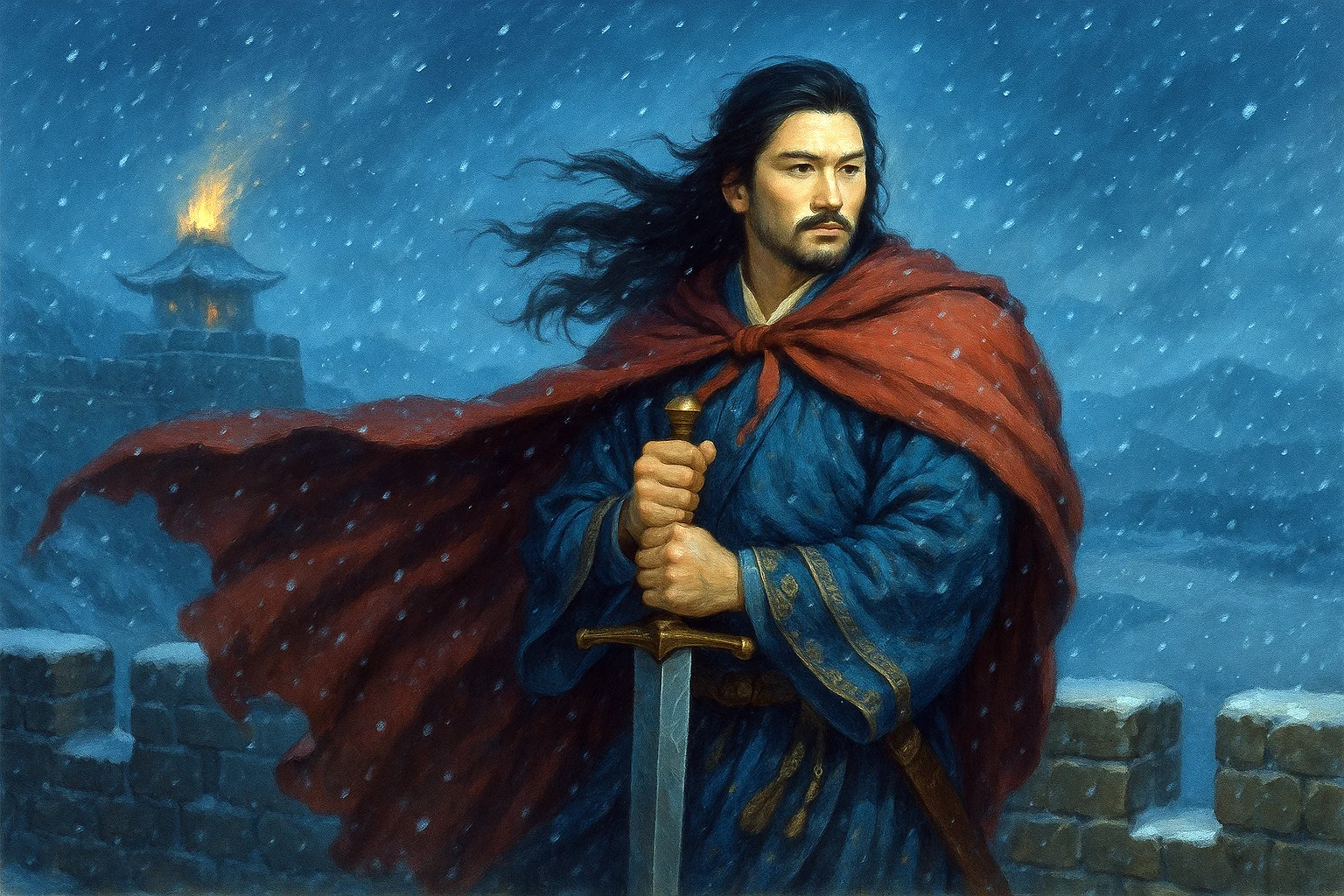
Cen Can(岑参), 715 - 770 AD, was a native of Jingzhou, Hubei Province. He studied at Mt. Songshan when he was young, and later traveled to Beijing, Luoyang and Shuohe. Cen Can was famous for his border poems, in which he wrote about the border scenery and the life of generals in a majestic and unrestrained manner, and together with Gao Shi, he was an outstanding representative of the border poetry school of the Sheng Tang Dynasty.