
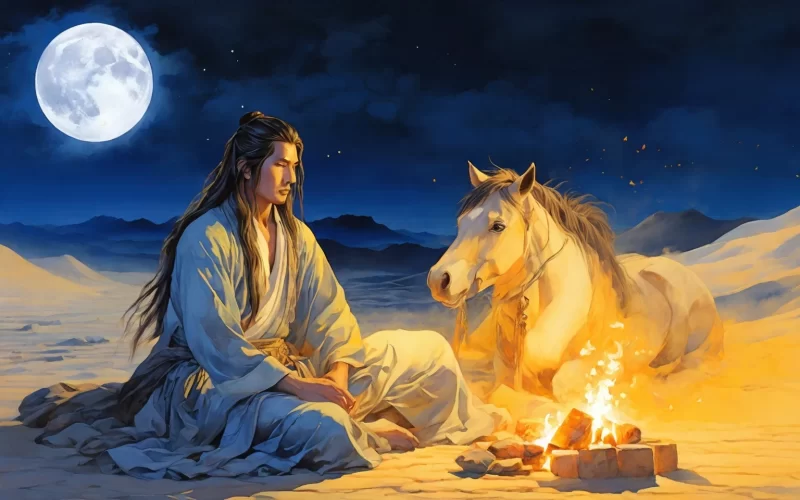
Westward I ride, as if to the sky I'd go;
Two full moons seen since I left home below.
Where to lodge tonight? No place in sight —
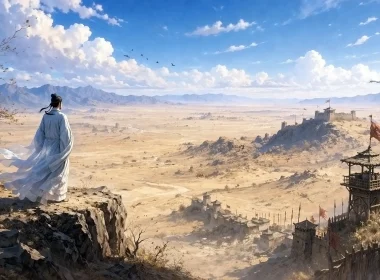
But boundless sand, no soul in the dying light.
Original Poem
「碛中作」
岑参
走马西来欲到天,辞家见月两回圆。
今夜不知何处宿,平沙万里绝人烟。
Interpretation
This poem was composed during Cen Can's first tour of duty beyond the frontier (c. 749–751 CE), and is a representative work of his early frontier poetry. Unlike his later poems from the Beiting period, which contain specific depictions of border scenery and expressions of heroic spirit, this piece captures a moment of vast desolation and existential solitude experienced while traveling through an utterly alien landscape. The poet's choice of "on the desert" (literally "amid the sands") as the setting is itself highly symbolic: the desert is the ultimate form of space, a double "extremity" both geographically and psychologically.
At this time, Cen Can was following the westward march of Gao Xianzhi's Anxi Protectorate headquarters. The length of the journey, the sudden transformation of the environment, and the distance from home all acted upon the poet's sensitive mind, giving birth to this poem that seems plain on the surface but is in fact profoundly desolate and vast in its artistic conception. It is not a record of a specific battle or location, but a poetic purification of the fundamental condition of the "frontier soldier" in infinite time and space—a drifting and questioning that approaches the philosophical. Thus, this poem transcends mere military chronicle to become a portrait of that "desert moment" that every soul traversing the wasteland of life may encounter.
First Couplet: "走马西来欲到天,辞家见月两回圆。"
Zǒu mǎ xī lái yù dào tiān, cí jiā jiàn yuè liǎng huí yuán.
Galloping westward, I feel I am about to reach the sky;
Since leaving home, I have seen the moon twice full.
The opening thrusts the reader into a grand sense of spatial motion. "Galloping westward" is swift, the direction clear; "about to reach the sky" uses extreme hyperbole to transform the visual experience of the horizon into a sublime and solitary psychological experience of touching the very edge of the cosmos. This line not only conveys the vastness of the journey but also the traveler's indomitable will to press forward to the limit. The second line abruptly turns to a delicate reckoning of time: "Since leaving home, I have seen the moon twice full." Using the moon's waxing and waning as a measure of time away from home is a classic device in Chinese poetry for expressing the sorrow of wandering. Two months—not long in a lifetime, yet on this desolate westward road, each full moon is a painful reminder of what has been left behind. The boundlessness of space and the measure of time here create a tremendous tension, where the heroism of the expedition and the quietly growing longing for home are intertwined.
Final Couplet: "今夜不知何处宿,平沙万里绝人烟。"
Jīn yè bù zhī hé chù sù, píng shā wàn lǐ jué rén yān.
Tonight I know not where I shall lodge—
Level sand stretches ten thousand li, with not a trace of human habitation.
This couplet pushes the desolation accumulated in the previous lines toward a real predicament and ultimate solitude. "Tonight I know not where I shall lodge" is a simple question filled with real anxiety, giving voice to the traveler's most fundamental unease—the bewilderment of having no place to rest. The answer, "level sand stretches ten thousand li, with not a trace of human habitation," presents a suffocating image. These eight characters are the most extreme and vivid poetic definition of "desolation." "Level sand ten thousand li" writes of the absolute flatness and infinite extension of space, depriving one of all landmarks and shelter; "not a trace of human habitation" writes of the absolute absence of life. This is not merely a description of the natural environment, but a metaphor for an existential condition: a person cast into an absolute emptiness where no one has gone before, no one will come after, and not even a fellow traveler is present. In all the vastness of heaven and earth, there is not a single place to lodge.
Overall Appreciation
This seven-character quatrain is one of the most desolate and linguistically condensed works in Cen Can's frontier poetry. It is like a massive ink painting executed with the simplest strokes, constructing an artistic world of profound philosophical tension between the movement of "galloping" and the stillness of "level sand," between the vastness of "about to reach the sky" and the constriction of "no place to lodge."
Structurally, the poem exhibits a remarkable balance between "expansion outward" and "contraction inward." The first two lines are outward-looking: the gaze is cast to the edge of heaven, the thoughts trace back to the full moon, stretching both time and space to their limits. The last two lines suddenly contract inward: focusing on the specific point of "tonight," settling on the concrete existential question of "where to lodge." Yet the answer to this concrete question is the absolute emptiness of "ten thousand li with not a trace of human habitation." Thus, the insignificance of the individual and the vastness of the universe, the predicament of the moment and the boundlessness of eternity, collide violently at this moment, producing a stirring artistic effect.
In terms of theme, the poem pivots on the character "绝" (absolute / without). The "绝" of "not a trace of human habitation" is the severance of all traces of life, the absence of sound and warmth, the stripping away of all connection between the self and the world. The poet does not write of loneliness, yet he captures the ultimate form of loneliness: not simply being without companions, but the disappearance of even the possibility of "human presence." This character "绝" is both a statement of geographical reality and a naming of an existential state—a person cast between heaven and earth, with neither origin nor destination.
Artistically, the most striking quality of this poem lies in the extreme contrast of time and space and the abstract purification of imagery. Spatially, from the vertical sublimity of "about to reach the sky" to the horizontal boundlessness of "level sand ten thousand li"; temporally, from the cyclical time of "twice full" to the immediate time of "tonight." This multi-dimensional accumulation of extremes concentrates and intensifies the typical experience of frontier travel to its utmost. The poem's visual elements are reduced to the barest minimum: only the galloping horse, the full moon, and the level sand. There are no specific mountains, rivers, or vegetation—only the most basic geometric forms (circles, planes) and trajectories (westward movement). This highly purified, almost abstract visual language paradoxically attains greater symbolic power and universality, lifting the poem's conception beyond a specific scene to reach the universal human state of mind when confronted with the primal vastness of the cosmos.
Artistic Features
- Extreme Treatment of Temporal-Spatial Contrast: The poem employs extreme writing in both temporal and spatial dimensions. Spatially, from the vertical sublimity of "about to reach the sky" to the horizontal boundlessness of "level sand ten thousand li"; temporally, from the cyclical time of "twice full" to the immediate time of "tonight." This multi-dimensional accumulation of extremes concentrates and intensifies the typical experience of frontier travel to its utmost.
- Abstract Purification of Imagery: The poem's visual elements are extraordinarily sparse: galloping horse, full moon, level sand. There are no specific mountains, rivers, or vegetation—only the most basic geometric forms (circle, levelness) and trajectories (westward movement). This highly purified, almost abstract visual language paradoxically attains greater symbolic power and universality, lifting the poem's conception beyond a specific scene to reach the universal human state of mind when confronted with the primal vastness of the cosmos.
- Internal Construction of Emotional Tension: The poem's emotional power does not rely on direct expression of feeling but emerges naturally through the juxtaposition of images and situations. The active advance of "galloping" versus the passive bewilderment of "knowing not where to lodge"; the human warmth implicit in "seeing the moon twice full" versus the cosmic coldness of "not a trace of human habitation." These internal contradictions and contrasts form the skeleton and sinew of the poem's emotion.
- Sparse, Vigorous Language and Majestic Atmosphere: The poem contains not a single obscure word nor any ornamental phrasing, composed entirely of the simplest characters. Yet phrases like "about to reach the sky" and "not a trace of human habitation," through their extremity of imagery and boldness of combination, achieve the effect of expressing complexity through simplicity and finding wonder in plainness, opening up a vast and majestic artistic atmosphere within a brief compass—this is the linguistic power of High Tang frontier poetry.
Insights
This poem is like a frontier ink painting executed with the simplest strokes, offering us another understanding of "walking" and "existence." It tells us that those "desert moments" in life—instances when the road ahead is unclear, the way back is indistinct, and one looks around to find no one—are not unique to frontier poetry, but are experiences that anyone venturing into unfamiliar territory and facing unknown challenges may encounter.
The poem's question, "Tonight I know not where I shall lodge," is an eternal query that transcends the specific context of a military journey. It asks: in the infinite expanse of time and space, where can one truly find rest? Cen Can does not provide an answer; he simply presents us with the image of "level sand ten thousand li with not a trace of human habitation," and then leaves us to bear that emptiness for ourselves. Yet the very act of writing the poem is itself a response: when one recognizes that one is in a place "without a trace of human habitation," one can at least give voice to it in language, fix it in poetry. This act of speaking is itself a confirmation of existence.
Ultimately, this work shows us that true courage lies not in ignoring desolation, but in choosing, after recognizing that "level sand stretches ten thousand li with not a trace of human habitation," still to "gallop westward." The "galloping horse" carries not only Cen Can himself, but all those who continue to move forward across the wasteland—their path ahead offers no certain destination, the road behind grows increasingly indistinct, yet still they walk. This, perhaps, is the most fundamental condition of the "frontier soldier," and the truest portrait of every traveler.
About the poet
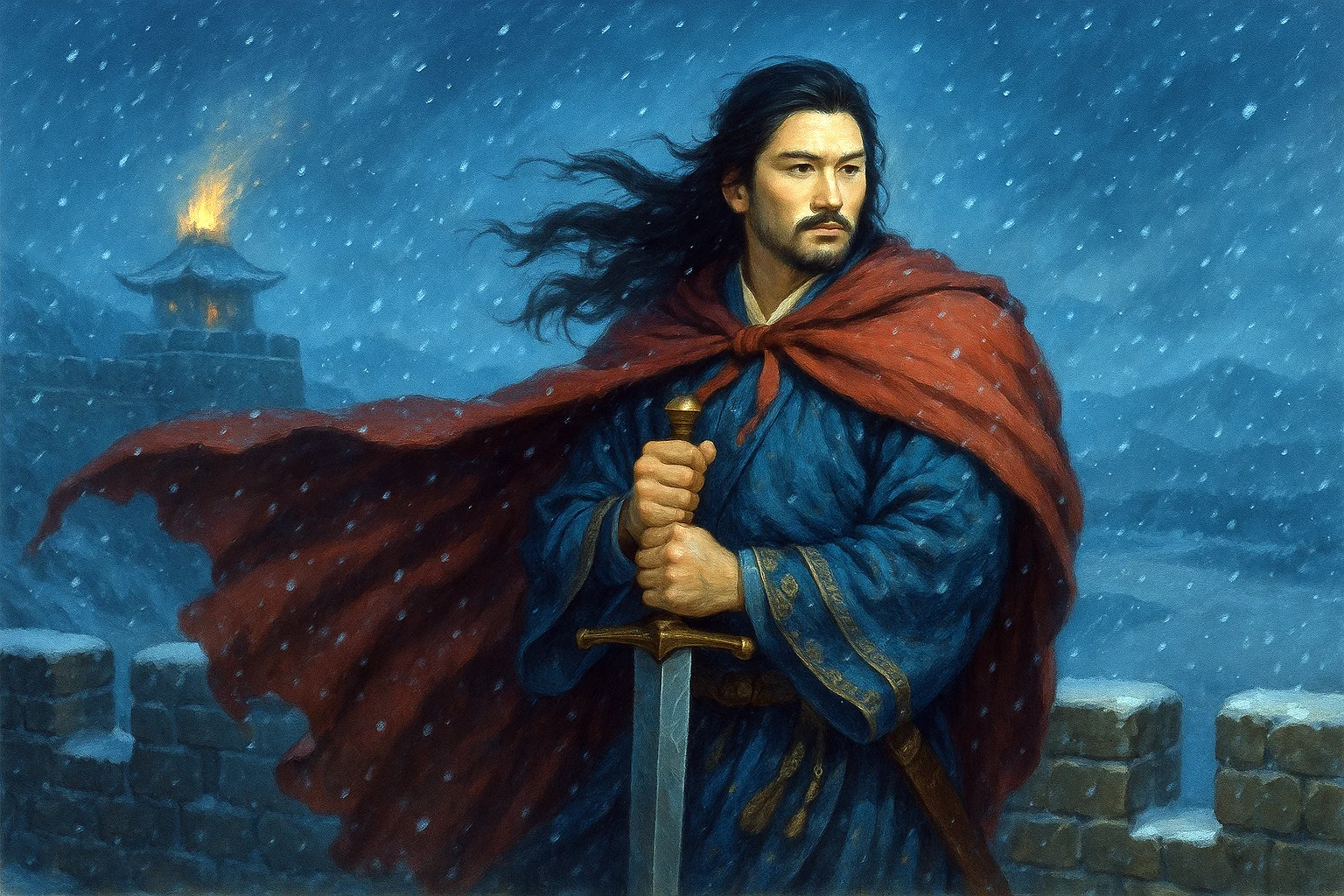
Cen Can(岑参), 715 - 770 AD, was a native of Jingzhou, Hubei Province. He studied at Mt. Songshan when he was young, and later traveled to Beijing, Luoyang and Shuohe. Cen Can was famous for his border poems, in which he wrote about the border scenery and the life of generals in a majestic and unrestrained manner, and together with Gao Shi, he was an outstanding representative of the border poetry school of the Sheng Tang Dynasty.