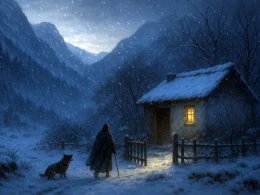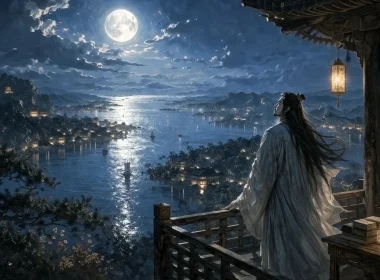
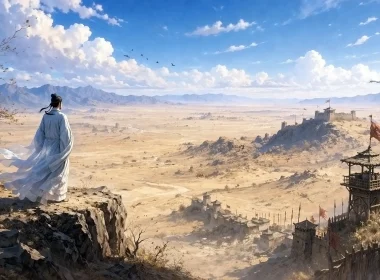
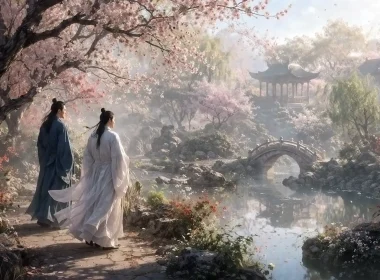
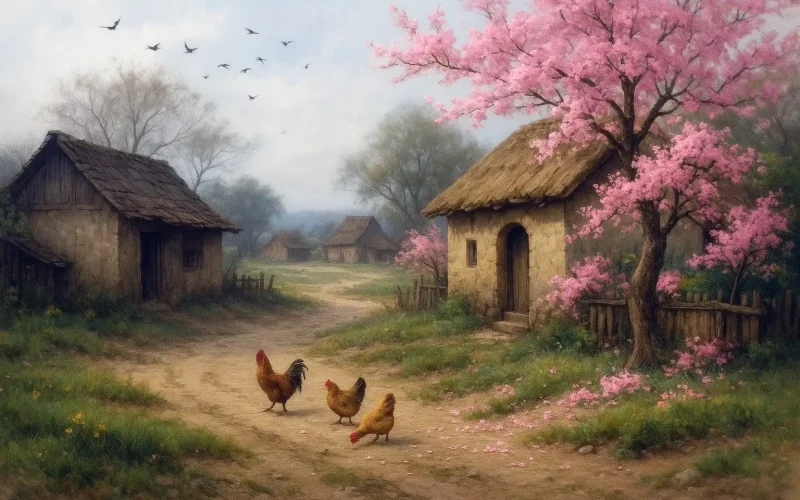
Crows swirl in the dusk above the desolate Garden of Liang;
Only two or three dwellings break the bleakness, stretching far and wide.

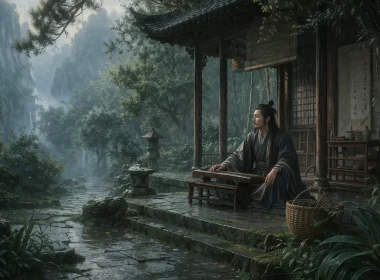
The trees in the courtyard do not know the people have all passed away;
Yet with the coming of spring, they put forth the same flowers as before, side by side.
Original Poem
「山房春事 · 其二」
岑参
梁园日暮乱飞鸦,极目萧条三两家。
庭树不知人去尽,春来还发旧时花。
Interpretation
This poem is the second of Cen Can's Spring in the Mountain Cottage series. Judging from its profound reflections on rise and decline and its mature artistry, it likely belongs to the poet's later years, after he had gained deeper experience and contemplation. The "Liang Garden" mentioned in the poem refers to the Eastern Garden built by Liu Wu, Prince Xiao of Liang in the Western Han (its site is in present-day Shangqiu, Henan), once a flourishing gathering place where literary figures such as Zou Yang, Mei Cheng, and Sima Xiangru assembled to compose and recite poetry. Passing by this site, Cen Can witnessed the desolation of the garden and projected his own reflections onto this historical relic laden with rich cultural memory.
This work is not merely a spontaneous expression triggered by a scene, but a silent dialogue with the spirits of history, a poetic exploration of the relationship between "time" and "existence." The poet's choice of the "spring scene" perspective is particularly ingenious: spring is a season of burgeoning life and renewal, yet the poet uses it to reflect upon the "dead stillness" and "forgottenness" of a human cultural relic. This collision between the seasonal attribute and the theme of nostalgic reflection generates powerful irony and tension, opening up for this short poem, beyond Cen Can's bold and unrestrained frontier verse, another realm of profound introspection and historical philosophizing.
First Couplet: "梁园日暮乱飞鸦,极目萧条三两家。"
Liáng yuán rì mù luàn fēi yā, jí mù xiāo tiáo sān liǎng jiā.
At dusk over the Liang Garden, crows fly in disorder;
Gazing into the distance, I see only two or three scattered households in the desolation.
The opening establishes the poem's desolate and lonely tone. The poet chooses "dusk"—that time of dim light most apt to stir melancholy—as his entry point. "Crows flying in disorder" is a dynamic clamor, yet it only accentuates the dead stillness and desolation of the ground below; the cawing of crows in traditional culture is often associated with decay and ill omen. "Gazing into the distance" is the poet's active visual search and emotional judgment, while "two or three households" specifies the degree of this "desolation"—the former glory of "three thousand guests on the terrace" has now shrunk to an extreme of quiet emptiness. These two lines, from looking upward (flying crows) to looking level (scattered households), sketch with vigorous strokes a wasteland scene of a historical relic fading and being marginalized by time.
Final Couplet: "庭树不知人去尽,春来还发旧时花。"
Tíng shù bù zhī rén qù jìn, chūn lái hái fā jiù shí huā.
The garden trees do not know that all the people have gone;
When spring comes, they still bloom with the flowers of bygone days.
This couplet is the soul of the poem, the eruption of emotion and philosophical reflection. The poet narrows his gaze from the broad background to a specific living being—the garden trees. Endowing the trees with the subjective experience of "not knowing" is a stroke of personified genius. This "not knowing" gives voice to the fundamental contradiction between the eternal, indifferent regularity of nature and the fleeting, fragile nature of human affairs. The trees follow the immutable biological rhythm: "when spring comes, they still bloom with the flowers of bygone days"—year after year, the flowers are the same, which in itself is a form of life's tenacity and beauty. Yet against the specific backdrop of "all the people have gone," this "still blooming" becomes glaring and even cruel. It becomes a heartless comparison, reminding one of the disappearance of glory and the ruthlessness of history. The three characters "旧时花" (flowers of bygone days) are especially poignant, connecting the past (bygone days) with the present (still blooming), yet through the "unchanging" flowers, highlighting the "complete change" of human affairs.
Overall Appreciation
This seven-character quatrain is a model of "expressing emotion through scenery and seeing the large in the small" in classical Chinese nostalgic poetry. Throughout the poem, only scenery is described; not a single word directly offers commentary or emotion. Yet the profound reflections on historical rise and decline, and the complex recognition of the power of time, are completely infused into every description of the scene and every contrast of imagery.
Structurally, the poem creates multiple layers of contrast: "outside-inside," "movement-stillness," "knowing-not knowing." The first two lines provide a general rendering of the external environment—dusk, flying crows, scattered households—with a broad view and a decayed atmosphere. The last two lines offer a close-up of internal detail—garden trees, spring blossoms—with a fixed composition and vivid imagery. The crows' "disorderly flight" is noise amid desolation; the trees' "still blooming" is silence amid unawareness. But the greatest tension lies between what humans "know" (the poet, gazing into the distance, knows full well that people have gone and the place is empty) and what things "do not know" (the garden trees still bloom). It is precisely this cognitive chasm that etches with penetrating force the poet's—and every nostalgic thinker's—clear-eyed yet utterly solitary historical loneliness. The four lines move from outside to inside, from movement to stillness, from scene to reflection, layer upon layer, in seamless unity.
In terms of theme, the poem pivots on the two characters "不知" (do not know). The garden trees' "not knowing" is nature's indifference to human affairs, and also nature's transcendence of them. The tree does not know that people have departed, just as spring does not know that the Liang Garden has fallen into ruin—it simply follows its own rhythm, blooming, shedding, and blooming again. This "not knowing" is both a cruel indifference and a simple eternity. And the poet's "knowing" is precisely the reverse of this "not knowing": he knows that all the people have gone, he knows that past glory has become history, he knows that these "flowers of bygone days" bloom upon ruins. The fissure between this "knowing" and "not knowing" is the poem's deepest tragedy—the one who sees clearly is destined for solitude, while the one who forgets finds peace.
Artistically, the most striking quality of this poem lies in the subtle technique of expressing emotion through scenery and grief through contrast. The poet juxtaposes "spring's arrival" (a season of vitality) with "desolation" (a scene of lifelessness), contrasts "still blooming with the flowers of bygone days" (nature's abundance) with "all the people have gone" (humanity's decline), and uses the trees' "not knowing" to offset the poet's "knowing fully." This layered contrast deepens the sense of grief with each turn, producing a profoundly moving artistic power. The three characters "旧时花" (flowers of bygone days) superimpose the past and the present at the same spatial point, creating a dizzying, piercing sense of history "ghostily" reappearing before one's eyes. Not a single word directly expresses sorrow, yet every word is an annotation of sorrow—this is the ultimate embodiment of classical Chinese poetry's aesthetic of "silence speaks louder than words."
Artistic Features
- The Ultimate Use of Contrast: The poem's core artistic device lies in multiple layers of contrast. The "arrival of spring" (a season of vitality) contrasts with "desolation" (a scene of lifelessness); "still blooming with the flowers of bygone days" (nature's abundance) contrasts with "all the people have gone" (humanity's decline); the trees' "not knowing" (nature's obliviousness) contrasts with the poet's "knowing fully" (the vicissitudes of human affairs). This layered contrast deepens the sense of grief with each turn, producing a profoundly moving artistic power.
- Classical Imagery Deepened: "Dusk," "flying crows," "garden trees," and "spring blossoms" are all common images in classical poetry. Cen Can's brilliance lies not only in combining these images but in endowing them with new relationships and depth. In particular, juxtaposing "garden trees" with "all the people have gone," and letting "spring blossoms" bloom within the context of "bygone days," gives these public images a fresh, individualized tragic beauty within a specific framework of historical reflection.
- Exquisite Compression of Time and Space: In just four lines, the poem achieves a masterful folding of time and space. "Dusk" is present time; "bygone days" is past time. "Liang Garden" is a specific space; "two or three households" and "garden trees" are details within that space. Using the present desolation (space) as a fulcrum, the poem awakens memories of past glory (time), and through the phenomenon of "still blooming with the flowers of bygone days," superimposes past and present at the same spatial point, creating a dizzying, piercing sense of history "ghostily" reappearing before one's eyes.
- Restrained and Subtle Expression of Emotion: The poet utters not a single sigh, sheds not a single tear; all surging emotion is suppressed beneath calm descriptive strokes. Yet the "gazing into the distance," the unspoken lament of "not knowing," and the helplessness of "still blooming"—these subtle signals of emotion are more powerful than overt expression. This aesthetic of "silence speaks louder than words" is one of classical Chinese poetry's most moving qualities.
Insights
This work is like an amber that has crystallized a tear of time, offering insights both profound and far-reaching. First, it reveals the eternal struggle between historical memory and nature's forgetfulness. Humans build cities and gardens, longing to leave marks of civilization and resist the passage of time (the "Liang Garden" is a symbol of this effort). Yet time's ultimate ally is often nature: plants are without feeling, flourishing and withering year after year; through their own cycles of life, they silently cover over and digest the stories of human rise and fall ("the garden trees do not know that all the people have gone"). This prompts us to consider what true eternity is—is it the material relics engraved in stone and metal, or the collective memory transmitted through the spirit?
Second, it displays a clear-eyed and poetic attitude of mourning in the face of historical ruins. Cen Can does not sink into cheap sentimentality nor engage in hollow moralizing. He simply "gazes into the distance," then records what he sees. This act of gazing itself is a form of respect and remembrance for history. The garden trees that "still bloom with the flowers of bygone days" are, in the poet's eyes, not only a heartless contrast but also a messenger connecting past and present. In the form of flowers, they remind us year after year of what once was. This reveals that true commemoration sometimes lies not in rebuilding the appearance of prosperity, but in learning to recognize, amid desolation, those "flowers of bygone days" that still speak with tenacity.
Ultimately, this poem elevates personal sentiment to a universal philosophical height. Each of us may have a "Liang Garden" in our lives—a faded prosperity, a dispersed gathering, a "bygone time" that is no more. When we look back in the "dusk" of our hearts and see the desolation of "all the people have gone," we may also find that the "garden trees" of memory still "bloom with the flowers of bygone days" within us. This poem teaches us how to gaze with poetic eyes at the immense tension between loss and preservation, and in that gaze, to find a place for our own melancholy, attaining a transcendent aesthetic understanding and emotional catharsis.
About the poet
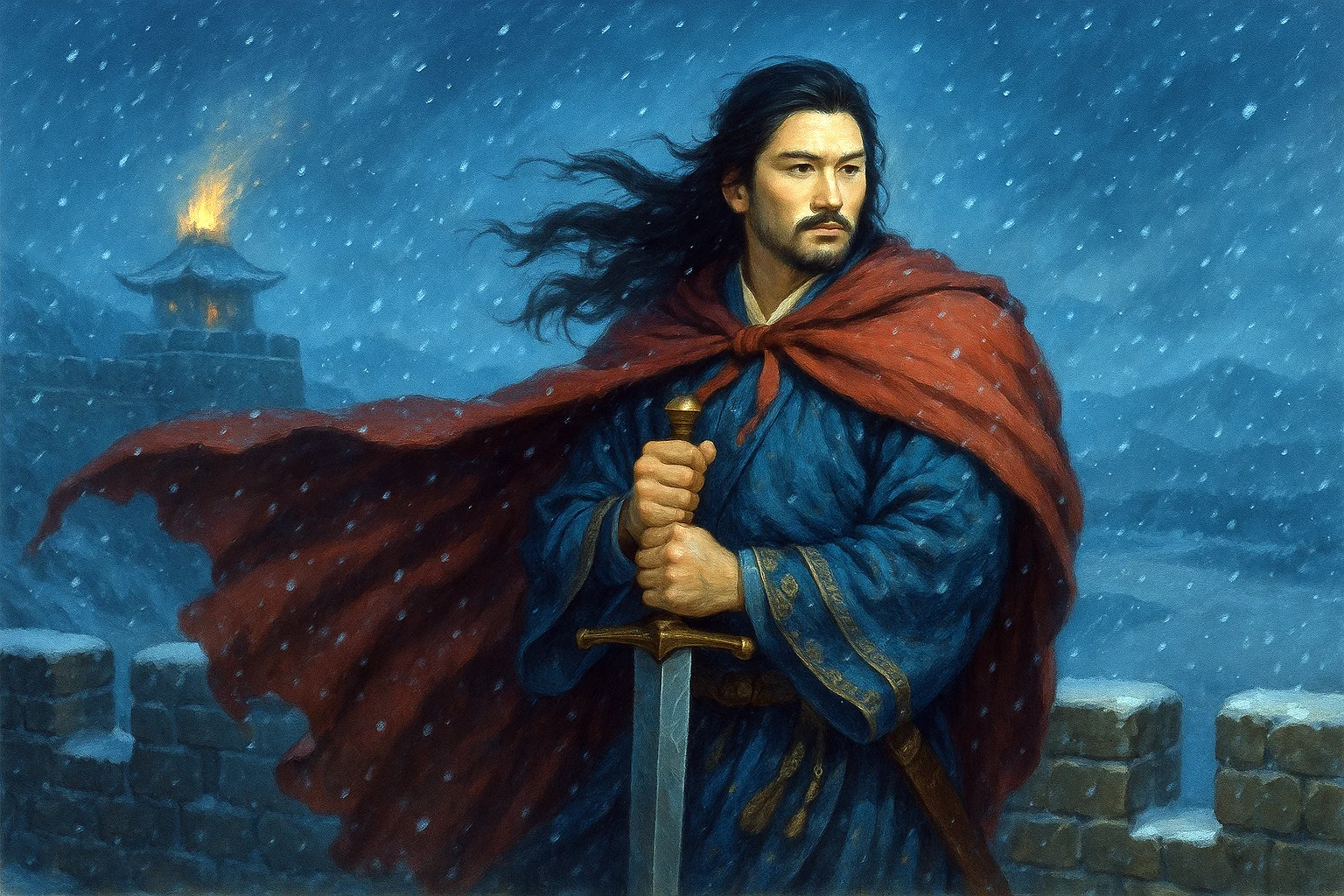
Cen Can(岑参), 715 - 770 AD, was a native of Jingzhou, Hubei Province. He studied at Mt. Songshan when he was young, and later traveled to Beijing, Luoyang and Shuohe. Cen Can was famous for his border poems, in which he wrote about the border scenery and the life of generals in a majestic and unrestrained manner, and together with Gao Shi, he was an outstanding representative of the border poetry school of the Sheng Tang Dynasty.