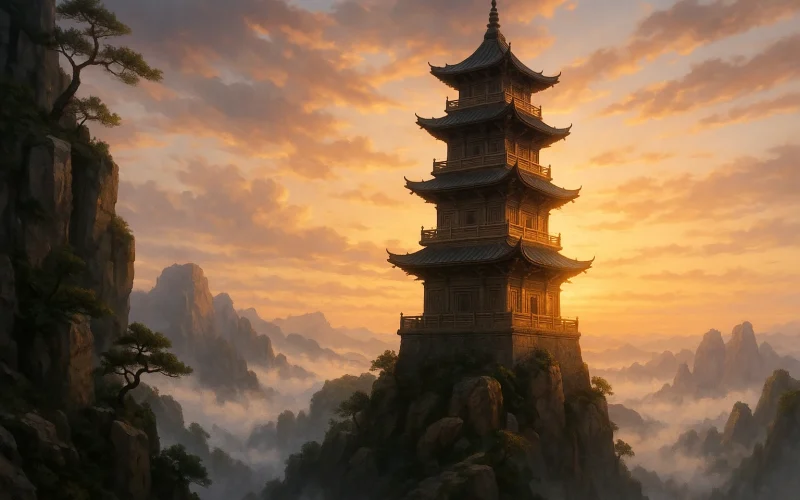
The pagoda, rising abruptly from earth,
Reaches to the very Palace of Heaven….
Climbing, we seem to have left the world behind us,
With the steps we look down on hung from space.

It overtops a holy land
And can only have been built by toil of the spirit.
Its four sides darken the bright sun,
Its seven stories cut the grey clouds;
Birds fly down beyond our sight,
And the rapid wind below our hearing;
Mountain-ranges, toward the east,
Appear to be curving and flowing like rivers;
Far green locust-trees line broad roads
Toward clustered palaces and mansions;
Colours of autumn, out of the west,
Enter advancing through the city;
And northward there lie, in five graveyards,
Calm forever under dewy green grass,
Those who know life's final meaning
Which all humankind must learn.

…Henceforth I put my official hat aside.
To find the Eternal Way is the only happiness.
Original Poem
「与高适薛据登慈恩寺浮图」
岑参
塔势如涌出,孤高耸天宫。
登临出世界,磴道盘虚空。
突兀压神州,峥嵘如鬼工。
四角碍白日,七层摩苍穹。
下窥指高鸟,俯听闻惊风。
连山若波涛,奔凑如朝东。
青槐夹驰道,宫馆何玲珑。
秋色从西来,苍然满关中。
五陵北原上,万古青蒙蒙。
净理了可悟,胜因夙所宗。
誓将挂冠去,觉道资无穷。
Interpretation
This poem was composed in the autumn of the eleventh year of the Tianbao era (752 CE). That year, Cen Can had returned to Chang'an from his service on the staff of Gao Xianzhi, Protector-General of Anxi, and joined friends including Du Fu, Gao Shi, Xue Ju, and Chu Guangxi on an excursion to Ci'en Temple, where they ascended the Great Wild Goose Pagoda (then known as the "Ci'en Temple Pagoda"). This gathering stands as a landmark event in High Tang poetry—all five participants composed poems that have been transmitted to posterity, and Cen Can's piece is particularly remarkable. Having undergone his first expedition beyond the frontier, Cen Can had witnessed the solitary smoke of the desert and returned with a transformed vision. His return to Chang'an coincided with a moment when the Tang dynasty, at its apparent zenith, harbored hidden anxieties. The ascent was not merely a literati pastime but became a spiritual survey and a soul-searching inquiry. The poem displays both the expansive spirit common to High Tang poets and Cen Can's unique imaginative power and spatial perception, cultivated through his Western Regions experience.
Section One: "塔势如涌出,孤高耸天宫。登临出世界,磴道盘虚空。"
Tǎ shì rú yǒng chū, gū gāo sǒng tiān gōng. Dēng lín chū shì jiè, dèng dào pán xū kōng.
The pagoda's form surges forth as if from the earth's core,
Lonely and lofty, it pierces the celestial palace.
Ascending, one steps beyond the mundane world;
The stone steps spiral through the void.
The opening bursts forth with a dynamic and powerful image. The two characters "涌出" (surge forth) are the most spirited—endowing a static structure with the force of nature, resonating with the Buddhist cosmology of "creation from nothing," and imbuing the pagoda's birth with sacred significance. "Lonely and lofty, it pierces the celestial palace" directs the gaze to the vertical limit, establishing the poem's spatial foundation. The next two lines shift to the experience of ascent: "stepping beyond the mundane world" conveys both physical transcendence and a spiritual suspension from earthly attachments; "the stone steps spiral through the void" vividly captures the visual illusion of the staircase appearing and disappearing amid the clouds, where reality and emptiness merge, laying the groundwork for the fantastical descriptions that follow.
Section Two: "突兀压神州,峥嵘如鬼工。四角碍白日,七层摩苍穹。下窥指高鸟,俯听闻惊风。连山若波涛,奔凑如朝东。"
Tū wù yā shén zhōu, zhēng róng rú guǐ gōng. Sì jiǎo ài bái rì, qī céng mó cāng qióng. Xià kuī zhǐ gāo niǎo, fǔ tīng wén jīng fēng. Lián shān ruò bō tāo, bēn còu rú cháo dōng.
Its abrupt height presses down upon the Middle Kingdom,
Its jagged splendor seems the work of ghosts.
Its four corners block the white sun's passage;
Its seven stories brush against the vault of heaven.
Looking down, I point to birds flying high above;
Bending low, I hear the startling wind roar.
The linked mountains are like surging waves,
Rushing and converging as if flowing eastward.
This section constructs a surreal visual system through multiple layers of hyperbole. "Pressing down upon the Middle Kingdom" endows the pagoda with absolute spatial majesty; "the work of ghosts" marvels at its construction beyond human capacity—together, they elevate the pagoda to a mythical dimension. "Blocking the white sun" and "brushing against the vault of heaven" achieve a breakthrough in spatial scale through the pagoda's conflict with (blocking sunlight) and contact with (brushing the sky) celestial phenomena. The downward gaze from the summit carries philosophical weight: "pointing to birds flying high" subverts the conventional "bird's-eye view," restructuring the order of heaven and earth; "hearing the startling wind" highlights the unique sensory experience of great height. Gazing into the distance, the poet transforms static geography into the surging vitality of eastward-flowing waves with the dynamic images of "surging waves" and "rushing and converging," reflecting both nature's eternal rhythms and the vigorous spirit of the High Tang era.
Section Three: "青槐夹驰道,宫馆何玲珑。秋色从西来,苍然满关中。五陵北原上,万古青蒙蒙。"
Qīng huái jiā chí dào, gōng guǎn hé líng lóng. Qiū sè cóng xī lái, cāng rán mǎn guān zhōng. Wǔ líng běi yuán shàng, wàn gǔ qīng méng méng.
Green locusts line the imperial avenue;
Palaces and pavilions appear so delicate and exquisite.
Autumn colors come from the west,
Spreading their grey-green haze throughout the Guanzhong plain.
On the northern heights, the Five Mounds stand,
Vast and dim through ten thousand ages.
The gaze turns from nature to human culture, creating a dialectical interplay between the micro and macro. Viewed from above, Chang'an's orderly grid (green locusts lining the imperial avenue) and imperial majesty (delicate palaces) take on a model-like, almost surreal beauty, hinting at the relativity of human power on a cosmic scale. "Autumn colors come from the west" is a stroke of genius: the season is given direction and momentum, actively sweeping across the earth—both a realistic depiction (the west is the direction from which autumn arrives) and an echo of the poet's own trajectory returning from the Western Regions, while also infusing the grey-green tones with a sense of time's passage. The section concludes with the historical image of the "Five Mounds" (the Han imperial tombs), and "vast and dim through ten thousand ages" superimposes a profound temporal dimension upon the spatial vastness, bringing the moment of personal ascent into confluence with the river of history and leading to the spiritual awakening that follows.
Section Four: "净理了可悟,胜因夙所宗。誓将挂冠去,觉道资无穷。"
Jìng lǐ liǎo kě wù, shèng yīn sù suǒ zōng. Shì jiāng guà guān qù, jué dào zī wú qióng.
The pure principles can now be clearly understood;
The excellent causes have long been my devotion.
I swear I will hang up my official cap and leave—
The path of awakening offers inexhaustible sustenance.
After the spatial ascent and historical survey, the poet completes his return to the inner self. "Pure principles" corresponds to the pagoda's religious essence and the clarity of mind achieved through elevation; "excellent causes" points to personal karmic connections, suggesting that this awakening is no accident. The final vow to "hang up my official cap and leave" is not a retreat from the world born of disillusionment, but an active renunciation of worldly values and a pursuit of higher spiritual dimensions ("the path of awakening") after contemplation on a cosmic scale ("stepping beyond the mundane world," "pressing down upon the Middle Kingdom") and a historical perspective ("vast and dim through ten thousand ages"). This is both the necessary sublimation of the pagoda-climbing experience and a reflection of the complex personality of the High Tang scholar-official—nourished by Confucianism, Buddhism, and Daoism, they aspired both to worldly achievement and spiritual transcendence.
Overall Appreciation
This poem is a paradigm of Cen Can's "love for the extraordinary" style. Its artistic achievement lies not merely in depicting the pagoda's magnificence but in creating a multi-dimensional coordinate system of spiritual ascent. The poem's structure spirals upward like the pagoda itself, forming a fourfold sublimation: from physical height (piercing the celestial palace, brushing the vault of heaven) to psychological experience (stepping beyond the mundane world, hearing the startling wind); from spatial conquest to temporal contemplation (vast and dim through ten thousand ages); and finally to spiritual awakening (understanding the pure principles, drawing from the path of awakening). The poet fuses the magnificent imagination cultivated through his Western Regions experience with the Central Plains tradition of ascent, transforming the pagoda into both a fulcrum for measuring the relationships between heaven, earth, humanity, and the divine, and a medium connecting the mundane world to the far shore.
Structurally, the poem progresses from external to internal, from object to mind. The first section describes the pagoda's astonishing form and the transcendence of ascent—the climbing of physical space. The second section pushes the limits of spatial perception with the extreme height and the view from above. The third section turns from nature to human culture, infusing spatial experience with temporal reflection through the momentum of "autumn colors coming from the west" and the vastness of "vast and dim through ten thousand ages." The fourth section turns inward, concluding with the spiritual illumination of "the pure principles can now be clearly understood." The four sections move from pagoda to heaven, from heaven to earth, from earth to history, and from history to mind—layer upon layer, in seamless unity.
In terms of theme, the poem pivots on the resonance between "stepping beyond the mundane world" and "hanging up my official cap and leaving." The "stepping beyond" of "stepping beyond the mundane world" is transcendence in physical height, and even more so a temporary liberation from worldly attachments on a spiritual level. The "leaving" of "I swear I will hang up my official cap and leave" is the realization and fulfillment of that transcendent feeling in practical life. Between this "stepping beyond" and "leaving" lies the complex spiritual structure of the High Tang literati: they aspired to worldly achievement while maintaining a perspective of scrutiny and transcendence over the worldly at a higher spiritual dimension. The moment of ascent granted them the vision of "stepping beyond the mundane world"; upon returning to the ground, this vision was transformed into a re-evaluation of life's path.
Artistically, the most striking quality of this poem lies in the unique technique of writing stillness through motion and controlling the ordinary through the extraordinary. The poet writes the static pagoda as "surging forth," the fixed staircase as "spiraling through the void," the mountains as "surging waves," and the season as "coming from the west"—all static things are endowed with dynamic life. This technique of infusing the Central Plains tradition of ascent with the fantastical imagination born of Western Regions experience gives the poem, beyond its expansive spirit, an added layer of surreal splendor. And the line "autumn colors come from the west," through its synesthetic expression, fuses vision, touch, and kinesthesia into one of the poem's most distinctive images.
Artistic Features
- Dynamic Spatial Rhetoric: The poem is filled with verbs such as "surging forth," "spiraling," "pressing," "brushing," "looking down," "hearing," and "rushing," transforming static ascent into a continuous experience of spatial motion, embodying Cen Can's characteristic "dynamic spectacle."
- The Dialectic of Hyperbolic Scale: On one hand, the pagoda's immensity is pushed to extremes ("pressing down upon the Middle Kingdom," "blocking the white sun"); on the other, the smallness of things is highlighted ("pointing to birds," "delicate palaces"). The contrast in scale creates visual shock and philosophical reflection.
- Synesthetic Sensory Writing: Visual (vast and dim), auditory (startling wind), tactile (brushing), and kinesthetic (rushing) senses intertwine, creating a holographic experience of elevation.
- Layered Structure of Time and Space: Spatially, the poem completes a vertical traversal from "earth—pagoda—heaven"; temporally, it achieves a historical perspective from "present autumn colors—vast and dim through ten thousand ages"; ultimately, it leads to the eternal pursuit of "hanging up the cap and following the path of awakening."
Insights
This work reveals three forms of transcendence achieved through the act of climbing: first, transcendence of physical height, providing a new coordinate from which to view the world; second, transcendence of psychological perspective, allowing everyday trivialities to be reoriented within a grander framework; third, transcendence of spiritual dimension, exploring the ultimate meaning of life within the tension between "worldly engagement" and "transcendence." Cen Can's pagoda ascent reminds us that true "height" is never beneath our feet, but lies in the recognition and surpassing of our own limitations achieved with each ascent. When the poet moves from the physical limit of "blocking the white sun" to the spiritual awakening of "understanding the pure principles," that staircase "spiraling through the void" becomes an eternal metaphor for all who seek spiritual elevation. In the fragmented and flattened landscape of contemporary life, this capacity to achieve integrative contemplation through "climbing high" is perhaps more precious than ever.
Poem translator
Kiang Kanghu
About the poet
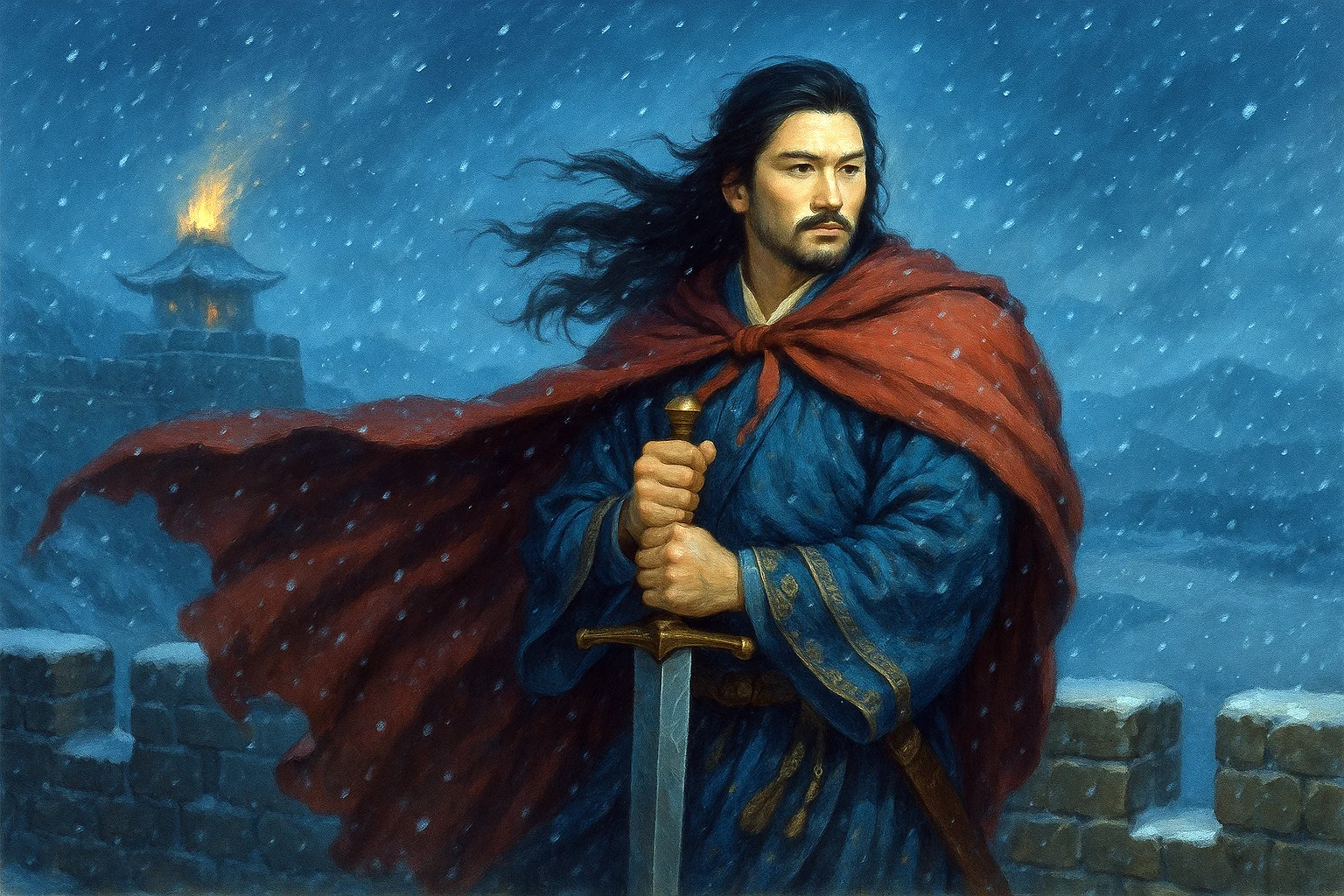
Cen Can(岑参), 715 - 770 AD, was a native of Jingzhou, Hubei Province. He studied at Mt. Songshan when he was young, and later traveled to Beijing, Luoyang and Shuohe. Cen Can was famous for his border poems, in which he wrote about the border scenery and the life of generals in a majestic and unrestrained manner, and together with Gao Shi, he was an outstanding representative of the border poetry school of the Sheng Tang Dynasty.