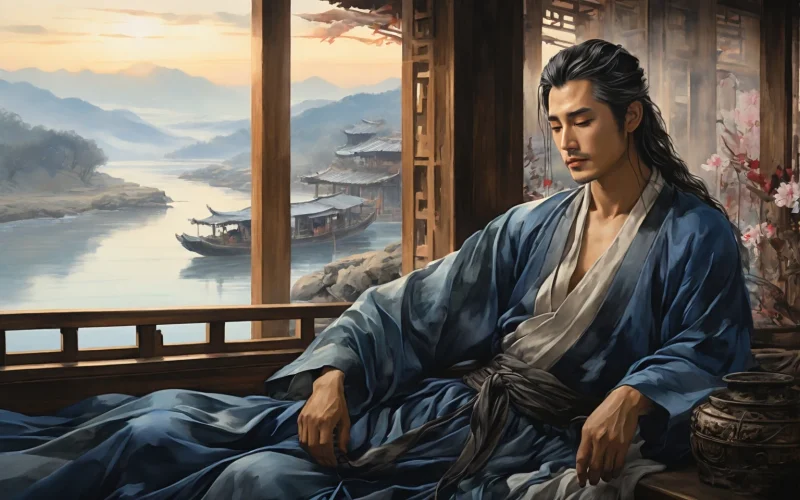

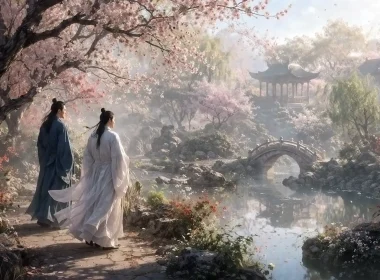
The east and west are joined by boundless water clear;
On the endless spring river goes the boat you steer.
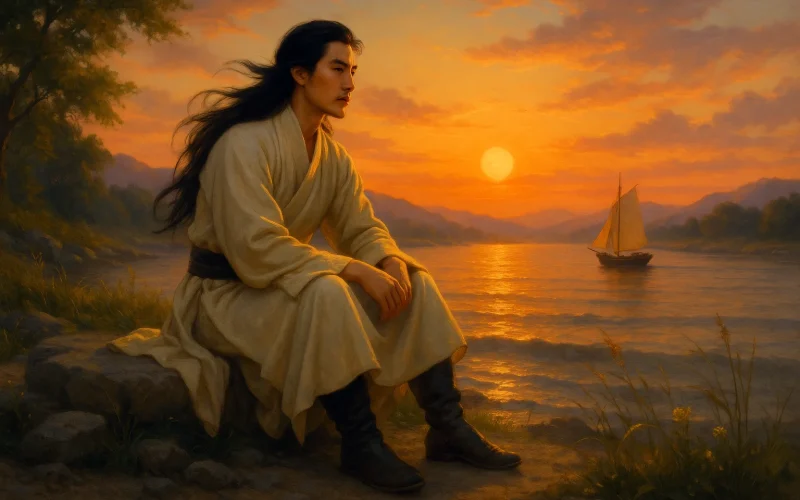
Where will you moor it at sunset far, far apart?
Can I not gaze far, far away with broken heart!
Original Poem
「送杜十四之江南」
孟浩然
荆吴相接水为乡,君去春江正渺茫。
日暮征帆何处泊?天涯一望断人肠。
Interpretation
This poem was composed during Meng Haoran's travels in the Jing-Chu region. In the Tang Dynasty, transportation relied primarily on waterways. Frequent boat traffic between the Jing region (modern Hubei) and Wu region (modern Jiangsu) along the Yangtze River fostered a regional culture centered on water and a boat-based life of impermanent wandering. Du Fourteen, named Du Huang, was ranked fourteenth in his family. Addressing someone by their generational ranking within the family was an affectionate practice among literati of the time, indicating a close friendship between the two. By this time, Meng Haoran had already experienced disappointment in the imperial examinations and no longer harbored illusions about an official career. He was spending the remainder of his life wandering through landscapes and befriending people from all quarters. It was precisely this life experience that gave him an unusual understanding of parting—knowing deeply that wandering is the normal state of life, yet treasuring each specific separation all the more.
When he saw off his friend by the riverside in spring, the vast, unpredictable river waters before his eyes were both a real scene and a profound worry in his heart about his friend's unknown path ahead and the uncertainty of their reunion. This poem was composed on the occasion of this farewell. Using the spring river as its backdrop and the lone sail as its focus, it elevates personal sorrow at parting into a universal lament on the wandering world-path and the impermanent human condition. The poem's language is extremely plain, yet its emotion is extremely deep. It is a model of "using scenery to convey emotion, using simplicity to master complexity" among farewell poems of the High Tang.
First Couplet: "荆吴相接水为乡,君去春江正渺茫。"
Jīng Wú xiāng jiē shuǐ wéi xiāng, jūn qù chūn jiāng zhèng miǎománg.
The lands of Jing and Wu connect, sharing water as their home; you leave as spring rivers swell, vast and misty.
The poem opens with a geographical reference. "荆吴相接" (The lands of Jing and Wu connect) points out the two regions are linked by waterways, subtly containing the consolation of "though parting, still connected." The three characters "水为乡" (sharing water as their home) state that this land depends on rivers for livelihood, but also metaphorically imply the desolate undertone of a life spent wandering, with everywhere and nowhere as home. The next line, "春江正渺茫" (as spring rivers swell, vast and misty), shifts from concrete to abstract—the river's vastness is the actual scene before the eyes, yet it is also the materialization of the poet's inner sorrow at parting. The two characters "渺茫" (vast and misty) describe both the natural landscape where water and sky merge, stretching endlessly, and even more so the uncertain state of mind regarding the unknown road ahead and the uncertain reunion. Within this couplet, geographical closeness and the distance of the future, the concreteness of the river flow and the abstraction of sorrowful thought, intertwine to form a deep, foundational tone of parting-sadness.
Final Couplet: "日暮征帆何处泊?天涯一望断人肠。"
Rì mù zhēng fān hé chù pō? Tiānyá yī wàng duàn rén cháng.
At sunset, where will your journeying sail find mooring? Gazing to the world's edge, heart-wrenching, is the view.
This couplet shifts from describing scenery to expressing emotion, striking the heart directly with a concerned question. "日暮征帆何处泊?" (At sunset, where will your journeying sail find mooring?) is the most genuine, instinctive worry of the one seeing off—dusk approaches, on what shall the lone boat rely? This question is not merely a practical inquiry but an externalization of feeling: what has nowhere to moor is not just the friend's boat, but also the poet's concern, which finds no place to rest. The next line, "天涯一望断人肠" (Gazing to the world's edge, heart-wrenching, is the view), uses "一望" (gazing) to describe the limit of sight and "断人肠" (heart-wrenching) to describe the reach of emotion. When even the horizon's end is not far enough for the gaze to break, the depth of longing and weight of sorrow have reached their peak. This line gathers the parting sorrow accumulated in the preceding text and confines it within five characters, ending abruptly, with lingering sorrow unceasing.
Holistic Appreciation
This is an excellent work among Meng Haoran's farewell poems. The entire poem consists of four lines and twenty-eight characters. Using the spring river as its backdrop and the lone sail as its focus, it fuses geographical space, natural scenery, and the emotions of parting into one, revealing the poet's profound understanding of life's wandering and the impermanence of meetings and separations.
Structurally, the poem presents a progressive sequence from concrete to abstract, from scene to emotion. The first couplet uses "The lands of Jing and Wu connect" to describe geographical closeness, and "as spring rivers swell, vast and misty" to describe the distance of the future—an opening and closing of space. The final couplet uses "At sunset" to describe the lateness of time, and "heart-wrenching" to describe the peak of emotion—a surging of feeling. Between the four lines, the poem moves from distant to near, from outer to inner, progressing layer by layer, forming a seamless whole.
In terms of conception, the poem's core lies in the resonance between "渺茫" (vast and misty) and "何处泊" (where will... find mooring?). That "as spring rivers swell, vast and misty" is a natural scene no one can change, yet also a metaphor for life's impermanence. That "where will... find mooring?" is the concern of the one seeing off for the friend, yet also the shared inquiry of every person facing the vast, uncertain path of the world. This character "泊" (moor) signifies both the mooring of a boat and the settling of a heart—the friend has not yet found a place to moor, and where, then, does the poet's own heart find its mooring?
Artistically, the poem's most moving aspect lies in its light-touch technique of "using plain language to write deep sorrow, using concern to harbor deep feeling." The poet does not directly write how reluctant he is, only posing the ordinary question, "where will... find mooring?"; he does not directly express grief, only gently concluding with the three characters "断人肠" (heart-wrenching). Yet it is precisely this seemingly plain diction that fully expresses the deepest emotion of the one seeing off—the more restrained, the deeper; the more one does not speak of sorrow, the more unbearable the sorrow becomes.
Artistic Merits
- Using Scenery to Convey Emotion, Creating Vast Imagery: Beginning with "The lands of Jing and Wu connect" and "as spring rivers swell, vast and misty", it sets a vast, boundless spatial backdrop for the parting emotion, allowing personal feeling to be set against the breath of heaven and earth.
- Interweaving Concrete and Abstract, Emotion Within Question: "At sunset, where will your journeying sail find mooring?" is both a practical question and an externalization of emotion. Imagery like the lone sail, sunset, and world's edge intertwines concrete and abstract, evoking the atmosphere of uncertain wandering on a journey.
- Concise, Pure Language, Deep and Sincere Emotion: The entire poem contains no difficult words, no risky lines; it is as fresh and natural as spoken language. It progresses gradually from plain narration to the emotional peak of "heart-wrenching," the language plain yet rich in flavor.
- Using "泊" (moor) as the Focal Point, Layered Progression: From the spatial boundlessness of "as spring rivers swell, vast and misty" to the concerned inquiry of "where will... find mooring?" to the emotional outburst of "heart-wrenching." One character leads to one realm, one realm deepens into the next.
Insights
This farewell poem transcends ordinary sorrow at parting, touching upon the universal human experiences of concern and loneliness. A friend's distant journey leaves behind not only longing but also endless concern for the safety of their travels and the vicissitudes of their life. The poet's question, "where will... find mooring?" is an eternal inquiry—asking not only where the boat will moor, but also: in this vast human world, on this long journey, how should the heart find its anchorage?
On life's journey, we are both the ones seeing off and, ultimately, the ones becoming the journeying sail. This poem reminds us: to cherish the deep affection of those who, at sunset, worry for us, "where will... find mooring?"; and to let us learn, when traveling far in loneliness, to know how to look back at that gaze from the world's edge. True friendship is a spiritual connection that geographical separation cannot sever; it is a warm regard that, even as the river flows vast and misty and dusk grows deep, can still traverse time and space to see each other.
This poem writes of a farewell in the High Tang, yet it allows everyone who has seen off a friend by a spring river or questioned their own destination at a crossroads in life to find resonance within it. The boundlessness of "as spring rivers swell, vast and misty" is the endless scene before the eyes of every person seeing someone off. The loneliness of "journeying sail" at sunset is the shared silhouette of every wanderer. The concluding three characters, "heart-wrenching," are the shared sentiment of all heart-rending partings throughout the ages. This is the vitality of poetry: it writes of Meng Haoran's farewell to Du Huang, but one reads of people of all eras—those who watch from the water's edge, and those who gaze from the world's edge.
Poem translator
Xu Yuanchong (许渊冲)
About the poet
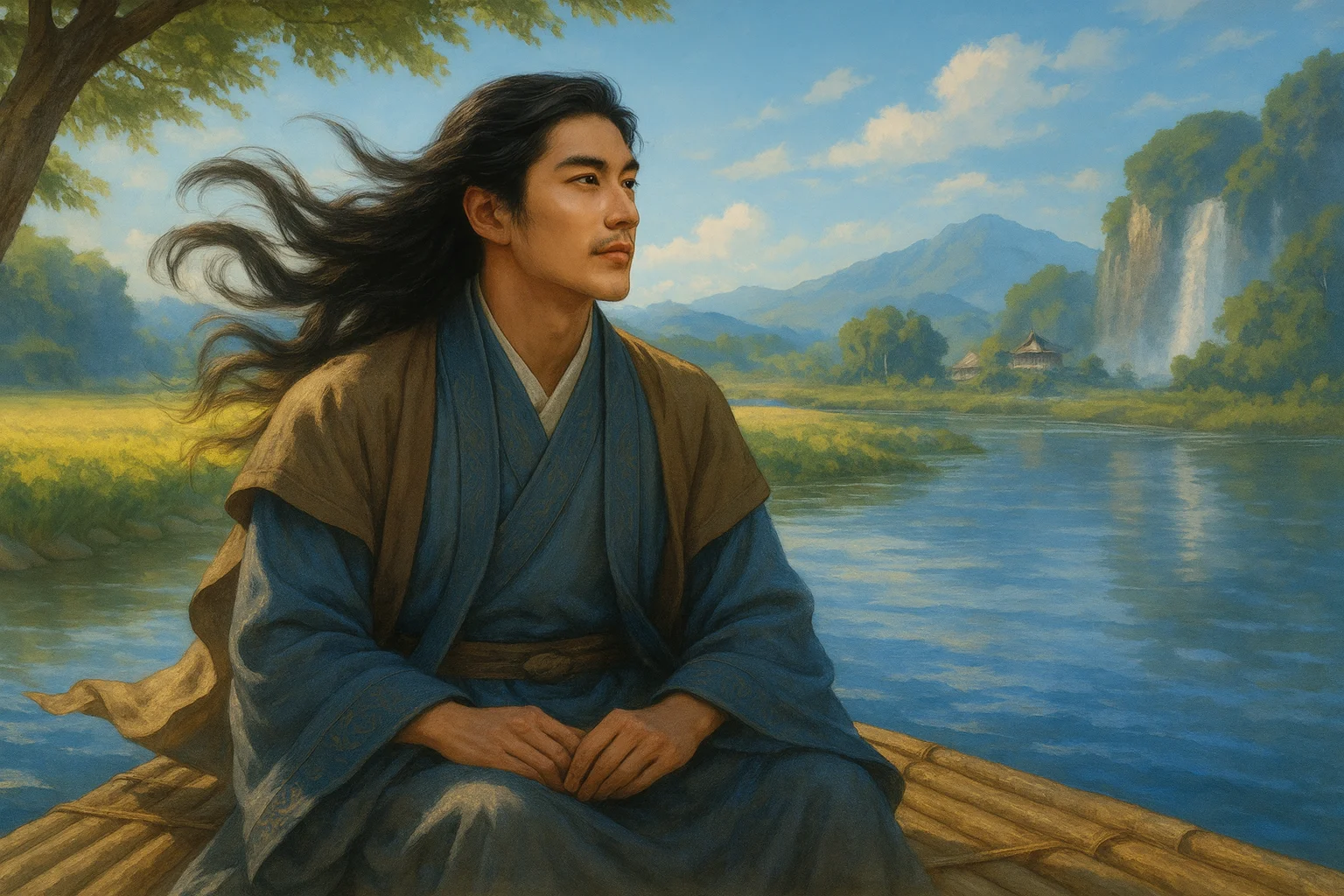
Meng Haoran (孟浩然 689 - 740), a native of Xiangyang, Hubei Province, was a renowned landscape and pastoral poet of the Tang Dynasty. In his early years, he lived in seclusion on Mount Lumen, reading for his own pleasure. At the age of forty, he traveled to the capital to take the jinshi examination but failed. Thereafter, he remained a commoner for the rest of his life, roaming the Wu and Yue regions and finding contentment in poetry and wine. He excelled in five-character verse, with a style that is light and natural, often depicting the pleasures of landscapes and reclusion. He is regarded as a representative of the High Tang landscape and pastoral poetry school. His collected works, Meng Haoran Ji, have been handed down, and his poetry exerted a profound influence on later hermitic poetic traditions.