



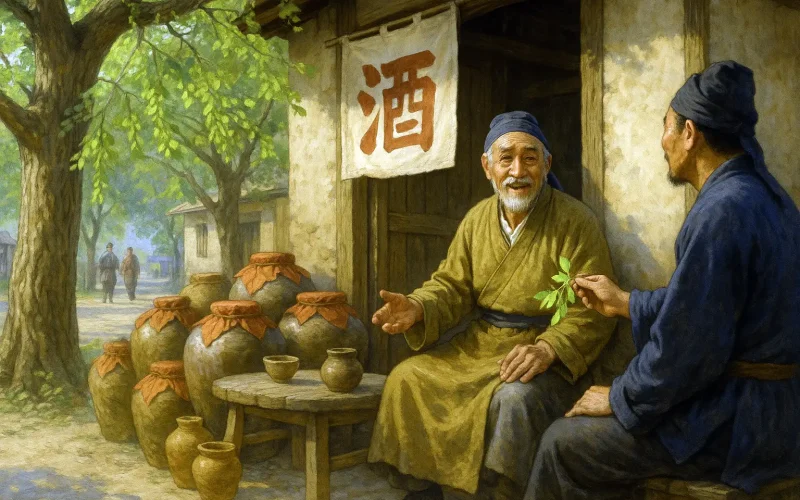
The greybeard, seventy, still deals in wine;
A thousand jars, a hundred urns, at Huamen’s gate in line.

The roadside elm seeds look like cash, you know;
If I pick them to buy your drink, will you let them go?
Original Poem
「戏问花门酒家翁」
岑参
老人七十仍沽酒,千壶百瓮花门口。
道傍榆荚仍似钱,摘来沽酒君肯否?
Interpretation
This poem was composed in the spring of 751 AD, during the Tianbao reign of Emperor Xuanzong. At the time, Cen Shen was serving on the staff of Gao Xianzhi, Military Governor of Anxi. Amidst the urgency of his military duties, he was briefly stationed in Liangzhou (modern Wuwei, Gansu). "Flowery-Gate Tower" was the name of a guesthouse in Liangzhou, a stopping point for officials and merchants traveling to and from the Western Regions. Unlike the majority of Cen Shen's frontier poetry, which depicts the harshness of distant deserts and the bitter struggles of campaign life, this work captures a rare moment of peace and worldly bustle found in the interstices of war. It reveals a glimpse of the market-town prosperity and semblance of normal life that existed under military protection along the Hexi Corridor during the High Tang.
The words "A Jesting Inquiry" in the title establish the poem's playful and lighthearted tone. This "jest" is not frivolity, but rather a reflection of the poet's undiminished zest for life and his mental spaciousness, maintained even amidst the rigors of frontier service. It acts as a unique window, allowing us to see that Cen Shen—the poet famous for lines like "In the Flaming Mountains' fifth month, wayfarers are few"—also cherished and possessed the keen eye to discover warmth and humor in the commonplace. This poem thus stands as an important supplement showcasing the diverse facets of Cen Shen's frontier oeuvre, and a rare example within High Tang frontier poetry of a genre sketch centered on urban wit and local color.
First Couplet: "老人七十仍沽酒,千壶百瓮花门口。"
Lǎorén qīshí réng gū jiǔ, qiān hú bǎi wèng huāmén kǒu.
A man of seventy years still vends his wine; / By Flowery-Gate, a thousand flagons, hundred urns align.
The opening couplet swiftly sketches a vivid tavern scene in the frontier town, using concise, descriptive language. "Seventy and still vends wine"—the word "still" subtly conveys a note of admiration for the old man's enduring vigor, while also suggesting the accustomed, stable nature of commerce in this place. "A thousand flagons, hundred urns" employs a classic Tang hyperbolic mode, not meant as a precise count but to visually evoke, with an overwhelming sense of accumulation, the tavern's thriving business and the relative plenty of goods. It hints at the trade vitality and temporary peace enjoyed by this Silk Road outpost.
Second Couplet: "道傍榆荚仍似钱,摘来沽酒君肯否?"
Dào páng yú jiá réng sì qián, zhāi lái gū jiǔ jūn kěn fǒu?
Elm-pods by the roadside still look like strings of coin. / If I plucked these to buy your wine, my lord, would you be so kind?
This couplet is the soul of the poem, where the poet, inspired by the scene, gives flight to a whimsical fancy. In late spring, elm trees bear pods whose round shape resembles strings of cash, hence their playful folk name "elm coins." Moved by the sight, the poet connects the object before his eyes (elm pods) with his need (payment for wine) through metaphor, posing a delightfully naive, jesting question to the old man. The word "still" in "still look like strings of coin" echoes the "still" in the previous line ("still vends his wine"), carrying a sense of delighted discovery in this coincidence of nature. The phrasing of the question, "would you be so kind?", is witty and playful, instantly transforming a mundane commercial transaction into a spontaneous lyrical moment brimming with poetry and humor. Beneath this joke lies the poet's sensitivity to the spring scene and his easy-going, informal rapport with the common folk of the frontier.
Holistic Appreciation
This heptasyllabic quatrain is a charmingly witty sketch of frontier-town life and a natural expression of the optimistic spirit and delight in life's details characteristic of the High Tang poet. It forgoes any profound allegory or grand narrative, focusing instead on capturing a single, lighthearted, humorous instant. Yet, within its brief frame, it holds a wealth of charm.
The poem employs a simple structure of "setting the scene, then a sudden flight of fancy." The first two lines provide solid, descriptive narration, the last two pose a spirited, imaginative question. The "reality" of the former provides a believable stage for the "fancy" of the latter; the "fancy" of the latter, in turn, infuses the "reality" of the former with vibrant poetic life. The association from "elm-pods" to "coin" to "buying wine" is a metaphor, a joke, and, more importantly, an example of a creative mindset that instantly "poeticizes" and "emotionalizes" natural imagery. It showcases the poet's ability to maintain a fresh perception of the world and an instinct for artistic transformation, even while on campaign.
The poem's language is colloquial, as if the poet were chatting and joking with the old man and the reader. Yet, it is full of verve and invites contemplation. It proves that frontier poetry can possess not only the solemn grandeur of "Desert winds have dimmed the sunlight's sheen" but also the levity of "If I plucked these to buy your wine… would you be so kind?" This diversity is a testament to the robust vitality of High Tang verse.
Artistic Merits
- Warmth and Humor in Descriptive Simplicity: The poet outlines the character (the septuagenarian vintner) and the scene (the rows of vessels) with the simplest of brushstrokes, unadorned. Yet, by selecting details rich in human warmth and gentle comedy, the picture naturally fills with the warm breath of daily existence and a subtle, good-natured humor.
- Spontaneous Poetic Association: The mental leap from "elm-pods" to "coin" to "buying wine" is swift and natural, demonstrating the poet's keen observation and agile wit. This creative method of being moved by the immediate scene and inspired by the object at hand lends the poem a lively sense of spontaneity and playful delight.
- Fusion of Colloquial Ease and Literati Wit: The poem's language is almost vernacular, especially the phrasing of the question, which feels as familiar as face-to-face banter. However, the metaphor of "elm-pods like coin" carries a literati's clever conceit, creating a unique tone that is popular without being vulgar, witty without becoming glib—perfectly matching the title's "jesting."
- The Pivotal Role of Function Words: The use of the two instances of "still" is masterful. "A man of seventy years still vends his wine" expresses admiration for resilient vitality; "Elm-pods… still look like strings of coin" conveys a sense of delighted recognition. These function words are far from empty; they create rhythm through repetition and deepen the playful spirit through resonance, key to the poem's concise yet richly suggestive language.
Insights
This fresh, humorous little poem, like a warm sunbeam piercing the frontier's dust, reveals another possibility for poetry and for life.
It reminds us that poetic sentiment is not solely the province of the "sublime," the "profound," or the "melancholy"; it can also dwell within the most ordinary rhythms of daily life and the most casual of jests. Even amidst military travels, Cen Shen could still notice an old tavernkeeper and be inspired to whimsy by a cluster of elm pods. This affection for and insight into the everyday is among a poet's most precious gifts. It cautions us, in our rush toward grand objectives, not to lose the capacity to perceive and savor the small, beautiful moments around us.
Furthermore, the poem displays a rare spiritual ease and inclusivity within High Tang culture. While bearing the weighty duties of the frontier, the poet could still retain the mental space for playful banter with a commoner. This coexistence of the "serious" and the "lighthearted" reflects a certain healthy social temperament and cultural confidence of that era—an ability to withstand hardship while also appreciating life's minor joys.
Ultimately, this work suggests that true resilience and breadth of spirit are sometimes shown precisely in the ability to find the lively charm of "elm-pods like coin" amidst the laborious reality of "a thousand flagons, hundred urns." This capacity to create joy in the ordinary and discover poetry in the incidental is a wisdom for living, valuable in any age.
About the poet
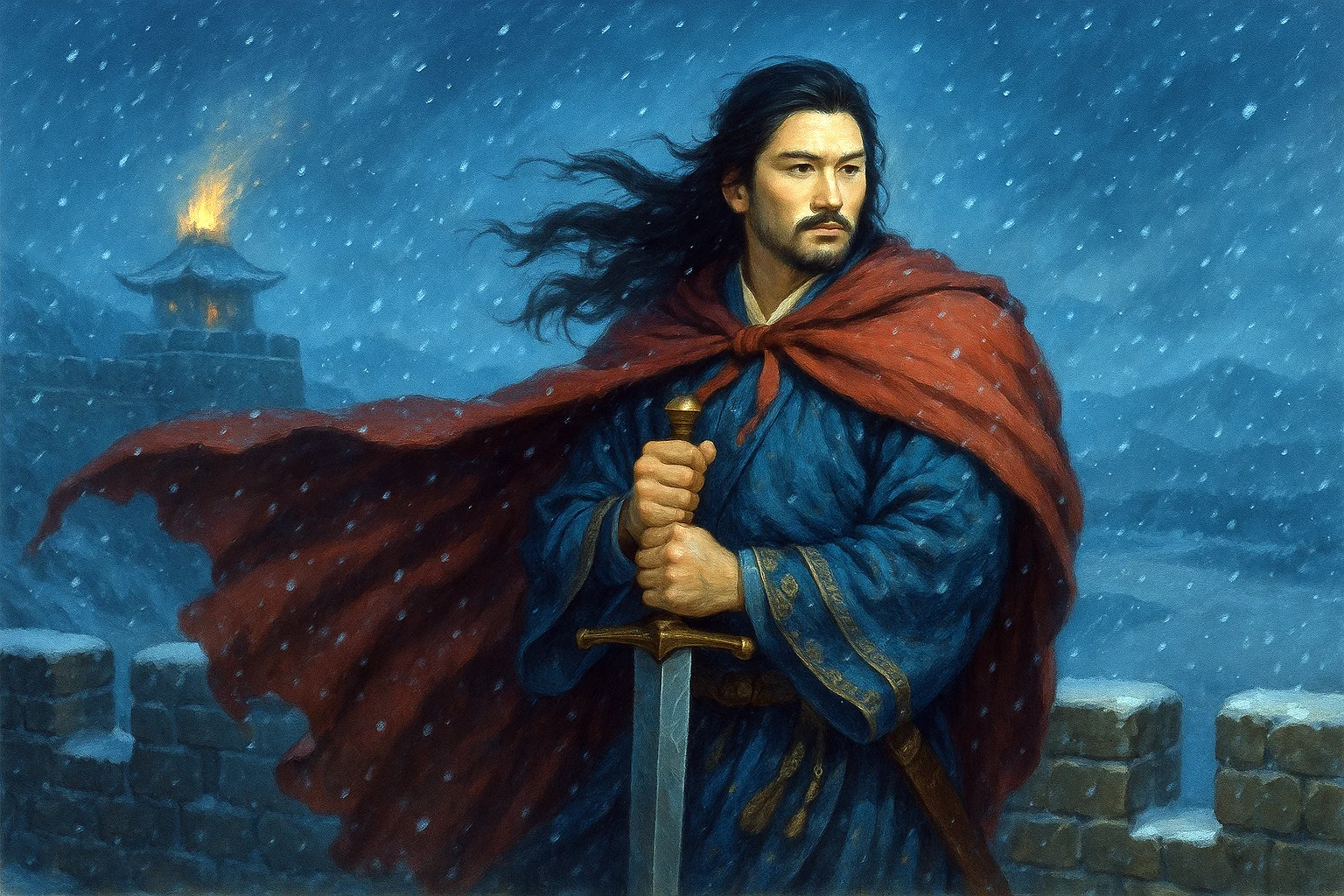
Cen Can(岑参), 715 - 770 AD, was a native of Jingzhou, Hubei Province. He studied at Mt. Songshan when he was young, and later traveled to Beijing, Luoyang and Shuohe. Cen Can was famous for his border poems, in which he wrote about the border scenery and the life of generals in a majestic and unrestrained manner, and together with Gao Shi, he was an outstanding representative of the border poetry school of the Sheng Tang Dynasty.