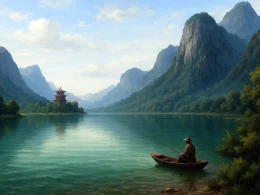



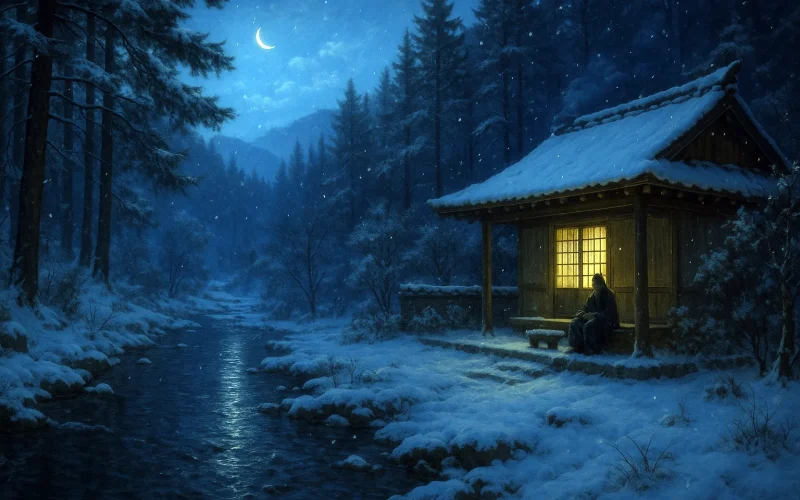
I petition no more at the north palace-gate.
...To this tumble-down hut on Zhongnan Mountain
I was banished for my blunders, by a wise ruler.
I have been sick so long I see none of my friends.

My white hairs hasten my decline,
Like pale beams ending the old year.
Therefore I lie awake and ponder
On the pine-shadowed moonlight in my empty window.
Original Poem
「岁暮归南山」
孟浩然
北阙休上书,南山归敝庐。
不才明主弃,多病故人疏。
白发催年老,青阳逼岁除。
永怀愁不寐,松月夜窗墟。
Interpretation
This poem was composed in 728 CE, when Meng Haoran was forty years old. This was a crucially important, and also the most cruel, year of his life. In this year, Meng Haoran traveled to Chang'an to sit for the Jinshi metropolitan examination. It was his first and only formal attempt at the examinations. At that time, he had already lived in reclusion in Xiangyang for many years, gaining fame for his landscape poetry and associating with literary giants like Wang Wei and Zhang Jiuling. Outwardly, he appeared a hermit content amidst forests and springs. But the forty-year-old Meng Haoran had never truly let go of his expectations for fame and achievement. Tang scholars considered forty the "age when a man should be strong for service" (as stated in the Book of Rites). This year, he felt he could wait no longer. Yet, he failed.
This failure struck Meng Haoran far more deeply than we might imagine. He was not an obscure, unknown candidate—he was already famous in literary circles, exchanging poetry and wine with prominent officials. He was not without connections—Wang Wei and Zhang Jiuling could have provided introductions. He was not even without talent—later generations would pair him with Wang Wei as "Wang-Meng," the pinnacle of High Tang landscape and pastoral poetry. Yet, he failed. More poignantly, the New Book of Tang records a famous anecdote: One day, Wang Wei privately invited Meng Haoran into the inner government offices. Suddenly, Emperor Xuanzong arrived. Meng Haoran, startled, hid under the bed. Wang Wei dared not conceal this and truthfully reported. The emperor ordered Meng to come out and asked to hear his poetry. Meng Haoran then recited this poem. Upon reaching the line, "A man of no talent, abandoned by a sage lord," the emperor was displeased and said, "You did not seek office, and I never abandoned you. Why falsely accuse me?" He then ordered him sent away. This story may not be factual, but it spread widely because it precisely captures the feeling this poem gave contemporaries: This is not humility, but sarcasm; not resignation, but indictment. Even before the Son of Heaven, Meng Haoran refused to utter a single insincere word in his poetry.
Thus, this poem stands as the most unique piece in Meng Haoran's collection. It lacks the secluded tranquility of his landscape poetry, the restraint of his patronage poems, or the warmth of his farewell verses. It offers only confession—confession bordering on pain. The forty-year-old Meng Haoran, having failed the exams, at this moment sheds the mask of the recluse, the posture of the famed scholar, and the measured language of the petitioner. He pours out his indignation and sorrow into this poem that is "the least Meng Haoran-like" of all. Yet, wonderfully, it is precisely this poem that makes him truly Meng Haoran. Afterwards, he retreated completely into reclusion, remained a commoner for life, and never set foot in Chang'an again. This surrender became the most important watershed of his life.
First Couplet: "北阙休上书,南山归敝庐。"
Běi què xiū shàng shū, Nánshān guī bì lú.
No more petitions at the palace's northern gate; / Back to my humble hut by South Mountain, I'll make straight.
The opening strikes a tone of absolute resolution. "Northern gate of the palace" symbolizes imperial power, fame, and the direction Meng Haoran had yearned for over forty years. The word "No more" is decisive, allowing no negotiation, no thought of turning back. This is less a statement than a vow made to himself. "South Mountain" refers to the area south of Mount Xian in Xiangyang, where Meng Haoran's Riverside Garden was located. The phrase "my humble hut" is deliberately stark—it is not false modesty, but a truthful depiction of his circumstances, and a mix of self-respect and self-mockery. He could have used neutral terms like "old hut" or "former garden," but chose the word "humble" (bi, implying shabby, worn). This demonstrates clear-eyed recognition of his situation and a preemptive response to external judgment: do not pity me; I know how humble my state is.
Between the two lines, the shift from "north" to "south," from "palace gate" to "hut," from "presenting petitions" to "returning" completes a dual shift in both space and mentality. Yet this shift is neither leisurely nor unhurried; it is forced. It is not peaceful or gentle; it is borne of resentment.
Second Couplet: "不才明主弃,多病故人疏。"
Bù cái míng zhǔ qì, duō bìng gùrén shū.
A man of no talent, abandoned by a sage lord; / Often ill, estranged from old friends' fond accord.
These are the poem's most famous lines, and Meng Haoran's most poignant lifetime soliloquy. Literally, they are self-deprecating: "no talent" is his own incompetence; "often ill" is his own burdensomeness. Yet, in the juxtaposition of "no talent" with "sage lord," and "often ill" with "old friends," a tremendous ironic tension instantly forms. If the lord is truly "sage," why abandon a "man of no talent"? If "old friends" are truly friends, why become estranged because of "often ill"? The logical fissure is precisely where the poet buries his grievance.
More tragically, these two lines might be entirely factual. Meng Haoran indeed never held office; indeed, after failing, he drifted apart from some influential friends. The deepest pain is not being wronged, but being accurately described. When someone states facts in a self-deprecating manner, and those facts happen to be irrefutable, the humiliation and helplessness are more stifling than any accusation.
Third Couplet: "白发催年老,青阳逼岁除。"
Bái fà cuī nián lǎo, qīng yáng bī suì chú.
White hair hastens advancing years; / The vigor of spring forces the old year to disappear.
The focus shifts from human affairs to the passage of time; emotion turns outward resentment inward to sighs. "White hair" contrasts with "vigor of spring" (qingyang, a poetic term for spring)—white versus vibrant green, aging versus renewal, passing versus arriving—creating immense temporal tension. The poet is caught between these two forces—pursued from behind by white hair, confronted head-on by spring's vigor, with nowhere to hide. "Hastens" conveys the speed of aging, a fear; "forces" conveys the pressure of the year's end, an oppression. This is no longer mere lament; it is a sense of being besieged by time. Failing the exams at forty was not a dead end in the Tang Dynasty; but for Meng Haoran, this was the final window. He knew he would not return.
Fourth Couplet: "永怀愁不寐,松月夜窗墟。"
Yǒng huái chóu bù mèi, sōng yuè yè chuāng xū.
Ceaseless cares deny me sleep, sorrow my plight; / Pine-filtered moonlight on my window through the night.
The concluding couplet closes emotion with scene, Meng Haoran's signature technique. Yet the scene here lacks the secluded tranquility of "Thinking of Xin, the Elder on a Summer Day" or the serenity of "Night Journey to Lumen Mountain." The word "desolation" is the coldest in the poem—it implies ruins, a wasteland. The moonlight remains, the pine shadows remain, the night window remains, but the person sitting before it is already a ruin. "Ceaseless cares" means to brood, to be unable to let go. The poet does not say what he thinks about. Is it the shame of failure? The abandonment by the sage lord? The estrangement of old friends? The hastening of white hair? Or the journey home he must embark on tomorrow? Perhaps all, perhaps none. He is merely awake, watching the moonlight turn everything outside the window the color of ruins.
Overall Appreciation
This is the most painful poem in Meng Haoran's collection. It is painful in the necessity of conceding defeat, painful in having no one to blame, painful in the unvarnished truth of each line. The poem's unique value lies in its complete tearing away of the "indifferent to fame and gain" mask of the reclusive poet. Meng Haoran considered himself a hermit all his life, and later generations have been happy to shape him as a figure, aloof from worldly strife, devoted to landscape. But the real Meng Haoran, in this poem, reveals all his unwillingness, his resentment, his reluctance, his lack of desire. He did not so much want to be a hermit; he became one because he could not pass the exam, was not wanted, could not wait, and had no way back.
This does not diminish his greatness. On the contrary, it is this very unwillingness that makes his reclusion not an escape, but a choice; it is this very pain that makes his landscape not an empty void, but a form of healing.
The poem's four couplets show a layering of emotion: the first is a resentful resolution, the second a plaintive self-justification, the third a fearful sigh, the fourth a desolate emptiness. Meng Haoran does not find an answer in the poem, nor does he provide himself a path to release. He simply records the truth of that one night, and then, at dawn, takes the road back to South Mountain. It is not a triumphal return; it is a retreat. But it is precisely this defeat that made him a true hermit—not because he lacked desire, but because, after the shattering of that desire, he did not choose to complain about the times or blame others. He swallowed all the grief and indignation, transforming it into the cold moonlight on his window.
Artistic Features
- Dual Tones of Irony and Self-Deprecation: Lines like "A man of no talent, abandoned by a sage lord" and "Often ill, estranged from old friends" are superficially self-effacing, but in fact contain veiled criticism and resentment. This tension between surface and subtext creates an undercurrent of turbulence beneath a calm tone.
- The Oppressive Force of Temporal Antithesis: The third couplet's "white hair" vs. "vigor of spring," "hastens" vs. "forces," "advancing years" vs. "old year" form a multi-layered temporal antithesis, juxtaposing the passage of an individual life with the cycle of the natural seasons, highlighting a sense of powerlessness before time.
- The Transformative Image of the Concluding Line: The final couplet shifts from direct expression to imagistic presentation, closing the entire poem with the line, "Pine-filtered moonlight on my window through the night." This image does not "alleviate" the preceding emotion, but is the "objectification" of that emotion—all the poet's sorrows congeal in that stretch of cold, desolate moonlight.
- Narrative Gaps and Omission: The poem does not detail the process of failing the exam, nor the specific journey home. It jumps directly from "No more petitions…" to "Back to my humble hut…" This narrative leap is precisely the truthful portrayal of a traumatized psyche—the most painful details are often automatically erased by memory.
Insights
Meng Haoran's greatness lies not in his indifference to fame and gain, but in his honesty about his inability to be indifferent. Chinese literati historically possessed a mature discursive system for handling career disappointment: either portraying officialdom as a "dusty net" and elevating reclusion to "lofty purity," or attributing lack of success to "heaven's will" and dissolving discontent with "contentment." In this poem, Meng Haoran refuses to use this discourse. He does not say the official world is corrupt; he says, "abandoned by a sage lord." He does not claim transcendence; he says, "a man of no talent." He does not describe the joys of reclusion; he speaks of a "humble hut," "often ill," and sorrow that "denies sleep."
This is a terrifying honesty. It tears open the literati's most secret wound: It's not that they didn't want it; it's that they couldn't get it. It's not that they didn't strive; it's that they couldn't succeed. This poem tells us: True dignity is not never bowing one's head, but admitting, after bowing, that one once wished to hold it high. True openness is not never having regrets, but choosing, in the depths of regret, to face oneself honestly.
Twelve hundred years later, we no longer care who became chancellor or who topped the examinations, yet we still read this poem by the failed candidate. Not because his failure is more compelling than the successes of others, but because every word he wrote in failure speaks, on behalf of countless later individuals who "long to cross, yet lack both boat and oar," the unspoken sentence: I, too, once thought I could make it across.
Poem translator
Kiang Kanghu
About the poet
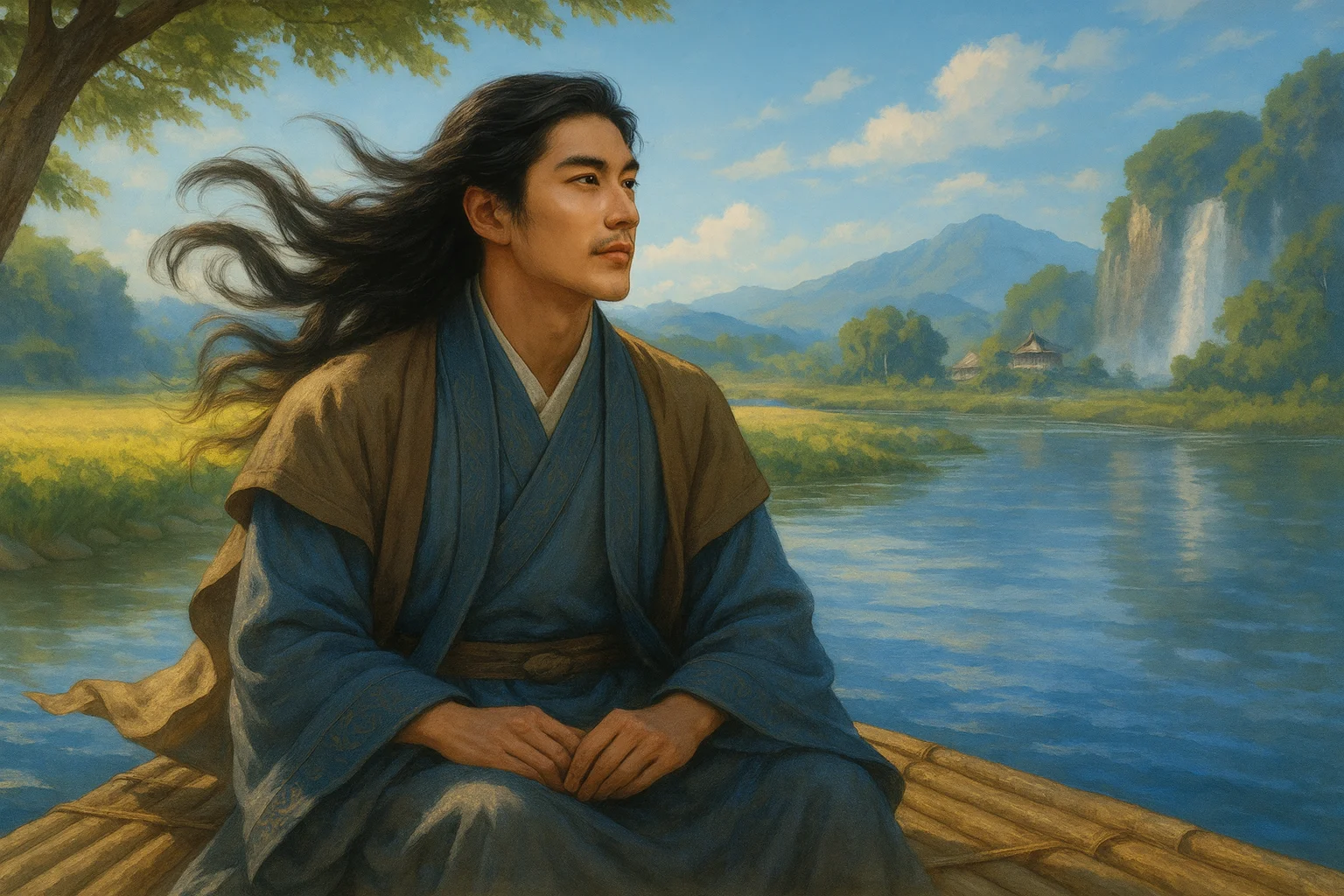
Meng Haoran (孟浩然), 689 - 740 AD, a native of Xiangyang, Hubei, was a famous poet of the Sheng Tang Dynasty. With the exception of one trip to the north when he was in his forties, when he was seeking fame in Chang'an and Luoyang, he spent most of his life in seclusion in his hometown of Lumenshan or roaming around.