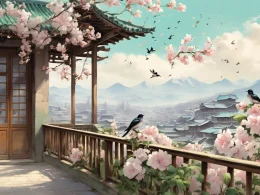

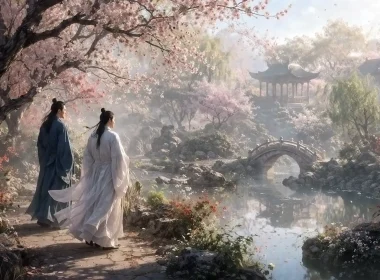
His palace locked in rainbow cloud on high,
He’d make the Weedy Town his home nearby.
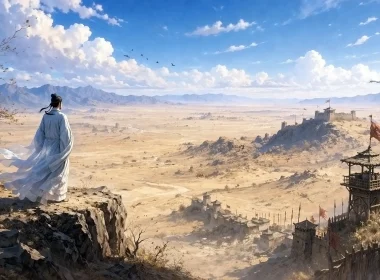
But for the Seal passed to the destined lord,
His sails would seek the earth’s remotest board.

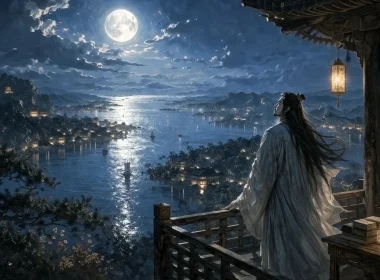
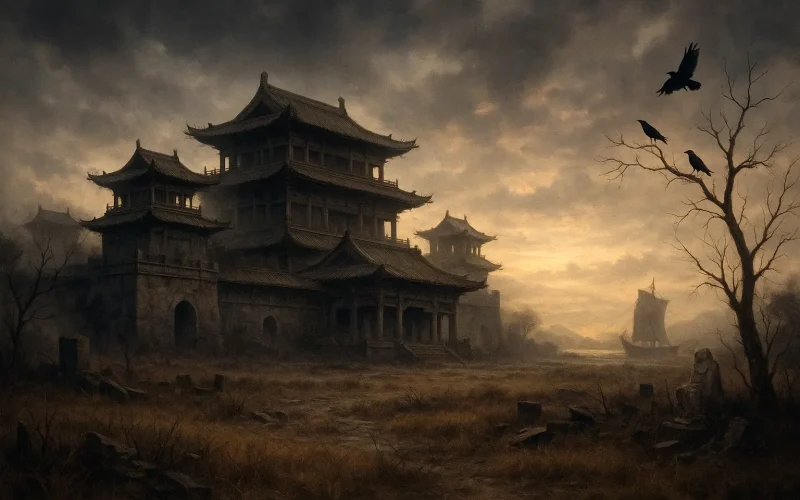
Now fireflies die in grass decayed and low;
Willows still host crows as sunsets glow.
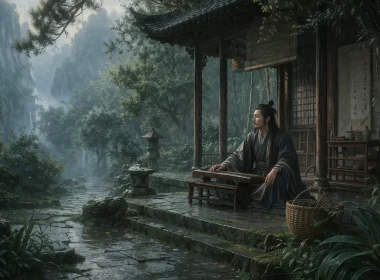
Should he meet Chen’s king beneath the clay,
Dare he ask for the song that wrought decay?
Original Poem
「隋宫」
李商隐
紫泉宫殿锁烟霞,欲取芜城作帝家。
玉玺不缘归日角,锦帆应是到天涯。
于今腐草无萤火,终古垂杨有暮鸦。
地下若逢陈后主,岂宜重问后庭花!
Interpretation
This poem was composed in 857 AD during Li Shangyin's travels through the Jiang-Huai region. Confronted with the ruins of the Sui palaces, the poet, moved by the scene, superimposed present desolation upon historical memory, creating this pinnacle of late Tang historical poetry. At this time, the Tang dynasty was deeply mired in a terminal crisis of separatist military governors and eunuch dominance, yet its rulers remained immersed in pleasure-seeking, with no thought of reform. By using the Sui to allude to the Tang, Li Shangyin's critical edge points not only towards the foolish rulers of a past dynasty but, more sharply, directly targets the contemporary ruling class's historical amnesia and the cyclical malaise of corrupt power.
The imagery of "The Purple Spring's palaces are locked in mist and glow" in the poem subtly corresponds to the actual state of Chang'an's Daming Palace—the palaces stood, but the emperors had grown dissolute. The ambition in "He sought to make the Waste his royal seat" echoes the frequent imperial progresses to Luoyang and the Xingqing Palace during the late Tang. Li Shangyin's choice of Emperor Yang of Sui as an extreme case serves precisely to reveal the inevitable, mad logic that unfolds when power is left unchecked: when an emperor equates personal desire with the will of the state and treats the people's wealth as his private treasury, downfall is already foreordained.
First Couplet: 紫泉宫殿锁烟霞,欲取芜城作帝家。
Zǐ quán gōngdiàn suǒ yānxiá, yù qǔ wú chéng zuò dì jiā.
The Purple Spring's palaces are locked in mist and glow;
He sought to make the Waste his royal seat, we know.
"Purple Spring" refers to Chang'an, alluding to Sima Xiangru's "Rhapsody on the Imperial Park" ("the Purple Deep winds north"), borrowing the Han dynasty's grandeur to contrast with the Sui palaces' ruin. "Locked in mist and glow" is exquisitely crafted: mist and glow are ethereal, yet the verb "locked" imbues them with a quality of imprisonment, suggesting the palaces have become gilded cages. "Sought to make" in the second line reveals the tyranny of imperial will—this is not a "capital transfer" but a "taking for use," treating a city as private property to be appropriated at will. "The Waste" refers to Yangzhou, named after Bao Zhao's "Rhapsody on the Ruined City" lamenting its rise and fall. By using this old name, Li Shangyin presupposes the outcome of decay within the very act of naming.
Second Couplet: 玉玺不缘归日角,锦帆应是到天涯。
Yùxǐ bù yuán guī rìjiǎo, jǐnfān yīng shì dào tiānyá.
Had not the seal passed to the true Son of Heaven's sway,
His silken sails would have reached the ends of earth, they say.
This couplet uses historical hypothesis to depict the terrifying vision of unchecked power. "The true Son of Heaven" refers to Li Yuan (historical records describe him having the "sun-horn" physiognomy of an emperor). "Passed to" emphasizes the legitimate transfer of the Mandate of Heaven. "Silken sails would have reached the ends of earth" combines an image of extravagance (silken sails) with limitless space (ends of earth), sketching the frightening trajectory of boundless desire. Most masterful are the words "would have"—this is not an objective statement but a necessary deduction based on Emperor Yang's behavioral logic, revealing the inherent law that absolute power leads inevitably to absolute excess.
Third Couplet: 于今腐草无萤火,终古垂杨有暮鸦。
Yújīn fǔ cǎo wú yínghuǒ, zhōnggǔ chuí yáng yǒu mù yā.
Now, from rotting grasses, no fireflies take their light;
Forever, by drooping willows, crows perch at night.
This couplet delivers historical judgment through natural imagery. "From rotting grasses, no fireflies" alludes to Emperor Yang's notorious gathering of fireflies for nocturnal revels, but the poet reverses the meaning: it is not that the fireflies are gone, but that even the rotting grasses that produce them have withered, emphasizing utter desolation. The image of "drooping willows" and "crows at night" is even richer in implication: Emperor Yang planted willows along the canals, making them symbols of his achievement; now the willows remain, but serve only as roosts for crows at dusk. This contrast between the permanence of natural objects and the transience of human affairs lends the satire a desolate, poetic depth.
Fourth Couplet: 地下若逢陈后主,岂宜重问后庭花!
Dìxià ruò féng Chén Hòuzhǔ, qǐyí chóng wèn Hòutínghuā!
If underground he met the last lord of Chen's line,
How could he ask again for "Backyard Flowers" divine?
The final couplet elevates the allegory to its climax through a ghostly dialogue across history. According to The Lost Records of Sui, Emperor Yang once dreamed of meeting the last ruler of Chen and enjoying the song "Jade Trees and Backyard Flowers" with him. By placing this anecdote in an "underground" setting, Li Shangyin brings two vanquished rulers together in the underworld, creating exquisite irony. The phrase "how could he" carries immense force: it is not "would not," but "would have no face to"—while the last ruler of Chen lost his kingdom, at least he did not mock his predecessors; Emperor Yang, who once derided Chen's ruler for debauchery, proceeded to surpass him. This self-entrapment of the historical critic constitutes the deepest tragedy of corrupt power.
Holistic Appreciation
This is a work of historical critique constructed through a poetics of space. The poem juxtaposes and transforms four spatial realms: the palaces of Chang'an (the abandoned political center), the Waste as an imperial seat (the newly constructed playground of desire), the ends of the earth (the imagined boundary of expansion), and the underworld (the final destination). This outlines the complete trajectory of imperial desire from accumulation to explosion to obliteration. Li Shangyin's profundity lies in revealing the isomorphic relationship between the geography of power and the psychology of desire—Emperor Yang's relentless conquest of space (taking the Waste, reaching the ends of the earth) was, in fact, the external projection of his infinitely expanding internal desires.
The poem's temporal structure is particularly sophisticated: the first couplet presents the will to power in spatial transfer (present desire); the second, a virtual historical possibility (hypothetical future); the third, the reality of historical ruins (present outcome); the fourth, an eternal encounter in the netherworld (posthumous judgment). The interweaving of these four tenses lends Emperor Yang's individual case a trans-temporal, parabolic quality—it is not merely a historical event but a dramatization of the nature of power itself.
Noteworthy is the use of the correlative phrases "Had not… would have…" (second couplet) and "If… how could…" (fourth couplet). The former reveals the inevitable logic under historical contingency (if not for the transfer of the Mandate, excess would surely have reached the earth's ends); the latter reveals the absoluteness of moral judgment (even in a posthumous meeting, shame would be inescapable). This dual structure of logical deduction and value judgment allows the poem to achieve perfect balance between rational analysis and emotional condemnation.
Artistic Merits
- Symbolic Transformation of Toponyms: Purple Spring (a metonym for Chang'an) symbolizes the legitimate political center; the Waste (an old name for Yangzhou) symbolizes the new territory onto which desire is projected; the ends of the earth symbolize the boundless realm of desire; the underground symbolizes history's final court of judgment. Each place-name transcends geographical meaning to become a vessel for value judgment.
- The Historical Inscription upon Natural Imagery: Fireflies were conscripted by power as tools of entertainment (Emperor Yang releasing them), only to ultimately vanish from the rotting grasses; willow trees were shaped by power into symbols of achievement (planted along canals), only to end up as perches for crows. Natural objects in the poem undergo a process of alienation by power followed by a return to their natural essence, becoming silent witnesses to the vanity of power.
- The Critical Force of the Hypothetical Mood: The poem employs hypothetical expressions throughout ("sought to make," "would have," "if… met," "how could"). This subjunctive mood not only expands the poetic时空 but also constructs multi-dimensional critical perspectives—examining the tragedy of power from angles such as possible histories and imaginary encounters.
Insights
This work reveals a fatal paradox in the operation of power: the rulers most obsessed with building eternal monuments are often the fastest to be forgotten by history; the power most intent on spatial expansion is ultimately compressed by time into a mere warning symbol. The Grand Canal Emperor Yang excavated still flows today; the willows he planted return green every spring. Yet the objects of his greatest concern—the silken-sailed dragon boats, the firelit night scenes, the Waste as an imperial seat—have left behind only the desolation of "from rotting grasses, no fireflies." The lesson for any era is this: the true legacy of power depends not on the scale of its material projects, but on its connection to the welfare of the people.
The historical hypothesis in "Had not the seal passed… His silken sails would have reached…" poses a profound political philosophy question: Where would the innate expansive instinct of power lead society if left unchecked by external forces? Li Shangyin's answer is hidden in the words "would have"—not might have, but would have. This reminds all eras: institutional constraints on power are not limitations on rulers but necessary protections for the continuity of civilization.
Ultimately, this poem offers not a simple "using history as a mirror," but a reflection on historical criticism itself. When Emperor Yang faced the last ruler of Chen underground, he lost all grounds for defense—because he had once been that ruler's harshest critic, only to become a more extreme version of him. This suggests an eternal predicament: Every era can soberly critique the folly of the previous dynasty, yet often repeats the same errors in the very act of critique. True historical wisdom lies perhaps not in remembering specific lessons, but in establishing institutions and a culture that keep power perpetually self-doubting and keep critics perpetually vigilant against becoming the criticized.
About the poet
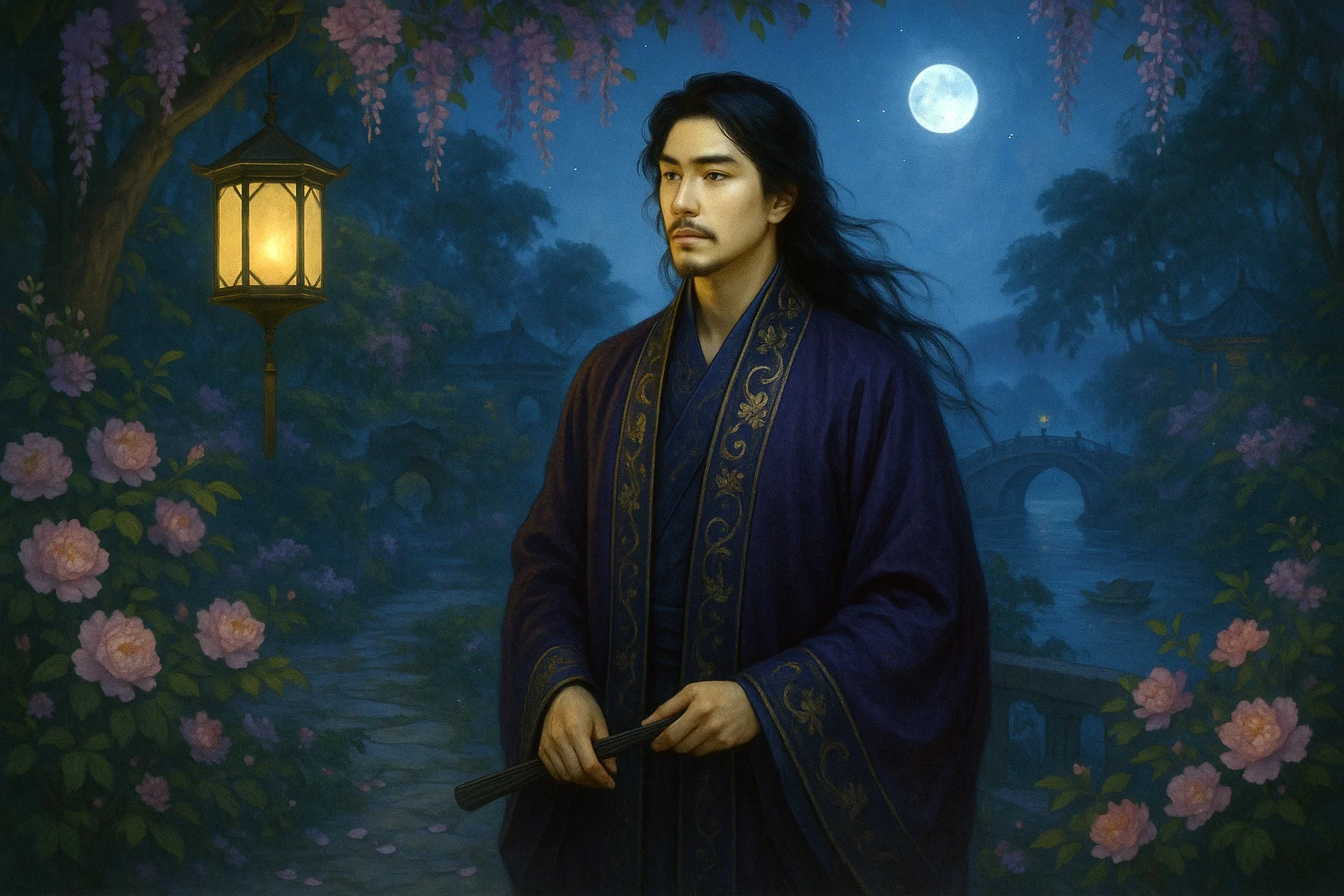
Li Shangyin (李商隐), 813 - 858 AD, was a great poet of the late Tang Dynasty. His poems were on a par with those of Du Mu, and he was known as "Little Li Du". Li Shangyin was a native of Qinyang, Jiaozuo City, Henan Province. When he was a teenager, he lost his father at the age of nine, and was called "Zheshui East and West, half a century of wandering".