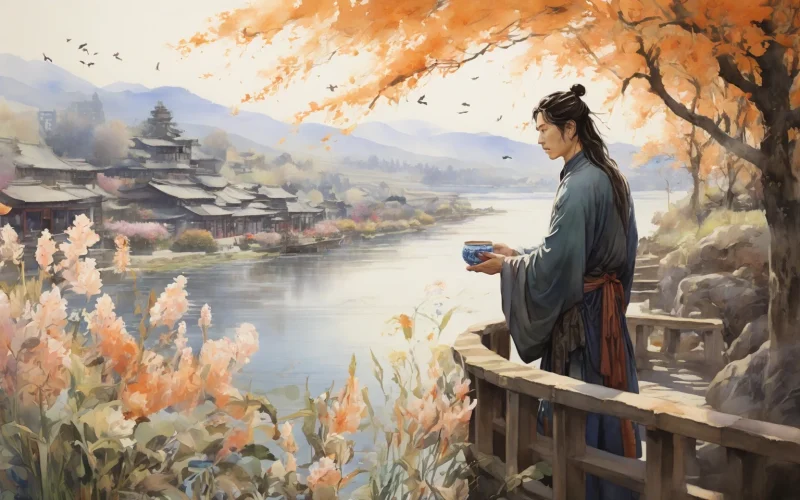



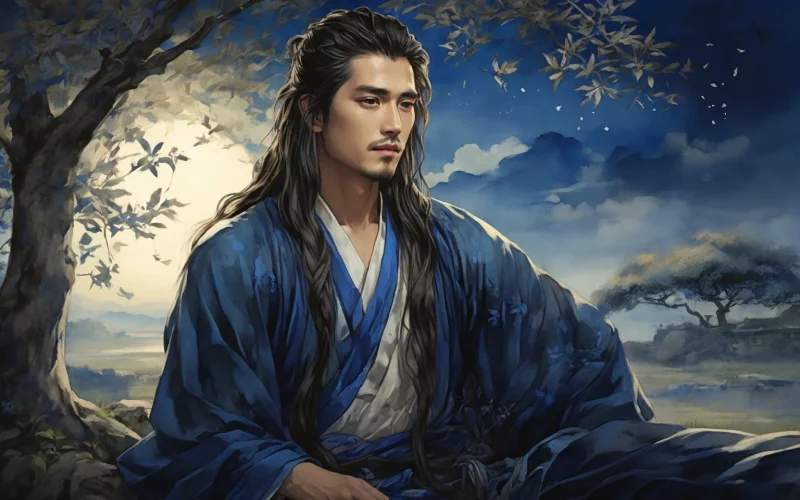
Li He (李贺 790 - 816), a native of Yiyang, Henan, was a Romantic poet of the Mid-Tang dynasty. A descendant of the Tang imperial clan, he was barred from taking the national jinshi civil service examination due to a naming taboo (his father's name contained a character homophonous with "Jin"), which led to a life of frustration and poverty. He died at the age of twenty-seven. His poetry, renowned for its bizarre grandeur, chilling elegance, and fantastical imagination, earned him the title "Ghost of Poetry." He pioneered the distinctive "Changji Style" within Tang poetry, exerting a profound influence on later poets like Li Shangyin and Wen Tingyun and on the expansion of poetic imagery in subsequent eras.
李贺
lǐ hè
Major Works


Biography
Li He was born into a declining, distant branch of the Tang imperial family. His distant ancestor was Li Liang (Prince of Zheng), the uncle of the dynasty's founder, Li Yuan, but by his father Li Jinsu's generation, the family's fortunes had long faded. This imperial lineage endowed him with an innate sense of nobility and a yearning for his family's past glory, yet it also made him acutely aware of the bitter contrast with his impoverished reality. This contradiction became a recurring theme in his poetry. He lost his father early, and his family fell into poverty. He lived in his ancestral home in Changgu with his mother, née Zheng, his sister, and his younger brother.
From childhood, Li He was sickly and frail, with an unusually thin build. A physical peculiarity—abnormally long, claw-like fingers—often drew curious or disdainful glances from his contemporaries. However, he was extraordinarily gifted and intelligent. By the age of seven, he could compose literary pieces, gaining fame in the capital. Legend has it that when the eminent scholars Han Yu and Huangfu Shi first read his works, they suspected they were written by an ancient master. They visited his home, where the young Li He promptly composed the poem "Gao Xuan Guo," astounding them both. While this story may not be entirely factual, it underscores his reputation for precocious talent.
In the fifth year of the Yuanhe era (810 AD), at twenty-one, Li He passed the provincial examination in Henan Prefecture. His set of poems, "Songs for the Twelve Months," deeply impressed the examiners, earning him the qualification to take the national jinshi examination in the capital. However, fate intervened cruelly. Rivals, vying for recognition, spread the rumor that it was unfilial for him to take the "jinshi" examination because the character "Jin" was homophonous with a character in his father's name, "Jinsu." Despite a vigorous defense by Han Yu, then the Magistrate of Henan, who wrote the famous essay "In Defense of Breaking Taboo"—rhetorically asking, "If the father's name is Jinsu, the son cannot take the jinshi exam; if the father's name is Ren ('benevolence'), can the son not be a man?"—the overwhelming pressure of contemporary ritual custom ultimately forced Li He to abandon his examination rights, severing the primary path to official advancement.
This setback was devastating. He not only lost hope for a bureaucratic career but also suffered profound spiritual trauma. In 811 AD, with assistance from imperial relatives and Han Yu, he obtained a minor post—Fengli Lang (Assistant Director of Ceremonies)—through hereditary privilege. This was a lowly, ninth-rank position responsible for managing ceremonial protocols during court audiences and sacrifices. Its petty and tedious nature was utterly mismatched with his talent and aspirations. During his three-year tenure in Chang'an, he witnessed the darkness of officialdom and the extravagance of the powerful. His resentment and depression grew daily, leaving deep impressions in his poetry.
In 813 AD, following his wife's illness and death, and due to his own failing health, Li He resigned and returned to his hometown. He subsequently embarked on a brief journey south, reaching areas like Jinling and Wuxing in search of new opportunities, but to no avail. In 816 AD, as northern China was again plunged into turmoil due to rebellions by regional military governors, the sickly and impoverished Li He finally died around 817 AD in his ancestral home in Changgu, at the mere age of twenty-seven.
On his deathbed, he compiled his poetic works into four collections and entrusted them to his friend Shen Shushi. They were later transmitted to posterity with a preface by the poet Du Mu and a biography by Li Shangyin. This genius, whose life was cut tragically short, used his brief twenty-seven years to cast the most bizarrely splendid arc of light in the history of Chinese poetry.
Poetic Style
Li He's poetry stands as one of the most uniquely individualistic voices in Chinese poetic history. With ghostly ingenuity and painstaking effort, he created a bizarre, grotesque, eerily cold, and hauntingly beautiful artistic world. His style can be summarized as "bizarre and steep, lush yet desolate."
1. Bizarre Imagination, Roaming Among Deities and Ghosts
Li He's poetic imagination is exceptionally peculiar, grotesque, and often transcends conventional logic, freely traversing the realms of the living and the dead. In his verse, the sun, moon, stars, immortals, ghosts, life, and death are all at his command. The sun can resonate with "羲和敲日玻璃声," the moon can roll with "玉轮轧露湿团光," the Xiang River can witness "九节菖蒲石上死," and in the heavens, one can find "彭祖巫咸几回死." He was especially adept at writing about ghosts, death, and the netherworld, cultivating an eerie and desolate beauty, hence his title "Ghost of Poetry." Lines like "秋坟鬼唱鲍家诗,恨血千年土中碧" from "Autumn Comes" render the image of ghosts chanting poetry with a chilling, yet devastatingly beautiful, aura.
2. Lush Imagery, Kaleidoscopic Colors
Li He's use of color is extreme. He favored intense, flamboyant words like red, green, blue/black, and purple, often employing unconventional combinations to create visually dazzling effects. Examples include "桃花乱落如红雨," "黑云压城城欲摧,甲光向日金鳞开," and "琉璃钟,琥珀浓,小槽酒滴真珠红." With richly pigmented strokes, he gave concrete form to his bizarre imaginings, endowing his poetry with a strong pictorial quality, even reminiscent of modernist painting.
3. Rugged Language, Unique Syntax
Li He strenuously avoided the commonplace in language, pursuing a rugged and novel quality. He frequently used ancient-style verse and yuefu ballad forms, with irregular line lengths, skipping rhythms, and broken conventional grammar. He excelled at synesthesia, blending different sensory experiences. For instance, "东关酸风射眸子" uses "sour" to describe the wind, fusing touch and taste; "霜重鼓寒声不起" uses the visual "heavy" and tactile "cold" to modify the auditory "sound." This defamiliarization of language gives his poetry tremendous impact and lingering resonance.
4. Profound Emotion, Dominated by Sorrow
The emotional undercurrent of Li He's poetry is sorrowful. The frustrations of his life, shattered ideals, life's brevity, and the torment of illness filled his verses with lamentations on impermanence and a fixation on death. He often used historical allusions to critique the present, compared himself to historical figures to express the grief of unrecognized talent, or conveyed his aspirations through objects, using fading flowers and the passage of celestial bodies to symbolize life's fragility. Even scenes of feasting or flights of immortal fancy often conceal a deep-seated melancholy beneath. This technique of "expressing sorrow through joyful scenes" adds significant artistic tension to his work.
5. Concentrated and Specialized Themes
His poetic themes are relatively focused, often dealing with history and nostalgia, roaming immortals and ghosts, boudoir sentiments and palace grievances, and expressing ideals through objects. He seldom engaged in direct social commentary. He typically avoided straightforward descriptions of contemporary life, preferring to seek expression within history, myth, and dreams. This thematic specialization both endowed his poetry with unique charm and somewhat limited its breadth of vision.
Literary Influence
Although he died young, Li He's unique poetic style profoundly influenced later generations, securing him a special place in Chinese literary history.
1. An Anomaly and Maverick in the Tang Poetic Landscape
Within the diverse developments of Mid-Tang poetry, Li He stood as an anomaly. While the Han-Meng school pursued the strange and grotesque, and the Yuan-Bai school championed plainness and accessibility, Li He pushed bizarre imagination and ornate diction to their extremes in a highly personal manner. He belonged to no established school but forged his own path, establishing the distinctive "Changji Style." Du Mu, in his "Preface to Li Changji's Song-Poems," offered this praise: "Interlinked clouds and mist are insufficient to represent its manner; the far-reaching flow of water is insufficient to convey its sentiment; the lushness of spring is insufficient for its harmony; the clarity and purity of autumn are insufficient for its character; sailboats in the wind and horses in battle array are insufficient for its valor; pottery coffins and ancient bronze inscriptions are insufficient for its antiquity; seasonal flowers and beautiful women are insufficient for its color; ruined states, crumbling palaces, overgrown mounds, and desolate graves are insufficient for its resentment, grief, and sorrow; whales gaping, giant turtles leaping, ox-demons and snake-gods are insufficient for its illusory and absurd fantasy." This evaluation vividly captures the multifaceted and fantastically bizarre nature of Li He's style.
2. A Precursor to Late-Tang Poets like Li Shangyin and Wen Tingyun
Li He's most direct influence was on the Late-Tang poetic scene. Poets like Li Shangyin and Wen Tingyun were deeply influenced by him. The ornate intricacy, adept use of symbolism, and fondness for mythological imagery in Li Shangyin's poetry clearly show Li He's imprint. The exquisite delicacy and dense imagery of Wen Tingyun's ci poetry also share an affinity with Li He's work. It can be said that Li He inherited the romantic tradition of the Songs of Chu and Li Bai and initiated the aestheticist poetic style of the Late Tang, serving as a crucial bridge between the High Tang and Late Tang eras.
3. Enduring Influence on Later Literature
Li He's influence extended far beyond the Tang. Song dynasty ci poets like Zhou Bangyan and Wu Wenying, in their dense imagery and ornate language, show traces of Li He's influence. Ming and Qing dynasty poets, such as Xu Wei and Huang Jingren, were also inspired by him to varying degrees. Into the modern era, Chairman Mao Zedong frequently borrowed from or adapted Li He's lines in his own poetry, such as transforming "雄鸡一声天下白" into "The crow of a cock brings dawn to the whole world" and directly quoting "天若有情天亦老." This demonstrates the enduring vitality of his art.
4. A Unique Position in Chinese Poetics
Li He's significance lies in his extreme personal approach, which expanded the imaginative boundaries and linguistic possibilities of Chinese poetry. His work proved that poetry could not only describe reality and express emotion but could also create a fantastical world entirely independent of it. This exploration provided valuable inspiration for later poets. Simultaneously, his "painstaking, heart's-blood" attitude towards composition (Li Shangyin's "A Biography of Li Changji" records him riding a donkey daily to seek lines, depositing them in a brocade pouch, and completing them upon returning home at dusk) became another model of the intense, dedicated poetic spirit in Chinese literary history.
In summary, Li He was a genius poet who lived for poetry and whose genius thrived on the strange and exceptional. In his brief twenty-seven years, he wove a poetic world both bizarre and grotesque, lushly ornate and hauntingly pure, securing his place as the most singular figure in the Mid-Tang poetic scene. The fantastical strangeness of his imagination, the splendor of his imagery, and the ruggedness of his language opened new aesthetic dimensions for Chinese poetry. He inherited the romantic spirit of the Songs of Chu and Li Bai, while also foreshadowing the aestheticist style of Late Tang poets such as Li Shangyin and Wen Tingyun. Though he died young, his name—crowned with the title "Ghost of Poetry"—remains etched forever in the annals of poetic history. A millennium later, his lines can still dazzle the eyes, stir the soul, and leave one breathless with admiration.