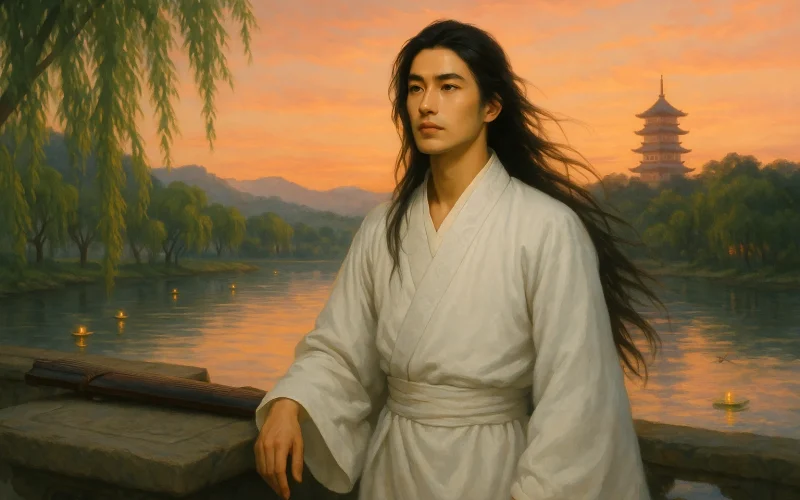




Here in the Eighth-month the waters of the lake
Are of a single air with heaven,
And a mist from the Yun and Meng valleys
Has beleaguered the city of Youzhou.

I should like to cross, but I can find no boat.
...How ashamed I am to be idler than you statesmen,
As I sit here and watch a fisherman casting
And emptily envy him his catch.
Original Poem
「望洞庭赠张丞相」
孟浩然
八月湖水平,涵虚混太清。
气蒸云梦泽,波撼岳阳城。
欲济无舟楫,端居耻圣明。
坐观垂钓者,空有羡鱼情。
Interpretation
This poem was composed in 733 CE, when Meng Haoran was forty-four years old, during his westward travels to Chang'an. This marked his final active attempt to secure an official career. Nine years prior, in 725 CE, he had traveled extensively in the Wu and Yue regions. In 728 CE, he went to the capital to sit for the imperial examinations, but ended in failure both times. His famous lines, "In silence, what is there to await? / Morning after morning, I return alone, forlorn," truthfully captured his state of mind at that time. Yet Meng Haoran had not completely given up hope. In 733, he came to Chang'an once more, hoping to obtain an official post by presenting his writings and seeking recommendation from eminent figures.
The intended recipient of this poem was Zhang Jiuling, who at the time served as Vice Director of the Secretariat and participated in policy-making as a chief minister. Renowned for his literary talent and virtuous character, Zhang was known as a wise and capable chancellor. Choosing Zhang Jiuling was not random. Zhang himself hailed from a humble family in Lingnan and had entered officialdom through his literary compositions; he was known for promoting talented scholars. More importantly, he and Meng Haoran shared a poetic friendship and had exchanged verses. In the Tang bureaucracy, which emphasized connections between patrons and protégés, this literary affinity provided the most natural opening for seeking recommendation. However, poems seeking patronage are notoriously difficult to write. Too direct, and they descend into beggary; too obscure, and they become cryptic. Meng Haoran's supreme artistry lies in finding a mode of discourse that is neither obsequious nor arrogant. He transforms his political aspirations entirely into a depiction of Lake Dongting. His desire for office is hidden within the lake waters; his plea for patronage is entrusted to boats and oars. Not a single word in the poem explicitly asks for help, yet every line pertains to this request. This is not merely rhetorical skill, but the manifestation of a personality—even when seeking favor, he maintains the dignity and composure of a scholar.
Lake Dongting, located in the Shannan East Circuit during the Tang, was within the region where Zhang Jiuling had previously served as Prefect of Yuezhou. The poem's magnificent portrayal of Dongting is both a realistic description and arguably a subtle tribute to Zhang Jiuling's administrative achievements in that land. This nuanced awareness of his reader elevates the poem beyond mere personal ambition, making it a paramount example within High Tang patronage verse where artistic achievement and political appeal achieve perfect balance.
First Couplet: "八月湖水平,涵虚混太清。"
Bā yuè hú shuǐ píng, hán xū hùn tài qīng.
In the eighth month, the lake waters brim level with the shore; / Embracing emptiness, they merge with heaven's pure core.
The opening is profoundly steady. It does not describe perilous waves or shifting winds and clouds, but focuses on the water's "level"—the static fullness of autumn waters at their peak, a potency waiting to be unleashed. The word "level" reveals the lake's vastness, and even more, the poet's serene gaze. The phrase "Embracing emptiness, they merge with heaven's pure core" pushes the scene of lake and sky merging to its extreme. "Emptiness" is space; "heaven's pure core" is the firmament; "merge" signifies seamless fusion. This line not only depicts Dongting's immensity but evokes a cosmic sense of openness. The poet has not yet declared his ambition, yet that ambition already spreads boundlessly like these waters.
Second Couplet: "气蒸云梦泽,波撼岳阳城。"
Qì zhēng Yúnmèng zé, bō hàn Yuèyáng chéng.
Vapors rise, shrouding Yunmeng's ancient marshland wide; / Waves surge, as if to shake Yueyang's walls with their tide.
This couplet holds the poem's most majestic spirit, showcasing a rare vigor in Meng Haoran's style. "Rise" suggests an inward, accumulating force; "shake" implies an outward, releasing energy. One static, one dynamic; one containing, one releasing—they vividly capture Dongting's dual nature: both nurturing all things and awing the region. Yunmeng Marsh and Yueyang City were both places associated with Zhang Jiuling's official career. While seemingly a pure description of the lake, this couplet subtly echoes the recipient's administrative reputation. Dongting's "rising vapors" are like the widespread reach of beneficence; its "shaking waves" are like the far-reaching influence of virtuous authority. This is Meng Haoran's most discreet tribute and his most fitting compliment.
Third Couplet: "欲济无舟楫,端居耻圣明。"
Yù jì wú zhōu jí, duān jū chǐ shèngmíng.
I long to cross, yet lack both boat and oar; / To dwell at ease in this sage age brings me shame the more.
The poem turns from scene to feeling, the transition as natural as water dividing around an island. "Long to cross" follows from the preceding lake description—facing such vast waters, anyone would feel the desire to traverse them. This "crossing" is both geographical and a crossing in life: from the rivers and lakes to the court, from commoner to official. "Lack both boat and oar" is the poem's central, pivotal line. It blames neither heaven nor others, but calmly states a fact: to cross a lake, one needs a boat; to enter official service, one needs recommendation; the boat is not in my hands, the recommendation is not within my power. This calmness is more moving than indignation. "To dwell at ease in this sage age brings me shame" elevates the personal desire for office to the level of duty to one's time. The word "shame" carries great weight, yet contains not a trace of resentment. The poet does not pity himself for unrecognized talent; he feels ashamed at the thought of idling away a sage-ruled era. This reflects the unique spirit of High Tang scholars—it is not that the court owes me a post, but that I owe this age my service.
Fourth Couplet: "坐观垂钓者,空有羡鱼情。"
Zuò guān chuí diào zhě, kōng yǒu xiàn yú qíng.
I sit and watch the angler on the shore; / In vain, this longing for the fish he catches in his net, nothing more.
The final couplet alludes to a saying from Huainanzi: "Standing by a river and longing for fish is not as good as going home to weave a net." Meng Haoran inverts the meaning: he does not write of the "weaving" resolve, but focuses on the "longing" feeling. The word "in vain" expresses the melancholy of having the will but not the means. "The angler" metaphorically represents those already in office, or specifically refers to worthy ministers like Zhang Jiuling. The poet positions himself as the one who "sits and watches"—not unwilling to participate, not incapable, but for now, still standing on the shore. This posture is modest without being servile, expectant without being desperate, its nuance exquisitely measured. The poem concludes here. The emotion has been fully conveyed, yet not a single word directly states "I request." This is the highest achievement of High Tang patronage poetry: the request remains unspoken, the integrity preserved beyond the words.
Overall Appreciation
This work is an anomaly and a solitary peak within Meng Haoran's collection. An anomaly, because Meng is famed for his landscape and pastoral poetry, his style characterized by "clarity," "subtlety," "seclusion," and "distance," yet this poem displays a rare majestic grandeur. The first four lines on Dongting, with their rising vapors and shaking waves, containing the cosmos, would not be out of place among the finest High Tang frontier poetry. A solitary peak, because it is the only work in his entire life that so perfectly melds political appeal with landscape description—before this, his poems on Xiangyang's scenery expressed a pure desire for reclusion; after this, he completely abandoned official aspirations, and the moon over Lumen Mountain became his final destination.
The most remarkable aspect of this poem is not that it successfully moved Zhang Jiuling (in fact, it does not seem to have immediately secured him a post), but that it elevates a potentially humbling act into a statement of such dignity and nobility.
The essence of a patronage poem is "to ask." The one who asks inevitably stoops, feels slighted, and risks revealing anxiety and eagerness between the lines. Yet throughout this poem, Meng Haoran maintains a gaze of equals. His relationship with Zhang Jiuling is not the groveling of an inferior to a superior, but a dialogue between poets, a spiritual exchange between a witness of Lake Dongting and its former governor. He uses the lake to write of his own aspirations, the oarless boat to write of his predicament, the longing for fish to write of his hope—every metaphor is precise, restrained, and elegant. He asked, but he did not kneel.
This is the unique spiritual dignity of the High Tang scholar. In that era, seeking office was not a disgrace; unrecognized talent was not a tragedy. The true disgrace was losing one's own form in the act of asking. Meng Haoran did not lose his. Every word in this poem remains his own.
Artistic Features
- Grafting of Landscape and Patronage Poetry Genres: Meng Haoran completely transposes the discourse of landscape and pastoral poetry onto the writing of a patronage poem. Lake Dongting is not just a real scene, but a symbolic system for political ambition; the boat and oar are not just means of crossing, but metaphors for the path to official service. This grafting created a new aesthetic paradigm for patronage poetry.
- Isomorphic Relationship between Natural Grandeur and Inner State: The first four lines describe the lake, making it vaster and vaster; the last four lines describe the self, making it smaller and smaller. This contracting structure, moving from external to internal, from object to person, precisely mirrors a reverse increase in emotional intensity. The vaster the lake, the smaller the man; the more majestic the scene, the more profound the feeling. The extremity of the natural grandeur sets off the extremity of the inner state.
- Invisible Handling of Allusion: The "longing for fish" allusion dissolves into the everyday image of "the angler," its meaning clear without citing the source. This technique of making allusions seamless gives the poem cultural depth while maintaining linguistic naturalness, a mark of mature allusion-use in High Tang poetry.
- Pursuit of Ultimate Balance: The entire poem is a study in balance—the lake's level surface versus its shaking waves; the desire to cross versus the shame of idleness; watching versus longing; seeking office versus preserving integrity. This sense of balance is both a rhetorical achievement and an externalization of character. In this poem, Meng Haoran found the golden mean between ambition and equanimity.
Insights
Meng Haoran ultimately did not receive a response from Zhang Jiuling. A few years later, he retired completely, remaining a commoner for life. "Gazing at Lake Dongting, Presented to Prime Minister Zhang" became the final, and most splendid, curtain call for his political aspirations. Yet, interestingly, history did not record whether Zhang Jiiling recommended anyone that year, but it firmly remembered this "poem seeking office." It was included in the 300 Tang Poems, recited by generations of readers, and silently repeated by countless people waiting for their "boat and oar" at life's crossings.
This teaches us a harsh yet tender truth: Often, the scenery along the journey is more worth remembering than the final destination of a life. Meng Haoran did not get the official post, but he got this poem. He was not employed by his age, but he was remembered by it. The "boat and oar" he could never board in his lifetime ferried him to a place far beyond the official world. "I long to cross, yet lack both boat and oar"—in every age, countless people stand by their own Lake Dongting, gaze at the opposite shore, and find no boat. This poem was written for them, and for them it is passed down. It cannot provide the boat, but it provides a stance: Even without a boat, it does not prevent you from looking earnestly at this lake, and earnestly speaking your wish to cross.
A thousand years later, we have long forgotten whether Prime Minister Zhang replied, but we still remember that August, the waters of Dongting brimming full, a commoner poet standing on the shore, gazing at the distant merging of water and sky, writing his heart's concern into the most dignified letter of request in Chinese history. He did not make the crossing. But he stood on the shore and became a landscape.
Poem translator
Kiang Kanghu
About the poet
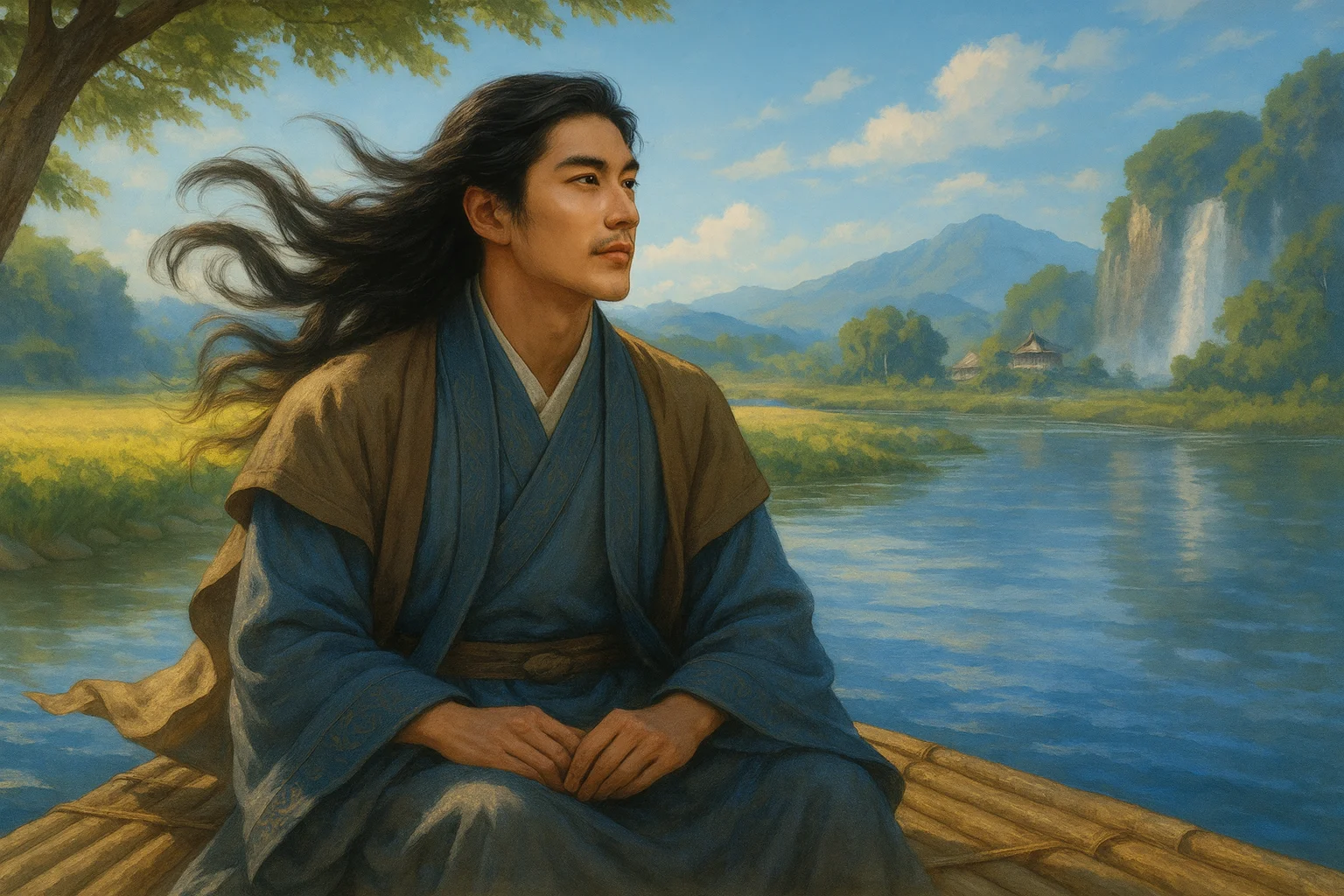
Meng Haoran (孟浩然), 689 - 740 AD, a native of Xiangyang, Hubei, was a famous poet of the Sheng Tang Dynasty. With the exception of one trip to the north when he was in his forties, when he was seeking fame in Chang'an and Luoyang, he spent most of his life in seclusion in his hometown of Lumenshan or roaming around.