


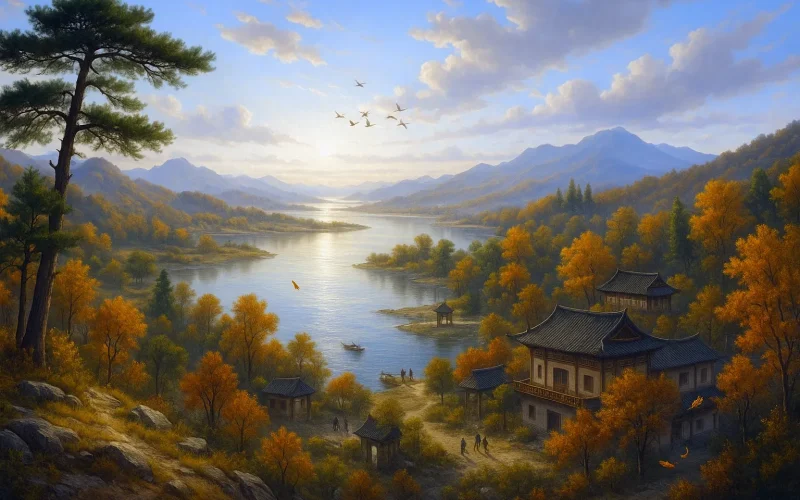
On a northern peak among white clouds
You have found your hermitage of peace;
And now, as I climb this mountain to see you,
High with the wildgeese flies my heart.

The quiet dusk might seem a little sad
If this autumn weather were not so brisk and clear;
I look down at the river bank, with homeward-bound villagers
Resting on the sand till the ferry returns;
There are trees at the horizon like a row of grasses
And against the river's rim an island like the moon
I hope that you will come and meet me, bringing a basket of wine --
And we'll celebrate together the Mountain Holiday.
Original Poem
「秋登兰山寄张五」
孟浩然
北山白云里,隐者自怡悦。
相望始登高,心随雁飞灭。
愁因薄暮起,兴是清秋发。
时见归村人,沙行渡头歇。
天边树若荠,江畔洲如月。
何当载酒来,共醉重阳节。
Interpretation
This poem was composed during Meng Haoran's period of reclusion in Xiangyang. While the exact year is difficult to ascertain, its poetic atmosphere and emotional tone suggest a date after 732 CE, during the final phase of his life when he had completely abandoned official ambitions and settled contentedly in his Riverside Garden. "Zhang the Fifth" refers to Zhang Yin, a close friend and fellow townsman of the poet, also a reclusive painter. Zhang Yin once served as an Assistant Director in the Ministry of Justice before resigning to live in seclusion. He associated closely with figures like Wang Wei and Meng Haoran. Wang Wei's three poems titled "Playfully Sent to Younger Brother Zhang the Fifth, Yin" depict this very "brother's" hermit image in the Zhongnan Mountains: "Behind closed doors, reading histories and books; / Opening the gate, facing the waters and clouds." Meng Haoran exchanged verses with him, their bond deep and genuine.
The title is "On an Autumn Day, Climbing Mount Lan and Sending This to Zhang the Fifth." "Mount Lan" refers to Mount Wan (or, by some accounts, Mount Shimen) near Xiangyang, a place Meng Haoran frequented. With the Double Ninth Festival approaching, the poet ascends alone, gazing afar at the white clouds over the northern mountains, the wild geese flying south, villagers returning home by ferry in the twilight, and the river islets, clear as the moon, under the autumn sky. The more limpid and serene the autumn scene before him, the more profound and lingering his longing for his old friend becomes. Thus, he writes this poem, sending it afar to the friend who, like him, chose the path of reclusion.
The poem presents a juxtaposition of two "recluse" images. The opening line, "In northern mountains white clouds hide you, sir," transforms the sentiment of Tao Hongjing's famous lines—"What do you find in the hills? / White clouds for your pleasure alone. / I can bring you the clouds, / But you must keep them for your own"—to describe an unknown recluse in the northern mountains, a portrait of Zhang Yin, and also Meng Haoran's own affirmation of identity. The line "I climb the mountain to gaze toward you" reveals that although poet and friend are secluded in separate mountains, through the act of ascending and gazing afar they achieve a spiritual regard and meeting. This state of being physically separated yet spiritually connected forms the poem's most moving emotional structure—true kindred spirits need not face each other day and night; it is enough that each ascends a height, each gazes intently under the same autumn sun, amid the same cries of wild geese, for their hearts to commune.
First Couplet: "北山白云里,隐者自怡悦。"
Běi shān bái yún lǐ, yǐn zhě zì yí yuè.
In northern mountains white clouds hide you, sir; / You enjoy yourself in peace as a recluse there.
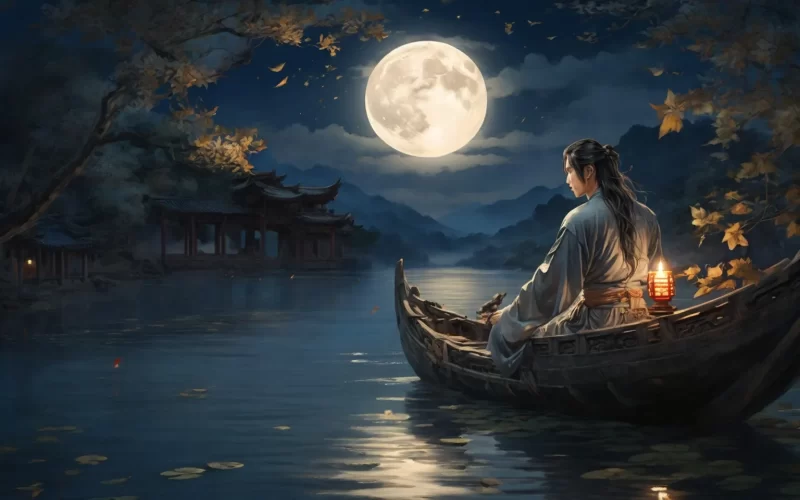
The opening paints a scene of lofty clarity and distance. The northern mountains are where his friend Zhang Yin resides (some say it refers to the Zhongnan Mountains); white clouds are a classic image of the reclusive life—they both shut out the dusty world and embody effortlessness and desirelessness. The poet incorporates Tao Hongjing's words but transforms the aloof solitude of "for your pleasure alone… you must keep them for your own" into the gentle contentment of "You enjoy yourself in peace." This is Meng Haoran's unique warmth: the recluse in his verse is not an isolated, austere figure, but one content and self-sufficient, breathing with heaven and earth.
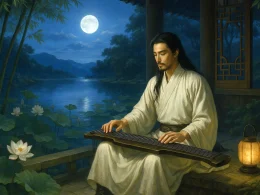
This line describes his friend's state, yet it is also a clear self-projection of the poet himself. By then, he was already the "man of seclusion" under the Lumen Mountain moon, the one holding the qin amidst the Southern Pavilion's lotus breeze. He understands this "contentment" as he understands the white clouds' untroubled emergence from the peaks. Yet understanding aside, in this moment of ascending and gazing afar, he still feels the impulse to "gaze toward"—contentment is the recluse's normal state; longing is the underlying tone of human feeling. The two are not contradictory; instead, they constitute the rich, inner layers of the reclusive life.
Second Couplet: "相望始登高,心随雁飞灭。"
Xiāng wàng shǐ dēng gāo, xīn suí yàn fēi miè.
For you I climb the mountain high; / My heart flies with the wild geese until they disappear in the sky.
This couplet marks the turning point where emotion shifts from implicit to explicit. The two words "For you" reveal the unspoken attachment beneath the surface contentment of the recluse described earlier. The poet does not ascend merely to admire autumn; his climb has a specific emotional direction—that person, that mountain, that friendship undiminished despite intervening clouds and waters.
"My heart flies with the wild geese" is the poem's most poignant image. Wild geese are classical messengers of letters and longing, but Meng Haoran does not have them carry a note; instead, he lets his heart follow their wings, flying toward where his friend is. "Until they disappear" suggests not vanishing, but merging—merging into the flock, into the distant sky, into that same twilight his friend also contemplates. The poet no longer needs to send a letter, for he has sent his very self.
Third Couplet: "愁因薄暮起,兴是清秋发。"
Chóu yīn bómù qǐ, xìng shì qīng qiū fā.
My sorrow rises as the daylight wanes; / In the clear autumn, my spirit soars and sustains.
This couplet expresses the dual aspects of his mood atop the height. "As the daylight wanes" is the time for returning home—villagers return by ferry, birds seek the woods—yet the one he yearns for cannot return, hence sorrow arises. But this grief is not stagnant or oppressive; it is gently held aloft by the phrase "In the clear autumn"—with the crisp air, the lucid firmament, and the sharp clarity of all things, the season itself carries an uplifting power.
"Sorrow" and "spirit soars" are juxtaposed, not as opposites but as coexisting forces. This is the true portrayal of Meng Haoran's state of mind in his later years: he had long accepted fate's arrangement, no longer harboring the anxiety of "wishing to cross, but having no boat or oar," nor writing the indignation of "a man of no talent, abandoned by a wise lord." His sorrow is faint, lingering, like autumn evening haze; his uplift is composed and self-sufficient, like the distant gaze from a height. The two interweave to form the complete mood of this autumn ascent.
Fourth Couplet: "时见归村人,沙行渡头歇。"
Shí jiàn guī cūn rén, shā xíng dù tóu xiē.
I see, as I look around, the homeward bound; / On the sand, or at the ferry, they can be found.
This couplet represents a drawing in of the scene from distance to nearness, and a settling of emotion. The preceding lines describe geese, sky, twilight—all distant vistas. Here, the poet's gaze returns to the human world, settling on these daily scenes, unrelated to himself yet comforting.
"The homeward bound" form a subtle contrast with the poet: they are also on their way home, but to a concrete home, a concrete village; the poet's "return" is to the mountain forest, to solitude, to a Double Ninth without his friend. Yet the poet bears no resentment. He simply watches quietly: the returning people, the sandy path, the ferry landing—life proceeding as usual in the twilight. This act of watching itself is a gentle reconciliation with the world.
Fifth Couplet: "天边树若荠,江畔洲如月。"
Tiān biān shù ruò jì, jiāng pàn zhōu rú yuè.
Trees at the sky's edge look like heads of green chive; / The river's isles, like the crescent moon, alive.
This couplet represents a Tang poetic pinnacle in depicting distant views. At the farthest reach of sight, scenery distorts with distance: towering trees shrink to shepherd's purse, vast sandbars curve into crescent moons. This is the law of physical perspective, and even more, the visual externalization of a state of mind—when longing reaches its limit, everything in the distance loses weight, distorts, becoming the infinitely miniaturized figure held in the heart.
"Trees… like heads of green chive" alludes to a line by Xue Daoheng, but Meng Haoran places this scene by the riverside, on the eve of moonlight, adding an ethereal quality. Those moon-crescent-shaped islets are both an accurate capture of nature and subtly echo the anticipated fulfillment in the following couplet's "get drunk on the Double Ninth Day"—the moon will eventually be full, people will eventually gather, and present longing will transform into the shared wine of the festival.
Sixth Couplet: "何当载酒来,共醉重阳节。"
Hé dāng zài jiǔ lái, gòng zuì Chóngyáng jié.
When, with a jar of wine, will you come cheer me up? / We'll celebrate the Mountain-Climbing Day with cup!
The conclusion gathers all the preceding distant gazing, longing, mingled sorrow and uplift, quiet observation, into this simple yet profound wish, ending with a question. It is not a strong summons, not an urgent urging, but a near-soliloquizing murmur—"When, … will you come" expresses hope, but even more, patient waiting; it is a promise certain to be kept, yet tinged with the melancholy of not knowing when.
"Celebrate the Mountain-Climbing Day" (the Double Ninth Festival) is the emotional endpoint of the entire poem. The Double Ninth is the festival for ascending heights, and also the festival for remembrance. Wang Wei wrote, "On festive days more than ever we think of our dear ones far away." Meng Haoran writes, "When, with a jar of wine, will you come… / We'll celebrate the Mountain-Climbing Day"—the former expresses fraternal longing, the latter a pact between kindred spirits. Two poets from Xiangyang, under the same autumn light, define the emotional core of the Double Ninth in different ways: it is not sorrowful, but expectant; not lonely, but trusting in eventual reunion.
Overall Appreciation
This is the pinnacle of Meng Haoran's landscape-and-longing poetry and one of the most gently moving chapters in classical Chinese poetry on the themes of "waiting" and "hoping."
The poem's unique charm lies in its simultaneous accomplishment of two narratives. On the surface is a spatial narrative of ascent and distant gaze: the poet, inspired by the northern mountains' white clouds, ascends, gazes into the distance, watches the returning geese, looks down on the villagers, peers to the horizon's trees and the river's islets, finally gathering his thoughts into the anticipation of getting drunk together on the Double Ninth. Space moves from near to far, from high to low, from human to celestial, forming a complete vista. Underlying this is the emotional narrative of flowing remembrance: from the recluse's state of contentment, to the concern of "gazing toward," to the following of "my heart flies," to the complex mood of sorrow and uplift, to the contrast with the "homeward bound" and the fixed gaze at "trees like chive" and "isles like the moon," finally arriving at the wish to "celebrate… with cup." Space is the vessel for emotion; emotion is the soul of space—the two are inseparable, like shadow following form.
In this poem, Meng Haoran presents an extremely mature aesthetic of "understated yet deeply resonant." Not a word is vehement, not a line is tragic. All longing is filtered by the autumn light, softened by the distant mountains, carried away on the geese's wings, ultimately settling into the soft query, "When, with a jar of wine, will you come cheer me up?" Yet it is precisely this restraint that grants the emotion greater enduring vitality. It is not strong liquor, but clear tea; not a rainstorm, but autumn drizzle—unremarkable at first sip, but with a lasting, sweet aftertaste.
Artistic Features
- The Layered Aesthetics of Spatial Composition: The poetic vista unfolds in a stepped manner—the northern mountains and white clouds are the distant view; ascending and gazing is the middle ground; returning villagers are the near view; the horizon's trees are the extreme distance; the riverside islets are the boundary between water and sky. Like a landscape painter, the poet uses words as brush and ink, layering washes to render the complete spatial perspective of the ascent.
- The Tidal Rhythm of Emotion: The emotion does not advance linearly but ebbs and flows like the tide. "Contentment" is the calm ebb; "my heart flies" is a surging flow; "sorrow rises" is an undercurrent; "spirit soars" is a rising mood; the final "When… will you come" is the full tide, yet concludes not with a surge but a fixed gaze. This masterful ebb and flow of emotion marks the maturity of Meng Haoran's later poetic realm.
- Psychological Rendering of Visual Perspective: The couplet "Trees at the sky's edge look like heads of green chive; / The river's isles, like the crescent moon, alive" obeys the laws of physical perspective but is more profoundly a psychological projection. Distant trees shrink because the gazer has strained his eyes; islets curve into crescents because the anticipator's heart already holds the shape of reunion. Here, descriptive language has become entirely the language of feeling.
- The Invisible Use of Allusion: The opening transforms Tao Hongjing's poetic idea yet conceals the source, making it seem to flow naturally from the heart. The conclusion's "celebrate the Mountain-Climbing Day" implicitly contains a series of festive customs—ascending heights, wearing cornel, drinking chrysanthemum wine—yet uses not a single ritual word, transforming ceremony into pure emotional anticipation. This seamless integration of allusion is the hallmark of a High Tang master at the height of his craft.
- The Fluid Absence of Persona: The entire poem unfolds from a first-person perspective, yet the word "I" never appears. The poet hides behind a series of actions—"climb," "my heart flies," "see," "look around"—absent yet everywhere present. This concealed subjectivity grants the poem a depersonalized universality—every reader who has ascended a height thinking of another can find themselves within this autumn light.
Insights
This work teaches us that the highest form of longing is not bitter waiting, not insistent questioning, not pulling the other from afar, but each, in their own place, completing the act of gazing upon the same sky. Meng Haoran and Zhang Yin, separated by mountains and rivers, "gaze toward" each other through ascending on the Double Ninth. This mutual regard needs no response, no arrival, does not even require the other's awareness. It is one-directional, silent, expecting nothing in return—yet it is friendship in its purest form.
Contemporary life is filled with instant communication; longing no longer needs entrusting to geese or rivers. We can call, message, confirm the other's presence at will. Yet, does this zero-distance connection dilute the very concentration of longing? Meng Haoran tells us that the aesthetics of longing lie precisely in distance—not geographical distance, but the distance of holding the other in one's heart, the patience to wait an entire autumn for a meeting, the solemn sense of ceremony in sending two lines of tears "to the far-off west of the sea."
"When, with a jar of wine, will you come cheer me up? / We'll celebrate the Mountain-Climbing Day with cup!" Whether this wish was ultimately fulfilled, we do not know. But the poem's moving quality lies precisely in its forever remaining in the suspended state of "When"—an unfulfilled yet never abandoned promise. Life finds direction in such unresolved hopes, just as a lone boat sails at night guided by a distant, steadfast lighthouse. On an autumn day in Xiangyang a millennium ago, a commoner poet ascended alone, watching wild geese fly south, thinking of his friend in some distant mountain, by some remote water. He did not know when his friend would come, nor how many more Double Ninths he himself would see. He simply wrote this moment's longing into a poem. Then, he let the poem wait on his behalf.
Poem translator
Kiang Kanghu
About the poet
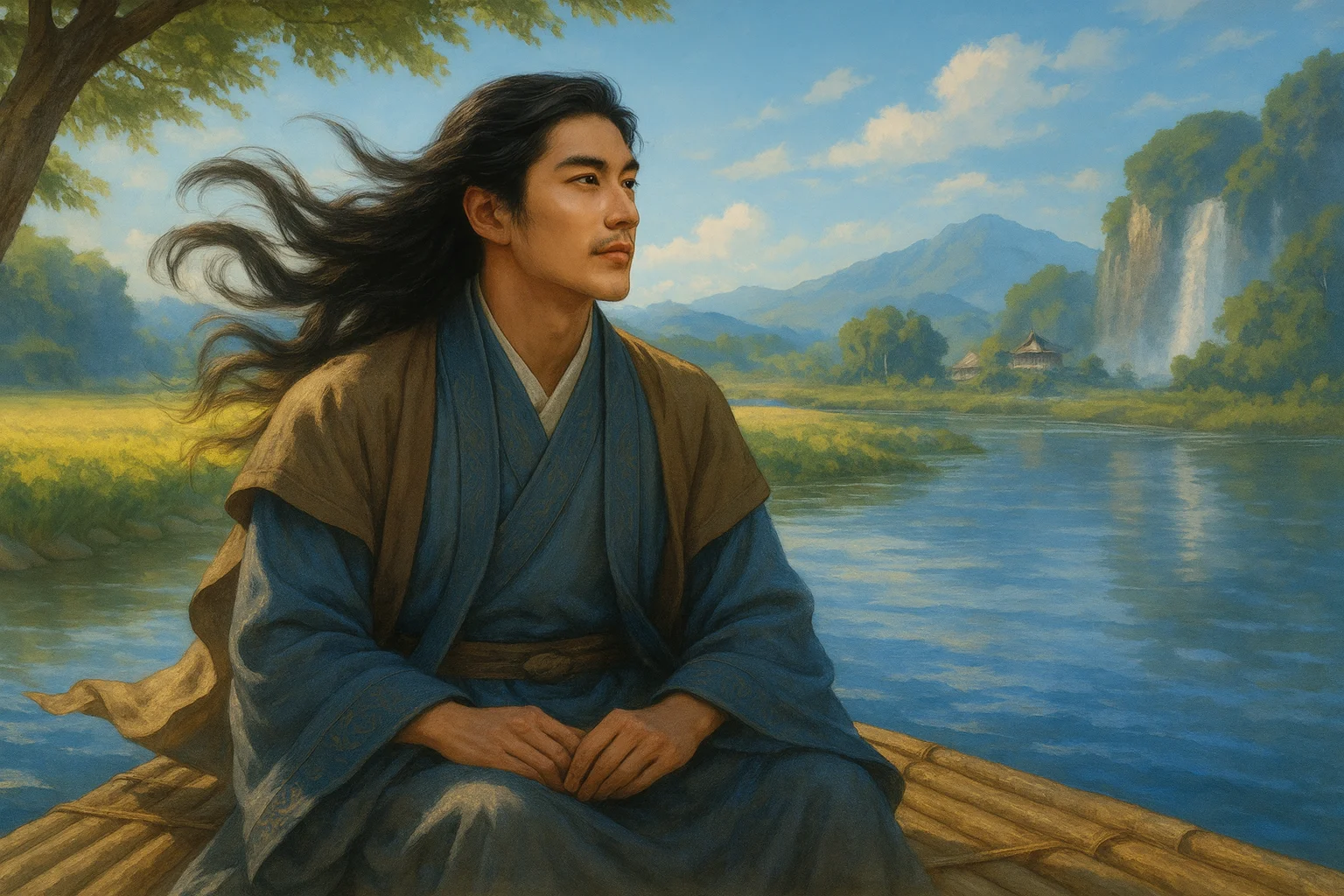
Meng Haoran (孟浩然), 689 - 740 AD, a native of Xiangyang, Hubei, was a famous poet of the Sheng Tang Dynasty. With the exception of one trip to the north when he was in his forties, when he was seeking fame in Chang'an and Luoyang, he spent most of his life in seclusion in his hometown of Lumenshan or roaming around.