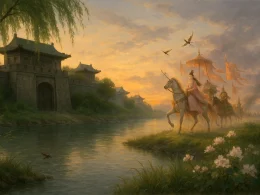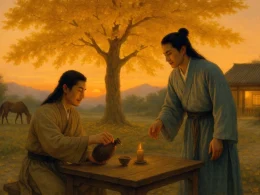

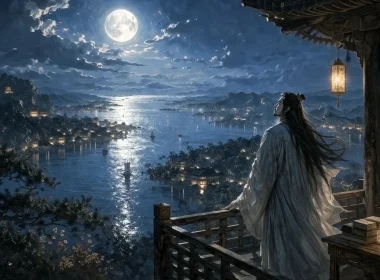
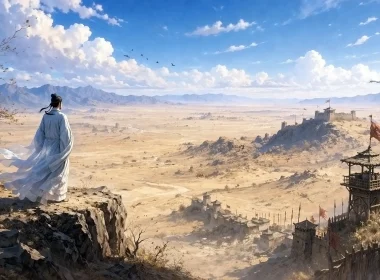
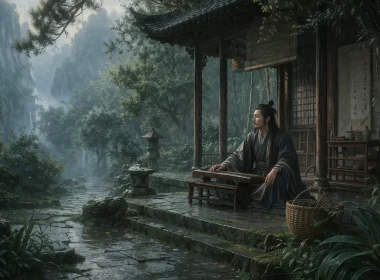
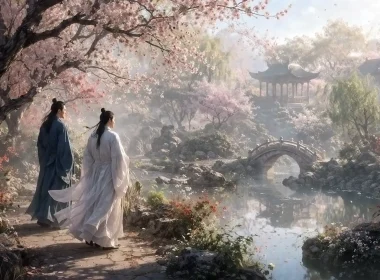

The soughing autumn wind is blowing;
Grieved, I complain my man is going.
We face each other eye to eye;
Before I speak, I sob and sigh.

My heart is like a winding stream,
How can I tell my dreary dream?
When I miss him after we part,
We can but share moonlight apart.
Original Poem
「古怨别」
孟郊
飒飒秋风生,愁人怨离别。
含情两相向,欲语气先咽。
心曲千万端,悲来却难说。
别后唯所思,天涯共明月。
Interpretation
This poem is an imitation of the old yuefu style by the Mid-Tang poet Meng Jiao (751–814), courtesy name Dongye, a native of Wukang, Huzhou (present-day Deqing, Zhejiang). Throughout his life he suffered poverty and repeated examination failures, finally passing the imperial examination at the age of forty-six, only to endure the loss of his son in his later years. His poetry often dwells on destitution, loneliness, and the coldness of the world; he is renowned for his "painstaking chanting" (kǔ yín) and is often paired with Jia Dao in the famous phrase "Jiao's chill and Dao's thinness." He excelled at expressing profound emotion in spare language, particularly skilled at depicting the sorrow of parting and the grief of life's disappointments.
This poem takes its theme from the old yuefu tradition, using an autumn departure as its setting to portray the touching scene of a couple parting in deep affection. The "whistling autumn wind" is both a seasonal touch and an externalization of inner feeling; "gazing at each other with tenderness" captures the frozen moment of farewell; "about to speak, the breath catches" renders the sob caught in the throat; "grief comes, yet words are hard to find" expresses the speechlessness of utter sorrow; and "sharing the bright moon across the horizon" becomes the寄托 of longing after parting. The poet unfolds the entire process of parting—from the stirring of the season, to the scene of farewell, to the inner turmoil, to the longing thereafter—layer by layer, with delicacy and truthfulness. Meng Jiao, having drifted through life and tasted the bitterness of separation, possessed an extraordinary understanding of the two characters "怨别" (lamenting parting). Though this poem is in the imitation style, every word flows from the depths of his heart—only one deeply versed in emotion could have written it.
First Couplet: "飒飒秋风生,愁人怨离别。"
Sà sà qiū fēng shēng, chóu rén yuàn lí bié.
The whistling autumn wind arises,
And the sorrowful one laments this parting.
The poem opens by evoking the atmosphere of parting with the autumn wind. "飒飒" (sà sà), an onomatopoeia for the autumn wind, conveys both the desolation of sound and the chill on the skin; "秋风生" describes the wind gradually rising, coming into being from nothing—as if the sorrow itself, like the autumn wind, spreads imperceptibly. The second line, "愁人怨离别," introduces the protagonist and the theme. The character "怨" (lament) sets the poem's tone—not a faint melancholy, not a light sadness, but a deep resentment, a powerless protest against fate's cruel arrangement of forced parting. This couplet begins with scenery and ends with emotion, blending the two and establishing the poem's mournful foundation.
Second Couplet: "含情两相向,欲语气先咽。"
Hán qíng liǎng xiāng xiàng, yù yǔ qì xiān yān.
With tender feelings, they gaze at each other;
About to speak, their breath catches first in sobs.
This couplet captures the moment of parting, the most moving scene in the poem. "含情两相向" describes the two facing each other, their eyes brimming with reluctant attachment and deep affection, all flowing in that silence; "欲语气先咽" portrays the attempt to speak, but before words can emerge, the throat is choked by sobs. The three characters "气先咽" are extraordinarily vivid and precise—not crying aloud, but words stopped at the lips by a surge of grief. A thousand words are contained in that voiceless sob; a thousand feelings in that gaze. The poet does not write what they said; he writes that they could not speak—and this is more powerful, more moving, than any words.
Third Couplet: "心曲千万端,悲来却难说。"
Xīn qǔ qiān wàn duān, bēi lái què nán shuō.
The heart's winding thoughts number a thousand, ten thousand strands;
When grief comes, it is hard to speak.
This couplet delves into the inner world, depicting the complex psychology of the departing ones. "心曲千万端" uses "曲" (winding) as a metaphor for the heart, suggesting the convoluted and tangled nature of their feelings—not one thing, not two, but a thousand entangled threads; "悲来却难说" writes that when sorrow reaches its peak, it defies expression. The two characters "难说" (hard to speak) both echo the previous line's "欲语气先咽" and deepen it: a moment ago they were merely choked with sobs; now they realize that even if they could speak, they would not know where to begin, because there is too much, too tangled, too deep. This couplet captures the inner complexity and helplessness of parting with penetrating insight.
Fourth Couplet: "别后唯所思,天涯共明月。"
Bié hòu wéi suǒ sī, tiān yá gòng míng yuè.
After parting, only longing remains;
Across the horizon, we share the bright moon.
The final couplet turns from the present to the future, from reality to imagination. "别后唯所思" writes that after parting, only endless longing accompanies them—the character "唯" (only) expresses both the singleness and the bitterness of longing, for there is nothing else. The next line, "天涯共明月," closes the poem with an expansive image. The bright moon is both a real scene and an emotional emblem; it is both a witness to their separation and a bridge connecting them. From now on, though separated by vast distances, they can still share the same moon; though they cannot meet, they can sense each other's presence in its light. The character "共" (share) elevates the sorrow of parting into a kind of aesthetic longing, bringing the poem to a close in deep feeling, with lingering resonance.
Overall Appreciation
This is an outstanding example of Meng Jiao's imitations of the old yuefu. In forty characters across eight lines, it takes an autumn parting as its entry point and weaves together environmental rendering, scene depiction, psychological portraiture, and post-farewell imagination into a rich and poignant emotional world.
Structurally, the poem presents a progression from outside to inside, from present to future. The first couplet begins with the autumn wind, establishing the season and theme and setting the poem's mournful tone; the second couplet depicts the scene of parting—"gazing with tender feelings" and "breath catching before words"—these are external expressions and gestures; the third couplet penetrates the inner heart—"a thousand winding thoughts" and "grief too hard to speak"—the inner psychological turmoil; the final couplet projects from the present into the future, closing with "sharing the bright moon," extending the feelings of parting from this moment into eternity. The four couplets move from scene to emotion, from outside to inside, from present to future, deepening layer by layer in seamless unity.
In terms of theme, the poem pivots on the contrast between the two characters "难说" (hard to speak) and the character "共" (share). At the moment of parting, a thousand words are caught in the throat, wanting to be spoken but impossible—this is "难说"; after parting, all longing has nowhere to go but to the moon—this is "共说" (shared speech)—the moon speaks the words they cannot say; its light is the voiceless voice of their hearts. This contrast between "wanting to speak but holding back" and "speaking without words through shared silence" is the poem's most moving quality: the deepest emotions often defy language; the truest longing is often deepest in its silence.
Artistically, the most striking quality is the subtle restraint of expressing deep feeling through silence. The poet does not write what the departing ones said, but that they could not speak; does not write how they wept, but that their breath caught in sobs; does not write how bitter the longing is, but that they share the same bright moon. This method of concealing emotion in silence and entrusting it to imagery embodies the highest ideal of classical Chinese poetry: "without a single word, yet fully capturing the spirit."
Artistic Features
- Blending of Scene and Emotion, Subtle and Implicit: The autumn wind evokes the sorrow of parting, the bright moon carries the longing; every description of scenery is a description of feeling, every image an emblem of the heart.
- Vivid and Penetrating Detail: The five characters "欲语气先咽" capture the moment of choked sobs with such lifelike precision that they move the reader instantly.
- Layered Psychological Portraiture: From the external gesture of "breath catching before words" to the inner monologue of "grief too hard to speak," the poem peels back the complex emotional world of the parting ones layer by layer.
- Closing with Scenery, Lingering Resonance: The final couplet, with "sharing the bright moon across the horizon," elevates the sorrow of parting into an aesthetic longing, where the words end but the meaning continues.
Insights
This poem, through a single autumn parting, voices an eternal truth: the deepest emotions often cannot be expressed in words; the truest longing often lies deepest in silence.
It first reveals to us the beauty of the unsaid. At the moment of parting, the gaze of "gazing at each other with tender feelings," the sob of "breath catching before words," the silence of "grief too hard to speak"—all carry more power than any words. True depth does not need constant verbal declaration; true understanding is often accomplished in silence.
On a deeper level, this poem invites us to reflect on the relationship between distance and longing. After parting, "only longing remains"—longing becomes the sole companion. Yet the poet does not remain in sorrow; he elevates longing into a spiritual connection through "sharing the bright moon." True love is not diluted by distance; true longing grows purer in separation.
And what is most moving is the poem's faith in depth without words. The parting couple makes no vows, no grand declarations, no dramatic weeping—they simply gaze in silence, sob in silence, and then long in silence. Yet it is precisely this "silence" that makes us believe their love can transcend time and space. True depth does not need vows to prove itself; true steadfastness does not need words to sustain it.
This poem speaks of parting in the ancient world, yet every reader who has experienced parting will find resonance in it. The whistling autumn wind is the sound at every parting ear; the choked sob before speaking is the catch in every reluctant throat; the shared bright moon across the horizon is the comfort in every longing heart's night sky. Such is the vitality of poetry: it writes the feelings of the ancients, yet speaks the parting sorrow of all.
Poem translator
Xu Yuanchong (许渊冲)
About the Poet
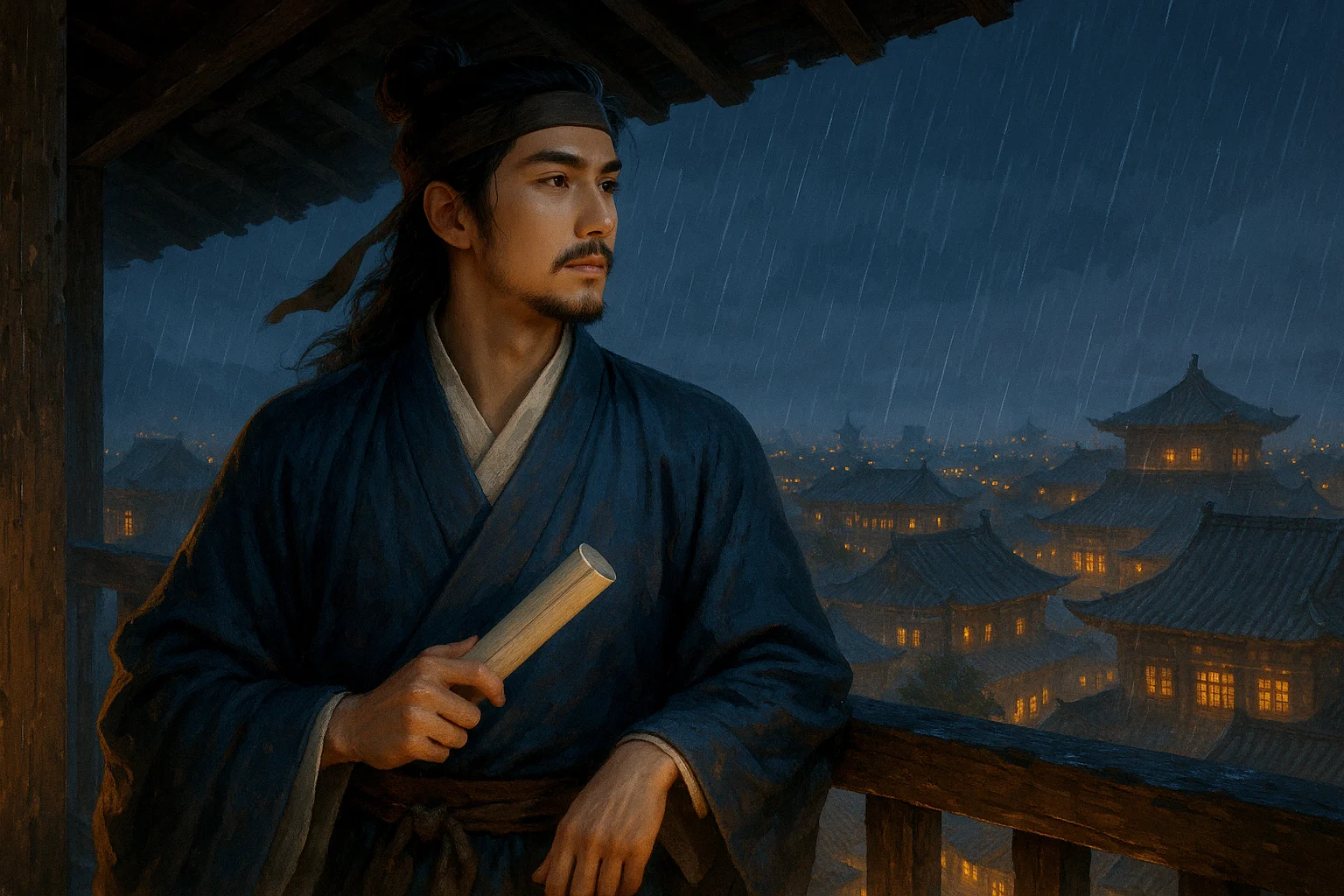
Meng Jiao (孟郊 751 - 814), a native of Deqing, Zhejiang Province, was a renowned poet of the Mid-Tang Dynasty. In his early years, he repeatedly failed the imperial examinations and only obtained the jinshi degree at the age of forty-six. He held minor posts such as Sheriff of Liyang, living a life of poverty and hardship. In his later years, he suffered the loss of his son and died while en route to a new official post. His poetry is renowned for its "bitter chanting" style, and he was often mentioned alongside Jia Dao, with Su Shi coining the famous phrase: "Jiao is lean, Jia is thin." His yuefu (Music Bureau) poems inherited the tradition of Du Fu and paved the way for Yuan Zhen and Bai Juyi, establishing a unique and distinctive place in the history of Tang poetry.