


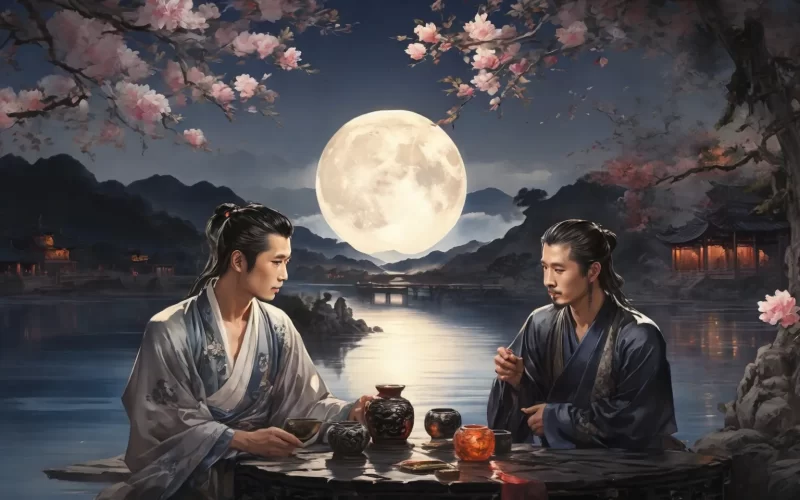
The fine clouds have opened and the River of Stars is gone,
A clear wind blows across the sky, and the moon widens its wave,
The sand is smooth, the water still, no sound and no shadow,
As I offer you a cup of wine, asking you to sing.

But so sad is this song of yours and so bitter your voice
That before I finish listening my tears have become a rain:

"Where Lake Tung-t'ing is joined to the sky by the lofty Nine-Doubt Mountain,
Dragons, crocodiles, rise and sink, apes, flying foxes, whimper.
At a ten to one risk of death, I have reached my official post,
Where lonely I live and hushed, as though I were in hiding.
I leave my bed, afraid of snakes; I eat, fearing poisons;
The air of the lake is putrid, breathing its evil odours . . . .

Yesterday, by the district office, the great drum was announcing
The crowning of an emperor, a change in the realm.
The edict granting pardons runs three hundred miles a day,
All those who were to die have had their sentences commuted,
The unseated are promoted and exiles are recalled,
Corruptions are abolished, clean officers appointed.
My superior sent my name in, but the governor would not listen
And has only transferred me to this barbaric place.
My rank is very low and useless to refer to;
They might punish me with lashes in the dust of the street.
Most of my fellow exiles are now returning home -
A journey which, to me, is a heaven beyond climbing."

...Stop your song, I beg you, and listen to mine,
A song that is utterly different from yours:

"Tonight is the loveliest moon of the year.
All else is with fate, not ours to control;
But, refusing this wine, may we choose more tomorrow?"
Original Poem
「八月十五夜赠张功曹」
韩愈
纤云四卷天无河,清风吹空月舒波。
沙平水息声影绝,一杯相属君当歌。
君歌声酸辞且苦,不能听终泪如雨。
洞庭连天九嶷高,蛟龙出没猩鼯号。
十生九死到官所,幽居默默如藏逃。
下床畏蛇食畏药,海气湿蛰熏腥臊。
昨者州前槌大鼓,嗣皇继圣登夔皋。
赦书一日行万里,罪从大辟皆除死。
迁者追回流者还,涤瑕荡垢清朝班。
州家申名使家抑,坎轲只得移荆蛮。
判司卑官不堪说,未免捶楚尘埃间。
同时辈流多上道,天路幽险难追攀。
君歌且休听我歌,我歌今与君殊科。
一年明月今宵多,人生由命非由他。
有酒不饮奈明何?
Interpretation
This poem was composed on the night of the Mid-Autumn Festival in 805 AD, the first year of the Yongzhen era under Emperor Shunzong of Tang, when Han Yu was forty-two years old. Zhang, the Officer of Merit, refers to Zhang Shu. He and Han Yu both served as Investigating Censors. In 803 AD, the 19th year of the Zhenyuan era, they were simultaneously demoted for angering powerful officials by submitting memorials on state affairs: Han Yu was demoted to Magistrate of Yangshan (present-day Yangshan, Guangdong), and Zhang Shu to Magistrate of Linwu (present-day Linwu, Hunan). In the eighth month of 805, Emperor Shunzong abdicated in favor of his heir, Emperor Xianzong ascended the throne, and a general amnesty was proclaimed. Both men went to Chenzhou (present-day Chenzhou, Hunan) to await new appointments. However, due to suppression by Yang Ping, the Surveillance Commissioner of Hunan, Han Yu was only reassigned as a Legal Officer in the Jiangling Prefecture administration, and Zhang Shu as an Officer of Merit in the same prefecture—still not permitted to return to the capital.
On the night of the Mid-Autumn Festival, these two companions in adversity drank wine facing the moon, pouring out their hearts to each other. The poem, through Zhang Shu's voice, recalls the brush with death during the journey into exile, the perils of the southern wilds, and the disappointment of hopes rekindled by the amnesty only to be suppressed again. Then, with his own song, the poet consoles his friend, urging him to cherish the bright moon before them and to take lightly the gains and losses of life. The poem is cleverly conceived, placing the hardships of personal fate against the eternal backdrop of the Mid-Autumn moon. Grandeur emerges from sorrow, detachment shines through deep pain, making it an excellent work among Han Yu's heptasyllabic ancient-style poems.
Stanza One: «纤云四卷天无河,清风吹空月舒波。沙平水息声影绝,一杯相属君当歌。»
Xiān yún sì juǎn tiān wú hé, qīngfēng chuī kōng yuè shū bō. Shā píng shuǐ xī shēng yǐng jué, yī bēi xiāng zhǔ jūn dāng gē.
Fine clouds roll back on four sides, sky shows no River; / Clear winds blow through empty space, moon spreads its waves. Sands level, waters still, all sound and shadow cease; / I offer you a cup—you ought to sing!
The opening four lines describe the Mid-Autumn night scene, with delicate strokes creating an ethereal atmosphere. «纤云四卷» describes the scattering clouds; «天无河» describes the concealed Milky Way—the moon is so bright, even the Silver River pales. The three words «月舒波» are especially fine, comparing the pouring moonlight to rippling water waves, transforming the static into the dynamic. The next two lines shift from scene to people. The stillness of «沙平水息声影绝» contrasts with the poet's inner unrest; it is precisely within this absolute silence that he raises his wine cup, urging his friend to sing aloud. This "urging" reflects both his high regard for their friendship and the expectation of dispelling sorrow through song.
Stanza Two: «君歌声酸辞且苦,不能听终泪如雨。洞庭连天九嶷高,蛟龙出没猩鼯号。十生九死到官所,幽居默默如藏逃。下床畏蛇食畏药,海气湿蛰熏腥臊。»
Jūn gē shēng suān cí qiě kǔ, bùnéng tīng zhōng lèi rú yǔ. Dòngtíng liántiān Jiǔyí gāo, jiāolóng chūmò xīng wú háo. Shí shēng jiǔ sǐ dào guān suǒ, yōu jū mòmò rú cáng táo. Xià chuáng wèi shé shí wèi yào, hǎiqì shī zhé xūn xīngsāo.
Your song's notes sour, its words moreover bitter; / I cannot hear it to the end, tears fall like rain.
Lake Dongting joins the sky, Mount Jiuyi towers high; / Dragons appear and vanish, apes and flying-squirrels wail. By ten chances born, by nine died, I reached my post; / Dwelt in seclusion, silent, like a fugitive in hiding. Afoot, feared snakes; eating, feared poison; / Sea-damp, steaming miasma, reeking rank and foul.
This section, through Zhang Shu's voice, unfolds a tearful indictment of life in exile. «歌声酸辞且苦» introduces the tone; «不能听终泪如雨» shows the power of its emotive force. The next six lines elaborate the suffering with two sets of imagery: first, the perils of the journey—«洞庭连天» describes the water's vastness, «九嶷高» the mountain's danger, «蛟龙出没» and «猩鼯号» evoke the terror of the wild southern lands. Then, the hardships of life—«十生九死» summarizes, «幽居默默» describes the mental oppression, «下床畏蛇» and «食畏药» describe daily fears, and «海气湿蛰熏腥臊» describes the vile environment. These six lines progress in layers, thoroughly depicting every aspect of exile life, making the reader's heart tremble.
Stanza Three: «昨者州前槌大鼓,嗣皇继圣登夔皋。赦书一日行万里,罪从大辟皆除死。迁者追回流者还,涤瑕荡垢清朝班。州家申名使家抑,坎轲只得移荆蛮。判司卑官不堪说,未免捶楚尘埃间。同时辈流多上道,天路幽险难追攀。»
Zuó zhě zhōu qián chuí dàgǔ, sì huáng jì shèng dēng Kuí Gāo. Shèshū yīrì xíng wànlǐ, zuì cóng dàpì jiē chú sǐ. Qiān zhě zhuī huí liú zhě huán, dí xiá dàng gòu qīng cháo bān. Zhōu jiā shēn míng shǐ jiā yì, kǎnkě zhǐdé yí Jīngmán. Pànsī bēi guān bùkān shuō, wèimiǎn chuí chǔ chén'āi jiān. Tóngshí bèiliú duō shàngdào, tiānlù yōu xiǎn nán zhuī pān.
Yesterday before the prefecture they beat the great drum; / The successor-king follows the sage, ascends to Kuí and Gāo. The pardon-edict in one day travels ten thousand miles; / Crimes from capital punishment downward—all have death remitted. The banished are recalled, the exiled return; / Flaws are cleansed, filth purged, the court ranks purified. The prefecture submitted names, the commissioner suppressed them; / Bumpy the road, I could but move to Jing and Man. A petty Judge-Officer's post is not worth mention; / Can't avoid the lash and cudgel in the dust. My fellows of that time mostly took the road upward; / The road to Heaven dark and perilous, hard to pursue and climb.
This section narrates the process of hopes rekindled by the amnesty only to be dashed, the emotions rising and falling dramatically. «州前槌大鼓» describes the clamorous scene of the pardon's arrival; «嗣皇继圣» places hope in the new sovereign. The speed of «赦书一日行万里» echoes the urgency in the poet's heart. «罪从大辟皆除死» brings joy; «迁者追回流者还» is joy upon joy. However, the line «州家申名使家抑» is like a blow to the head, shattering all hope. The two words «只得» in «坎轲只得移荆蛮» speak volumes of helplessness. The next two lines, «判司卑官» and «未免捶楚», powerfully describe the lowliness of the new post—not only humble in rank but also at any time subject to the humiliation of flogging, creating a stark contrast with the earlier expectation of «登夔皋». The final line, «天路幽险难追攀», refers both to the actual difficulty of the road back to the capital and is a despairing sigh over the treacherousness of officialdom.
Stanza Four: «君歌且休听我歌,我歌今与君殊科。一年明月今宵多,人生由命非由他。有酒不饮奈明何?»
Jūn gē qiě xiū tīng wǒ gē, wǒ gē jīn yǔ jūn shū kē. Yīnián míngyuè jīnxiāo duō, rénshēng yóu mìng fēi yóu tā. Yǒu jiǔ bù yǐn nài míng hé?
Your song, for now, cease; listen to my song; / My song today belongs to a different category from yours.
In a year of bright moons, tonight's is most; / Human life is ruled by fate, not by other things.
To have wine and not drink it—what will you do with the bright moon?
The conclusion shifts to the poet's own song of consolation. The first two lines interrupt the friend's lament with «君歌且休» and introduce his own attitude with «我歌殊科». «一年明月今宵多» describes both the actual scene before them and subtly suggests that the beautiful things in life, though few, are at this moment held in their hands. «人生由命非由他» is the pivotal line—not passive resignation, but calm acceptance after seeing clearly the impermanence of fate. The final line, «有酒不饮奈明何», concludes with a rhetorical question, dissolving all reflection into a cup of wine: since fate is uncontrollable, one should cherish the present, drink freely facing the moon, and not fail to appreciate this night.
Holistic Appreciation
This poem is a model of Han Yu's "using poetry as a letter." Its artistic achievement lies first in using a "song-exchange" structure to achieve polyphonic expression of emotion. The poem consists of three sections: the first is a prelude, describing the moonlit night and urging a song; the second, through Zhang Shu's voice, elaborates the bitterness of exile; the third, with his own song, consoles his friend to take lightly gain and loss. These three sections form a clear emotional contrast—Zhang Shu's song is full of grievous pain, Han Yu's song expresses philosophical detachment. Yet these two voices are unified under the eternal backdrop of the Mid-Autumn moon, creating a polyphonic artistic effect.
Particularly commendable is that the poet does not simply dismiss Zhang Shu's pain. Instead, he first lets his friend vent fully, then offers solace with the philosophical insight of «人生由命». This approach shows both understanding and respect for his friend's suffering and displays the life wisdom tempered through his own hardships. The line «州家申名使家抑» exposes corruption in Tang local administration, giving the lament of personal fate a depth of social critique. The words urging to drink, concluding with «有酒不饮奈明何», elevate all joy and sorrow into a cherishing of present life, offering the reader an eternal insight.
Artistic Merits
- Dual Narrative and Emotional Contrast
The poem unfolds along dual lines of «君歌» (your song) and «我歌» (my song). The friend's song is dominated by sorrow, powerfully depicting the bitterness of exile; the poet's song is dominated by magnanimity, expressing a philosophical acceptance of fate. The two form a sharp contrast, yet are unified within the specific time and space of the Mid-Autumn night, creating rich and multi-dimensional emotional layers. - The Verisimilitude and Generalizing Power of Detail
Lines like «下床畏蛇食畏药» describe the perils of daily life; «海气湿蛰熏腥臊» describes the foulness of the environment. These details are concrete and minute, making the bitterness of exile not an abstract concept but tangible, visceral pain. Simultaneously, generalizing expressions like «十生九死» and «坎轲只得» give these details universal significance. - Variation in Linguistic Tension and Release
When elaborating suffering in the earlier section, the language is dense, the phrasing compact, like a torrential downpour. When consoling his friend in the latter section, the language becomes open and expansive, the phrasing relaxed, like a gentle breeze. This rhythm of tension and release in language perfectly corresponds to the emotional shifts. - Skillful Use of Rhetorical Question and Symbolism
The conclusion, «有酒不饮奈明何», ends with a rhetorical question, dissolving all reflection into unspoken resonance. The image of the Mid-Autumn moon is both the actual scene before them and a symbol of eternity and beauty, forming a stark contrast with the brevity of life and the hardships of an official career, deepening the poem's philosophical depth.
Insights
The core insight this poem offers contemporary readers concerns how to maintain the resilience of the spirit under the heavy pressure of fate. Han Yu and Zhang Shu suffered the same demotion, encountered the same suppression, facing nearly identical adversity. But their responses to hardship differed markedly: Zhang Shu wallowed in pain, his song «酸且苦»; Han Yu, after listening to his friend's lament, chose to console himself with «人生由命非由他» and to comfort his friend with «有酒不饮奈明何».
This is not a simple distinction between "optimism" and "pessimism" but reflects two different attitudes toward life. Han Yu's «由命» is not passive resignation, but, after recognizing the uncontrollability of fate, he still chooses to cherish the present and treat himself well. The word «多» in «一年明月今宵多» reveals his value orientation: fate can strip me of my official career, but it cannot deprive me of my right to admire the bright moon; it can restrict my actions, but it cannot limit the freedom within my heart.
This ability to still discover beauty and enjoy the present amidst hardship is precisely the spiritual quality most needed by modern people. We may not control external circumstances, but we can choose how to face them—whether to wallow in the self-pity of «歌声酸辞且苦», or to raise the wine cup and say to the bright moon: Tonight, I shall not fail to appreciate you. Han Yu's poem tells us: The truly strong person is not one who has no tears, but one who, with tears in their eyes, can still admire the moonlight and raise a cup in free-spirited drinking.
Poem translator
Kiang Kanghu
About the Poet
Han Yu (韩愈, 768 - 824), a native of Mengzhou, Henan Province, he was the leader of the Ancient Prose Movement in the Tang Dynasty. He became a jinshi (presented scholar) in the eighth year of the Zhenyuan era (792 AD). His prose was vigorous and powerful, and he patronized notable poets such as Meng Jiao and Jia Dao. Regarded as the foremost of the "Eight Great Masters of the Tang and Song Dynasties," Han Yu revolutionized both poetry and prose, exerting a profound and lasting influence. Later generations honored him as the "Literary Patriarch of a Hundred Generations."