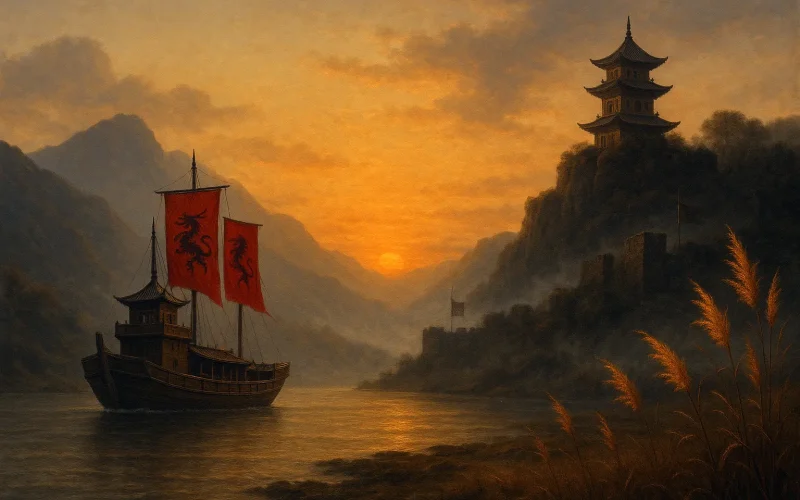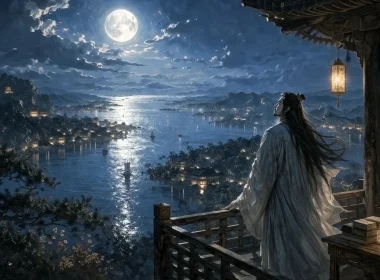
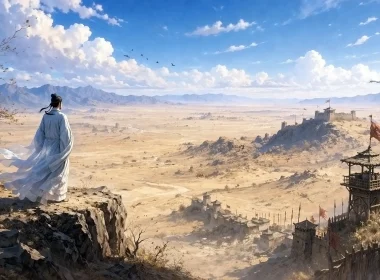
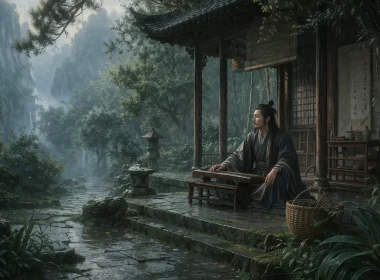
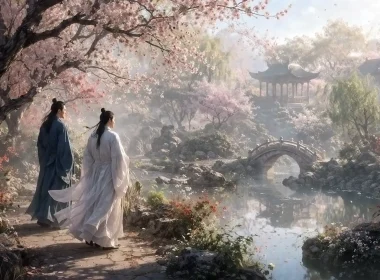
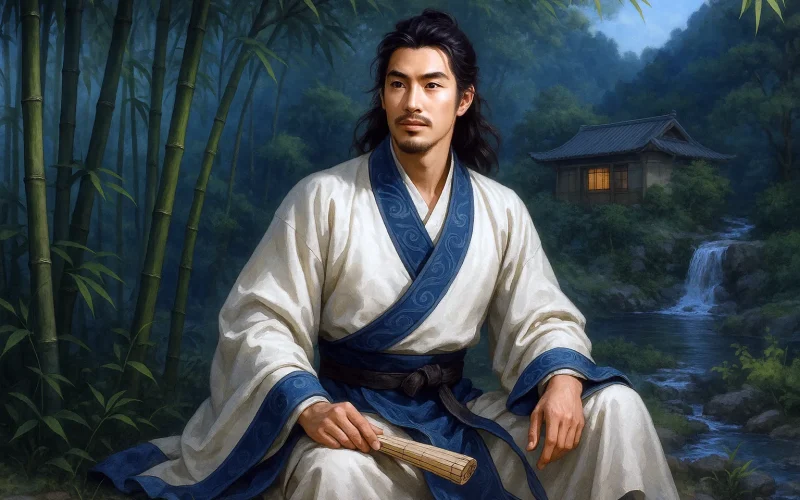
Liu Yuxi (刘禹锡 772 - 842), a native of Luoyang, Henan Province, was a renowned poet and philosopher of the Mid-Tang Dynasty. He passed the jinshi examination in the ninth year of the Zhenyuan era (793 AD). After the failure of the “Yongzhen Reform,” he suffered repeated exiles to Langzhou, Lianzhou, Kuizhou, Hezhou, and other places for as long as twenty-three years. His poetic style is vigorous and bold; his short poems are fresh and graceful, while his longer works are profound and powerful. Bai Juyi praised him as the “Hero of Poetry.” Unlike the declining style of the Dali era, his poetry carries a unique spirit of uplift and resilience, exerting a profound influence on later bold and unconstrained poets such as Su Shi and Lu You.
Major Works




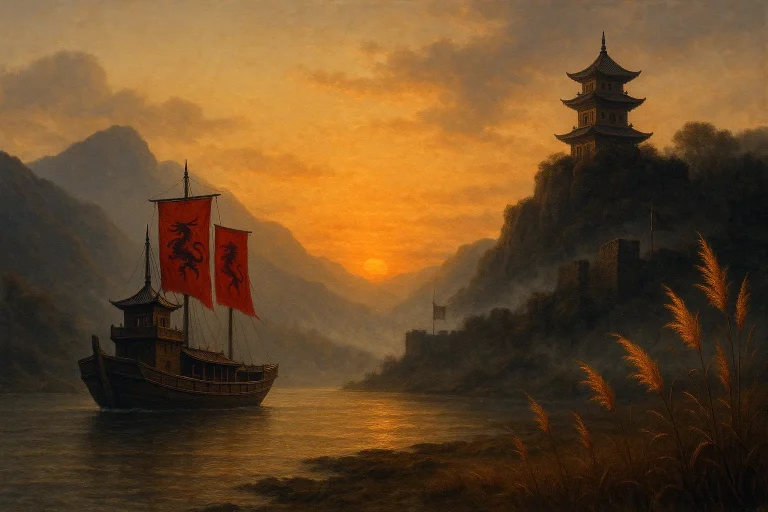

Life
There are some discrepancies in historical records regarding Liu Yuxi's ancestral home and lineage. According to the "Autobiography of Master Liu" which he wrote shortly before his death, he claimed to be a descendant of Liu Sheng, Prince Jing of Zhongshan. His ancestors originally belonged to the Xiongnu tribe, but his seventh-generation ancestor changed the family name to Liu by imperial decree during the reign of Emperor Xiaowen of the Northern Wei dynasty, and thereafter "the family was renowned for Confucian scholarship for generations." His father, Liu Xu, moved the entire family eastward to escape the An Lushan Rebellion and settled in Jiaxing. Liu Yuxi was born after his father's relocation, spent his childhood in the Jiangnan water town, and once went to Wuxing to study poetry under the monk-poets Jiaoran and Lingche, receiving a good literary education and immersion in Buddhist thought.
Liu Yuxi was intelligent and studious from a young age, harboring great ambitions. In the ninth year of the Zhenyuan era of Emperor Dezong (793 AD), the twenty-two-year-old Liu Yuxi went to Chang'an to take the imperial examinations and passed the Jinshi examination in the same year as Liu Zongyuan. Thereafter, he successively passed the Boxue Hongci and the Lishi Qu Shi examinations, and in the eleventh year of the Zhenyuan era (795 AD) was appointed Collator to the Crown Prince, a promising young talent with a smooth official career. In the sixteenth year of the Zhenyuan era (800 AD), he joined the staff of Du You, the Military Governor of Huainan, as Chief Clerk, participating in the campaign against the rebel army in Xuzhou, demonstrating extraordinary political talent, and winning Du You's high regard. In the eighteenth year of the Zhenyuan era (802 AD), he was transferred to the post of Recorder of Weinan County; the following year, he entered the court as a Censor, entering the central supervisory body of the court.
While serving as Censor, Liu Yuxi, together with Liu Zongyuan, Chen Jian, Han Ye, and others, formed a political group with Wang Shuwen at its core. At this time, Liu Yuxi was ambitious in his official career, harboring far-reaching political aspirations, and together with Liu Zongyuan became a core figure in Wang Shuwen's political reform. In the first year of the Yongzhen era of Emperor Shunzong (805 AD), when Emperor Shunzong ascended the throne, Liu Yuxi was promoted to Vice Director of the Bureau of State Lands, in charge of the Salt and Iron Revenue, assisting Du You and Wang Shuwen in rectifying finances and promoting reforms. This political movement, known as the "Yongzhen Reform," aimed to eliminate the long-standing abuses of eunuch monopoly, regional military governor separatism, and heavy taxation that had plagued the mid-Tang period. In its early stages, the reform achieved remarkable results, with "the markets rejoicing and the people greatly pleased." However, as the reform touched the fundamental interests of the eunuchs, regional military governors, and conservative court officials, and due to Wang Shuwen's inappropriate appointments and excessive haste, the reform group soon faced fierce backlash. In August of the same year, Emperor Shunzong was forced to abdicate in favor of his son, Prince Li Chun (Emperor Xianzong), marking the complete failure of the "Yongzhen Reform." The reform lasted only 146 days before ending in disastrous defeat.
After the failure of the Yongzhen Reform, Liu Yuxi, along with Liu Zongyuan and other core reformers, was demoted. In September, Liu Yuxi was first demoted to Prefect of Lianzhou (present-day Guangdong), but on the way was reassigned to be Military Advisor of Langzhou (present-day Changde, Hunan), where he lived in exile for nine years. This demotion was a major political blow to his life, yet it also gave him the opportunity to deeply observe the people's hardships and extensively experience the local customs of the Ba-Chu region, providing rich material for his later poetry.
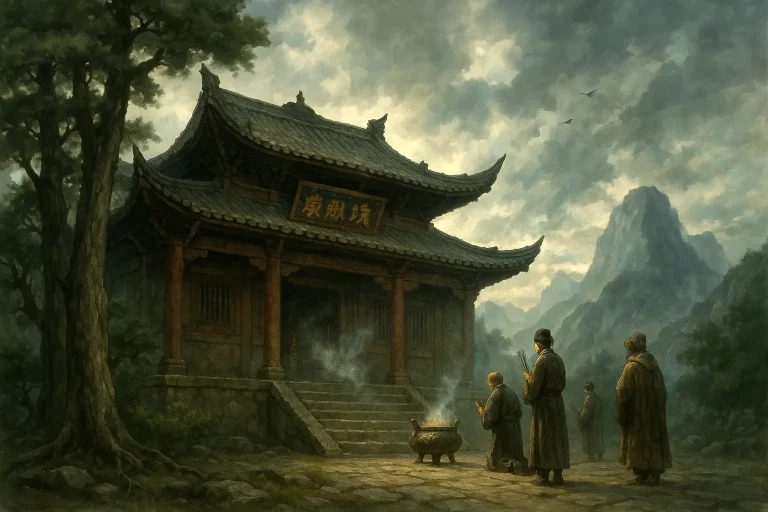
In the early tenth year of the Yuanhe era of Emperor Xianzong (815 AD), Liu Yuxi and Liu Zongyuan were recalled to the capital. However, Liu Yuxi had a resolute character and refused to submit to those in power. After returning to the capital, he visited the Xuandu Temple and wrote the poem "Playfully Presented to the Gentlemen Viewing Flowers on Being Recalled from Langzhou to the Capital in the Tenth Year of Yuanhe" (commonly known as "Visiting the Xuandu Temple and Singing of the Gentlemen Viewing Flowers"), with lines such as "玄都观里桃千树,尽是刘郎去后栽" that satirized the powerful, incurring the displeasure of the ruling faction. Liu Yuxi was demoted again, this time to Prefect of Lianzhou. Thereafter, he successively served as Prefect of Kuizhou and Prefect of Hezhou, wandering among the mountains and rivers of Ba-Chu for more than twenty years.
Throughout his long years of exile, Liu Yuxi, with his resolute character and optimistic spirit, persisted in his creative work even in adversity, leaving behind a large number of excellent poems. During his time in Langzhou, he wrote political satires such as "Song of the Gathering Mosquitoes," "Song of the Hundred-Tongued Bird," and "The Kite's Cry," using allegorical techniques to attack his political enemies. While in Kuizhou, he immersed himself in local culture, collected folk songs from the Bayu region, and created the famous nine "Bamboo Branch Songs," opening up a new field in Tang poetry. He also maintained poetic correspondence with his close friend Liu Zongyuan, who was in far-off Yongzhou, consoling each other and sharing the hardships of life. When Liu Zongyuan wrote "On Heaven" in response to Han Yu's "The Origin of the Way," Liu Yuxi immediately wrote three chapters of "On Heaven" to echo and support him, jointly advancing the development of Mid-Tang philosophical thought.
In the first year of the Dahe era of Emperor Wenzong (827 AD), Liu Yuxi was recalled to Luoyang and appointed Director of Receptions in the Eastern Capital. The following year, he returned to court and was again appointed Director of Receptions. In the fifth year of the Dahe era (831 AD), he was appointed Prefect of Suzhou, and later served as Prefect of Ruzhou and Prefect of Tongzhou. Beginning in the first year of the Kaicheng era (836 AD), Liu Yuxi was reassigned to the sinecure positions of Guest of the Crown Prince and Secretary of the Palace Library, with duties in the Eastern Capital, and later was given the honorary title of Minister of Rites. In his later years in Luoyang, he frequently exchanged poems with Bai Juyi, Linghu Chu, Li Deyu, and other leading figures in literature and politics, his life gradually becoming more leisurely.
Liu Yuxi lived through the reigns of eight emperors—Daizong, Dezong, Shunzong, Xianzong, Muzong, Jingzong, Wenzong, and Wuzong—yet rarely had the opportunity to fully exercise his political talents. In his early years, he suffered repeated political blows and the hardships of exile; in his later years, although he wished to achieve something in politics, the changed circumstances and increasingly intense political struggles made him feel that it was neither possible nor advisable to act. In the second year of the Huichang era of Emperor Wuzong (842 AD), Liu Yuxi died of illness in Luoyang at the age of seventy. Before his death, he wrote the "Autobiography of Master Liu," systematically reviewing his life. After his death, the court posthumously awarded him the title of Minister of Revenue, and he was buried in Luoyang.
Stylistic Characteristics
Liu Yuxi's poetry achieved extremely high distinction. More than 800 of his poems survive. His poetry covers a wide range of themes and forms. Both short pieces and long poems are mostly concise and lively, with a handsome and vigorous charm. They are infused with the wisdom of a philosopher and the sincere emotion of a poet, rich in artistic tension and heroic vigor. According to scholarly research, Liu Yuxi's highest achievements are found in three categories: political satirical poetry, poems on ancient sites, and "Bamboo Branch Songs."
The Title "Hero of Poetry" and His Vigorous Style
Liu Yuxi is known in literary history as the "Hero of Poetry" (Shihao). This title was bestowed by his close friend Bai Juyi. In his "Collected Explanations of the Exchanged Poems of Liu and Bai," Bai Juyi said: "Liu Mengde of Pengcheng is a hero of poetry. His poetic edge is so sharp that few dare to challenge him." Thereafter, "Hero of Poetry" became the definitive assessment of Liu Yuxi's poetic style. The character "hero" is rich in meaning, implying both heroic brilliance, praising Liu Yuxi's outstanding poetic talent and charm, and heroic boldness and defiance, reflecting his indomitable spirit. His vigorous style derived from three factors: first, his resolute, heroic, and straightforward character; second, his life of political ups and downs, which tempered him into an "unyielding and striving" individual; and third, his ability to draw on diverse sources, inheriting the tradition of High Tang poetry while borrowing from folk songs, making his poetry artistically exquisite and robust.
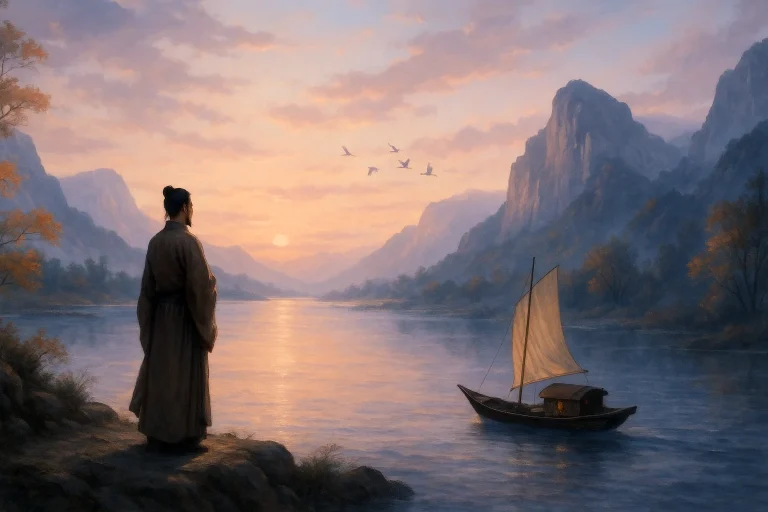
The quintessential example of Liu Yuxi's vigorous style is the couplet "沉舟侧畔千帆过,病树前头万木春" from "In Reply to Bai Juyi at Our First Meeting in Yangzhou." This poem was written in response to Bai Juyi when they first met in Yangzhou. In the winter of the second year of the Baoli era (826 AD), Liu Yuxi, having ended more than twenty years of exile, met Bai Juyi for the first time at Yangzijin. Bai Juyi, full of indignation and sympathy for Liu Yuxi's suffering, wrote the poem "Presented Drunkenly to Liu, the Twenty-eighth Envoy," containing the lines "诗称国手徒为尔,命压人头不奈何……亦知合被才名折,二十三年折太多." Liu Yuxi responded with "In Reply to Bai Juyi at Our First Meeting in Yangzhou." The first half laments the desolation of "巴山楚水凄凉地,二十三年弃置身," while the second half bursts forth with the triumphant "沉舟侧畔千帆过,病树前头万木春." Bai Juyi praised these two lines as "truly divine and marvelous; everywhere and anywhere, spiritual beings must protect them." Faced with twenty-three years of exile, Liu Yuxi did not wallow in bitterness but instead displayed a broad-minded attitude toward the vicissitudes of life and career, truly worthy of the title "Hero of Poetry."
Political Satirical Poetry
Liu Yuxi's political satirical poetry is another important manifestation of his heroic spirit. These poems, often written in allegorical form, attacked the powerful who had suppressed the Yongzhen Reform, covering a wide range of social phenomena. During his exile in Langzhou, Liu Yuxi wrote a series of political satirical poems, including "Song of the Gathering Mosquitoes," "Song of the Hundred-Tongued Bird," "The Kite's Cry," "The Clouded Mirror," and "Poem on the Fierce Bird," using images of mosquitoes, birds, eagles, and other animals to express his condemnation of social ills. For example, in "Song of the Gathering Mosquitoes," the lines "我躯七尺尔如芒,我孤尔众能我伤" expose the despicable nature of petty men; the concluding line of "The Kite's Cry," "鹰隼仪形蝼蚁心,虽能戾天何足贵," compares petty men to ants and expresses contempt for them with the rhetorical question "虽能戾天何足贵." These poems are so sharp that "few dared to challenge them."
Liu Yuxi's most famous satirical poem is "Playfully Presented to the Gentlemen Viewing Flowers on Being Recalled from Langzhou to the Capital in the Tenth Year of Yuanhe" (commonly known as the "Peach Blossom Poem"). After returning to the capital, he visited the Xuandu Temple and saw peach trees in full bloom, writing: "紫陌红尘拂面来,无人不道看花回。玄都观里桃千树,尽是刘郎去后栽." The poem uses "桃千树" as a metaphor for the newly powerful at court, and "尽是刘郎去后栽" satirizes the fact that these powerful figures only rose to prominence after reformers like him were demoted. When the poem circulated, it was said to have "offended those in power," and Liu Yuxi was again demoted, first to be Prefect of Bozhou, then changed to Prefect of Lianzhou. Fourteen years later, when Liu Yuxi was once again recalled to Chang'an, he even wrote another quatrain, "Again Visiting the Xuandu Temple," which ends with "种桃道士归何处,前度刘郎今又来." Using "the same old Liu" as a self-reference, he expressed his defiance and contempt for the powerful. This was no longer mere satire but an unyielding spirit that refused to submit even unto death.
Poems on Ancient Sites
Liu Yuxi's poems on ancient sites hold an important place in Tang poetry of this genre. His poems on ancient sites are both deeply melancholy and vigorous, with lofty artistic conception. He often expresses profound reflections on the rise and fall of dynasties and on life, evoking a strong sense of historical vicissitude and deep philosophical contemplation.
"Meditating on the Past at Xisaishan" is a representative work: "王濬楼船下益州,金陵王气黯然收。千寻铁锁沉江底,一片降幡出石头." Taking the historical event of the Jin dynasty's conquest of Wu as his starting point, the poet contrasts "千寻铁锁沉江底" with "一片降幡出石头" to reveal that no matter how strong the defenses, they cannot stop the tide of history. The poem is majestic and profound.
"Black Robe Lane" is the most widely recited of Liu Yuxi's poems on ancient sites: "朱雀桥边野草花,乌衣巷口夕阳斜。旧时王谢堂前燕,飞入寻常百姓家." Black Robe Lane was originally the residence of the two great noble families of the Eastern Jin dynasty, Wang Dao and Xie An, once a place of great prosperity. But by Liu Yuxi's time, it had become overgrown with weeds and bathed in the slanting rays of the setting sun. Using images of wild grass and the setting sun to evoke desolation, and noting that the swallows still return but to different homes, the poet conveys the great changes wrought by time. Short and profound, these twenty-eight characters express the rise and fall of dynasties and the impermanence of human affairs, a masterpiece for the ages.
"Stone City" is also a fine example: "山围故国周遭在,潮打空城寂寞回。淮水东边旧时月,夜深还过女墙来." Using the eternal natural scenes of mountains, tides, and the bright moon to contrast with the desolation of Stone City, the poet expresses deep emotion over the disappearance of the Six Dynasties' splendor. Liu Yuxi's poems on ancient sites are deeply melancholy, vigorous, and profound, with simple language carrying deep meaning, and have long been regarded as exemplary works of Tang poetry on ancient themes.
"Bamboo Branch Songs"
One of Liu Yuxi's most celebrated achievements is his collection and adaptation of folk songs. While exiled in Kuizhou, he immersed himself in local culture and extensively encountered the folk songs of the Bayu region, known as "Bamboo Branch Songs." These folk songs are "melodious and graceful, simple and beautiful," with lyrics that describe local customs and the love between men and women, rich in the flavor of everyday life. Deeply moved, Liu Yuxi created nine (or thirteen, according to some sources) "Bamboo Branch Songs" based on his study of these folk songs, pioneering a new field in Tang poetry in which literati learned from and composed folk-style songs. It is said that he not only collected the lyrics but could also sing them; a single clear song would bring tears to the eyes of all present.
The first of "Two Bamboo Branch Songs" is the most famous: "杨柳青青江水平,闻郎江上唱歌声。东边日出西边雨,道是无晴却有晴." The poem depicts a young woman hearing her lover singing on the river on a spring day when the willows are green and the river is calm. The line "道是无晴却有晴" cleverly uses the pun between "晴" (sunny) and "情" (affection), subtly expressing the young woman's excitement and uncertainty about love—she understands that her lover has her in his heart, just as the sky, though half rainy and half sunny, is ultimately sunny. This poem, with its simple yet vivid language and ingenious use of puns, has become a timeless masterpiece, fully demonstrating Liu Yuxi's exceptional artistic talent for "conveying deep meaning in simple words."
In addition, the "Bamboo Branch Songs" also include many works describing local customs, such as "山上层层桃李花,云间烟火是人家。银钏金钗来负水,长刀短笠去烧畲," which vividly record the production and lifestyle of the Bashu region. These poems are fresh, natural, healthy, and full of life's pleasures, breaking new ground in Tang poetry. Besides the "Bamboo Branch Songs," Liu Yuxi also composed many other works that draw on folk songs, such as "Willow Branch Songs" and "Waves Scouring Sand." These seven-character Music Bureau short poems adopt the melodic advantages of folk songs, with clear, flowing tones and distinct rhythms, suitable for singing.
Philosophical and Aspirational Poetry
Liu Yuxi's poetry also includes many philosophically rich works. These poems, whether expressing aspirations or describing scenes, often embody profound philosophical reflections within seemingly plain narratives, manifesting the fusion of a philosopher's wisdom and a poet's true feelings.
The couplet "沉舟侧畔千帆过,病树前头万木春" from "In Reply to Bai Juyi at Our First Meeting in Yangzhou" depicts the sight of thousands of sails passing by a sunken boat and ten thousand trees thriving in spring before a withered one, expressing a broad-minded attitude that transcends personal gain and loss and a firm belief in the future, inspiring countless people in adversity for centuries.
The first of "Two Autumn Poems" is a classic example of Liu Yuxi's aspirational poetry: "自古逢秋悲寂寥,我言秋日胜春朝。晴空一鹤排云上,便引诗情到碧霄." Since Song Yu's "Sad indeed is the autumn spirit," autumn had been a theme of sorrow in classical Chinese poetry. Liu Yuxi, with the bold declaration "我言秋日胜春朝," completely subverted this tradition, expressing the poet's uplifting spirit and his personal strength in the face of adversity. This represented an entirely new mentality of the exiled poet in Chinese literary history—from Qu Yuan to the Mid-Tang period, exiled poets generally wrote within the framework of "resentment." Only with the appearance of Liu Yuxi did a new style of "unyielding and striving" emerge.
The first of "Nine Poems on Waves Scouring Sand" takes the Yellow River as its setting: "九曲黄河万里沙,浪淘风簸自天涯。如今直上银河去,同到牵牛织女家." The imagery is grand, the emotions rich; the magnificence of the Yellow River expresses concern for both the nation and the poet's personal destiny, reflecting the author's deep historical consciousness and strong sense of responsibility.
"Viewing Lake Dongting" shows another aspect of Liu Yuxi's landscape poetry: "湖光秋月两相和,潭面无风镜未磨。遥望洞庭山水翠,白银盘里一青螺." The poem describes the autumn night scene of Lake Dongting, using "镜未磨" to depict the calm surface of the lake and "白银盘里一青螺" as a metaphor for Junshan Island in the lake. The metaphors are novel and ingenious, the imagery clear and serene, offering the reader aesthetic pleasure and spiritual comfort.
Prose Achievements
Liu Yuxi was not only an outstanding poet but also an excellent prose writer and an active participant in the Classical Prose Movement. His prose is most accomplished in the discursive essay, with specialized essays covering philosophy, politics, medicine, calligraphy, and etiquette. His philosophical work "On Heaven" in three chapters discusses the material nature of heaven and analyzes the roots of the "theory of heavenly mandate," embodying materialist thought and holding an important place in the history of Chinese philosophy.
Liu Yuxi's most well-known prose piece is undoubtedly "Inscription of the Humble Room." According to tradition, this essay was written while he was serving as Prefect of Hezhou (824-826 AD), when Liu Yuxi was around fifty-two or fifty-three years old. The essay begins with the lines "山不在高,有仙则名;水不在深,有龙则灵," and then states "斯是陋室,惟吾德馨," expressing the author's noble character of being content in poverty and devoted to virtue, unwilling to follow worldly ways. Lines such as "苔痕上阶绿,草色入帘青。谈笑有鸿儒,往来无白丁" seamlessly blend the humble room's environment with the owner's aspirations, demonstrating the author's independent personality in the face of adversity. Although short, this essay is beautifully written, with an elevated artistic conception, and its expressed ideas resonate with the essence of traditional Chinese culture, making it widely known and a classic for the ages.
Exchange Poems and the "Liu-Bai" Pairing
Liu Yuxi's exchange poems from his later years are an important part of his oeuvre. From the second year of the Baoli era (826 AD) to the year of his death in the second year of the Huichang era (842 AD), from age fifty-five to seventy-one, nearly 70% of his poetic output consisted of exchange poems, with the recipients including leading figures in literature and politics such as Bai Juyi, Yuan Zhen, Liu Zongyuan, Niu Sengru, Li Deyu, and Linghu Chu. Among these, 62% were exchanges with his contemporary Bai Juyi.
The poetic exchanges between Liu Yuxi and Bai Juyi have become a celebrated story in Chinese literary history. The two were born in the same year (both in 772 AD), both had bumpy official careers, and after first meeting in Yangzhou, they became lifelong poetic friends. In their later years, they both lived in Luoyang, serving as officials while also living like recluses, often drinking and composing poetry together, exchanging verses. More than 100 of their exchange poems survive. Bai Juyi had the highest regard for Liu Yuxi's talent, saying "his poetic edge is so sharp that few dare to challenge him," and admitted, "I overestimate myself and often dare to compete with him." Facing old age, Bai Juyi wrote "On Old Age, Presented to Mengde," and Liu Yuxi responded with "In Reply to Bai Juyi on Old Age," the concluding line of which, "莫道桑榆晚,为霞尚满天," similarly expresses a heroic spirit that grows stronger with age. Liu Yuxi and Bai Juyi are known together as "Liu-Bai." The "New Book of Tang · Biography of Bai Juyi" records: "After Yuan Zhen's death, [Bai Juyi] became equally famous with Liu Yuxi, and they were called 'Liu-Bai'." Shen Deqian's "Tangshi Biecai" also states: "Among poets after the Dali era, Liu Yuxi surpasses Liu Zhangqing. Because he exchanged poems with Bai Juyi, they are called 'Liu-Bai'."
Literary Influence
Liu Yuxi holds an extremely important place in the literary history of the Mid-to-Late Tang and indeed of all Chinese literature. He was not only a great poet of the Mid-Tang but also an important prose writer and philosopher, achieving excellence in multiple fields.
The Title "Hero of Poetry" and Its Established Position in Literary History
Liu Yuxi was called the "Hero of Poetry" by Bai Juyi, and this assessment has become the definitive evaluation of his poetic style. Bai Juyi, in his "Collected Explanations of the Exchanged Poems of Liu and Bai," highly praised Liu Yuxi's poetry, saying "his poetic edge is so sharp that few dare to challenge him," fully affirming his status in the Mid-Tang poetic world. His vigorous and powerful poetic style stands out in the Mid-Tang, differing both from Han Yu's rugged strangeness and from Bai Juyi's plainness and accessibility, forming his own unique artistic style. Bai Juyi, commenting on his own exchanges with Liu Yuxi, said that "once we started exchanging, we could not stop," and admitted that "I overestimate myself," showing his sincere admiration for Liu Yuxi's poetic talent. Liu Yuxi's poems, whether short or long, are mostly concise and lively, with a handsome and vigorous charm, infused with the wisdom of a philosopher and the sincere emotion of a poet, rich in artistic tension and heroic vigor.
Lifelong Friendship with Liu Zongyuan
Liu Yuxi and Liu Zongyuan are known together as "Liu-Liu." Not only did they encourage each other and achieve distinction together in literature, but they also fought side by side in politics and shared life and death. They passed the Jinshi examination in the same year, served as officials in the same court, participated together in the Yongzhen Reform, were exiled together, recalled together, and exiled again. Their friendship has been described as "half a lifetime of drifting, lifelong good brothers." Liu Yuxi was exiled to Langzhou, Liu Zongyuan to Yongzhou. Although separated by thousands of miles, they constantly exchanged poems and writings, consoling and encouraging each other. On his way into exile, Liu Zongyuan once sent a poem to Liu Yuxi expressing their wish to "spend their later years as neighboring elders." In the fourteenth year of the Yuanhe era (819 AD), Liu Zongyuan died of illness in Liuzhou at the age of only forty-seven. Liu Yuxi was overwhelmed with grief and wrote a series of poems and essays to express his sorrow, including "Sacrificial Essay to Liu Yuanwai," "A Second Sacrificial Essay to Liu Yuanwai," and "Three Poems on Mourning Yuxi." In these works, lines such as "草圣数行留坏壁,木奴千树属邻家" and "柳门竹巷依依在,野草青苔日日多" describe the desolation of Liu Zongyuan's former residence, and the lament "纵有邻人解吹笛,山阳旧侣更谁过" expresses the infinite grief of losing his soulmate. This friendship, sharing life and death, is unique in Chinese literary history.
Collection of Folk Songs and the Innovation of "Bamboo Branch Songs"
One of Liu Yuxi's great contributions to Tang literary history is his collection, arrangement, and adaptation of folk songs. The "Bamboo Branch Songs" he wrote during his time in Kuizhou initiated a new tradition of literati learning from and composing folk-style songs. He combined the artistic features of Bayu folk songs—"melodious and graceful, simple and beautiful"—with the refined techniques of classical poetry to create a unique poetic style that is fresh, natural, healthy, and lively. The appearance of "Bamboo Branch Songs" not only greatly enriched the themes and styles of Tang poetry but also laid the foundation for the formation and development of the ci (lyric) form. Some of his six-character poems and new-style poems differ from regulated verse in their sentence patterns, rhythms, and rhymes, gradually evolving toward long-and-short-line verse, already anticipating the ci form. In addition, Liu Yuxi also composed two ci poems to the tune of "Remembering Jiangnan," which has a certain pioneering significance in the history of ci development.
Exemplary Status of Poems on Ancient Sites
Liu Yuxi's poems on ancient sites have long been regarded as exemplary works of the genre in Tang poetry. His masterpieces such as "Meditating on the Past at Xisaishan," "Black Robe Lane," and "Stone City," with their profound historical insight, broad artistic conception, and refined language, became models for later poets to study and imitate. The line "旧时王谢堂前燕,飞入寻常百姓家," with its technique of seeing the great in the small, became a classic pattern for poems on historical themes, exerting a profound influence on the historical works of late Tang poets such as Li Shangyin and Du Fu, and Song poets such as Su Shi and Wang Anshi.
The Cultural Symbol of "Inscription of the Humble Room"
Although short, "Inscription of the Humble Room" has become a symbol of the traditional Chinese spirit of being content in poverty and preserving one's integrity. The essay begins with "山不在高,有仙则名;水不在深,有龙则灵," states its theme with "斯是陋室,惟吾德馨," describes the environment with "苔痕上阶绿,草色入帘青," writes of social interaction with "谈笑有鸿儒,往来无白丁," expresses aspirations with "无丝竹之乱耳,无案牍之劳形," and concludes with "孔子云:何陋之有," perfectly integrating the Confucian spirit of contentment with virtue and the poet's personal reclusive tastes. For centuries, this essay has been regarded by scholars as a classic for self-cultivation, becoming an inseparable part of Chinese cultural tradition.
Philosophical Achievements: The Intellectual Contribution of "On Heaven"
Liu Yuxi also made important contributions to philosophy. His "On Heaven" in three chapters inherited and developed the ideas of Liu Zongyuan's "On Heaven," systematically discussing the material nature of heaven, pointing out that "heaven" is merely a natural phenomenon without will or purpose. He profoundly analyzed the social roots of the "theory of heavenly mandate" and put forward the famous proposition that "heaven and man overcome each other," arguing that humans can overcome nature through their own efforts and wisdom. This idea holds an important place in the history of Chinese philosophy as a materialist contribution. The philosophical debate he conducted with Han Yu and Liu Zongyuan on the relationship between heaven and man was a major event in the intellectual history of the Mid-Tang period.
Evaluations Through the Ages
Liu Yuxi enjoyed a very high reputation even during the Tang dynasty, and later critics have also given him high praise.
Bai Juyi, in his "Collected Explanations of the Exchanged Poems of Liu and Bai," said: "Liu Mengde of Pengcheng is a hero of poetry. His poetic edge is so sharp that few dare to challenge him." This is the most authoritative assessment of Liu Yuxi's poetic standing. The "New Book of Tang · Biography of Bai Juyi" records: "After Yuan Zhen's death, [Bai Juyi] became equally famous with Liu Yuxi, and they were called 'Liu-Bai'."
The Song poet Huang Tingjian commented: "Generally speaking, Liu Yuxi's Music Bureau short poems are superior to his long poems, and his poetry is superior to his other writings," fully affirming his achievements in Music Bureau poetry. Shao Bo of the Song dynasty, in his "Record of Things Heard and Seen by the Shao Family, Second Series," explicitly stated: "The title 'Hero of Poetry' was given to Liu Yuxi by Bai Juyi."
Shen Deqian of the Qing dynasty, in his "Tangshi Biecai," commented: "Among poets after the Dali era, Liu Yuxi surpasses Liu Zhangqing. Because he exchanged poems with Bai Juyi, they are called 'Liu-Bai'." In his "Shuo Shi Zui Yu," he also said: "He is paired with Bai Juyi because Liu and Bai have a 'Collection of Exchanged Poems'."
Modern scholars also hold Liu Yuxi in very high esteem. Wen Yiduo and other scholars consider him one of the most important poets of the Mid-Tang period, believing that the vigorous, heroic, and indomitable spirit expressed in his poetry represents the noble character of Tang intellectuals in adversity.
In summary, Liu Yuxi was one of the most outstanding literary figures of the Mid-Tang period, known in literary history as the "Hero of Poetry." His life was full of political ups and downs, but twenty-three years of exile did not extinguish his heroic spirit; rather, they inspired him to create a large number of outstanding poems. His poetry covers a wide range of themes and diverse styles: his political satirical poems are sharp-edged, his poems on ancient sites are deeply melancholy and vigorous, his "Bamboo Branch Songs" are fresh and natural, and his philosophical poems are vigorous and broad-minded, representing some of the highest achievements of Mid-Tang poetry. Lines such as "沉舟侧畔千帆过,病树前头万木春" from "In Reply to Bai Juyi at Our First Meeting in Yangzhou," "旧时王谢堂前燕,飞入寻常百姓家" from "Black Robe Lane," "东边日出西边雨,道是无晴却有晴" from "Bamboo Branch Songs," "晴空一鹤排云上,便引诗情到碧霄" from "Autumn Poems," as well as the prose masterpiece "Inscription of the Humble Room," have all become immortal classics in Chinese cultural tradition. His life-and-death friendship with Liu Zongyuan is a celebrated story in Chinese literary history, and his poetic exchanges with Bai Juyi established the "Liu-Bai" pairing in literary status. His character and his poetry, even a thousand years later, still convey the heroic spirit of "莫道桑榆晚,为霞尚满天" and the indomitable spirit of "前度刘郎今又来." This is the deepest spiritual connotation of the title "Hero of Poetry."