


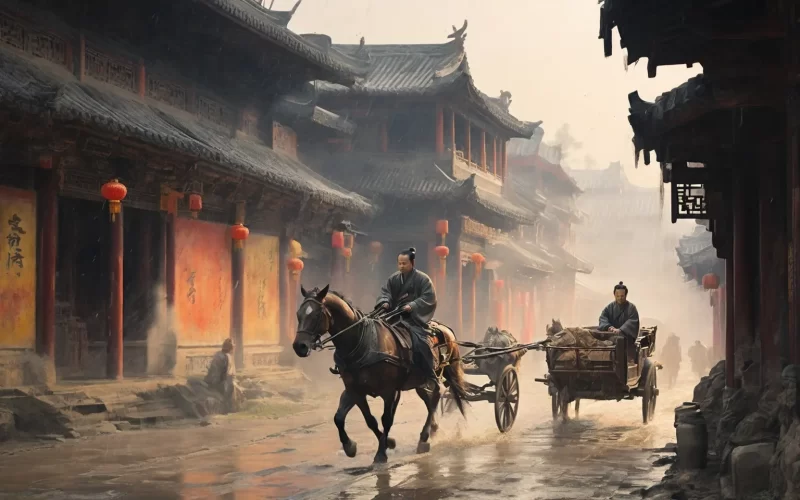
This is the road by which I fled,
When the rebels had reached the west end of the city;
And terror, ever since, has clutched at my vitals
Lest some of my soul should never return.
...The court has come back now, filling the capital;
But the Emperor sends me away again.
Useless and old, I rein in my horse
For one last look at the thousand gates.
Original Poem
「至德二载…有悲往事」
杜甫
此道昔归顺, 西郊胡正繁。
至今残破胆, 应有未招魂。
近得归京邑, 移官岂至尊。
无才日衰老, 驻马望千门。
Interpretation
This poem was composed in 758 CE, the first year of the Qianyuan era under Emperor Suzong of the Tang dynasty. The previous year (757 CE, the second year of the Zhide era), Du Fu had risked his life to flee the occupied capital Chang'an and made his way to Fengxiang, where Emperor Suzong was based, and was appointed Reminder of the Left. A mere year later, however, for his memorial pleading on behalf of Fang Guan, he angered the emperor and was demoted to Military Advisor of Hua Prefecture. As he once again passed through the Golden Light Gate of Chang'an on his way to exile, retracing the very path he had taken the year before to "pledge his allegiance" to the court, the contrast between past and present stirred profound emotions within him. This poem is the poignant expression of personal sorrow and national grief that burst forth from this spatial superimposition of the present "departure" and the past "return."
First Couplet: “此道昔归顺,西郊胡正繁。”
Cǐ dào xī guī shùn, xī jiāo hú zhèng fán.
This is the path where once to my sworn lord I fled, / While western suburbs seethed with savage horsemen bred.
The opening couplet seizes the poem's theme, plunging directly into the core scene of "grieving the past." The two words "This is the path" are intensely physical and full of tension. They compress the present moment (exile from the capital) and the past (the desperate, loyal journey to the court) into a single space, making the poet's footsteps heavy with historical weight. The three words "seethed with savage horsemen" coolly restore the perilous environment of that time—Chang'an fallen, rebel forces rampant—which in turn highlights the loyalty and courage of his "pledge of allegiance."
Second Couplet: “至今残破胆,应有未招魂。”
Zhì jīn cán pò dǎn, yīng yǒu wèi zhāo hún.
Still now my broken heart trembles at what I bore; / Who knows if all my scared soul has been called back once more?
Building on the previous couplet, this line delves deeper into the poet's inner trauma. "Broken heart" is a dual portrayal of both physiological and psychological states; the extreme terror of escaping in a time of chaos is engraved in bodily memory. "Who knows if all my scared soul has been called back" goes a step further. Using the subjunctive mood ("Who knows if"), it expresses a hazy truth: the poet feels that a part of his soul was perhaps left forever on that terrifying road of flight. This couplet materializes the "grief" of the past as a kind of enduring physical and mental tremor, achieving a profound depth.
Third Couplet: “近得归京邑,移官岂至尊。”
Jìn dé guī jīng yì, yí guān qǐ zhì zūn.
No sooner to the capital recalled, / Could I blame my sovereign for my new post being stalled?
The brush turns back to the present, in words that seem self-consolation but churn with inexpressible indignation. "No sooner to the capital recalled" and "my new post being stalled" form a swift, jarring turn, speaking to the unpredictability of worldly affairs and the perils of official life. "Could I blame my sovereign" is a classic example of the "resentful yet not angry" style. It transforms direct accusation into a circuitous rhetorical question and self-consolation. Yet behind the word "Could," grievances, resentment, and discontent with the court's lack of discernment are palpable.
Fourth Couplet: “无才日衰老,驻马望千门。”
Wú cái rì shuāi lǎo, zhù mǎ wàng qiān mén.
Talentless, I grow older with each day; / I rein in my horse, gaze toward palace gates away.
The final couplet condenses complex emotions into an eternal, sculptural image. "Talentless, I grow older with each day" is ironic, a bitter self-mockery gathering the immense sense of loss from unfulfilled ambition and empty years. The action "I rein in my horse, gaze toward palace gates away" is the ultimate destination of the poem's emotion—despite all the grievances, fears, and sorrows, the poet's backward gaze still holds deep attachment and an inextricable sense of duty toward the symbol of the state (the "palace gates"). The act of "rein[ing] in" and "gaz[ing]" contains boundless loyalty, regret, and desolation.
Holistic Appreciation
The charm of this poem lies in the dual temporalities and contradictory emotions strung together by a single road. Taking "This is the path" as its axis, the poet constructs immense psychological tension between the loyalty and bravery of the "pledge of allegiance" in the past and the disappointment of the "new post being stalled" in the present. The poem's emotional progression is somber, restrained, yet forceful: from the "terror" of recalling danger ("broken heart"), to the "suppression" of facing injustice ("Could I blame"), to the "lament" over one's own fate ("grow older"), finally culminating in the "attachment" of the backward gaze ("gaze toward"). This emotion is not expressed linearly but accumulates through layers of repression, circuitousness, and self-consolation, finally exploding in the static moment of "rein[ing] in" the horse, possessing a heart-shaking power.
Here, Du Fu reveals the true dilemma of a loyal minister caught between the vicissitudes of personal fate and the pull of national sentiment. His "grief" is not merely for personal career setbacks but also the universal disillusionment and perseverance experienced by an idealist within a complex political reality.
Artistic Merits
- Contrast of Past and Present, Superimposition of Time and Space
The core image, "This is the path," tightly interweaves the past (allegiance) and the present (exile), giving personal experience historical depth. The same space at different times carries utterly opposite life experiences, greatly enhancing the poem's sense of vicissitude and tragedy. - Psychological Portrayal, Deep and Minute
The poet's depiction of inner trauma is especially profound. "Broken heart" conveys the depth of terror; "my scared soul" speaks to the permanence of the wound. Both transcend the boundaries of traditional lyricism, touching upon the psychological scars left by war and political persecution, demonstrating Du Fu's profound insight into human nature. - Irony and Indirect Language, Subtle and Profound
"Could I blame my sovereign" and "Talentless, I grow older" both say one thing while meaning another. Superficially self-deprecating and self-consoling, they actually contain strong satire and indignation. This expression—"direct yet indirect, resentful yet not angry"—is an important manifestation of Du Fu's restrained and forceful style, enriching the poem's emotional complexity. - A Concluding Image Vast and Resonant
"The image of 'I rein in my horse, gaze toward palace gates away' concludes the poem with potent action and imagery, condensing all turbulent emotions into a static pose brimming with symbolic meaning. This posture contains attachment, questioning, despair, and an undying concern, creating a vast and resonant tableau whose emotional reverberations linger long after the poem ends."
Insights
This work shows us that true loyalty and devotion are often accompanied by trauma, grievance, and disappointment. Du Fu's experience reveals a profound paradox of life: the most fervent longing may lead to the most painful loss; and the deepest loss sometimes precisely proves the sincerity and intensity of that initial longing.
The lesson this poem offers modern readers is this: faced with the vast gap between ideal and reality, how should one conduct oneself? Du Fu, with his "rein[ing] in my horse" and backward gaze, provides an answer—not simple cynicism or despondency, but rather, after recognizing reality's cruelty and accepting one's own wounds, still choosing to shoulder that profound sense of responsibility and attachment. It teaches us that true perseverance is choosing to move forward even after seeing all the costs; the noblest backward glance is one that, though tearful, never abandons the direction in which one first set out.
Poem translator
Kiang Kanghu
About the poet
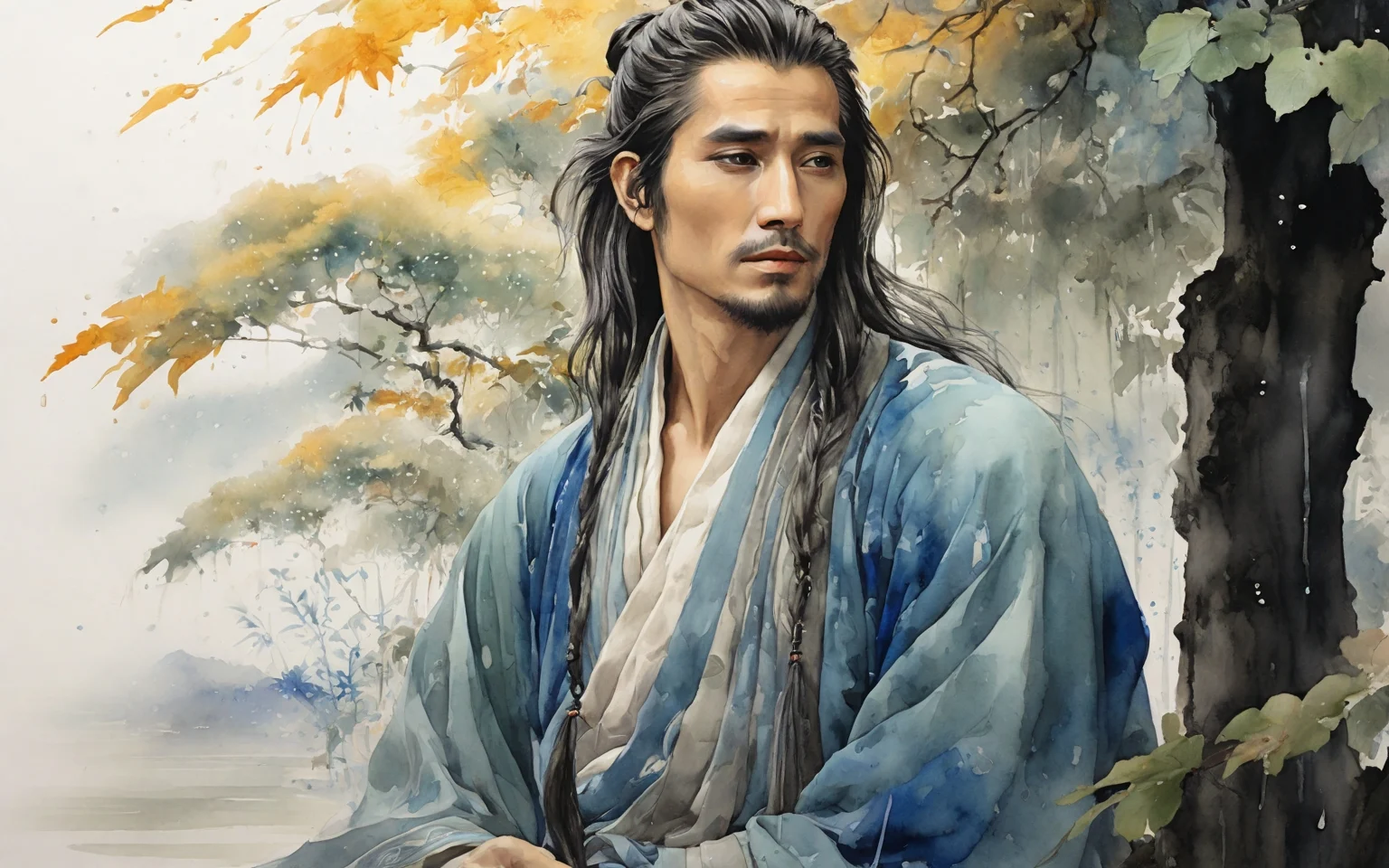
Du Fu (杜甫), 712 - 770 AD, was a great poet of the Tang Dynasty, known as the "Sage of Poetry". Born into a declining bureaucratic family, Du Fu had a rough life, and his turbulent and dislocated life made him keenly aware of the plight of the masses. Therefore, his poems were always closely related to the current affairs, reflecting the social life of that era in a more comprehensive way, with profound thoughts and a broad realm. In his poetic art, he was able to combine many styles, forming a unique style of "profound and thick", and becoming a great realist poet in the history of China.