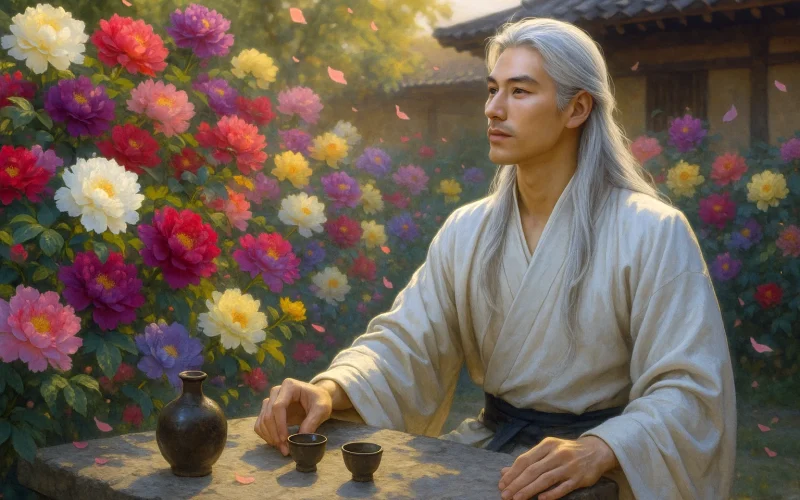
Before the flowers I drink today, with ease;
To drain a few more cups will surely please.

I fear, should flowers speak from where they grow,
“We bloom not for the aged here below.”
Original Poem
「饮酒看牡丹」
刘禹锡
今日花前饮,甘心醉数杯。
但愁花有语,不为老人开。
Interpretation
This poem was likely composed during Liu Yuxi's later years in Luoyang. During the Taihe era (827–835) of Emperor Wenzong, this "Poetic Hero," who had endured the failure of the Yongzhen Reform, exile to Langzhou and Lianzhou, and postings to Kui and He Prefectures, finally settled in Luoyang as the Crown Prince's Guest with duties in the Eastern Capital. A lifetime of hardships and repeated banishments never bowed his head in his poetry. He was the Tang poet most capable of bearing hardship with unyielding fortitude, yet this short poem reveals an extremely tender side of his nature.
By this time, Liu Yuxi was a man in his sixties. Luoyang's spring scenery arrived punctually each year; the peonies in his courtyard bloomed as gloriously as ever. He sat alone before the flowers, raising his cup. The flowers were so full, bright, and proud, while he was white-haired and aged. He was content to get drunk, yet he couldn't help harboring an almost childlike suspicion towards the flowers: Could it be that you disdain my old age, and that's why you won't bloom your fullest for me? This poem contains no political allegory, no sighs about his fate, not even the rugged defiance habitual to the "Poetic Hero." It is simply an old man, beneath spring blossoms, gently joking with himself. Yet it is precisely this unguarded candor that gives these twenty characters their heart-piercing power.
First Couplet: "今日花前饮,甘心醉数杯。"
Jīnrì huā qián yǐn, gānxīn zuì shù bēi.
Today, drinking before the flowers, / Content, I'll get drunk on a few cups.
The opening is exceedingly plain, yet each word has substance. "Today" specifies the uniqueness of this moment—not yesterday, not tomorrow, but this very present of perfect bloom. The poet did not invite friends to admire them together, did not bring a zither to enhance the mood; he is simply alone, sitting opposite the flowers. "Content" is the eye of the line. It is not the compulsion of drowning sorrows in wine, nor the helplessness of having to get drunk; it is an intoxication actively chosen. Within this intoxication lies an acceptance of the spring light, an embracing of solitude, and, even more, a reconciliation with old age. The poet needs to explain to no one why he drinks; he is simply before the flowers, surrendering himself to the wine.
"A few cups" is an understated measure—not greedy for more, not forcing it, stopping at just enough. This sense of proportion is precisely the posture of an old man drinking—knowing the taste of drunkenness, yet remembering the necessity of sobriety.
Second Couplet: "但愁花有语,不为老人开。"
Dàn chóu huā yǒu yǔ, bù wéi lǎorén kāi.
I only fear, if flowers could speak, / They'd say they don't bloom for the old.
This couplet is the poem's most moving and unexpected turn. The poet does not describe how he admires the flowers or their beauty; instead, he conjures a hypothetical worry out of thin air: Here I am, drinking myself into a contented stupor, but if the flowers could talk, might they look down on me? "If flowers could speak" is the imagination that instantly illuminates the entire piece. Flowers are inherently without feeling, yet the poet insists on endowing them with emotion, attitude, even aesthetic judgment. This stroke transforms the relationship between person and flower from "appreciation" to "mutual gaze"—the flowers are no longer a silent object but become a potential speaking subject. Thus, the poet is no longer an admirer of flowers, but rather a passerby awaiting judgment by them.
"They don't bloom for the old"—these five words are self-mockery, a touch of coquettishness, and, most subtly, a sigh for the passing years. "The old" refers to himself, unadorned, unconcealed. The poet frankly acknowledges his aging, frankly acknowledges how out of place this aging is before the glorious bloom of spring. But he does not complain, does not grieve; he merely says lightly, with a hint of a smile: You see, even the flowers probably won't bloom for me. This is Liu Yuxi's brand of optimism—not a lofty declaration, but a gentle self-mockery born of sedimentation. He speaks life's regret as a childlike conjecture.
Holistic Appreciation
This is a rare, soft hue in the poetic landscape of Liu Yuxi's later years. Twenty characters: the first ten describe the posture of drinking, the last ten describe the thought that arises while drinking. The posture is "content," open and active; the thought is "I only fear," slight and sensitive. Between this release and contraction, the complete psychological curve of an old man before spring blossoms is outlined.
The poem's deepest charm lies in its refusal to treat "old age" as a weighty topic. Liu Yuxi does not lament lost youth, does not bemoan a fate full of hardship, does not comfort himself with "the setting sun's beauty is infinite." He simply sits before the flowers, drinks his wine, and suddenly thinks: Might the flowers disdain me for being old? This thought is so naïve, so incongruous, yet so utterly real. It comes from an old man who has weathered the vicissitudes of official life, life and death, glory and disgrace, yet in that moment, it turns him back into a child full of conjectures about the world.
The peony was the most beloved flower of the Tang, its grace, lushness, and opulence themselves metaphors for youth and a flourishing age. Liu Yuxi chooses to write of peonies, yet writes of an old man who "dares not" meet the flowers' gaze. This dislocation is precisely the poem's core—he is not the master of the flowers, merely their passerby; not a conqueror of spring, merely spring's lodger. Yet he does not therefore leave the scene. He still sits before the flowers, content to get drunk. This "contentment" is the best answer to "they don't bloom for me."
Artistic Merits
- The Light Touch of Personification: "If flowers could speak"—these three words twist the relationship between object and self from static observation to dynamic dialogue. The poet does not write how he views the flowers, but how the flowers might view him. This reversal of perspective allows a mere ten characters to contain a dual perspective, dual states of mind.
- The Emotional Juxtaposition of "Content" and "I Only Fear": The "content" of the first couplet is active indulgence; the "I only fear" of the second is passive suspicion. One active, one passive; one unrestrained, one restrained—creating exquisite psychological tension. The poet is not uniformly optimistic; ripples remain beneath the optimism.
- Colloquial Tone of Self-Mockery: "They don't bloom for the old" is straightforward as speech, utterly unadorned. This colloquial self-mockery sheds the reserve and elegance of traditional literati flower poetry, granting the theme of aging an unprecedented intimacy and authenticity.
- Narrative Density with Extreme Conciseness: Within twenty characters are contained nearly ten layers of information: time (today), scene (before flowers), action (drink), state (drunk), psychology (content), hypothesis (I only fear), personification (flowers could speak), self-reference (the old). Each line advances; not a word is wasted.
- Resonance in the Unsaid: The poet does not describe the flowers' posture, the wine's taste, his own expression after getting drunk. He does not even answer that "fear"—would the flowers actually bloom for him or not? This unsaid space is precisely where the poem is most richly abundant.
Insights
This work tells us: Old age is not an enemy to be defeated, but an old friend with whom to make peace. Liu Yuxi struggled against fate all his life. After the failure of the Yongzhen Reform, exiled for a decade, upon his return he wrote, "Where is the Taoist who planted the peach trees gone? / The Liu Lang of before has come again!"—that was defiance towards power. Banished to Kui Prefecture, he wrote, "Sunken boats side by side, beyond, a thousand sails pass; / Sick trees ahead, ten thousand saplings greet the spring"—that was a declaration of war on time. But in this short poem, he lays down all his weapons. He does not compete with the flowers for spring, does not demand justice from time, does not justify himself. He merely, lightly, almost apologetically, conjectures that perhaps the flowers are unwilling to bloom for the old. Within this conjecture lies no anger, only understanding; no unwillingness, only acceptance. He can finally sit as an equal with his own old age, like two old friends who know each other inside out, sharing a drink, exchanging a smile.
Contemporary society has a profound anxiety about aging. We fight aging, fight wrinkles, fight white hair, using every means to reject the identity of "old." Yet Liu Yuxi, in this poem, actively speaks the word "old," forthrightly, without concealment. He does not feel it a disgrace, does not feel the need to pretend youth before the flowers. He simply sits there, drinks his wine, enjoying spring's final gift like any ordinary old man.
"I fear, should flowers speak from where they grow, we bloom not for the aged here below.”"—This line moves us not because it articulates the sorrow of aging, but because it articulates the honesty of aging. Only one who has truly accepted oneself dares say before flowers: You probably won't bloom for me.
A thousand years ago, on a Luoyang spring day, Liu Yuxi sat before peonies, drinking himself into a contented stupor. He did not know the twenty characters he casually wrote would be read, over a millennium later, by another old man in another spring. That old man, too, will raise his cup, look at the flowers outside his window, and smile lightly. He, too, will think: If flowers could speak, they probably wouldn't bloom for me either. But what does it matter? The flowers bloom theirs; I get drunk on mine.
About the poet
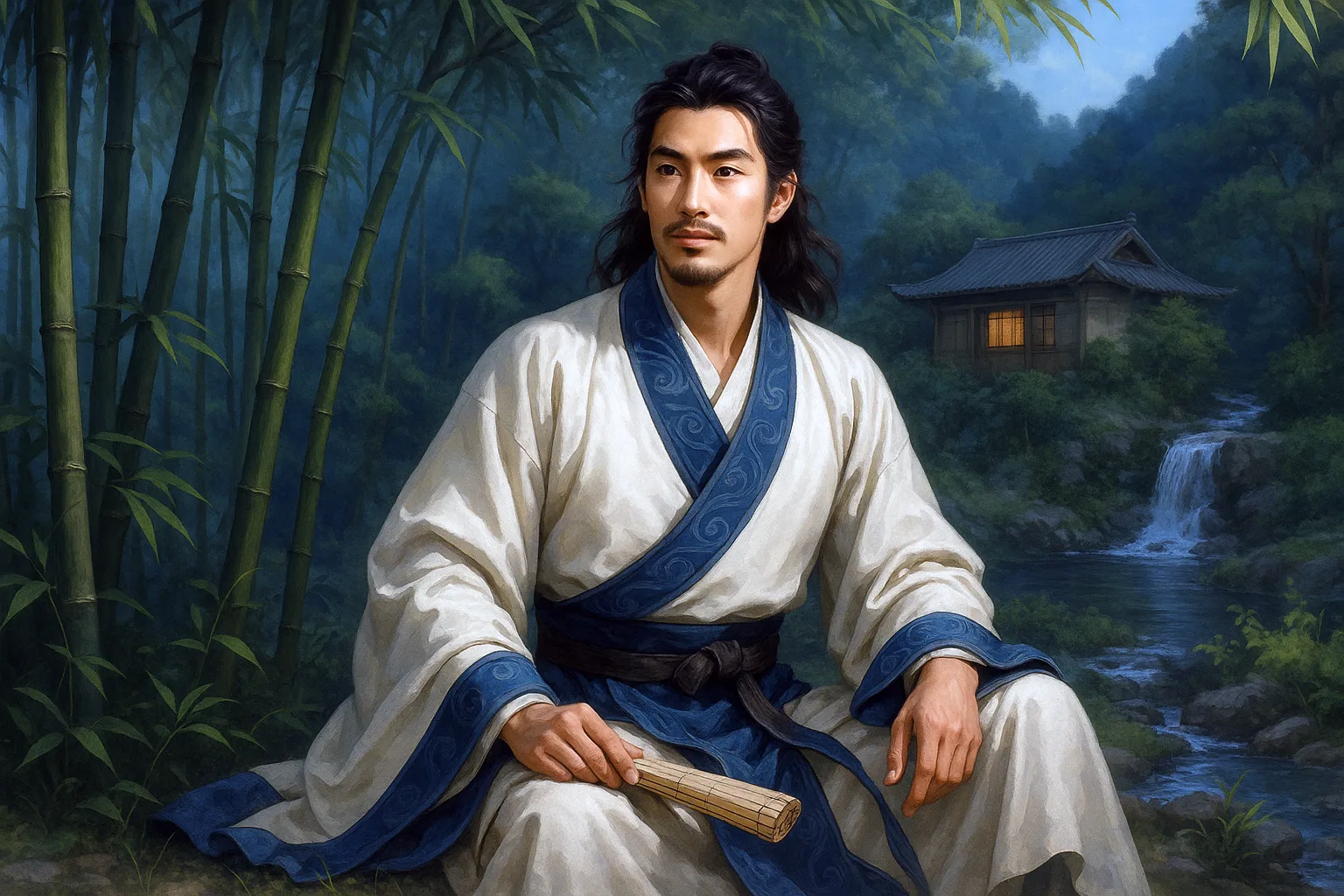
Liu Yuxi(刘禹锡), 772 - 842 AD, was a native of Hebei. He was a progressive statesman and thinker in the middle of the Tang Dynasty, and a poet with unique achievements in this period. In his compositions, there is no lack of poems reflecting current affairs and the plight of the people.