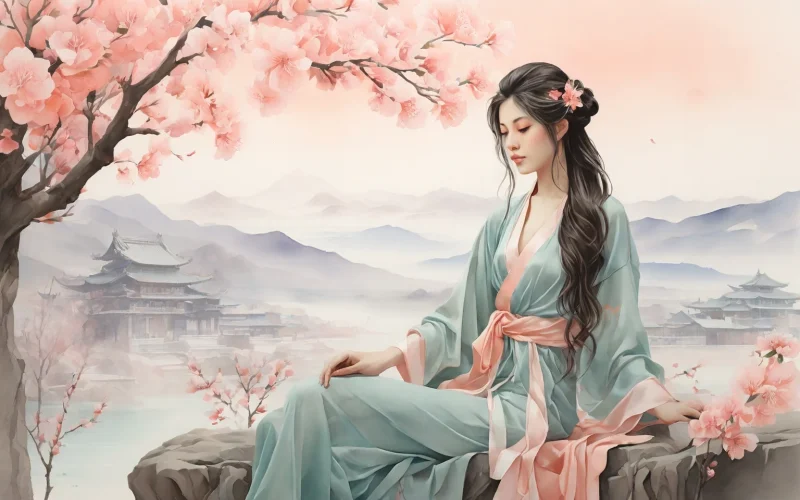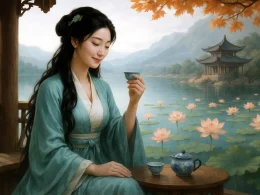



Pomegranate flowers in fifth moon dazzle the eye;
Among the boughs first fruits are seen, small and shy.
No coach or horse comes to this place, alas!
Red blooms on green moss lie, like stained glass.
Original Poem
「题张十一旅舍三咏 · 榴花」
韩愈
五月榴花照眼明,枝间时见子初成。
可怜此地无车马,颠倒青苔落绛英。
Interpretation
This poem was composed during the Yuanhe era of Emperor Xianzong of Tang. Han Yu, having angered powerful officials with his outspoken remonstrances, was demoted to the post of Magistrate of Yangshan (in present-day Yangshan, Guangdong). Yangshan was located in the Lingnan region, considered a wild and desolate place at the time. The poet, far from the Central Plains and living in a land of miasmic diseases, can be imagined to have been deeply depressed. Zhang Shiyi refers to Zhang Shu, a close friend of Han Yu. They attained the jinshi degree in the same year and were both demoted for their remonstrances—Zhang Shu to Linwu (in present-day Hunan) and Han Yu to Yangshan. The two places were adjacent, and they shared the same misfortune. On his way to the place of exile or during his banishment, Han Yu once stayed with Zhang Shu. Seeing pomegranate flowers in full bloom in his friend's courtyard, he was moved to write this poem that chants an object to express his feelings.
Pomegranate flowers bloom in the fifth month, red and fiery, a symbol of prosperity and liveliness, yet they bloom in this small, ignored courtyard of exile. Facing this scene, the poet naturally thinks of his own fate: full of talent, yet like these pomegranate flowers, blooming in a remote wilderness, unseen and unknown. The lonely image of "颠到青苔落绛英" (scarlet petals scattered and strewn on green moss) is precisely a portrayal of the solitary indignation in the poet's heart. Chanting the flower is chanting the man. The poem is both a comfort for his friend Zhang Shu and the poet's own self-consolation—even if no one admires them, the pomegranate flowers still dazzle the eyes; even in exile, one must still maintain the fervor and noble purity of life. In just four short lines, the words are brief but the meaning is long, fully displaying Han Yu's unyielding spirit in adversity.
First Couplet: "五月榴花照眼明,枝间时见子初成。"
Wǔ yuè liú huā zhào yǎn míng, zhī jiān shí jiàn zǐ chū chéng.
In the fifth month, pomegranate flowers dazzle the eyes with their brilliance;
Among the branches, one sees the first small fruits beginning to form.
The opening line, with the three characters "照眼明" (dazzle the eyes with brilliance), captures the intense lushness of pomegranate flowers with powerful visual impact. "照眼" (dazzle the eyes) means the light shines directly into the eyes, unavoidable; "明" (brilliance) means vivid and dazzling, resplendent as clouds at sunrise. These five characters are both realistic—in the southern land under the blazing sun of the fifth month, pomegranate flowers are indeed red and dazzling—and even more expressive: the fervor of life, the eruption of talent, cannot be suppressed even in a remote wilderness. The word "明" (bright/brilliant) refers both to the flower's brightness and the clarity of the heart. The next line, "枝间时见子初成" (Among the branches, one sees the first small fruits beginning to form), moves from flower to fruit, capturing the transitional moment of the pomegranate from bloom to fruit. The two characters "时见" (one sees from time to time) describe the poet's stance of lingering and gazing closely, and also hint at his sensitivity to and cherishing of the process of life. The flowers have bloomed; the fruits are beginning to form. This is the hope of nature and the poet's own undying expectation.
Second Couplet: "可怜此地无车马,颠倒青苔落绛英。"
Kělián cǐ dì wú chē mǎ, diāndǎo qīng tái luò jiàng yīng.
Alas, in this place there are no carriages or horses;
Scarlet petals scattered and strewn on green moss.
This couplet turns from splendor to solitude, from warmth to chill. The two characters "可怜" (alas) are the poem's emotional turning point, expressing pity for the flower and lament for oneself. "无车马" (there are no carriages or horses) points to the remoteness of the place, the scarcity of people—such brilliant flowers, if in the capital, would surely draw crowds of admirers. But in this small courtyard of exile, there are only the poet and Zhang Shu, two souls adrift, silently facing each other. The final line, "颠倒青苔落绛英" (scarlet petals scattered and strewn on green moss), concludes the poem with a scene of extreme beauty. "颠倒" (scattered and strewn) describes the disordered, natural way the petals fall; "青苔" (green moss) indicates the absence of people, with moss covering the ground; "绛英" (scarlet petals) are the red flower petals, forming a sharp contrast in color with the green moss. The scarlet petals fall on the green moss, unswept, unadmired, quietly rotting into mud. The scene is breathtakingly beautiful, yet utterly desolate. The poet does not write a single word of sorrow, yet sorrow is within; he does not utter a sentence of indignation, yet indignation is fully present in the scene.
Overall Appreciation
This is a typical work that uses an object to express the poet's aspirations. The entire poem of four lines and twenty-eight characters moves from the blooming of the pomegranate flowers to their falling, from external brilliance to inner solitude, hiding the shared pain of exile and frustration of unrecognized talent shared by the poet and his friend within the natural scene of bloom and fall.
Structurally, the poem shows a clear pattern of "introduction, development, turn, and conclusion." The first line, with "照眼明" (dazzle the eyes with brilliance), introduces the poem, describing the splendor of the pomegranate flowers like a sudden, striking peak. The second line, with "子初成" (first small fruits beginning to form), develops the theme, moving from flower to fruit, subtly containing hope. The third line, with "无车马" (there are no carriages or horses), makes the turn, shifting from splendor to solitude, from warmth to chill. The final line, with "落绛英" (scarlet petals fall), concludes, gathering everything into that image of fallen blossoms unseen by anyone. The four lines are tightly structured: the introduction is fervent, the development subtle, the turn profound, and the conclusion desolate. The composition is disciplined, forming a seamless whole.
In terms of conception, the core of this poem lies in its use of "contrast." The pomegranate flowers' "照眼明" (dazzle the eyes with brilliance) stands in sharp contrast with the courtyard's "无车马" (there are no carriages or horses)—the more brilliant they are, the more they highlight the solitude of the environment; the more lush, the more they reveal the sadness of being unadmired. This contrast is precisely a portrayal of the poet and his friend's fate: full of talent, yet cast away in a remote wilderness; in the prime of life, yet ignored by all. However, the poem contains no cries of despair, only the quiet falling blossoms and the pomegranate flowers that still "dazzle the eyes with brilliance." This exactly reveals the poet's unyielding character: even if no one admires me, I will still bloom fervently.
Artistically, the most exquisite aspect of this poem is "not writing a single word directly, yet capturing the essence completely." The entire poem does not directly mention a person, yet the person's shadow is visible everywhere—"照眼明" (dazzle the eyes) is a person's perception; "时见" (one sees from time to time) is a person's gaze; "可怜" (alas) is a person's sigh; "颠倒" (scattered and strewn) is a person's observation. The poet completely projects his own feelings onto the pomegranate flowers, letting the flower become his own embodiment, letting the falling blossoms become a metaphor for fate. This state of unity between object and self is precisely the highest aesthetic pursuit of classical Chinese poetry.
Artistic Features
- Using an Object to Express Aspirations, Profoundly Conveying Emotion: Using the bloom and fall of pomegranate flowers to metaphorize the poet's own talent and circumstances. Every line chants the flower, yet every line chants the person; object and self merge seamlessly.
- Vivid Contrast, Full of Tension: The fervent "照眼明" (dazzle the eyes with brilliance) and the desolate "无车马" (there are no carriages or horses) form a strong contrast, making the poem's emotion deeper and more moving. Using a joyful scene to write sorrow doubles the sorrow.
- Concise Language, Vivid Imagery: The three characters "照眼明" (dazzle the eyes) fully capture the flower's splendor; the two characters "颠倒" (scattered and strewn) fully capture the state of the fallen blossoms. The entire poem has not a single superfluous word, yet the meaning is rich.
- Vivid Colors, Strong Visual Imagery: The red of "绛英" (scarlet petals) and the green of "青苔" (green moss) form a strong visual contrast, creating a desolate yet poignantly beautiful picture. There is painting in the poetry, and poetry in the painting.
- Subtle and Implied, Endless Aftertaste: The poet does not directly express his grief and indignation but hides all emotion within the scenic description, leaving readers endless space for reflection. The words end, but the meaning is boundless, leaving much to ponder.
Insights
This poem, using the unadmired pomegranate flowers in the courtyard, speaks of the eternal pain of unrecognized talent, offering profound insights for later generations. It tells us: True value does not need external recognition to prove itself. The pomegranate flowers bloom in the remote courtyard of exile, without the clamor of carriages and horses, without the praise of visitors, yet they still bloom to "dazzle the eyes," still bear the "first small fruits." This life posture of not asking for reward, only tending to the work, is precisely the poet's response to his own fate—even in exile, even ignored, one must still maintain the fervor and noble purity of life. It enlightens us: The meaning of life lies not in how many people see you, but in whether you have lived as you ought to live.
Second, the desolate image of "颠倒青苔落绛英" (scarlet petals scattered and strewn on green moss) makes us contemplate the difference between "being seen" and "being understood." Those petals fallen on the moss are also a kind of beauty, but this beauty requires a discerning heart to discover. Though Zhang Shu's courtyard had no carriages and horses, it had Han Yu, a confidant. Though the pomegranate flowers had no crowds of onlookers, they were written into a poem by the poet, passed down through the ages. It reminds us: True soulmates lie not in their number, but in the depth of their understanding. Rather than longing for the attention of the multitude, cherish the one or two who can appreciate the beauty of your "fallen scarlet petals."
On a deeper level, this poem also lets us see the aesthetic capacity Han Yu maintained even in adversity. In exile, depressed in spirit, he could still pause for the pomegranate flowers that "dazzle the eyes," could still closely observe the subtle changes of "枝间时见子初成" (among the branches, one sees the first small fruits beginning to form). These senses that remain open amidst suffering are the most powerful weapon against despair. It tells us: No matter how difficult the circumstances, do not close your eyes and ears, do not stop feeling the world. Beauty is always there, waiting for us to discover it; and a heart capable of discovering beauty will never be completely lost.
About the Poet
Han Yu (韩愈, 768 - 824), a native of Mengzhou, Henan Province, he was the leader of the Ancient Prose Movement in the Tang Dynasty. He became a jinshi (presented scholar) in the eighth year of the Zhenyuan era (792 AD). His prose was vigorous and powerful, and he patronized notable poets such as Meng Jiao and Jia Dao. Regarded as the foremost of the "Eight Great Masters of the Tang and Song Dynasties," Han Yu revolutionized both poetry and prose, exerting a profound and lasting influence. Later generations honored him as the "Literary Patriarch of a Hundred Generations."