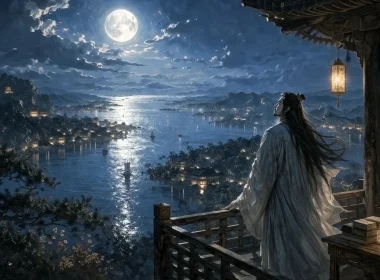
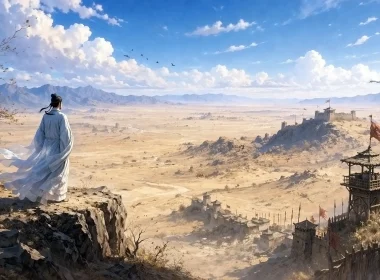
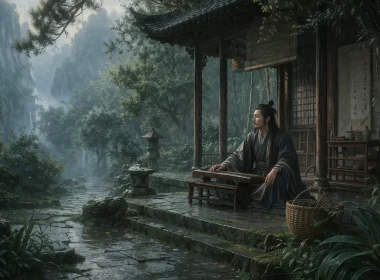
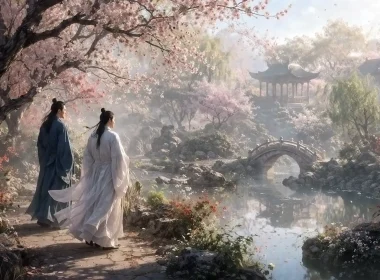
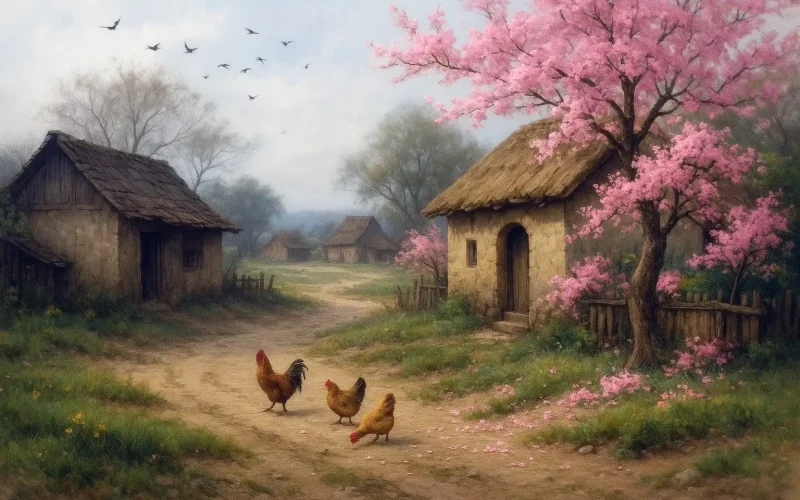
Crows swirl in the dusk above the desolate Garden of Liang;
Only two or three dwellings break the bleakness, stretching far and wide.

The trees in the courtyard do not know the people have all passed away;
Yet with the coming of spring, they put forth the same flowers as before, side by side.
Original Poem
「山房春事 · 其二」
岑参
梁园日暮乱飞鸦,极目萧条三两家。
庭树不知人去尽,春来还发旧时花。
Interpretation
This poem is the second piece in Cen SCan's series "The Mountain Lodge in Spring" Judging by its profound sentiment on the transience of glory and its accomplished artistic technique, it belongs to a period of the poet's life marked by deepened experience and contemplative thought. The "Liang Park" referenced in the poem refers to the East Garden constructed by Liu Wu, Prince Xiao of Liang during the Western Han Dynasty (its ruins are in present-day Shangqiu, Henan). It was once a flourishing site of elegant gatherings and literary compositions for scholars like Zou Yang, Mei Sheng, and Sima Xiangru. Visiting this location and witnessing the garden's desolation, Cen Can projected his own lament onto this historical site, rich with cultural memory.
This work is not a typical lyrical response to a scene. It is a silent conversation with the ghosts of history, a poetic inquiry into the relationship between "time" and "existence." The poet's choice of the "spring scene" perspective is particularly clever: spring is inherently a season of burgeoning life and renewal, yet the poet uses it to contemplate the "deathly stillness" and "oblivion" of a cultural ruin. The collision between the season's inherent qualities and the theme of lamenting the past creates a powerful irony and tension. This allows the short poem to carve out a realm of art distinct from Cen Can's majestic, unrestrained frontier verse—one that is deeply introspective and imbued with historical philosophy.
First Couplet: "梁园日暮乱飞鸦,极目萧条三两家。"
Liáng yuán rì mù luàn fēi yā, jí mù xiāo tiáo sān liǎng jiā.
At dusk o'er Liang Park, crows wheel in restless flight; / Far and wide, a dreary sight—two or three houses lone.
The opening establishes the poem's desolate, solitary tone. The poet chooses to enter at "dusk," a time of dimming light prone to evoke melancholy. "Crows wheel in restless flight" presents a dynamic clamor that, conversely, accentuates the deathly stillness and barrenness below; in traditional culture, crow cries are often associated with decline and ill omen. "Far and wide, a dreary sight" represents the poet's active visual search and emotional judgment, while "two or three houses lone" confirms the degree of this "dreary" state with a specific image—the former splendor of "three thousand guests on the terrace" has now shriveled into extreme desolation. These lines move from an upward gaze (crows) to a level view (houses), sketching with concise strokes a picture of a historical site fading with time, marginalized into a wasteland.
Final Couplet: "庭树不知人去尽,春来还发旧时花。"
Tíng shù bù zhī rén qù jìn, chūn lái huán fā jiù shí huā.
The courtyard trees, unaware that all the guests are gone, / Still put forth blooms of yesteryear when spring comes on.
This couplet is the soul of the poem, the point where emotion and philosophical thought converge. The poet shifts his gaze from the broad background to a specific living entity—the courtyard trees. Endowing the trees with the subjective state of being "unaware" is a masterstroke of personification. This "unaware" speaks volumes of the fundamental conflict between the eternal, indifferent laws of nature and the transience and fragility of human affairs. The trees follow their ancient biological rhythm; "still put forth blooms of yesteryear" when spring arrives. This in itself is a form of life's resilience and beauty. Yet, against the specific backdrop of "all the guests are gone," this "still put forth" appears glaringly harsh and ironic. It becomes a merciless contrast, a reminder of vanished glory and history's ruthlessness. The phrase "blooms of yesteryear" is especially poignant. It connects the past ("yesteryear") with the present ("still put forth"), yet uses the flower's unchanging nature to highlight the "utter change" in human affairs.
Holistic Appreciation
This heptasyllabic quatrain is a model of the classical "lamenting the past" genre, exemplifying "concluding with scene to convey feeling" and "seeing the large through the small." The entire poem depicts scenery; not a single word offers direct commentary or lyrical outburst. Yet, its deep lament for historical vicissitudes and complex recognition of time's power are completely infused into every scenic description and imagistic contrast.
The poem's structure is ingeniously crafted, forming multiple layers of contrast: "external-internal," "dynamic-still," "knowing-unknowing." The first two lines render the overall external environment (dusk, crows, houses)—the vista is broad, the atmosphere decaying. The last two lines focus on an internal detail in close-up (courtyard trees, spring blooms)—the picture is still, the imagery vivid. The crows' "restless flight" is noise within desolation; the trees' "still put forth" is silence within ignorance. The greatest tension, however, lies between human "knowing" (the poet sees the dreariness, knows the place is empty) and nature's "unawareness" (the trees still bloom). It is precisely this cognitive chasm that carves with penetrating depth the poet's (and all who lament the past) clear-sighted, yet unshared, historical loneliness.
The poem's language is refined to the extreme, having pared away almost all superfluity. Yet, phrases like "restless flight," "dreary sight," "unaware," and "still put forth" carry immense emotional weight and contemplative depth. In twenty-eight characters, Cen Can achieved a precise capture and poetic presentation of a sense of historical poignancy, its artistic power enduring and ever fresh.
Artistic Merits
- The Masterful Employment of Contrast: The core artistic technique of the entire poem lies in its multiple layers of contrast. It uses "spring's coming" (season of vitality) to contrast with "dreary" (scene of deathly stillness); uses "still put forth blooms" (nature's cyclical return) to contrast with "all the guests are gone" (the end of human culture); uses the trees' "unaware" (nature's obliviousness) to contrast with the poet's "deep knowing" (the vicissitudes of human affairs). This layered, progressive contrast deepens the sentiment of sorrow and lament with each turn, producing a powerfully moving artistic force.
- The Classical and Deepened Use of Imagery: "Dusk," "crows," "courtyard trees," "spring blooms" are all common images in classical poetry. Cen Can's excellence lies not only in combining these images but in granting them new relationships and resonance. Particularly, placing the "courtyard trees" alongside "all the guests are gone" and having the "spring blooms" blossom within the context of "yesteryear" allows these public images to acquire a fresh, personalized tragic beauty within the specific framework of historical reflection.
- The Exquisite Compression of Temporal-Spatial Structure: Within just four lines, the poem achieves a clever folding of time and space. "Dusk" is the present moment; "yesteryear" is the past. "Liang Park" is the specific space; "two or three houses" and "courtyard trees" are details within that space. Using the present desolation (space) as the base point, the poet awakens memory of past glory (time). Then, through the phenomenon of "still put forth blooms," he forcibly superimposes the past and present onto the same spatial point, creating a sense of poignant disorientation, as if history is reappearing "spectrally" before one's eyes.
- The Restraint and Resonance of Emotional Expression: The poet utters not a single sigh, sheds not a single tear. All surging emotion is suppressed beneath the calm description of scenery. Yet, the emotional cues in subtle places—the intense gaze implied in "far and wide," the profound irony in "unaware," the helpless inevitability in "still put forth"—are more powerful than direct lyricism. This aesthetic of restraint, where "what is left unsaid resonates more deeply than what is said," is one of the most moving traits of classical Chinese poetry.
Insights
This work is like a teardrop of time solidified in amber; the insights it offers are profound and far-reaching. First, it reveals the eternal struggle between historical memory and natural oblivion. Humans build cities and gardens, striving to leave the imprint of civilization, to resist time's flow ("Liang Park" symbolizes this very effort). Yet, time's ultimate ally is often nature: plants and trees are heedless, withering and flourishing with the seasons. They silently cover and absorb the tales of human rise and fall with their own cycle of life ("The courtyard trees, unaware…"). This prompts us to ponder: what is true persistence? Is it material traces inscribed on metal and stone, or the collective memory circulating within the human spirit?
Second, it demonstrates a clear-sighted and deeply poetic posture of mourning when facing historical ruins. Cen Can does not sink into facile sentimentality, nor does he engage in empty moralizing. He simply gazes intently and then records. This act of gazing is itself a form of respect and remembrance for history. The courtyard trees that "still put forth blooms of yesteryear"—in the poet's eyes, are they not, even as merciless objects of contrast, also messengers connecting past and present? In the form of blossoms, they signal the existence of the past, year after year. This enlightens us: True commemoration sometimes lies not in reconstructing the appearance of past glory, but in learning to recognize, amidst the desolation, those "blooms of yesteryear" that still stubbornly speak.
Ultimately, the poem elevates personal lament to a universal philosophical height. In each of our lives, there may be a "Liang Park"—a bygone period of splendor, a dissipated gathering of joy, a "time of yore" that is no more. When we look back in our spirit's "dusk," we see the "dreary" desolation of "all the guests gone," yet the "courtyard trees" of memory still "put forth blooms of yesteryear" within our hearts. This poem teaches us how to gaze upon the immense tension between this loss and this persistence with a poet's eye, and in that gaze, to place our own sense of poignant loss, attaining a transcendent aesthetic comprehension and emotional clarity.
About the poet
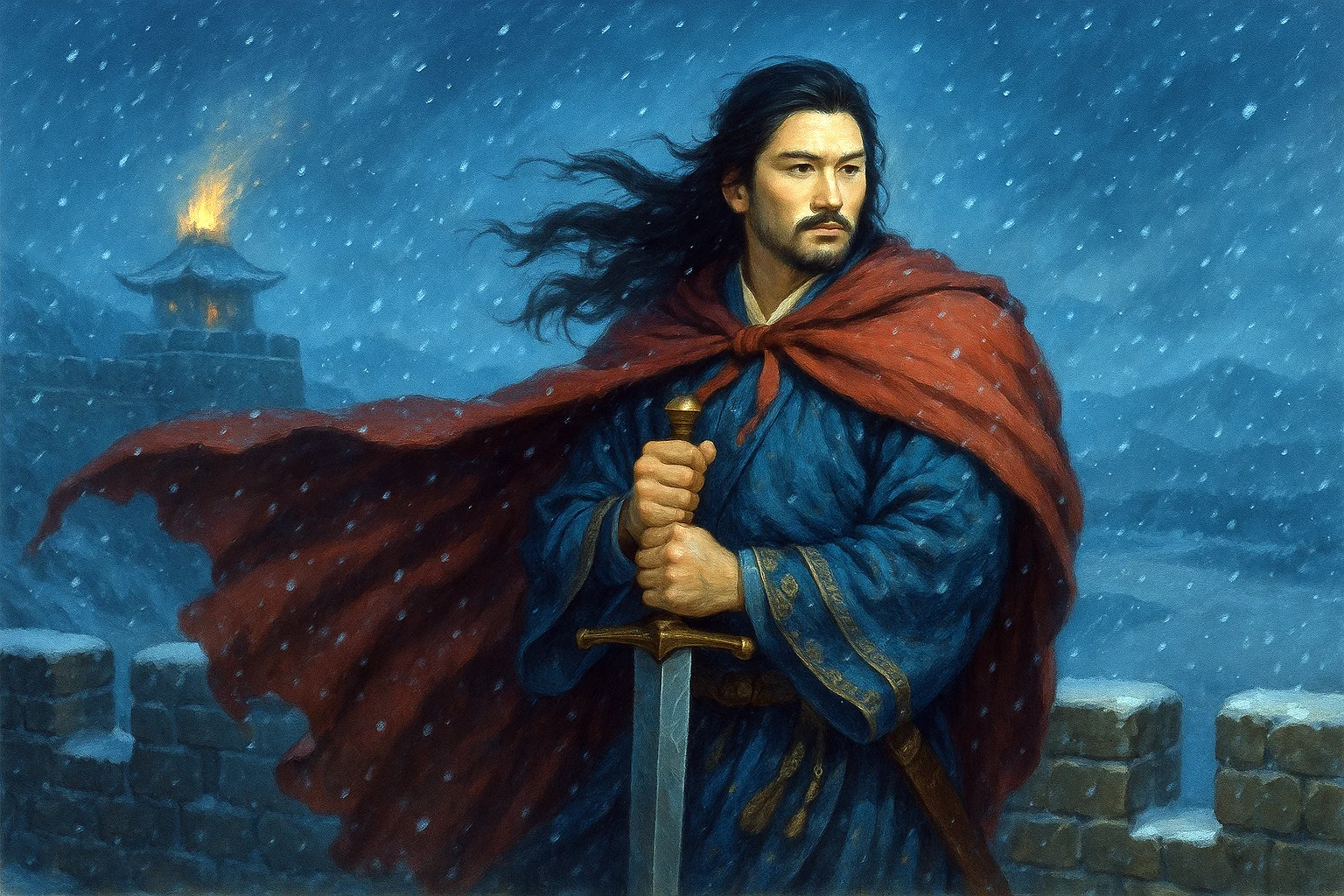
Cen Can(岑参), 715 - 770 AD, was a native of Jingzhou, Hubei Province. He studied at Mt. Songshan when he was young, and later traveled to Beijing, Luoyang and Shuohe. Cen Can was famous for his border poems, in which he wrote about the border scenery and the life of generals in a majestic and unrestrained manner, and together with Gao Shi, he was an outstanding representative of the border poetry school of the Sheng Tang Dynasty.