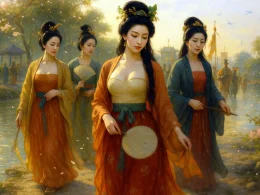


The capital's in parting spring,
Steeds run and neigh and cab bells ring.
Peonies are at their best hours
And people rush to buy the flowers.
They do not care about the price,
Just count and buy those which seem nice.
For hundred blossoms dazzling red,
Twenty-five rolls of silk they spread.

Sheltered above by curtains wide,
rotected with fences by the side,
Roots sealed with mud, with water sprayed,
Removed, their beauty does not fade.
Accustomed to this way for long,
No family e'er thinks it wrong.

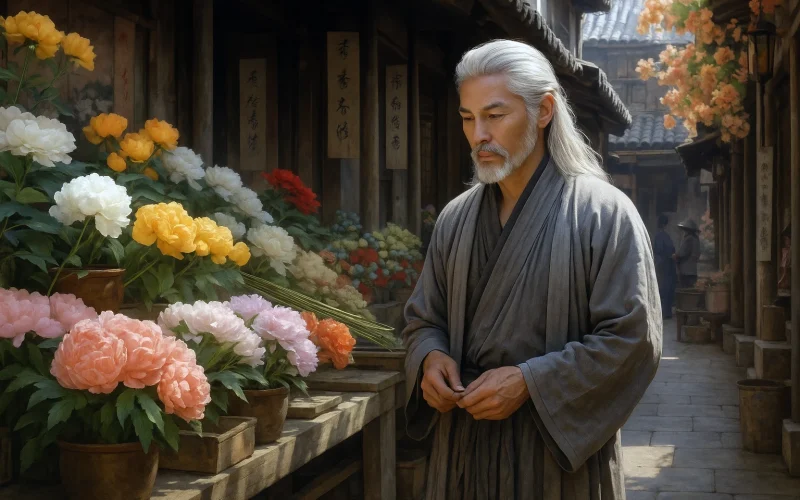
What's the old peasant doing there?
Why should he come to Flower Fair?
Head bowed, he utters sigh on sigh
And nobody understands why.
A bunch of deep-red peonies
Costs taxes of ten families.
Original Poem
「买花」
白居易
帝城春欲暮,喧喧车马度。
共道牡丹时,相随买花去。
贵贱无常价,酬直看花数。
灼灼百朵红,戋戋五束素。
上张幄幕庇,旁织巴篱护。
水洒复泥封,移来色如故。
家家习为俗,人人迷不悟。
有一田舍翁,偶来买花处。
低头独长叹,此叹无人喻。
一丛深色花,十户中人赋。
Interpretation
This poem is the tenth in Bai Juyi’s suite Ten Songs of Qin, composed around 810 CE while he served as a Hanlin Academician and Reminder. During the mid-Tang period, a craze for prized peonies gripped Chang’an. Each late spring, the nobility and the wealthy competed to purchase rare varieties, with a single exceptional plant commanding tens of thousands in coin—indeed, as a contemporary noted, “tens of thousands for a single stalk.” This trend, escalating into a potent symbol of ostentatious consumption and hollow vanity for the elite, drew the critical eye of Bai Juyi. As a remonstrance official committed to the ideal of “singing only of the people’s sufferings, hoping the Son of Heaven might know,” he keenly discerned the acute social inequity and resource extraction underlying this phenomenon. Using the deceptively genteel ritual of “buying flowers” as his point of entry, and through the chance perspective of a “village elder” who stumbles upon the scene, he tears open the brutal truth beneath the era’s glittering surface. This makes the poem one of the most directly critical and starkly contrasted in the Ten Songs of Qin.
Section One: 帝城春欲暮,喧喧车马度。共道牡丹时,相随买花去。
Dì chéng chūn yù mù, xuān xuān chē mǎ dù. Gòng dào mǔdan shí, xiāng suí mǎi huā qù.
The capital, in spring’s last days, is loud, / With chariots and horses in a clamorous crowd. / “It is the peony time!” is the word they share; / They follow in each other’s wake, to buy, with hurried care.
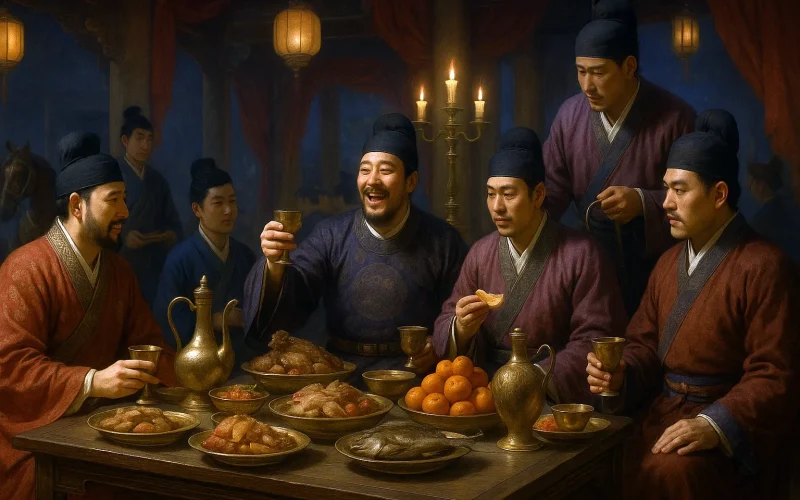
The poem opens by conjuring a spectacle of febrile prosperity. “The capital” fixes the setting as the political and social center; “spring’s last days” describes the season but also subtly suggests a cultural decline. “A clamorous crowd” begins with sound—an overwhelming din of traffic that pulls the reader into a pervasive, collective agitation. The phrases “is the word they share” and “follow in each other’s wake” vividly reveal this pursuit as a social contagion, a mass unconsciousness of the elite, foreshadowing the critique to come.
Section Two: 贵贱无常价,酬直看花数。灼灼百朵红,戋戋五束素。上张幄幕庇,旁织巴篱护。水洒复泥封,移来色如故。
Guì jiàn wú cháng jià, chóu zhí kàn huā shù. Zhuózhuó bǎi duǒ hóng, jiānjiān wǔ shù sù. Shàng zhāng wò mù bì, páng zhī bā lí hù. Shuǐ sǎ fù ní fēng, yí lái sè rú gù.
No fixed price, high or low—the cost depends upon the bloom. / A dazzle of a hundred scarlet flowers, a fiery plume— / Light expense: five bolts of plain white silk, a trifling sum. / Tents spread above for shade; wicker fences are set all around. / They sprinkle water, pack the roots with earth, to seal the ground. / Transplanted, their color stays, as brilliant as if new-found.
This section exposes the reality of the flower market with a clinical eye. Prices have “No fixed price”; payment “depends upon the bloom,” indicating this is no normal market but a vanity-fueled auction. “A dazzle… a fiery plume” describes the flowers’ intense beauty; calling the cost a “Light expense… a trifling sum” is deeply ironic, reflecting the buyers’ warped perspective. The poet then meticulously details the extravagant care—“Tents spread… wicker fences… sprinkle water, pack the roots.” This catalog of efforts underscores the absurd珍视 lavished on this luxury. The phrase “their color stays” speaks to the meticulous preservation but also hints at the illusory permanence of this gilded world.
Section Three: 家家习为俗,人人迷不悟。有一田舍翁,偶来买花处。低头独长叹,此叹无人喻。一丛深色花,十户中人赋。
Jiājiā xí wéi sú, rénrén mí bú wù. Yǒu yī tián shè wēng, ǒu lái mǎi huā chù. Dī tóu dú cháng tàn, cǐ tàn wú rén yù. Yī cóng shēn sè huā, shí hù zhōng rén fù.
In every house, a custom now, a common sight; / Each person lost within the craze, blind to the light. / An old man from the farmlands happened there to stray; / He reached the place where flowers were bought and sold that day. / He bowed his head, heaved forth a solitary sigh— / A sigh whose meaning, to the crowd, passed idly by. / For one cluster of flowers, deep-hued, of rarest kind— / Ten average households’ yearly tax is left behind.
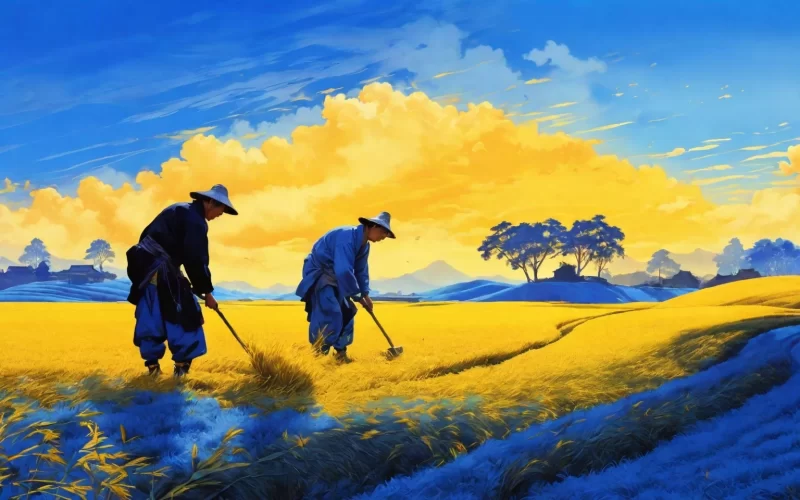
Here, the poem pivots with devastating force. The summation—“In every house… Each person…”—broadens the critique from individuals to a societal malaise. “Lost… blind” names its本质 folly. Then, the poet introduces the figure of the “old man from the farmlands.” His “happened there to stray” marks the chance, jarring intersection of two separate worlds. “He bowed his head, heaved forth a solitary sigh”—a gesture of immense weight, containing shock, anguish, and impotence. “A sigh whose meaning… passed idly by” lays bare the profound, willful incomprehension between classes. The climax is the old man’s silent, damning equation: “For one cluster of flowers… / Ten average households’ yearly tax.” With brutal, simple arithmetic, the poet converts aesthetic value into social cost, directly linking elite extravagance to the systemic exploitation of the common people. This is not a lament but an indictment.
Holistic Appreciation
This poem is a prime example of the “direct and incisive” style of Bai Juyi’s social critique. Its power derives from using a meticulously framed scene and stark numerical contrast to stage a public trial of wealth inequality. The structure is masterful: the first half unfolds like a lavish tracking shot of the buying and tending ritual; the latter half, with the intrusion of the old farmer, cuts abruptly to a close-up and voice-over, creating a shocking rupture. Bai Juyi’s insight goes beyond condemning luxury; it exposes its foundation—the “ten… households’ yearly tax” that funds the “one cluster of flowers.” This elevates the poem from moral satire to political-economic critique.
Artistic Merits
- Masterful Use of Layered Contrasts: The poem builds multiple, deepening contrasts: the noise of the crowd versus the farmer’s silent sigh; the flowers’ blazing beauty versus the “trifling” cost; the universal delusion versus the one man’s clarity. All culminate in the final, shocking equivalence of a luxury item and the tax burden of ten families.
- A Powerful Shift in Narrative Focus: The perspective shifts from an omniscient view of the spectacle to the limited, subjective experience of the farmer. Seeing through his eyes and hearing his unspoken thought masterfully transfers the reader’s sympathy and the poem’s moral judgment.
- The Rhetorical Force of Concrete Data: Introducing specific figures—“five bolts of silk,” “ten households’ tax”—is a hallmark of Bai Juyi’s method. It transmutes abstract injustice into tangible, quantifiable fact, grounding the critique in undeniable economic reality.
- Accessible Language Bearing Profound Meaning: The diction is deceptively simple, almost prosaic (“is the word they share,” “In every house”), yet it precisely captures social behavior. The final, proverbial couplet is simple in form but devastating in its revealed truth, achieving the ideal of being “understandable to an old woman” yet “profound in thought and far-reaching in implication.”
Insights
The poem’s warning echoes across centuries. It compels us to scrutinize the hidden pipelines connecting “conspicuous consumption” to “basic subsistence” in any society. When profligate spending on frivolities becomes normalized, when a society is “lost within the craze, blind,” it often signals a profound moral and distributive failure. The farmer’s sigh, whose “meaning… passed idly by,” reminds us that true progress is measured not by wealth alone but by the presence of a shared conscience—a common scale of value that can weigh the price of a “peony” against the burden of a “tax,” and find the disparity intolerable. Thus, the poem transcends its time, standing as a permanent challenge to all societies to examine the human cost of their luxuries and to bridge the gulfs of understanding that enable exploitation.
Poem translator
Xu Yuanchong (许渊冲)
About the Poet
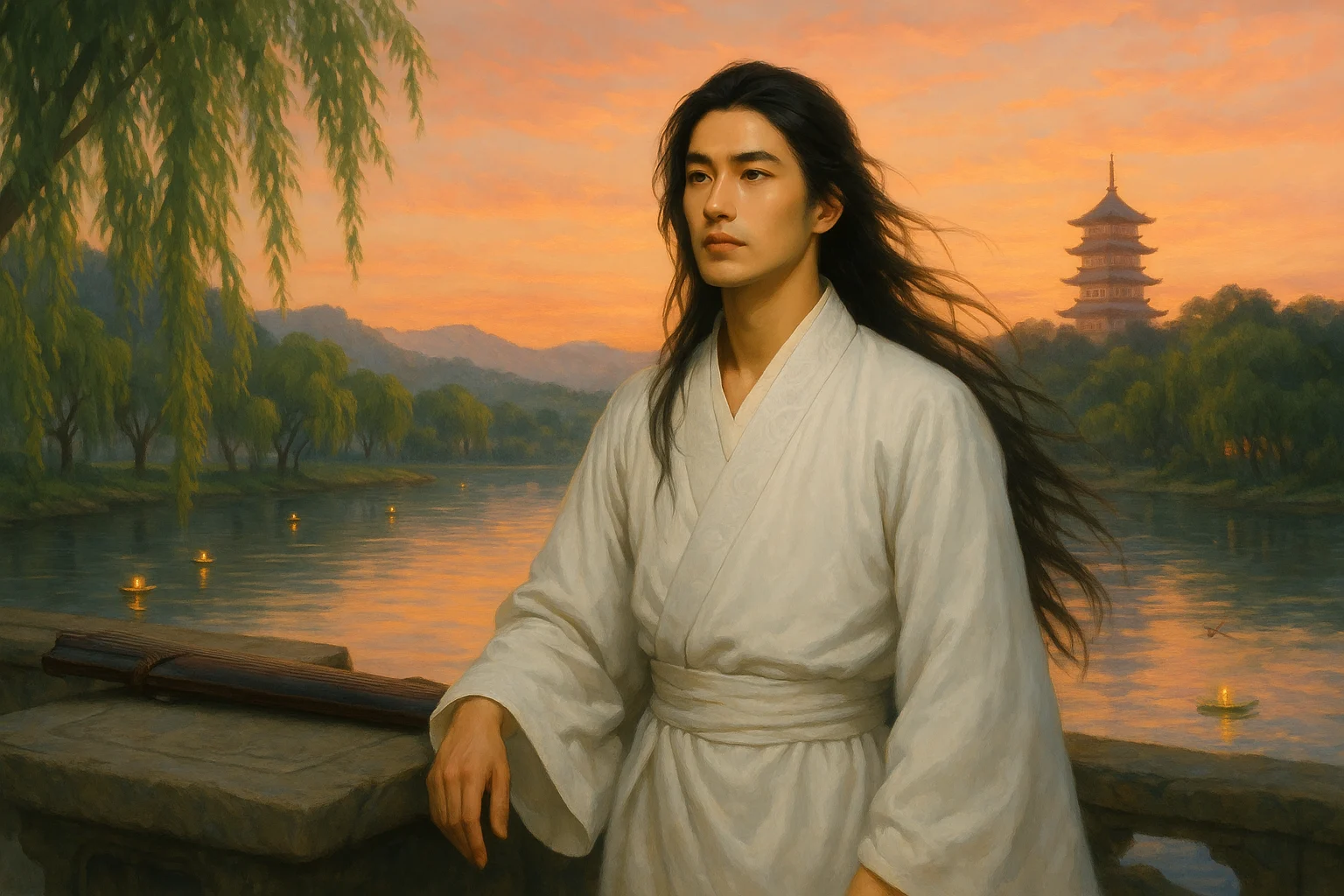
Bai Juyi (白居易), 772 - 846 AD, was originally from Taiyuan, then moved to Weinan in Shaanxi. Bai Juyi was the most prolific poet of the Tang Dynasty, with poems in the categories of satirical oracles, idleness, sentimentality, and miscellaneous rhythms, and the most influential poet after Li Bai Du Fu.