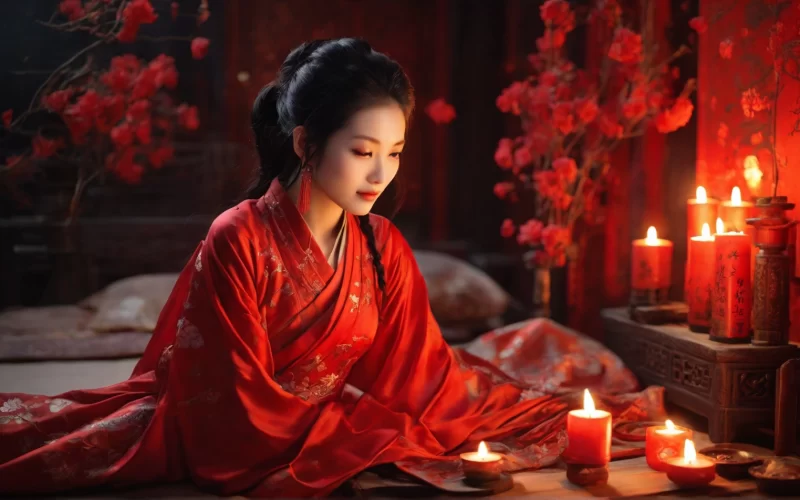
All night the bridal tapers spent their red
And perfumed light, until the grey east bled;

And now, with dawn, to his grave Sire’s regard
And the stern Mother, she prepares her award.

Her glass consulted, every art applied,
She bends, and whispers at the bridegroom’s side:

“This pencilling of brows — this hue and line —
Say, do they in the present fashion shine?”
Original Poem
「近试上张籍水部」
洞房昨夜停红烛,待晓堂前拜舅姑。
妆罢低声问夫婿,画眉深浅入时无。
Interpretation
This poem is a famous piece of examination-period networking by the Mid-Tang poet Zhu Qingyu, written on the eve of his taking the imperial Jinshi examinations. Under the Tang dynasty's examination system, scholars would often compile their poems and essays into scrolls and present them to eminent literary figures and officials before the formal exam, seeking their appreciation and recommendation. This practice was called "xingjuan" (advance presentation of one's work). Zhang Ji, to whom this poem is addressed, held the post of Vice-Director of the Waterways Bureau at the time. He was a renowned poet under Han Yu's circle, famous for his yuefu-style poetry, and was also known for promoting younger talents. Zhu Qingyu's poem is precisely such a "xingjuan" piece presented to Zhang Ji. Using the metaphor of a bride, he compares the imperial examination to a new wife meeting her in-laws, skillfully concealing his own nervousness and desire for approval within the intimate scene of a boudoir. The solemnity of "Last night in nuptial chamber red candles burned long" symbolizes the formal preparation before the exam. The tension of "Waiting for morning to salute the parents in the hall" mirrors the anxiety before meeting the examiner. The shyness of "Having made up, she asks her lord in a voice sweet and low" reflects his doubt about whether his work is "in fashion." And the question "Are my eyebrows penciled in fashion that is in vogue now?" transforms the shared concern of countless exam candidates into a timeless, clever line.
In classical poetry, many examination-related networking poems directly express the author's intent, either praising the recipient or proclaiming the author's own talent. Zhu Qingyu's poem, however, breaks new ground by using a wedding custom as a metaphor, portraying the significant matter of scholarly achievement with such tenderness and subtlety. He not only uses the bride as a metaphor for himself but also uses the husband to represent Zhang Ji, the in-laws to represent the examiners, the penciling of eyebrows to represent writing poetry, and "in fashion" to symbolize whether the work fits the examiner's taste. This series of exquisite metaphors hides the tension, anticipation, and anxiety of the examination within the intimate talk of the boudoir, displaying both literary talent and clever intention, making it one of the most artistically charming "xingjuan" poems of the Tang dynasty. Zhang Ji greatly admired it upon reading and responded with the poem "In Reply to Zhu Qingyu" ("越女新妆出镜心,自知明艳更沉吟。齐纨未足时人贵,一曲菱歌敌万金。" - "A southern maiden with makeup fresh comes out of mirror bright; / Knowing her own beaming beauty, she hesitates in sight. / Rival silk is not worth a fortune in worldly eyes; / One song of water chestnut is worth gold of any prize."), using the southern maiden to metaphorize Zhu Qingyu and praising his poetic talent as "one song of water chestnut." Their poetic exchange became a celebrated literary anecdote.
First Couplet: "洞房昨夜停红烛,待晓堂前拜舅姑。"
Dòngfáng zuóyè tíng hóng zhú, dài xiǎo táng qián bài jiùgū.
Last night in nuptial chamber red candles burned long; Waiting for morning to salute the parents in the hall.
The poem opens with a wedding custom metaphor. "洞房昨夜停红烛" (Last night in nuptial chamber red candles burned long) describes the solemnity of the wedding night—red candles burning all night are a testament to the marriage and also set a tense atmosphere. The word "停" (stopped/burned long) describes the state of the candles' prolonged burning, also hinting at the bride's sleepless anticipation. The next line, "待晓堂前拜舅姑" (Waiting for morning to salute the parents in the hall), shifts from night to dawn, pointing to the imminent crucial moment. The two words "待晓" (waiting for morning) are the bride's wait, and also the poet's wait; the three words "拜舅姑" (salute the parents) are the new wife's nervousness, and also the candidate's anxiety before the examiner. Within the couplet, the poet uses the wedding-night scene as a metaphor for the examination journey, writing the solemnity and tension before the exam with subtlety and authenticity.
Second Couplet: "妆罢低声问夫婿,画眉深浅入时无?"
Zhuāng bà dīshēng wèn fūxù, huàméi shēngiǎn rù shí wú?
Having made up, she asks her lord in a voice sweet and low: "Are my eyebrows penciled in fashion that is in vogue now?"
This couplet is the soul of the entire poem, depicting the bride's nervousness with an extremely delicate touch. "妆罢低声问夫婿" (Having made up, she asks her lord in a voice sweet and low) writes of the bride's lack of confidence in her makeup—the two words "低声" (in a voice sweet and low) indicate both shyness and reverence; the three words "问夫婿" (asks her lord) signify both seeking help and dependence. The next line, "画眉深浅入时无" (Are my eyebrows penciled in fashion that is in vogue now?), concludes the whole piece with a single question. The "画眉" (eyebrows penciled) is the bride's makeup, and also the poet's work; the "深浅" (depths, i.e., light or dark) is the shade of the eyebrow color, and also the refinement or vulgarity of the poetic style; the "入时无" (in fashion) asks whether the makeup is fashionable, and also whether the work can be appreciated by the examiner. This question is asked cautiously, asked anxiously, yet it is precisely the shared sentiment of all candidates facing their fate. The poet uses boudoir talk to write of examination concerns, condensing the shared tension and anticipation of countless candidates into this softly asked question—subtle, profound, and with lasting resonance.
Holistic Appreciation
This is a divine work among Zhu Qingyu's examination networking poems. The entire poem consists of four lines and twenty-eight characters. Using a wedding custom as a metaphor, it writes of the tension and anticipation before the imperial examination with tenderness, subtlety, and profound grace.
Structurally, the poem presents a progression from night to morning, from external to internal. The first couplet begins with "Last night in nuptial chamber", describing the red candles of the wedding night and the visit to the hall the next morning; it is the description of the external scene. The second couplet shifts internally with "Having made up, she asks", depicting the bride's doubts about her makeup; it is the portrayal of internal psychology. Between the four lines, it moves from scene to feeling, from external to internal, progressing layer by layer, forming a seamless whole.
Thematically, the core of this poem lies in the word "问" (ask). That question, "she asks her lord in a voice sweet and low", is the bride's lack of confidence, and also the poet's lack of confidence; the question "Are my eyebrows penciled in fashion" asks about makeup, and also about fate. This question voices the shared concern of all candidates in the examination era—Will my work please the examiner's eye? Will my talent be appreciated? The poet uses a boudoir question to write of examination anxiety, transforming the grand affair of scholarly achievement into tender affection, handling weighty matters with a light touch, wonderfully clever.
Artistically, the poem's most moving aspect lies in the exquisite metaphorical device of "using marriage to metaphorize the exam, using feeling to write of aspiration." The poet compares the examination to a wedding, the examiner to in-laws, Zhang Ji to the husband, and his work to penciling eyebrows—a series of exquisite metaphors, writing the significant matter of scholarly achievement with such tenderness and subtlety, maintaining solemnity while being full of poetic flavor. The softly asked "Are my eyebrows penciled in fashion?" is both boudoir talk and examination anxiety, fusing two vastly different situations into one, becoming a clever phrase passed down through the ages.
Artistic Merits
- Novel Metaphorical Device, Ingenious Conception: Using a bride meeting her in-laws to metaphorize a candidate taking the exam, portraying the significant matter of scholarly achievement with tenderness and subtlety, handling weighty matters with a light touch, wonderfully clever.
- Vivid Detail, Minute Psychology: "低声问" (asks in a voice sweet and low) writes of shyness and reverence; "画眉深浅" (eyebrows penciled... depths) writes of doubt about the work's quality, depicting the candidate's anxiety with penetrating depth.
- Elegant Language, Subtle and Profound: The entire poem does not directly mention the examination in a single word, yet every line relates to it, using boudoir talk to write of scholarly aspirations, subtle but not obscure, profound but not affected.
- Rich Meaning, Seamlessly Integrated: The surface depicts wedding customs; the underlying reality is examination networking, highly unified in scene and meaning, thought-provoking.
Insights
This poem, through the morning of a wedding, speaks to an eternal theme—Regardless of era, people, facing crucial moments of fate, all need to ask a soft "question."
First, it lets us see "expectation within anxiety." That bride who "asks her lord in a voice sweet and low" is not unconfident, but cares too much; that doubt of "Are my eyebrows penciled in fashion" is not lack of skill, but a desire for approval. It reminds us: Only those who truly care will be nervous at critical moments; only those who truly care will be anxious at important times.
On a deeper level, this poem makes us contemplate the meaning of "asking." The bride asks her husband, asking about her makeup, and also about her fate; Zhu Qingyu asks Zhang Ji, asking about his poem, and also about his future prospects. It makes us understand: At life's critical moments, we all need someone to whom we can "ask in a low voice"—someone who can guide us, give us confidence, give us direction.
And what is most thought-provoking is the poem's wisdom of "writing the hard with softness." The imperial examination was a struggle for fame and fortune, a significant endeavor for men with ambitions. Yet Zhu Qingyu writes it with such tenderness—using the bride to metaphorize himself, penciling eyebrows as a metaphor, asking in a low voice as the posture. This technique of "writing the hard with softness" gives warmth to the rigid matter of scholarly achievement and lends poetry to the naked desire for competition.
This poem is set in a Mid-Tang imperial examination, yet it allows everyone who is anxious at life's critical moments to find resonance within it. The solemnity of "Last night in nuptial chamber red candles burned long" is the sense of ritual before every important moment. The tension of "Waiting for morning to salute the parents in the hall" is the shared feeling of everyone facing a test. The shyness of "Having made up, she asks her lord in a voice sweet and low" is the posture of everyone desiring approval. The question "Are my eyebrows penciled in fashion?" is the deepest echo in the heart of everyone facing fate. This is the vitality of poetry: it writes of Zhu Qingyu's examination, but one reads of people in all eras who, at critical moments, ask a soft question.
About the Poet
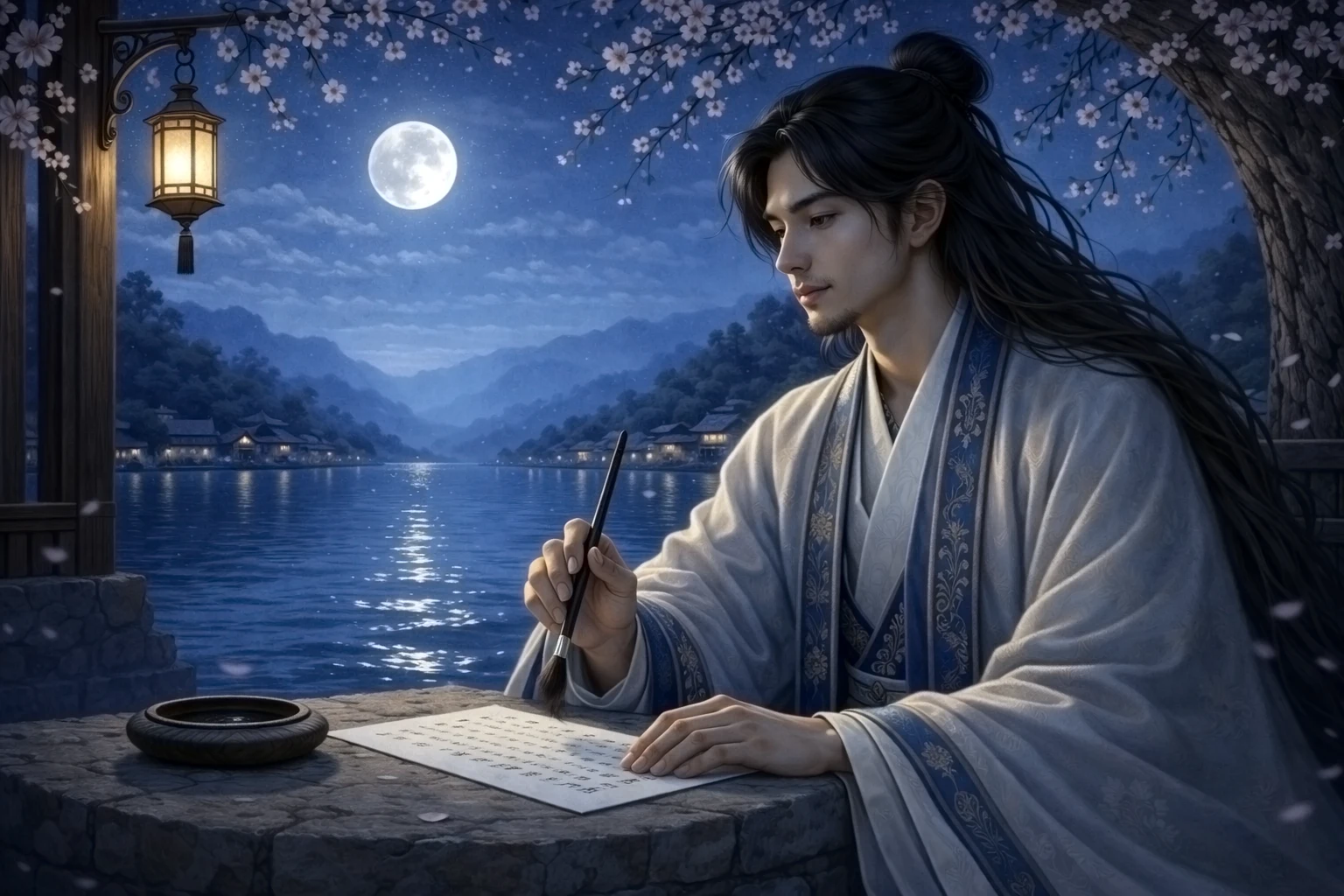
Zhu Qingyu (朱庆馀 dates of birth and death unknown), also known by his given name Kejiu, was a poet of the Mid-Tang period, a native of Yuezhou (present-day Shaoxing, Zhejiang Province). He passed the jinshi examination in the second year of the Baoli era (826 AD) and held the position of Collator in the Imperial Library. His poetry excelled in the five-character regulated verse style, characterized by a refined and subtle elegance, with particular skill in depicting the emotions of boudoir women and palace maidens. In the Complete Tang Poems, two volumes containing 177 of his works are preserved. He was adept at using allegorical and metaphorical techniques, blending everyday emotions with political aspirations. Although not many of his poems survive, his exquisite craftsmanship secures him a unique place in the history of Tang poetry, with his poem Boudoir Sentiments becoming a quintessential example of the fusion of examination-themed and boudoir poetry in later generations.