
Slow and reluctant, I have waited
Day after day, till now I must go.
How sweet the road-side flowers might be
If they did not mean good-bye, old friend.

The Lords of the Realm are harsh to us
And men of affairs are not our kind.
I will turn back home, I will say no more,
I will close the gate of my old garden.
Original Poem
「留别王维」
孟浩然
寂寂竟何待,朝朝空自归。
欲寻芳草去,惜与故人违。
当路谁相假,知音世所稀。
只应守寂寞,还掩故园扉。
Interpretation
This poem was composed in 729 CE, when Meng Haoran was forty-one years old. It marked his second, and final, departure from the capital, Chang'an. Having failed the imperial examinations the previous year, he did not immediately return south but lingered in the capital, continuing to seek a path to advancement. What did he experience in that year? The poem does not detail it, but the ten characters, "Silent, silent—what is there left to await? / Morning after morning, I return alone, in vain," are testimony enough. He had tried—he had tried. He had waited—he had waited until the end. Each morning he ventured out, each evening he returned alone—to where? Likely to Wang Wei's official residence, or perhaps to some borrowed, humble lodgings. He returned empty-handed, his heart also empty.
The title belongs to the genre of farewell poems, typically written on the eve of departure for those seeing the poet off. Yet Meng Haoran's poem, addressed to Wang Wei, reads more like a farewell letter he writes to himself. He is bidding farewell to his friend, but even more so, he is bidding farewell to Chang'an, to an official career, and to that younger version of himself who once "longed to cross the vast sea."
Wang Wei was twenty-nine that year, already serving in office in Chang'an, and was Meng Haoran's closest friend. The legend recorded in the New Book of Tang—that Wang Wei privately invited Meng to the inner offices, where they unexpectedly encountered Emperor Xuanzong, and Meng's recital of "for lack of talent, I'm ignored by the wise lord" angered the sovereign—may not be factual, but it reflects the contemporary perception of their relationship: Wang Wei was the one who wanted to help but couldn't, and Meng Haoran was the one fate toyed with yet refused to bow. By the poem's end, Meng does not ask Wang to continue recommending him, nor does he show any lingering expectation. He simply states: "I should only keep to my loneliness, / And close again the wicket of my old garden." This is not pique; it is acceptance. It is not resentment; it is a form of fulfillment.
First Couplet: "寂寂竟何待,朝朝空自归。"
Jìjì jìng hé dài, zhāozhāo kōng zì guī.
Silent, silent—what is there left to await? / Morning after morning, I return alone, in vain.
The opening is a thorough self-interrogation. "Silent, silent" describes the environment, but more so the state of mind—Chang'an's streets bustled with carriages and horses, yet the poet's world had already entered winter prematurely. The three words "what is there left to await" are a question, but even more an answer. Of course, he knew what he awaited: a letter of recommendation, an imperial audience, fate's belated favor. But after a year of waiting, all that came was "morning after morning, I return alone, in vain." The word "in vain" in "return alone, in vain" is the poem's first emotional accent. It is not the "aloneness" of solitude, but the emptiness of gaining nothing. He would leave with a sliver of hope, and return having exhausted even that sliver. Day after day, morning after morning, it was always thus. These five words encapsulate a thousand days and nights of futility in Chang'an.
Second Couplet: "欲寻芳草去,惜与故人违。"
Yù xún fāngcǎo qù, xī yǔ gùrén wéi.
I long to seek the fragrant grass and go, / Yet regret to part from you, my old friend.
This couplet is the turning point of the poem's emotion and Meng Haoran's most tender confession to Wang Wei. "Fragrant grass" is a code for reclusion; since the Li Sao's "why should I alone lack such fragrant grasses?" it has become a classic image of the literati's spiritual return. The poet says "I long to seek," not "I have sought"—the thought of retreat had long taken root but had never been acted upon. The reason was singular: "Yet regret to part from you, my old friend." The word "regret" is extremely light, yet carries immense weight. It is not "fear," not "resentment," not "helplessness," but simply a tender, gentle reluctance to part. Chang'an had given him nothing—no official rank, no opportunity, no reason to stay and keep waiting. Except for Wang Wei. This city gave him a kindred spirit. This one reason was enough to make him hesitate for a year.
Third Couplet: "当路谁相假,知音世所稀。"
Dānglù shuí xiāng jiǎ, zhīyīn shì suǒ xī.
Who among the powerful would lend a hand? / A friend who knows my heart is rare in the world.
Here, the focus shifts from personal affection to a general judgment of the world. "The powerful" refers to those in high positions, with whom Meng Haoran had little connection throughout his life. He was not without attempts to gain patronage, not without presenting poems, not without waiting at the gates of the powerful. But those gates, one by one, had closed. He did not resent any specific individual; his resentment was for "who would lend a hand"—no one was willing to lend him a ferry. "A friend who knows my heart is rare in the world" is the poem's most poignant line, yet it is not an accusation. Meng does not say "the world is turbid, I alone am clear," nor "the crowd fails to recognize this jewel." He merely states a fact: people like Wang Wei are too few. So few that, upon leaving Chang'an, the only thing he found difficult to part with was this friendship.
Between these two lines lies a remarkable balance: the former expresses disappointment with the world, the latter pays tribute to a friend. Disappointment does not turn to bitterness; tribute does not descend into flattery. Meng Haoran stands at the exit of Chang'an, takes one last look back, and then turns away calmly.
Fourth Couplet: "只应守寂寞,还掩故园扉。"
Zhǐ yīng shǒu jìmò, huán yǎn gùyuán fēi.
I should only keep to my loneliness, / And close again the wicket of my old garden.
The conclusion is one of complete resolution. "I should only" is not a compromise born of helplessness, but a lucid choice. He sees clearly: Chang'an has no place for him; the path of officialdom holds no ticket for his passage. Rather than linger here, asking "what is there left to await?", it is better to return to Xiangyang and "close again the wicket of my old garden." The three words "keep to my loneliness" are the poetic eye of the entire poem. This is not passively enduring loneliness, but actively choosing to abide with loneliness. Loneliness is no longer a punishment imposed by fate, but a destination he claims for himself. From "silent, silent—what is there left to await?" to "I should only keep to my loneliness," the poet completes his ultimate response to the first half of his life: it is not that he couldn't wait any longer, but that there was no longer any need; it is not that he couldn't return, but that he was finally willing to.
"And close again the wicket of my old garden" concludes the poem with a concrete action. This action, Meng Haoran had rehearsed countless times in his mind: descending the path of Lumen Mountain, pushing open that long-unopened garden wicket, shutting Chang'an's dust behind him. When this moment finally arrived, he had no tears, no sighs, only the calm act of closing the gate. Inside and outside the gate were two worlds. Inside were Xiangyang's mountains and waters, Lumen's pines and moon, the fragrant grass of his old garden; outside were Chang'an's silence, the vain returns morning after morning, the powerful who offered no hand. He chose inside.
Holistic Appreciation
This poem is the requiem Meng Haoran wrote for himself upon leaving Chang'an, a farewell penned a year later when anger had settled and fear had been digested, leaving only clarity and peace. What did Meng Haoran experience in that year? The poem does not state it explicitly, but we can read it between the lines. He experienced the cycle of "morning after morning, I return alone, in vain," the disappointment of "who among the powerful would lend a hand?", the torment of wavering between "I long to seek the fragrant grass and go" and "Yet regret to part from you, my old friend." In the end, he chose to leave, not because he no longer cherished this friendship, but precisely because he cherished it too deeply—he could not bear to let Wang Wei watch him wither away day by day.
The poem's four couplets trace a parabolic emotional arc: the first couplet is the trough of self-interrogation, the second the upswing of emotional attachment, the third the level observation of worldly affairs, and the fourth the final point of peaceful acceptance. Meng Haoran does not let the poem drown in "silence," nor does he let it linger in "reluctant parting." He simply writes it all out, then rises and sets out on his road.
Artistic Merits
- The Oppressive Repetition of Reduplication: "Silent, silent" and "morning after morning"—these two reduplicated phrases appear consecutively in the opening couplet, creating a cyclical, repetitive rhythm. This is not beautiful repetition, but the pacing of a caged beast. Day after day, morning and night, he never managed to escape the invisible cage that was Chang'an.
- The Precise, Logical Progression of Emotion: The emotional progression of the entire poem is exceptionally rigorous—the first couplet expresses the despair of "nothing left to await"; the second, the bond of "reluctance to part"; the third, the clarity of "no aid"; and the fourth, the resolution to "return." The four couplets are interlocked, inseparable, and unalterable. This marks Meng Haoran's consummate poetic artistry.
- The Personal Culmination of the "Kindred Spirit" Motif: Throughout his life, Meng Haoran wrote of the regret of lacking a kindred spirit. Variations of this motif include "I regret that none appreciates the music" in "South Pavilion in Summer" and "I'll send you two lines of tears borne by the stream" in "Mooring on the River at Tonglu." Yet "Parting for Wang Wei" depicts having found a kindred spirit right before him, yet still having to part—a tragedy deeper than having none. It wasn't that he failed to find one; it was that he had to leave even after finding one.
- The Semantic Reversal of "Loneliness": From the "silent, silent" of the first line to the "keep to my loneliness" of the last, the same vocabulary undergoes a qualitative emotional shift. The former "silence" is the isolation of being cast aside; the latter "loneliness" is the clarity of self-chosen solitude. Through the progression of four couplets, Meng Haoran thoroughly recasts a negative term, endowing it with new dignity.
- The Symbolic Power of the Concluding Action: "And close again the wicket of my old garden" is the poem's only concrete action. The previous three couplets are all mental activity—self-questioning, hesitation, emotion, judgment. Not until the final moment does the poet truly act. This action is like a period, canceling out a thousand days in Chang'an with one stroke; it is also like a bolt, gently latching all the unwillingness and regret of his former life outside the gate.
Insights
This work tells us: One can maintain the most complete dignity in the most thorough defeat. When Meng Haoran left Chang'an, he had nothing: no official post, no travel funds, no future. All he possessed was Wang Wei's friendship and the courage to choose to "keep to my loneliness." He did not beg Wang Wei to continue recommending him, did not complain of an unfair fate, did not leave in his farewell poem any line that might make his friend feel guilty. He simply said: I am going back; take care. This is a composure verging on severity. He left all the sorrow to himself, and all the consideration to the other.
Contemporary society esteems a philosophy of "never give up," equating surrender with failure, and acceptance of fate with cowardice. Yet Meng Haoran proves with this poem: Acceptance is not surrender; letting go is not defeat. Sometimes, acknowledging "this road is closed" requires greater courage than continuing to beat one's head against the wall; sometimes, choosing loneliness requires deeper resolve than enduring the clamor. He was forty-one when he left Chang'an, with nearly two decades of life remaining. In those years, he never set foot in Chang'an again, never wrote another poem seeking patronage or office. He simply lived quietly under Lumen Mountain's pines and moon, by the lotus-scented breeze of Jiannan Garden, writing poems quietly, waiting for spring quietly. He did not become a Zhang Jiuling, did not become a Wang Wei, did not become a "success" in any conventional sense. But he became Meng Haoran—the gentlest, the most dignified, the most unyieldingly composed "failure" in the history of Chinese literature.
"I will turn back home, I will say no more, I will close the gate of my old garden."
A millennium later, we no longer remember who the powerful in Chang'an were that year, nor who passed the imperial exams and rose to glory. But we remember this poem, and this figure turning his back in loneliness. The garden wicket he closed has not fully shut to this day. The light filtering through the crack has illuminated countless who came after.
Poem translator
Kiang Kanghu
About the poet
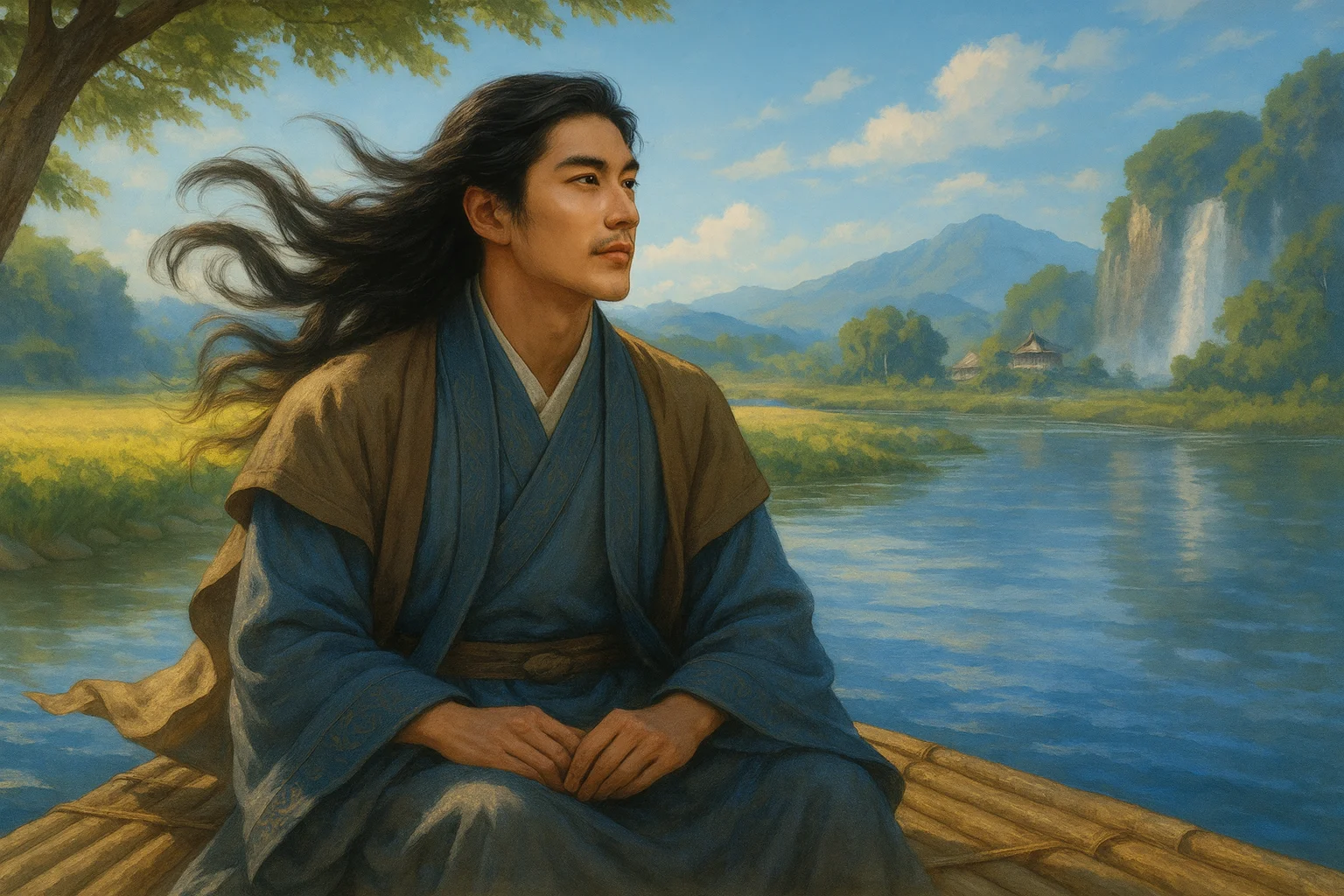
Meng Haoran (孟浩然), 689 - 740 AD, a native of Xiangyang, Hubei, was a famous poet of the Sheng Tang Dynasty. With the exception of one trip to the north when he was in his forties, when he was seeking fame in Chang'an and Luoyang, he spent most of his life in seclusion in his hometown of Lumenshan or roaming around.