
Together we officials climbed vermilion steps,
To be parted by the purple walls...
Our procession, which entered the palace at dawn,
Leaves fragrant now at dusk with imperial incense.
...Grey heads may grieve for a fallen flower,
Or blue clouds envy a lilting bird;
But this reign is of heaven, nothing goes wrong,
There have been almost no petitions.
Original Poem
「寄左省杜拾遗」
岑参
联步趋丹陛,分曹限紫微。
晓随天仗入,暮惹御香归。
白发悲花落,青云羡鸟飞。
圣朝无阙事,自觉谏书稀。
Interpretation
This poem was composed between 757 and 758 AD, during the Zhide and Qianyuan reign periods of Emperor Suzong of the Tang Dynasty. At that time, Cen Can, having been recommended by Du Fu, held the post of Reminder of the Right (You Buque), while Du Fu served as Rectifier of the Left (Zuo Shiyi). Both were imperial censors, belonging to the Secretariat (Right Department) and the Chancellery (Left Department) respectively. Although this period fell in the middle of the An Lushan Rebellion, with Emperor Suzong's court newly established and a hundred tasks awaiting restoration, the routinized life of the central bureaucracy and the practical difficulties faced by censors in presenting remonstrances had already induced in sensitive minds like Cen Can's a profound sense of disillusionment and weariness.
This poem, sent to his colleague and close friend Du Fu, is not a typical occasional verse. Rather, it is a political soliloquy and an intellectual's mutual affirmation of spirit, conveyed in poetic form. It was born of a unique political moment: superficially, it was the beginning of a "restoration," urgently needing loyal counsel; in reality, the power structure remained unstable, and channels for criticism were not necessarily unobstructed. From the perspective of a firsthand participant, Cen Can reveals the triviality, emptiness, and profound sense of powerlessness experienced by individual censors beneath the grand, solemn rituals of court. The startling tension between the poem's lavish, dignified depictions of court ceremonies and the ostensibly laudatory yet ironically tinged final couplet makes it a quintessential text for analyzing the existential condition and inner conflicts of bureaucratic intellectuals in the post-Glorious Tang era.
First Couplet: "联步趋丹陛,分曹限紫微。"
Lián bù qū dān bì, fēn cáo xiàn zǐ wēi.
With synchronized steps we hasten up the crimson stair; / Our offices apart, sundered by Purple Tenuity's lair.
The opening outlines the classic scene of officials attending dawn court audience with solemn diction. "With synchronized steps we hasten" conveys the uniformity of court ritual and the deferential posture of ministers; "crimson stair" evokes the palace's magnificence and majesty. However, the next line, "Our offices apart, sundered…" subtly reveals another reality: "Our offices apart" refers to their affiliation with different departments (the Chancellery and the Secretariat), which, though functionally connected, were physically and administratively separated; the word "sundered" faintly hints at a sense of constraint imposed by institutional division, hindering concerted effort. "Purple Tenuity" (Ziwei), the abode of the emperor, symbolizes supreme power. While all hasten towards it, they are also invisibly partitioned by it.
Second Couplet: "晓随天仗入,暮惹御香归。"
Xiǎo suí tiān zhàng rù, mù rě yù xiāng guī.
At dawn we enter in the Sovereign's retinue's train; / At dusk we bear imperial incense scent back again.
This couplet, with its polished parallelism, condenses the entirety and inherent emptiness of a censor's daily life. "At dawn we enter… / At dusk we bear back…" forms a strict temporal loop, highlighting the rigid cyclicality of existence. "In the Sovereign's retinue's train" and "bear imperial incense scent" sound prestigious, denoting proximity to the center of power, but in truth describe a form of participation that is utterly passive ("in the train of") and merely formal ("bear the scent"). The poet's capture of the detail "imperial incense scent" is especially masterful: it is the most honored contamination, yet also the most insubstantial acquisition; it is the sole tangible proof of a day's busyness, yet also a metaphorical irony for contributing nothing of substance.
Third Couplet: "白发悲花落,青云羡鸟飞。"
Bái fà bēi huā luò, qīng yún xiàn niǎo fēi.
White hairs grieve for blossoms falling, life's brief lease; / At azure clouds I envy birds that soar in flight and peace.
The emotion shifts abruptly from depicting external scenes to direct expression of the inner world. This couplet presents a sharp inner confrontation. "White hairs grieve for blossoms falling" is an inward gaze at life's anxiety: prime years secretly slip away amidst mechanical court rituals, like spring blossoms falling, filled with sorrow for what cannot be retrieved. "At azure clouds I envy birds that soar" is an outward projection of spiritual longing: a desire to break free from constraints, to attain the freedom and agency of birds soaring into the azure clouds. This pairing of "grieve" and "envy" reveals the poet's deep spiritual predicament while occupying a high court position: the body is disciplined beneath the crimson stairs, while the soul yearns for the expanse beyond the azure clouds.
Final Couplet: "圣朝无阙事,自觉谏书稀。"
Shèng cháo wú quē shì, zì jué jiàn shū xī.
In this sage reign, no faults or flaws are seen, they say; / Hence, few memorials of advice come from my way.
This couplet is the点睛之笔 (diǎnjīng zhī bǐ: finishing touch) of the entire poem, employing irony of the highest order. Superficially, it is language praising the emperor's reign: the court is flawless, hence no remonstrance is needed. However, considering the historical context—the An Lushan Rebellion still raging, state affairs in turmoil—and the poet's personal anguish expressed in "White hairs grieve…," the true meaning is precisely the opposite. The so-called "no faults or flaws" is not a reality, but a pretext for obstructed criticism or its perceived uselessness; "few memorials" does not stem from universal peace, but from silence chosen out of disappointment and helplessness, or the result of advice being ignored. This is an exceptionally subtle yet sharp critique of the court's political ecosystem.
Holistic Appreciation
This regulated verse (wǔyán lǜshī) is a masterpiece that perfectly blends Tang Dynasty court poetry with political lyricism. It employs a "two-tiered structure": the surface layer is an ornate, elegant scroll painting of courtly life, conforming to all conventions of occasional verse; the underlying layer, however, surges with profound lament on life and pointed political satire. The immense contrast between these two layers constitutes the poem's core artistic tension.
The poem follows an emotional progression of "scene depiction (first and second couplets) — inner turning point (third couplet) — ironic conclusion (final couplet)." The more solemn and magnificent the court rituals are portrayed in the first four lines ("synchronized steps," "crimson stair," "Sovereign's retinue," "imperial incense"), the more genuine and piercing the personal sorrow ("white hairs," "blossoms falling") and satirical edge ("no faults," "few memorials") in the last four lines become. Cen Can's brilliance lies in treating a theme that could easily devolve into complaint with such subtle depth and restrained sorrow, using strict prosody and elegant diction to complete a profound reflection on his own professional worth and the politics of his time.
Artistic Merits
- Ironic Meaning within Precise Parallelism: Each couplet exhibits exquisite parallel structure, such as "At dawn" (Xiǎo) paired with "At dusk" (Mù), "White hairs" (Bái fà) with "At azure clouds" (Qīng yún), achieving extreme formal beauty. Yet, it is precisely within this strict formal framework that the poet injects content full of contradiction and tension (e.g., the opposition between "grieve" and "envy," the discrepancy between "no faults" and the historical context). The wondrous coexistence of formal "stability" and internal "paradox" enhances the ironic effect.
- Symbolic Choice of Imagery: "Crimson stair," "Purple Tenuity," "Sovereign's retinue," "imperial incense" are typical symbols of the courtly space of power; "blossoms falling," "birds that soar" symbolize natural life and freedom. By juxtaposing these two sets of imagery, the poet creates a continuous collision between the oppressiveness of institutional space and the sense of life's transience and yearning for freedom, externalizing his inner struggle.
- The Pinnacle of Ironic Artistry: The final couplet, "In this sage reign, no faults or flaws are seen… / Hence, few memorials of advice come from my way," can be considered the pinnacle of ironic expression in classical political poetry. It fully utilizes the expressive nature of the Chinese language and the context of the court audience. Superficially, it contains not a word of criticism, yet in truth, it holds the deepest disappointment and satire. This mode of expression, where words say one thing but mean another, using praise to convey criticism, requires readers to "decode" it based on context, embodying the wisdom of scholar-officials expressing their intent indirectly under political pressure.
- Fusion of Personal Sentiment and Era's Dilemma: Although the poem begins with personal daily routine (attending court, serving duty, personal reflection), the anxiety of "White hairs grieve for blossoms falling" and the irony of "In this sage reign, no faults or flaws are seen" far exceed the personal sphere, pointing to the dilemmas of the censor system and the broader political culture of that specific historical period. Thus, the personal sigh carries the weight of its era.
Insights
This work is like a "poetic pathology report" on the state of mind of bureaucratic intellectuals after the Glorious Tang. Its insights are profound and complex. Firstly, it reveals the potential vast chasm between institutional existence and individual life fulfillment. Even in a seemingly honorable position near the center of power, an individual can feel a profound sense of emptiness, alienation, and powerlessness. The dialogue in the poem between "With synchronized steps we hasten up the crimson stair" and "White hairs grieve for blossoms falling" constitutes a harsh conversation between professional role and the essence of life, reminding all who find themselves within vast systems in later ages to remain vigilant about their own state of alienation.
Secondly, it demonstrates how, in an environment of restricted speech, intellectuals can employ high artistic language (irony, symbolism, two-tiered structure) to express the inexpressible, thereby maintaining spiritual independence and critical edge. Cen Candid not choose forthright, fierce remonstrance or complete reclusion. Instead, he remained within the system and, using a poem that met all formal requirements, delivered his most subtle and profound criticism of that very system. This represents a complex, tension-filled wisdom of survival and expression.
Ultimately, this poem prompts us to reflect on the relationship between "freedom of speech" and "good governance." A truly healthy "sage reign" may not lie in a surface silence of "no faults or flaws," but in its capacity to accommodate, even encourage, the sincerity and abundance of "memorials of advice." The helpless "Hence, few memorials of advice come from my way" in Cen Can's poem is an eternal question for rulers of all eras: Do we foster an environment where loyalty and wisdom can be spoken freely? Can we hear the real, though perhaps faint, voices of the heart, even when wrapped in gorgeous rhetoric and strict prosody? This, perhaps, is the reason this poem from a thousand years ago can still strike a chord in our hearts across time and space.
Poem translator
Kiang Kanghu
About the poet
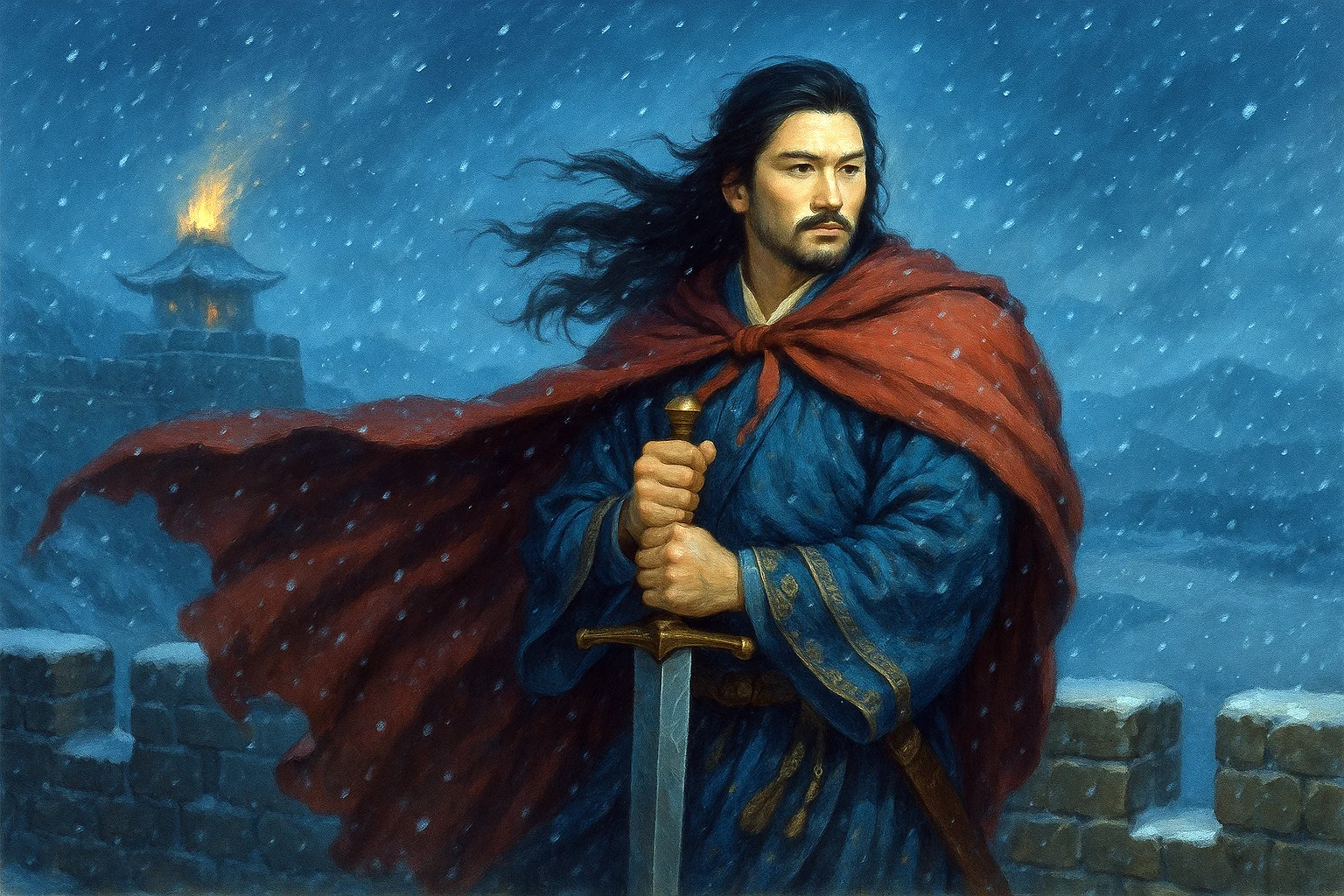
Cén Cān(岑参), 715 - 770 AD, was a native of Jingzhou, Hubei Province. He studied at Mt. Songshan when he was young, and later traveled to Beijing, Luoyang and Shuohe. Cén Cān was famous for his border poems, in which he wrote about the border scenery and the life of generals in a majestic and unrestrained manner, and together with Gao Shi, he was an outstanding representative of the border poetry school of the Sheng Tang Dynasty.