
Together we officials climbed vermilion steps,
To be parted by the purple walls...
Our procession, which entered the palace at dawn,
Leaves fragrant now at dusk with imperial incense.
...Grey heads may grieve for a fallen flower,
Or blue clouds envy a lilting bird;
But this reign is of heaven, nothing goes wrong,
There have been almost no petitions.
Original Poem
「寄左省杜拾遗」
岑参
联步趋丹陛,分曹限紫微。
晓随天仗入,暮惹御香归。
白发悲花落,青云羡鸟飞。
圣朝无阙事,自觉谏书稀。
Interpretation
This poem was composed between the second year of the Zhide era (757 CE) and the first year of the Qianyuan era (758 CE), when Cen Can, recommended by Du Fu, served as Right Remonstrator, while Du Fu served as Left Remonstrator. The two held parallel advisory posts in the Secretariat (Right Bureau) and the Chancellery (Left Bureau). Though this period fell in the middle of the An Lushan Rebellion—with the newly established Suzong court facing enormous challenges—the routinized life of the central bureaucracy and the practical difficulties of the remonstrators' path had already led the perceptive Cen Can to profound disillusionment and weariness.
This poem, sent to his colleague and close friend Du Fu, is no ordinary social verse but a political monologue of the heart, cast in the form of poetry, and a spiritual testament between two intellectuals. It was born at a particular political moment: on the surface, it was the dawn of "restoration," urgently in need of loyal counsel; in reality, the power structure was unstable and the path of remonstrance was not necessarily open. From the perspective of a participant, Cen Can reveals the triviality, waste, and profound helplessness experienced by the individual remonstrator beneath the grand and solemn court rituals. The splendid, solemn descriptions of court ceremony in the poem, together with the ostensible praise in the final couplet—which is in fact ironic—create a striking tension, making this a paradigmatic text for dissecting the existential condition and inner contradictions of post-High Tang bureaucratic intellectuals.
First Couplet: "联步趋丹陛,分曹限紫微。"
Lián bù qū dān bì, fēn cáo xiàn zǐ wēi.
Side by side we pace the crimson steps,
Yet our separate offices are divided by the Purple Palace.
The opening sketches the classic scene of a morning audience with dignified strokes. "Side by side we pace" conveys the uniformity of court ceremonial and the ministers' reverent bearing; "crimson steps" evokes the splendor and majesty of the palace. Yet the second line, "our separate offices are divided by the Purple Palace," subtly reveals another reality: "separate offices" refers to the Chancellery (Left Bureau) and the Secretariat (Right Bureau)—though their functions are connected, they are separated in physical space and administrative procedure; the character "divided" hints at a sense of constraint, a division imposed by the system that makes it difficult to form a united force. The Purple Palace, the emperor's residence, symbolizes supreme authority; all rush toward it, yet it divides them invisibly.
Second Couplet: "晓随天仗入,暮惹御香归。"
Xiǎo suí tiān zhàng rù, mù rě yù xiāng guī.
At dawn, I follow the imperial guard into the palace;
At dusk, I return bearing the scent of the imperial incense.
This couplet, with its refined parallelism, condenses the entire content and hollow essence of a remonstrator's day. "At dawn, entering" and "at dusk, returning" form a tightly closed temporal cycle, highlighting the monotonous routine of life. "Following the imperial guard" and "bearing the imperial scent" are superficially splendid—proximity to the seat of power—but actually entail wholly passive participation ("following") and purely formal acquisition ("bearing the scent"). The poet's choice of "imperial incense" as a detail is especially subtle: it is the most honored contamination, yet the most illusory gain; it is the only material proof of a day's busyness, yet also an ironic metaphor for substantive contribution.
Third Couplet: "白发悲花落,青云羡鸟飞。"
Bái fà bēi huā luò, qīng yún xiàn niǎo fēi.
Grey hairs grieve over falling blossoms;
I envy the birds that fly among the blue clouds.
The emotion turns from the description of external scenes to direct expression of the inner world. This couplet constitutes a sharp self-confrontation. "Grey hairs grieve over falling blossoms" is an inward-looking anxiety about life—youth silently flows away amid the mechanical routines of court ritual, like spring blossoms falling, filled with helpless sorrow. "I envy the birds that fly among the blue clouds" is an outward projection of spiritual longing—a desire to break free and gain the freedom and purpose of birds soaring into the clouds. This "grieving" and "envying" reveal the deep spiritual plight the poet feels despite his position at court: his body is disciplined at the crimson steps, while his soul yearns for the vastness beyond.
Final Couplet: "圣朝无阙事,自觉谏书稀。"
Shèng cháo wú quē shì, zì jué jiàn shū xī.
Our sage dynasty has no deficiencies to correct;
I find myself submitting fewer and fewer remonstrance memorials.
This couplet is the poem's masterstroke, employing the highest order of irony. On the surface, it praises the court: the dynasty is perfect, so remonstrance is unnecessary. However, in light of the historical context—the An Lushan Rebellion not yet quelled, the nation in turmoil—and the poet's personal anguish of "grey hairs grieving over falling blossoms," the real meaning is precisely the opposite. The claim of "no deficiencies" is not a reality but an excuse for obstructed or futile remonstrance; the "fewer memorials" is not because the realm is at peace, but due to disappointment, helplessness, and a choice to remain silent, or the result of advice going unheeded. This is an extremely subtle yet piercing critique of the political ecology of the court.
Overall Appreciation
This five-character regulated verse is a masterpiece combining court poetry with political lyricism. It employs a "dual structure": on the surface, a work of refined elegance depicting court life, conforming to all the norms of imperial occasional verse; beneath the surface, a surge of profound life-sorrow and sharp political irony. The great disparity between the two constitutes the poem's core artistic tension.
Structurally, the poem progresses from outside to inside, from scene to mood. The first couplet outlines the solemnity of court ritual with "side by side we pace the crimson steps"; the second couplet depicts the mechanical routine of the remonstrator's day with "at dawn, entering; at dusk, returning." Together, these two couplets lay out the splendor and hollowness of the external world. The third couplet makes an abrupt turn inward with "grey hairs grieve over falling blossoms," directly confronting the anxiety of life's passage and the yearning for spiritual freedom, focusing the emotion. The final couplet closes with the irony of "our sage dynasty has no deficiencies," elevating personal sorrow into a critique of the political ecology and giving the poem the weight of its age. The four couplets move from court to inner heart, from reality to aspiration, from the particular to the universal—layer upon layer, in seamless unity.
In terms of theme, the poem pivots on the character "无" (no / without). The "no" of "our sage dynasty has no deficiencies" is ostensibly praise for the court's perfection, but in reality a veiled indictment of the obstruction of remonstrance—it is not that there are truly no deficiencies, but that they are concealed, ignored, or defined as "none." This "no" resonates deeply with the "grieving" and "envying" of the third couplet: precisely because of the surface silence of "no deficiencies," there is the life-wasting "grey hairs grieve over falling blossoms" and the spiritual escape of "I envy the birds that fly among the blue clouds." This character "无" is the most poignant word in the poem—appearing as praise of the sovereign, it bears a remonstrator's deepest disappointment with his age.
Artistically, the most striking qualities of this poem are the ironic tension within perfect parallelism and the pinnacle use of ironic language. Every couplet is exquisitely parallel—"at dawn, entering" against "at dusk, returning," "grey hairs" against "blue clouds"—achieving a formal perfection. Yet within this formal framework, the poet infuses content charged with contradiction and tension: the opposition of "grieving" and "envying," the divergence of "no deficiencies" from the historical context. The formal "stability" and the semantic "deviation" form a strange symbiosis that enhances the ironic effect. The final couplet—"our sage dynasty has no deficiencies, I find myself submitting fewer and fewer remonstrance memorials"—is a paradigm of ironic language in classical political poetry. It fully exploits the expressive potential of the Chinese language and the court context: not a single word of overt criticism, yet carrying the deepest disappointment and satire. This mode of expression—saying one thing while meaning another, praising in order to censure—exemplifies the wisdom of scholar-officials who, under political pressure, turned to indirect expression of their convictions.
Artistic Features
- Ironic Tension within Perfect Parallelism
Every couplet is exquisitely parallel, such as "at dawn, entering" against "at dusk, returning," "grey hairs" against "blue clouds"—achieving a formal perfection. Yet within this formal framework, the poet infuses content charged with contradiction and tension (such as the opposition of "grieving" and "envying," the divergence of "no deficiencies" from the historical context). The formal "stability" and the semantic "deviation" form a strange symbiosis that enhances the ironic effect. - Symbolic Selection of Imagery
"Crimson steps," "Purple Palace," "imperial guard," and "imperial incense" are typical symbols of the court's power space; while "falling blossoms" and "birds in flight" are symbols of natural life and freedom. By juxtaposing these two sets of images, the poet allows the oppression of institutional space to collide continually with the sense of life's passage and the yearning for freedom, vividly externalizing inner struggle. - The Pinnacle Use of Ironic Language
The final couplet—"our sage dynasty has no deficiencies, I find myself submitting fewer and fewer remonstrance memorials"—is a paradigm of ironic language in classical political poetry. It fully exploits the expressive potential of the Chinese language and the court context: not a single word of overt criticism, yet carrying the deepest disappointment and satire. This mode of expression—saying one thing while meaning another, praising in order to censure—requires the reader to "decode" it in context, exemplifying the wisdom of scholar-officials in indirectly expressing their convictions under political pressure. - Fusion of Personal Sentiment and the Age's Predicament
Though the poem begins with personal routine (court attendance, duty, reflection), the anxiety of "grey hairs grieve over falling blossoms" and the irony of "our sage dynasty has no deficiencies" extend far beyond the individual, pointing to the predicament of the remonstrator system and, more broadly, of political culture in a specific historical period, giving personal sighs the weight of an era.
Insights
This work is like a "poetic pathology report" on the spiritual state of post-High Tang bureaucratic intellectuals, offering insights both profound and complex. First, it reveals the vast chasm that can exist between institutional existence and individual life-fulfillment. Even in a position near the center of power, seemingly honored, an individual can feel profound waste, alienation, and helplessness. The contrast in the poem between "side by side we pace the crimson steps" and "grey hairs grieve over falling blossoms" constitutes a cruel dialogue between professional role and life's essence, reminding all who exist within vast systems across the ages to remain vigilant against their own alienation.
Second, it demonstrates how, in an environment of limited speech, intellectuals can employ high-level linguistic artistry (irony, symbolism, dual structures) to speak of things that cannot be directly spoken, thereby preserving spiritual independence and critical edge. Cen Can did not choose direct remonstrance or complete reclusion; within the system, using a poem that meets all formal requirements, he delivered his most subtle and penetrating critique of that system. This is a form of complex, tension-filled wisdom in both living and expressing.
Ultimately, this poem compels us to contemplate the relationship between "channels of remonstrance" and "good governance." A truly healthy "sage dynasty" may lie not in the surface silence of "no deficiencies," but in its capacity to accommodate and even encourage the sincerity and abundance of "remonstrance memorials." Cen Can's helpless observation of "fewer and fewer remonstrance memorials" is an eternal challenge to rulers of all ages: have we created an environment in which loyalty and wisdom can speak freely? Can we hear those true, faint voices wrapped in ornate rhetoric and rigorous prosody? This, perhaps, is why this poem from a thousand years ago still touches our hearts across time.
Poem translator
Kiang Kanghu
About the poet
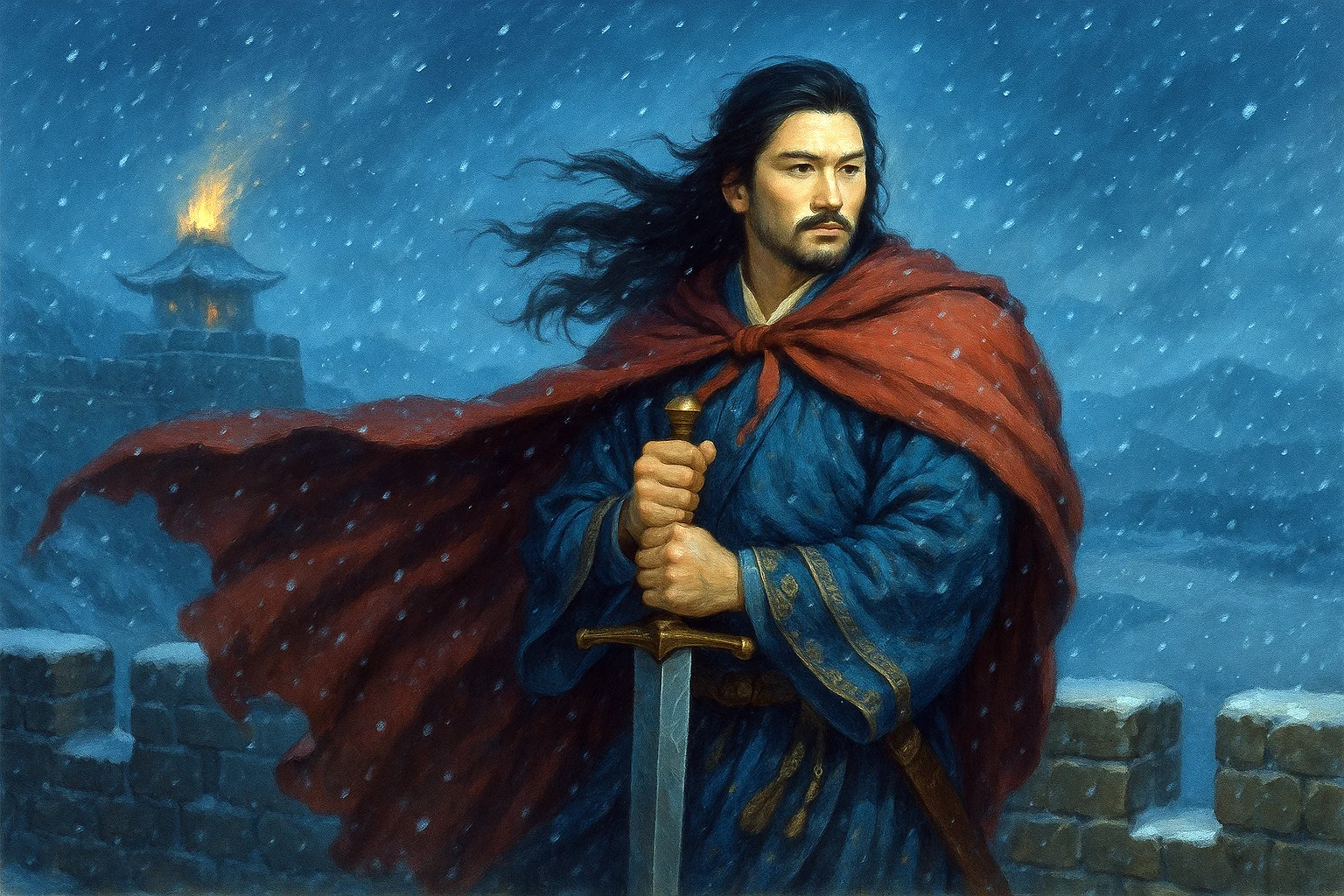
Cén Cān(岑参), 715 - 770 AD, was a native of Jingzhou, Hubei Province. He studied at Mt. Songshan when he was young, and later traveled to Beijing, Luoyang and Shuohe. Cén Cān was famous for his border poems, in which he wrote about the border scenery and the life of generals in a majestic and unrestrained manner, and together with Gao Shi, he was an outstanding representative of the border poetry school of the Sheng Tang Dynasty.