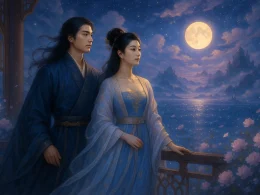



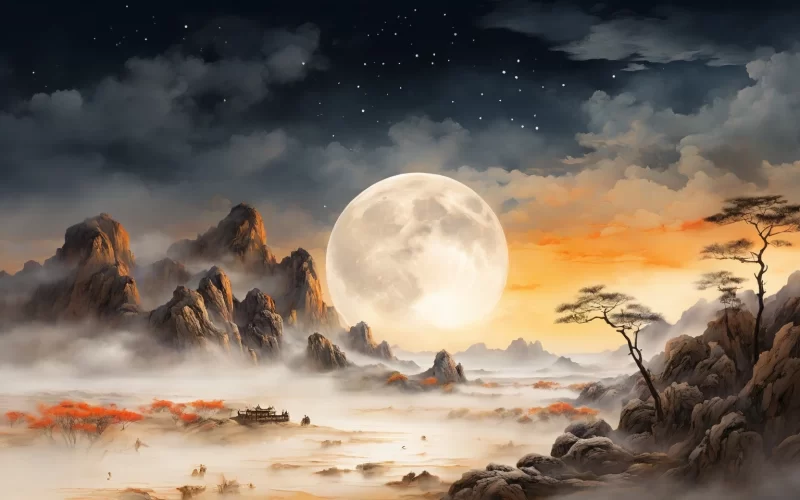
The bright moon lifts from the Mountain of Heaven
In an infinite haze of cloud and sea,
And the wind, that has come a thousand miles,
Beats at the Jade Pass battlements...
China marches its men down Po-teng Road
While Tartar troops peer across blue waters of the bay...
And since not one battle famous in history
Sent all its fighters back ag ain,
The soldiers turn round, looking toward the border,
And think of home, with wistful eyes,
And of those tonight in the upper chambers
Who toss and sigh and cannot rest.
Original Poem
「关山月」
李白
明月出天山,苍茫云海间。
长风几万里,吹度玉门关。
汉下白登道,胡窥青海湾。
由来征战地,不见有人还。
戍客望边色,思归多苦颜。
高楼当此夜,叹息未应闲。
Interpretation
Composed during the Tianbao era (742-756 CE) as the High Tang began declining, this poem was written amid frequent conflicts between the Tang dynasty and neighboring regimes like the Tibetan Empire and the Abbasid Caliphate. Li Bai adapted the traditional yuefu theme, using majestic brushstrokes to depict the tragic grandeur of frontier warfare. The poem reveals both the hardships of border troops and a profound yearning for peace, embodying deep humanitarian concern.
First Couplet: "明月出天山,苍茫云海间。"
Míngyuè chū Tiānshān, cāngmáng yúnhǎi jiān.
The bright moon rises from Tianshan's peaks, Drifting through vast seas of cloud that speak.
The poem opens with extraordinary vision. While the moon should rise in the east, the poet places his perspective in the northwest frontier, making it emerge from Tianshan—a deliberate geographical reversal that intensifies the borderland's boundless, exotic feel. "Vast seas of cloud" imagery conveys spatial immensity while subtly suggesting the era's uncertainty.
Second Couplet: "长风几万里,吹度玉门关。"
Chángfēng jǐ wàn lǐ, chuī dù Yùmén Guān.
Long winds sweep ten thousand miles ahead, Blowing through Jade Gate Pass, where few tread.
This line pushes spatial perception to its extreme. The hyperbolic "ten thousand miles" lends the wind temporal and historical weight—as if it blows from homeland only to halt at the frontier, becoming an invisible link between hometown and border. "Jade Gate Pass," dividing China proper from the Western Regions, symbolizes the boundary between life and death, peace and war.
Third Couplet: "汉下白登道,胡窥青海湾。"
Hàn xià Báidēng dào, hú kuī Qīnghǎi wān.
Han marched to Baideng's road in plight; Hu spies on Kokonor's bay tonight.
The poet skillfully employs historical allusion. "Baideng's road" (where Emperor Gaozu of Han was besieged by the Xiongnu) and "Kokonor's bay" (where Tang forces clashed with the Tibetan Empire) create a trans-temporal parallel. This not only highlights the prolonged nature of border conflicts but implicitly criticizes historical militarism.
Fourth Couplet: "由来征战地,不见有人还。"
Yóulái zhēngzhàn dì, bújiàn yǒu rén huán.
This land has bred war since days of yore; Few who march to battle return anymore.
This is the poem's most poignant line. "Since days of yore" expresses historical cycles and helplessness; "few return anymore" states war's cruelest truth in stark terms—the merciless obliteration of individual lives. Its power lies in its irrefutable finality.
Fifth Couplet: "戍客望边色,思归多苦颜。"
Shù kè wàng biān sè, sī guī duō kǔ yán.
Guards gaze on frontier's bleak hue; Homesick faces show anguish through and through.
The perspective shifts from grand history to individual experience. "Frontier's hue" represents not just desolate scenery but the daily reality of long garrison duty; "anguish" accurately captures the physical imprint of prolonged mental torment.
Sixth Couplet: "高楼当此夜,叹息未应闲。"
Gāolóu dāng cǐ yè, tànxī wèi yīng xián.
In homeland towers this same night, Sighs of wives never take flight.
The conclusion shifts perspective across space, from frontier to women's chambers, forming the classic "frontier soldier - pining wife" dual lyrical structure. "Never take flight" turns endless longing into ceaseless sound, echoing the opening's long winds to form an emotional circle with lingering resonance.
Holistic Appreciation
The poem's most striking artistic feature is its construction of multiple grand spatial contrasts: the frontier space of Tianshan and Jade Gate, the historical space of Baideng and Kokonor, and the emotional space between border and women's quarters. Within these layered frameworks, individual fates appear increasingly small and helpless. Li Bai's romantic brush paints a profoundly realistic tragic vision, achieving perfect unity of boldness and solemnity. Like a condensed epic, the poem carries deep reflection on war, history, and individual destiny within brief lines.
Artistic Merits
- Masterful Temporal-Spatial Structure: The poem spans thousands of miles spatially and connects ancient and modern temporally, creating a three-dimensional, epic narrative framework.
- Symbolic Use of Imagery: "Moon," "long winds," and "Jade Gate Pass" serve both as realistic description and symbols of nostalgia, history, and life-death boundaries.
- Contrast in Emotional Rendering: Multiple contrasts—between the frontier's grandeur and the individual's smallness, history's length and life's brevity—greatly enhance the poem's power.
Insights
Transcending its era, this poem reveals an eternal dilemma: the fragility and preciousness of individual happiness beneath grand state narratives and historical forces. The accusation "few who march to battle return anymore" represents the clearest understanding of war's essence. It reminds us that peace is not inevitable but built on countless sacrifices of soldiers and their families. Today, this poem remains a powerful reaffirmation of peace's value, teaching us that the greatest achievement is bringing soldiers home and silencing sighs.
Poem translator
Kiang Kanghu
About the poet
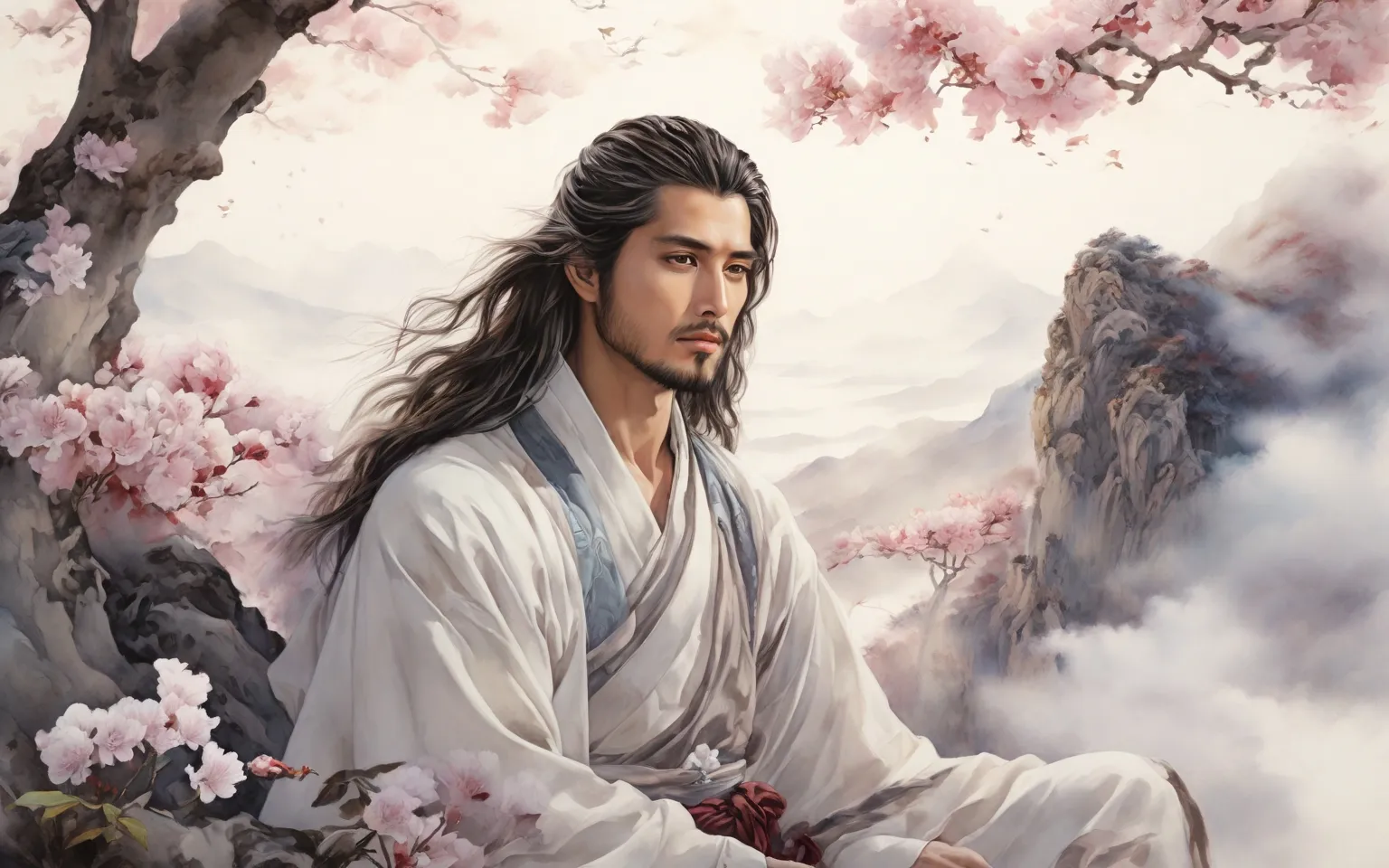
Li Bai (李白), 701 - 762 A.D., whose ancestral home was in Gansu, was preceded by Li Guang, a general of the Han Dynasty. Tang poetry is one of the brightest constellations in the history of Chinese literature, and one of the brightest stars is Li Bai.