
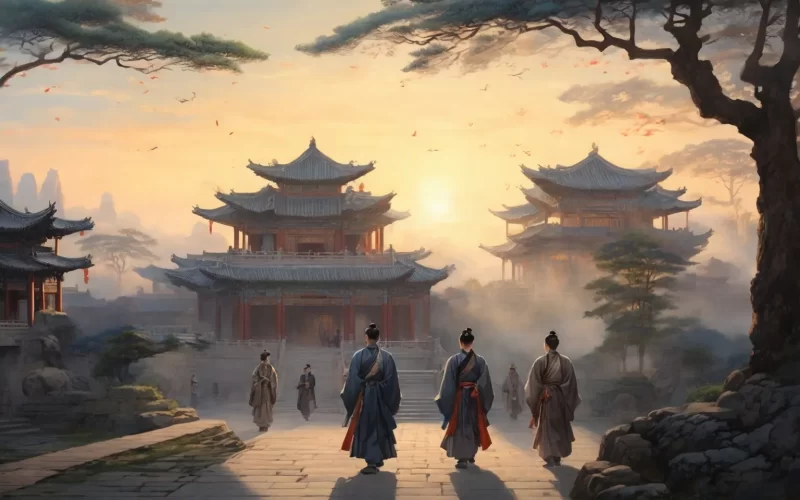
Cock-crow, the Purple Road cold in the dawn;
Linnet songs, court roofs tinted with April;
At the Golden Gate morning bell, countless doors open,
And up the jade steps float a thousand officials
With flowery scabbards... Stars have gone down;
Willows are brushing the dew from the flags --
And, alone on the Lake of the Phoenix, a guest
Is chanting too well The Song of Bright Spring.
Original Poem
「奉和中书舍人贾至早朝大明宫」
岑参
鸡鸣紫陌曙光寒, 莺啭皇州春色阑。
金阙晓钟开万户, 玉阶仙仗拥千官。
花迎剑佩星初落, 柳拂旌旗露未乾。
独有凤凰池上客, 阳春一曲和皆难。
Interpretation
This poem was composed in the spring of 758 AD, during the Qianyuan reign period of Emperor Suzong of the Tang Dynasty. Cen Shen was then serving as Reminder of the Right at court. Jia Zhi, holding the post of Secretariat Drafter at the time, authored the original poem "Morning Audience at the Great Brilliance Palace," which depicted the majestic spectacle of the dawn audience. This prompted poetic responses from eminent court figures like Wang Wei and Du Fu; Cen Shen's work is one of these responses. This cluster of poetic exchanges was born in the unique period shortly after the initial suppression of the An Lushan Rebellion and Emperor Suzong's return to Chang'an. The solemn scene of the dawn audience was imbued with the political symbolism of revitalizing court governance and restoring the flourishing age.
However, this poetic exchange was not mere literary diversion. The rebellion was not yet fully pacified; the nation faced arduous trials, and countless tasks awaited restoration. At such a moment demanding diligent governance, the celebration of the "morning audience"—the state's highest ceremonial activity—inherently contained aspirations for restoring order and upholding the court's authority. Cen Shen's responsive poem, crafted precisely within this complex context, participates through poetic artistry in the 'ritualistic' construction of a flourishing age. It needed to conform to the elegant conventions of palace occasional poetry, celebrating imperial majesty; it needed to showcase individual talent amidst a dazzling constellation of replies; and, on a deeper level, perhaps it also concealed the latent sentiments of a poet who had witnessed frontier conflicts and observed the hardships of the people—feelings encompassing both heartfelt yearning for "peaceful scenes" and a reserved, complex contemplation thereof.
First Couplet: "鸡鸣紫陌曙光寒,莺啭皇州春色阑。"
Jī míng zǐ mò shǔguāng hán, yīng zhuàn huáng zhōu chūn sè lán.
At cocks' crow on the Purple Road the cold daylight's still pale; / When orioles sing in Royal Spring, the spring colours grow stale.
The poem opens from the outskirts beyond the palace, with precise temporal-spatial positioning. "Cocks' crow" is auditory, marking dawn; "Purple Road" is visual, denoting the capital's grand avenues; "cold daylight's still pale" deftly blends vision and touch, evoking the crisp freshness peculiar to a spring morning. The next line, "orioles sing in Royal Spring," embellishes the capital with pleasing sounds, while "the spring colours grow stale" subtly reveals regret. It aligns with the late spring season and may also harbor a nuanced perception of the ephemeral nature of flourishing prosperity. This couplet uses the vast morning panorama of the capital as its canvas, with the sensory interplay of chill and fading beauty as its undertone, laying a backdrop for the imperial dawn audience that is both magnificent and tinged with a hint of serene solitude.
Second Couplet: "金阙晓钟开万户,玉阶仙仗拥千官。"
Jīn què xiǎo zhōng kāi wàn hù, yù jiē xiān zhàng yōng qiān guān.
The golden palace morning bell has opened thousand doors; / Before the jade steps royal guards stand with officials in rows.
The poet's gaze shifts toward the palace gates, then to the core of the assembly. "Golden palace morning bell" represents the solemn summons, symbolizing the imperial call to order; "opened thousand doors" conveys the grandeur of the palace and the spectacle of officials entering court. "Jade steps royal guards" vividly depicts the splendor of the imperial retinue and royal majesty; "stand with officials in rows" portrays the gathering of hundreds of officials, reverent and orderly. This couplet exhibits impeccable parallelism and opulent imagery, constructing the most iconic visual tableau of the dawn audience through representative symbols of palace power, fully displaying the majesty of the empire's center.
Third Couplet: "花迎剑佩星初落,柳拂旌旗露未干。"
Huā yíng jiàn pèi xīng chū luò, liǔ fú jīng qí lù wèi gān.
Flowers greet swords and pendants when stars begin to fade; / Willows caress flags and banners while dew is not yet dried.
This celebrated couplet shifts perspective from the macro-scene to exquisite detail. "Flowers greet swords and pendants" and "Willows caress flags and banners" personify the flora, endowing them with an attentive posture of welcome and gentle touch, instantly infusing the solemn audience scene with lively charm and graceful splendor. "Stars begin to fade" and "dew is not yet dried" capture time with precision: the former emphasizes "earliness," the latter evokes "freshness," together evoking that unique atmosphere of a spring morning—fresh, moist, vital, and supremely solemn. The natural imagery of flowers, willows, stars, and dew perfectly merges with the cultural imagery of swords, pendants, flags, and banners, achieving the highest integration of scene and sentiment within palace poetry.
Fourth Couplet: "独有凤凰池上客,阳春一曲和皆难。"
Dú yǒu fènghuáng chí shàng kè, yángchūn yī qǔ hè jiē nán.
Alone you sing a song as fine as springtime sunny ray; / It's hard for other poets to write words as fair as they.
The final couplet deftly returns to the original theme of "responding," expressing admiration for Jia Zhi's initiating poem. "Alone you" honors Jia Zhi, the "guest by the Phoenix Pond" (the Secretariat), hinting at his prestigious status near the center of power. "A song as fine as springtime sunny ray" uses the allusion to the sublime melody "Springtime White Snow" to highly praise Jia Zhi's work. The phrase "hard for other poets to write words as fair" serves both as modest self-deprecation, showing respect, and may contain genuine artistic sentiment—that responding to such a resplendent theme and exquisite original is truly challenging. This couplet displays propriety within praise and grace within humility, concluding this occasional, responsive poem fittingly.
Holistic Appreciation
This regulated verse is a superior work among Tang Dynasty courtly poetic exchanges, representing the refined, exquisite, and loftily splendid aspect of Cen Shen's poetry. The entire poem closely follows the "morning audience" theme, observing a rigorous structure of "from far to near, from grand to minute, from scene to people," akin to a meticulously shot documentary of the palace ceremony.
The first six lines fully elaborate the magnificent spectacle: from the faint morning light over the capital, to the bells opening the palace gates for the officials, to the blossoms and willows adorning the audience area. The spatial layers are distinct, the imagery resplendent, vividly depicting the solemn majesty and prosperous aura of the dawn audience. The third couplet, in particular, animates static scenes with lively brushstrokes, infusing natural freshness into imperial majesty, becoming a stroke of genius that balances "the aura of the court" with "the charm of poetry." The final couplet turns gracefully, returning to the original intent of the poetic exchange. While praising his friend, it also draws this peerless responsive poem to a perfect and resonant close.
Artistic Merits
- Precise Spatiotemporal Architecture: The poem progresses temporally from daybreak to the audience, and spatially from the capital's panorama to the palace core, to details before the hall. This orderly, interwoven narrative of time and space forms a perfect parallel with the strict formality of the dawn audience ritual itself.
- Sublimation of Classic Court Imagery: The poem employs iconic courtly and power-related imagery like "Purple Road," "golden palace," "jade steps," "royal guards," "swords and pendants," "flags and banners," and "Phoenix Pond." Cen Shen's brilliance lies in interweaving these with natural imagery full of vitality—"cocks' crow," "orioles sing," "flowers greet," "willows caress," "dew." This adds liveliness and freshness to the resplendent foundation, avoiding potential stiffness.
- Perfection of Parallelism and Diction: As a standard regulated verse, this poem's parallelism and lexical refinement reach a high degree of perfection. Pairs like "golden palace" to "jade steps," "morning bell" to "royal guards," "opened thousand doors" to "stand… in rows" are exquisitely crafted. The couplet "Flowers greet… Willows caress…" is a model of excellence in meaning, imagery, sound, and color, demonstrating the poet's high skill in achieving expressive freedom within strict form.
- Balance of Occasional Function and Poetic Talent: The poem fully satisfies the requirements of palace occasional poetry to extol the flourishing age with refined dignity, evident in its depiction of imperial majesty. Yet, through the subtle sigh in "spring colours grow stale," the delightful conceit of "flowers greet… willows caress," and the fitting modesty of the final couplet, the poet naturally incorporates his personal observation, aesthetic taste, and social grace, achieving a delicate balance between public occasion and private expression.
Insights
This resplendent and refined responsive poem provides an exquisite specimen for understanding High Tang court culture and the literati spirit. It reveals that even within highly formulaic, collective-oriented creative contexts like palace occasional poetry, great poets could still find space to exercise individual artistic talent. Through masterful pairing of imagery, vivid detail, and rigorous structure, Cen Shen transformed ceremonial praise into an artistic masterpiece of independent aesthetic value where feeling and scene merge.
Simultaneously, the poem shows how literature participated in a "ritualistic" national narrative during the empire's reconstruction. The repeated celebration of the "dawn audience"—a ritual symbolizing order, authority, and unity—was itself a cultural act of reaffirmation. The poetic exchanges of Cen Shen and others were not merely a literary contest but also a participation, through literary means, in shaping and consolidating the post-war empire's legitimacy.
Ultimately, this poem prompts reflection on "constraint" and "creation." Under multiple constraints of theme, genre, occasion, and political atmosphere, Cen Shen still created timeless lines like "Flowers greet swords and pendants when stars begin to fade; / Willows caress flags and banners while dew is not yet dried." This reminds all creators that true artistic creativity often lies not in casting off all constraints, but in recognizing necessary boundaries and, within that defined sphere, opening up infinite poetic possibility.
Poem translator
Kiang Kanghu
About the poet
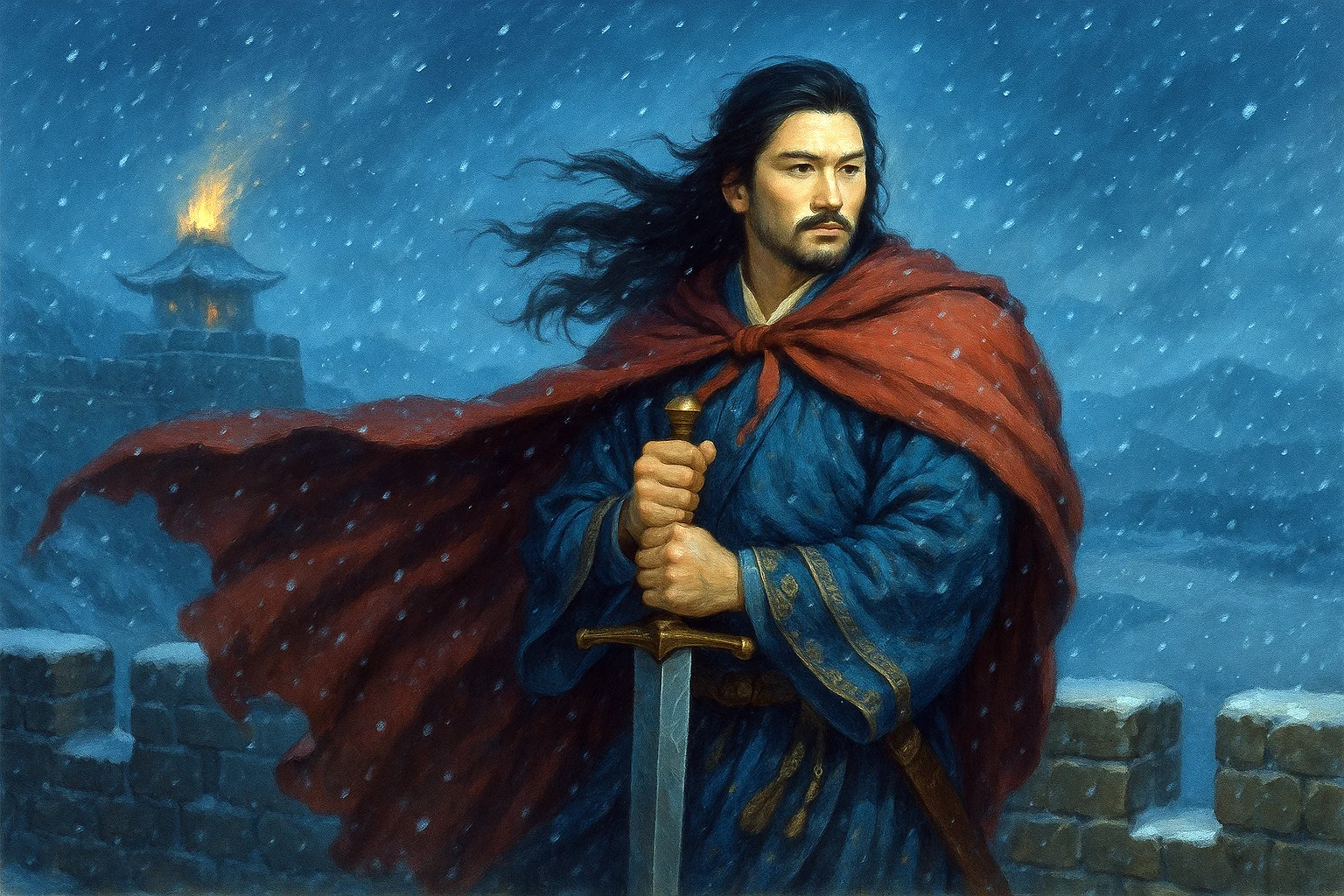
Cen Can(岑参), 715 - 770 AD, was a native of Jingzhou, Hubei Province. He studied at Mt. Songshan when he was young, and later traveled to Beijing, Luoyang and Shuohe. Cen Can was famous for his border poems, in which he wrote about the border scenery and the life of generals in a majestic and unrestrained manner, and together with Gao Shi, he was an oubout the border scenery and the life of generals in a majestic and unrestrained manner, and together with Gao Shi, he was an outstanding representative of the border poetry school of the Sheng Tang Dynasty.