


The north wind rolls the white grasses and breaks them;
And the Eighth-month snow across the Tartar sky
Is like a spring gale, come up in the night,
Blowing open the petals of ten thousand pear trees.

It enters the pearl blinds, it wets the silk curtains;
A fur coat feels cold, a cotton mat flimsy;
Bows become rigid, can hardly be drawn,
And the metal of armour congeals on the men;
The sand-sea deepens with fathomless ice,
And darkness masses its endless clouds;

But we drink to our guest bound home from camp,
And play him barbarian lutes, guitars, harps;
Till at dusk, when the drifts are crushing our tents
And our frozen red flags cannot flutter in the wind,

We watch him through Wheel Tower Gate going eastward,
Into the snow-mounds of Heaven-Peak Road…
And then he disappears at the turn of the pass,
Leaving behind him only hoof-prints.
Original Poem
「白雪歌送武判官归京」
岑参
北风卷地白草折, 胡天八月即飞雪;
忽如一夜春风来, 千树万树梨花开。
散入珠帘湿罗幕, 狐裘不暖锦衾薄。
将军角弓不得控, 都护铁衣冷犹著。
瀚海阑干百丈冰, 愁云黪淡万里凝。
中军置酒饮归客, 胡琴琵琶与羌笛。
纷纷暮雪下辕门, 风掣红旗冻不翻。
轮台东门送君去, 去时雪满天山路;
山回路转不见君, 雪上空留马行处。
Interpretation
This is a representative work of Cen Can's frontier poetry, composed roughly between the 13th year of the Tianbao era (754 CE) and the 1st year of the Zhide era (756 CE) under Emperor Xuanzong of Tang. At that time, Cen Canserved as a Military Judge under Feng Changqing, the Military Governor of Anxi and Beiting, stationed in Luntai (near modern-day Ürümqi, Xinjiang). Military Judge Wu (first name unknown) was likely Cen Can's colleague, now ordered to return to the capital for debriefing. This poem was born during the golden age of High Tang frontier poetry composition and at a time when Cen Can himself, on his second tour of frontier duty, had reached the pinnacle of his poetic artistry.
This is no ordinary farewell poem. It is a masterful synthesis, within an extreme natural environment, of the High Tang frontier spirit, the aesthetics of exotic landscapes, and the sincere emotions of humanity. The snows of Luntai in August are both a real climatic record and the wellspring of inspiration ignited by the poet's artistic soul encountering a natural marvel. Cen Can unfolds the sorrow of parting entirely within the magnificent, icy world of "a myriad pear trees blossoming" and the harsh reality of "The frozen red flag will not flap in the wind," granting private emotion an epic, vast backdrop. "Snow" is the absolute protagonist throughout the poem—it is the awe-inspiring presence of nature, the authentic backdrop of frontier military life, and the catalyst for the poet's surging passion and bold imagination, ultimately crystallizing into the most dazzling ice-and-snow symphony within High Tang frontier poetry.
Opening Couplet: "北风卷地白草折,胡天八月即飞雪。"
Běi fēng juǎn dì bái cǎo zhé, hú tiān bā yuè jí fēi xuě.
A savage north wind scours the land, snapping the hardy white grass; / The Tartar sky, already in the eighth moon, sends swirling snow flying down.
The opening is like a panoramic storm shot in a film, plunging the reader with tremendous force into the extraordinarily cold and harsh environment of the northwestern frontier. "Scours the land" depicts the ferocity of the wind; "snapping" displays nature's power—both are intensely forceful. "The Tartar sky, already in the eighth moon, sends swirling snow flying down" highlights the anomaly of time and place; the word "already" is filled with astonishment at the strange frontier climate. This is not merely environmental description; it establishes a majestic, vigorous, and primally charged emotional and aesthetic tone for the entire poem.
Second Couplet: "忽如一夜春风来,千树万树梨花开。"
Hū rú yī yè chūnfēng lái, qiān shù wàn shù lí huā kāi.
As if the warm spring wind returned in a single night, / Summoning thousands upon thousands of pear trees to burst into white bloom.
This couplet rises like a miraculous peak, an unmatched chant through the ages praising snow. With extraordinary imagination, the poet accomplishes a startling aesthetic transformation: turning bitter, flying snow instantly into the radiant, warm pear blossoms of spring. Using "spring wind" to metaphorize the north wind and "pear blossoms" for snowflakes, the repetition in "thousands upon thousands"极力 describes the grandeur, density, and boundlessness of the snowscape. This is not just a simile; it is a poetic alchemy that dissolves the bitterness of the northern frontier with the spirit of a Jiangnan spring. It showcases the characteristically High Tang poet's bold spirit, romantic sentiment, and powerful mental strength to transform hardship into beauty when facing severe nature.
Third Couplet: "散入珠帘湿罗幕,狐裘不暖锦衾薄。"
Sàn rù zhū lián shī luó mù, hú qiú bù nuǎn jǐn qīn báo.
Flakes drift in, pearl blinds and silken drapes grow damp; / Fox-furs bring no warmth, broidered quilts feel cold and thin.
The perspective shifts from the magnificent outdoor scene to details inside the military tent. The snow penetrates everywhere ("drift in"); the cold permeates everything. "Pearl blinds," "silken drapes," "fox-furs," "broidered quilts" are all luxurious, cold-resistant items, yet in this environment, they utterly fail. These four lines, through the realistic depiction of life's details, transform the abstract "cold" into a palpable, tactile sensation, laying a genuine physical background for the human activities that follow.
Fourth Couplet: "将军角弓不得控,都护铁衣冷犹著。"
Jiāngjūn jiǎo gōng bù dé kòng, dūhù tiě yī lěng yóu zhuó.
The general's horn-and-sinew bow grows too stiff to draw; / The protector's iron armor is piercing cold, yet still worn.
The focus lands on the frontier soldiers. The horn-and-sinew bow "grows too stiff to draw" due to the cold, showing weaponry subdued by nature; the iron armor is piercing cold but "yet still worn," reflecting military duty transcending physical suffering. The contrast between "too stiff to draw" and "yet still worn" highlights the frontier soldiers' resilience, tenacity, and proud commitment to duty in extreme conditions, adding profound human fortitude to the poem beyond its wondrous scenery.
Fifth Couplet: "瀚海阑干百丈冰,愁云黪淡万里凝。"
Hàn hǎi lángān bǎi zhàng bīng, chóu yún cǎn dàn wàn lǐ níng.
Across the vast sea of sand, ice stretches in ridges a hundred feet deep; / Somber, leaden clouds of sorrow hang congealed for ten thousand miles.
The poet's brush sweeps outward again, depicting a panoramic view of the frontier with extreme exaggeration. The combination of "vast sea of sand" and "ice… a hundred feet deep" emphasizes nature's colossal power and desolate cold; "Somber, leaden clouds of sorrow hang congealed for ten thousand miles" imbues heaven and earth with emotion, projecting the sorrow of parting onto the boundless sky. This makes the natural scene a grand correlative for the characters' inner feelings, creating a farewell atmosphere of universal sorrow, vast and desolate.
Sixth Couplet: "中军置酒饮归客,胡琴琵琶与羌笛。"
Zhōng jūn zhì jiǔ yǐn guī kè, húqín pípá yǔ qiāngdí.
In the central headquarters, wine is laid to speed the parting guest; / Barbarian lutes, pipas, and Qiang flutes play all at once.
This couplet directly engages the farewell theme. Against the backdrop of bitter cold, the scene of "wine is laid" appears especially precious and warm. The并列 of three typical Central Asian instruments—"Barbarian lutes, pipas, and Qiang flutes"—not only identifies the frontier setting of the farewell but also uses the cacophony and fervor of exotic melodies to set off the complex emotions of impending separation, where words fall short. The louder the music, perhaps the deeper the parting sorrow.
Seventh Couplet: "纷纷暮雪下辕门,风掣红旗冻不翻。"
Fēnfēn mù xuě xià yuánmén, fēng chè hóng qí dòng bù fān.
In thickening twilight snow falls fast on the camp gate; / The wind tugs at the red flag, frozen stiff, it will not flap.
This detailed description is hailed as a "stroke of genius." The evening snow continues the snow imagery; "The wind tugs at the red flag, frozen stiff, it will not flap" is a superb capture of a frontier wonder: the fierceness of the wind ("tugs at") and the rigidity of the flag ("frozen stiff, will not flap") form a powerful opposition, creating an image of great sculptural quality and symbolism. The red flag, symbol of the army camp and the homeland, frozen in the ice and snow, stands as a totem of the frontier defenders' resolute spirit, tragic yet sublime.
Final Couplet: "轮台东门送君去,去时雪满天山路;山回路转不见君,雪上空留马行处。"
Lúntái dōng mén sòng jūn qù, qù shí xuě mǎn Tiānshān lù; shān huí lù zhuǎn bù jiàn jūn, xuě shàng kōng liú mǎ xíng chù.
At Luntai's eastern gate I see you off on your way; / As you depart, snow wholly mantles the Tian Shan road. / Around the mountain's bend, the road turns; I lose sight of you; / On the snow, left behind, only the tracks of your horse.
The concluding four lines present a prolonged scene, deep in feeling. The farewell location and setting ("snow wholly mantles the Tian Shan road") are clearly stated. "Around the mountain's bend, the road turns; I lose sight of you" is a common phrase in farewell poetry, but followed by "On the snow, left behind, only the tracks of your horse," the artistic conception is fully realized. The traveler is gone, leaving only hoof-prints in the snow, stretching into the distance. The phrase "left behind, only" represents an extended gaze, a condensation of emotion, entrusting the poet's reluctance, melancholy, and well-wishes to this vast, silent snowy landscape. Silence speaks louder than words, leaving endless resonance.
Holistic Appreciation
This heptasyllabic song is the pinnacle of the perfect fusion of frontier poetry and farewell poetry. The entire poem uses "snow" as its thread and "farewell" as its core, with a grand, clearly layered structure and undulating emotions.
With genius imagination, the poet transforms the bitter, frontier "snow" into the fantastical beauty of "a myriad pear trees blossoming," establishing the poem's splendidly majestic aesthetic tone. Subsequently, the brush moves from nature to the military camp, from external scenes to the interior tent, from objects to people, layering descriptions of the intense cold. Only after fully depicting the extreme harshness of the environment does the farewell banquet in the central headquarters emerge. And the music of the farewell is quickly interrupted by the wondrous sight of "evening snow" and the "frozen flag," finally settling on the lingering image of the snowy farewell.
The poem's most prominent feature is the dialectical unity of the "fantastical" and the "real." The fantasy of imagination (e.g., pear blossoms for snow), the fantasy of exaggeration (hundred-foot ice, clouds congealed for miles), the fantasy of detail (the frozen flag)—all are astonishing. Yet simultaneously, the frontier climate, life, objects, and music and dance exude a strong sense of authenticity. It is precisely in this interweaving of "fantastical" and "real" that Cen Can both depicts the awe-inspiring natural features and military life of the frontier and infuses them with the deep affection of bidding farewell to a friend and his own bold spirit of participation. The poem is rich in emotion, at times marvelously unrestrained, at times quiet and subdued, embodying the vitality, expansive spirit, and heroic ethos characteristic of High Tang frontier poetry.
Artistic Merits
- Paragon of Innovative Metaphor: "As if the warm spring wind returned in a single night, / Summoning thousands upon thousands of pear trees to burst into white bloom" instantly transforms a cold snowscape into a bright, warm spring scene. This reversed, life-affirming metaphor is not only apt for the snow's appearance but also imbues the harsh environment with vibrant life and poetic beauty, a creative stroke of genius in literary history.
- Multidimensional Portrayal of Cold: The poet writes of "cold" from multiple dimensions: tactile cold (fox-furs bring no warmth), kinetic cold (bow too stiff to draw), visual cold (desert ice, miles of clouds), auditory cold (implied through the music), and even symbolic cold (the frozen flag). This comprehensive, three-dimensional sensory evocation immerses the reader, greatly enhancing the poem's power to move.
- Visual Editing and Rhythmic Control: The entire poem is like a meticulously edited film, seamlessly cutting between wide-angle panoramas (Tartar sky snow, desert ice), medium shots (central headquarters, camp gate), and close-ups (pearl blinds, horn bow, red flag, hoof-prints). The shifting scenes drive emotional undulations and rhythmic flow, creating a narrative rhythm that is both taut and relaxed, vast and magnificent.
- Poetic Sublimation of Frontier Imagery: Images like "hardy white grass," "Tartar sky," "vast sea of sand," "camp gate," "Luntai," "Tian Shan," "Barbarian lutes, pipas, and Qiang flutes" densely demarcate the unique space of the Western frontier. Cen Can's excellence lies not merely in listing these features but in poeticizing and aestheticizing them with magnificent imagination and heartfelt emotion, making them literary testaments to the expansion of the High Tang's spiritual realm.
Insights
This magnificent poem is the most powerful echo of the High Tang spirit reverberating in the distant frontier. It shows us that true heroism and poetry are often born from the most severe challenges. First, it enlightens us with wisdom regarding adversity and sublimation. Facing the extreme environment of "snow in the eighth moon" and "ice… a hundred feet deep," Cen Candoes not wallow in lamenting the bitter cold. Instead, with the splendid imagination of "a myriad pear trees blossoming," he achieves an aesthetic transcendence over real-world hardship. This reminds us that in life's "bitter cold" moments, we might learn this spiritual capacity to transform challenges into sources of creation and sublimate suffering into artistic beauty.
Secondly, it reveals the resonance between individual emotion and the spirit of the age. The farewell sentiment in the poem, placed against the grand backdrop of defending the homeland on the frontier and interwoven with the soldiers' heroic spirit, transcends the realm of personal friendship, attaining a broader perspective. This enlightens us that personal emotions and values, when combined with a greater cause or the spirit of the times, often burst forth with more dazzling brilliance.
Ultimately, this poem leaves us with a way of affirming emotion and existence within the vastness of heaven and earth. No matter how fierce the wind and snow, the red flag remains at the camp gate; no matter how far the departing friend travels, friendship lingers in the hoof-prints on the snow. Through his poetic brush, Cen Can tells us: even in the most desolate corners, human friendship, courage, and poetry can still take root, blossom, and traverse time and space to warm the hearts of countless readers for generations to come. This, perhaps, is the immortal power of literature and the human spirit.
Poem translator
Kiang Kanghu
About the poet
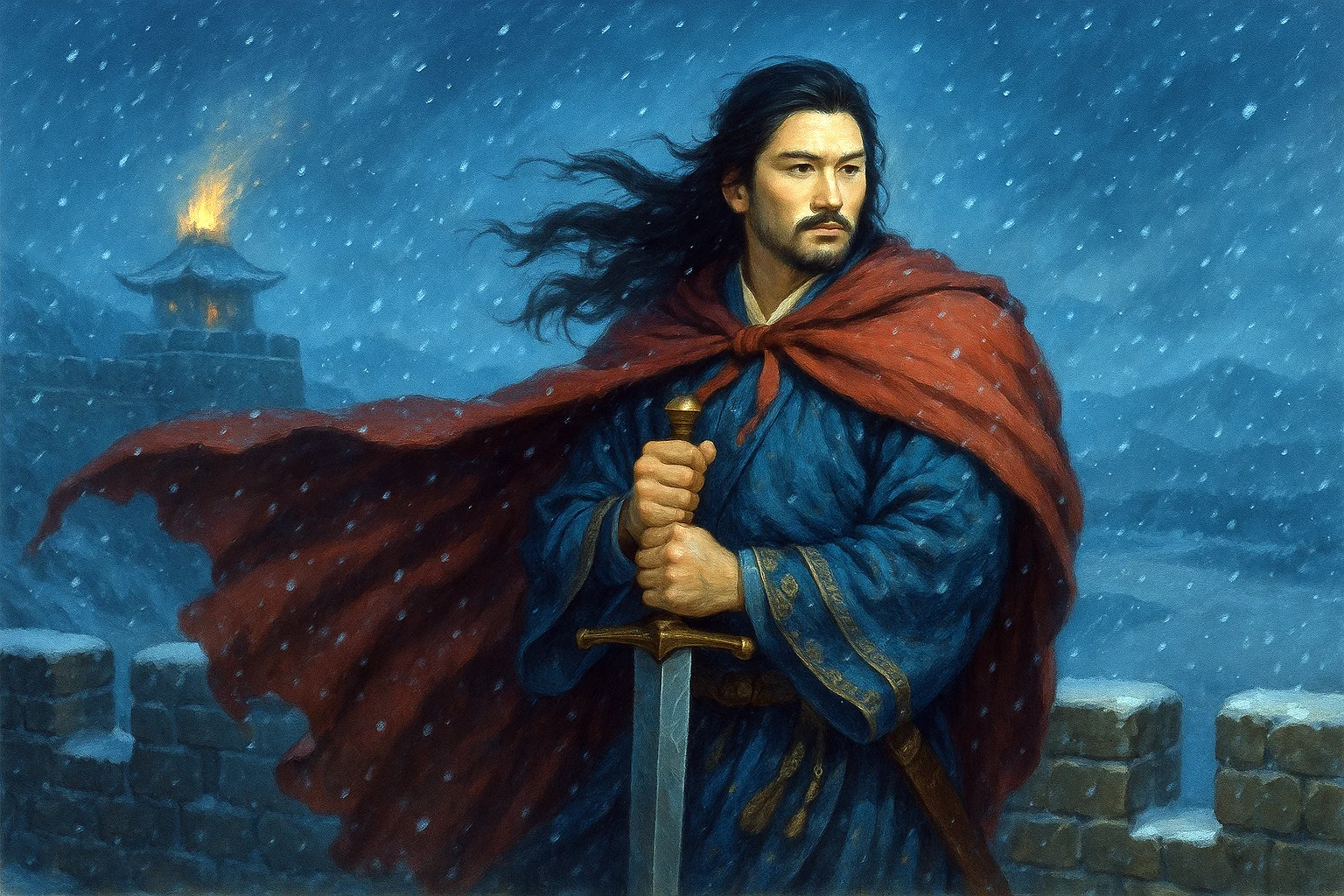
Cen Can(岑参), 715-770 AD, was a native of Jingzhou, Hubei Province. He studied at Mt. Songshan when he was young, and later traveled to Beijing, Luoyang and Shuohe. Cen Can was famous for his border poems, in which he wrote about the border scenery and the life of generals in a majestic and unrestrained manner, and together with Gao Shi, he was an outstanding representative of the border poetry school of the Sheng Tang Dynasty.