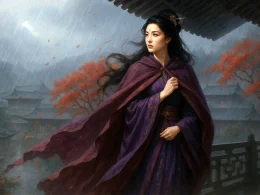

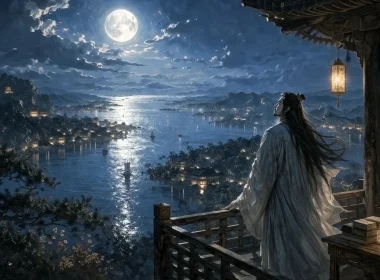
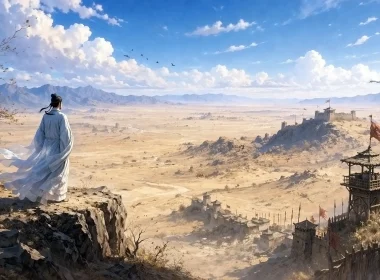
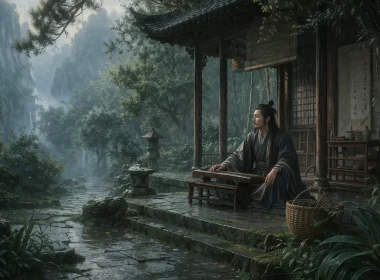
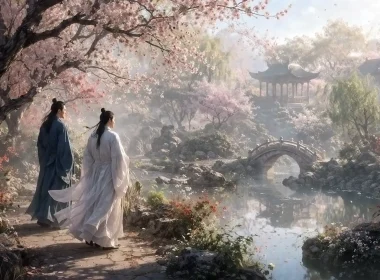
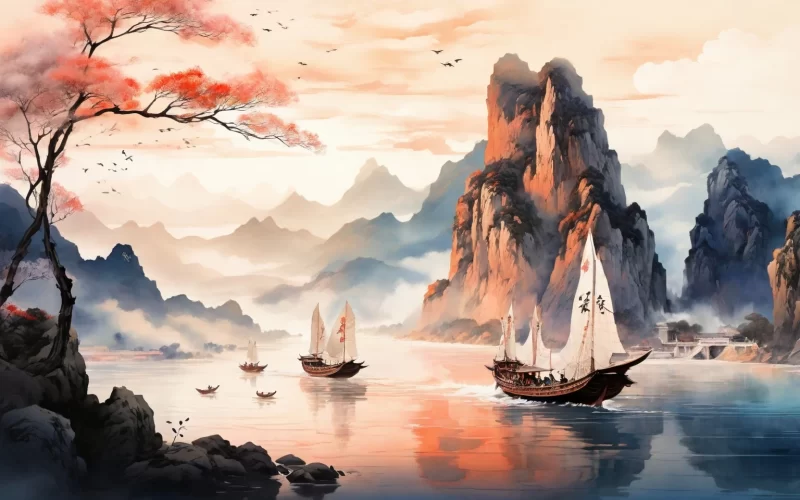
I sail and gaze southeast, hills green and blue;
A water-land where distant peaks are few.
Ships large and small vie for a speedy race;
They come and go, winds helping tides apace.

“Where are you going?” — “To the Bridge of Stone.”
I watch flushed clouds that with the dawn have grown.
They look like Crimson Wall against the sky,
Where fairies dwell, in hours passing by.
Original Poem
「舟中晓望」
孟浩然
挂席东南望,青山水国遥。
舳舻争利涉,来往接风潮。
问我今何适?天台访石桥。
坐看霞色晓,疑是赤城标。
Interpretation
This poem was written during Meng Haoran's travels through the Wu and Yue regions, specifically on a boat journey along the Cao'e and Shanxi rivers towards Mount Tiantai. Having experienced disappointment in his quest for an official career in Chang'an, Meng Haoran turned his aspirations towards the landscapes of the southeast. This journey to Mount Tiantai vividly embodies his spiritual quest to "find truth amidst mountains and waters."
In the Tang Dynasty, Mount Tiantai held deep cultural significance as both the ancestral seat of the Tiantai school of Buddhism and a sacred Daoist mountain—the legendary site of Liu Chen and Ruan Zhao's encounter with immortals. Thus, images like the "Stone Bridge" and "Redwall Peak" are imbued with rich religious and mythological meaning. For Meng Haoran, this was not merely sightseeing, but a pilgrimage towards a spiritual symbol. The phrase "to visit the Stone Bridge" implies a search for a transcendent realm, a world beyond.
Significantly, the poet does not describe arriving at the famed scenery. He focuses instead on gazing from the boat and imagining the destination. This narrative choice—longing without arriving—reflects his state of mind: after setbacks in his official pursuits, he projected his ideals onto the landscape. Mount Tiantai, a landmark glowing with Buddhist and Daoist significance, became the object of this spiritual projection. Thus, the physical boat journey becomes a fluid poem of spiritual seeking.
First Couplet: "挂席东南望,青山水国遥。"
Guà xí dōng nán wàng, qīng shān shuǐ guó yáo.
I set my sail and gaze southeast, afar;
Green hills in watery realms distant are.
The opening line, "I set my sail," is a dynamic image that commences the journey, suggesting both the physical act and the beginning of a spiritual voyage. The deliberate gaze "southeast" is significant—Mount Tiantai lies in that direction, creating a parallel between geographical sighting and spiritual inclination. The act of "gazing" establishes the poem's prevailing tone of looking ahead and seeking. "Green hills in watery realms distant are" sketches a vast, misty landscape with simple strokes. The word "distant" describes not only the great physical space but also a psychological remoteness—the ideal realm beyond the green hills feels both deeply alluring and profoundly elusive. In its expansive visual frame, this couplet already contains the eternal sense of distance between the seeker and his goal.
Second Couplet: "舳舻争利涉,来往接风潮。"
Zhú lú zhēng lì shè, lái wǎng jiē fēng cháo.
Ships, great and small, for gainful passage race,
Coming and going, borne by wind and tide's grace.
This couplet shifts focus to the bustling reality of the waterway. "Ships, great and small" describes the multitude of vessels. The phrase "for gainful passage race" is pivotal, laying bare that the world's bustle is driven by "gain"—racing to be first, pursuing profit. This stands in profound contrast to the poet's own transcendently motivated journey "to visit the Stone Bridge." "Coming and going, borne by wind and tide's grace" describes the natural reliance of boats on the elements, while also metaphorically suggesting how people chase profit by following trends. The poet observes like a contemplative philosopher, physically present yet mentally aloof, watching the worldly hustle with a calm eye, all the more determined to journey alone towards spiritual heights.
Third Couplet: "问我今何适?天台访石桥。"
Wèn wǒ jīn hé shì? Tiāntāi fǎng shí qiáo.
You ask where I am bound, and for what cause?
"To visit the Stone Bridge on Mount Tiantai's heights."
Adopting a dialogic form of self-questioning, the poem's rhythm shifts, and its emotion turns from implicit to clear. The words "You ask" introduce a virtual questioner, representing the poet's own introspection. The question "where I am bound" implies a deeper inquiry about life's direction. The answer, "To visit the Stone Bridge on Mount Tiantai's heights," is clear and resolute. The Stone Bridge is not a common sight; it is a sacred site from Buddhist and Daoist lore—both a specific bridge from the Records of Mount Tiantai and a symbol of the spiritual "other shore" the poet yearns for. The word "visit" carries great weight. Unlike "travel" or "see," it conveys a pilgrim's reverence and the persistence of active seeking. This couplet, like a brilliant passage in a movement, clearly reveals the poem's spiritual theme.
Final Couplet: "坐看霞色晓,疑是赤城标。"
Zuò kàn xiá sè xiǎo, yí shì Chìchéng biāo.
Sitting, I watch dawn's rosy clouds unfold,
And wonder, could that be Redwall's crest I behold?
The poem concludes at dawn's most brilliant moment, yet ends with a gentle doubt. "Sitting, I watch" echoes the earlier "gaze," but the state of mind has shifted from the anticipatory gaze of departure to the quiet observation of the journey itself. The dawn breaks in glorious hues, a scene of supreme beauty. Yet the poet moves from the concrete—"dawn's rosy clouds"—to the abstract, wondering if it signals "Redwall's crest." "And wonder, could that be" is the poem's pivotal moment. This uncertain recognition is its most poetic form of arrival. Redwall Peak, the gateway to Mount Tiantai, is indistinguishable in the ruddy dawn light. This physical blurring achieves a spiritual clarity: where the heart yearns, all things bear witness. The final line is open-ended, rich with resonance, eternally suspending the physical voyage within a contemplative gaze toward the ideal.
Holistic Appreciation
In forty concise characters, this poem builds a multi-layered spiritual space. Physically, it records a river journey at dawn. Psychologically, it traces a seeker's mind detaching from the mundane and approaching the sacred. Philosophically, it explores eternal themes: reality and ideal, the worldly and the transcendent, journeying and arriving.
Structurally, the poem progresses logically. The first couplet describes the gaze at departure. The second shifts to worldly clamor, creating contrast. The third directly states the spiritual destination. The fourth concludes with quiet observation, transforming the quest into an eternal gaze. The four couplets move seamlessly from outer to inner, from motion to stillness, from the concrete to the abstract, each layer deepening to form an organic whole.
The poem's core lies in the words "And wonder, could that be." The poet's wondering gaze is his recognition of the ideal and his transcendence of the immediate. It is not a certain arrival, but an aesthetic of suspension—true seeking lies not in possessing the goal, but in the perpetual orientation towards it. The imagined silhouette of Redwall Peak within the dawn is more moving than the real peak, for it is a radiance projected by the heart itself.
Artistically, the poem's power lies in this "aesthetic of suspension" and its portrayal of a "spiritual pilgrimage." The poet is perpetually "on the way," "gazing," "wondering," but never definitively "arriving." This state of incompletion is its deepest spiritual truth. The composure of "Sitting, I watch" and the hesitation of "And wonder" transform the distance between ideal and reality into a poetic space.
Artistic Merits
- Structural Tension: The poem establishes rich tension between motion and stillness (racing ships vs. sitting in dawn), the mundane and the sacred (vying for gain vs. visiting the bridge), and the concrete and the abstract (distant hills vs. the peak's marker), allowing its brief form to contain profound dimensions of thought.
- Symbolic Imagery: The "Stone Bridge" and "Redwall Peak" are not merely physical features. Within Tang poetic culture, they are potent symbols of transcendence. Their use roots the poem in a deep cultural tradition.
- Subtle Temporality: From the initial gaze to the break of dawn, time in the poem seems to both pass and stand still. This subtle treatment mirrors the Chan Buddhist moment where "the present is eternity."
- Shifting Perspective: The poet skillfully blends the traveler's perspective (setting sail, sitting), the observer's (gazing, watching), and the thinker's (questioning, wondering), creating a richly layered poetic space.
Insights
Meng Haoran's "Gazing at Dawn from the Boat" is, in essence, a metaphor for a spiritual posture. It suggests that life's value lies not only in which "Mount Tiantai" one reaches, but in maintaining the posture of "gazing" and the courage to "visit." Beyond the utilitarian "race for gain," there exists another course—the solitary voyage toward spiritual heights. The moment of wondering, "could that be Redwall's crest?" in the morning light is among humanity's most precious: when the heart is clear enough, it can discern the outline of the ideal on the horizon of reality.
This poem invites every reader to become the "passenger" of their own life, to remember to look up and "gaze at dawn" during daily voyages, and to seek their own "Redwall's crest" within the dawn light of their reality. True arrival may forever lie in the next act of looking ahead, and therein lies the quest's entire meaning.
The true destination lies not on the far shore, but in the hesitation of "could that be," the silence of "sitting and watching," and the pilgrim's heart carried within the word "visit." This is the vitality of poetry: it records one of Meng Haoran's boat journeys, but speaks to all who, amidst the world's clamor, still set their course toward spiritual heights.
About the poet
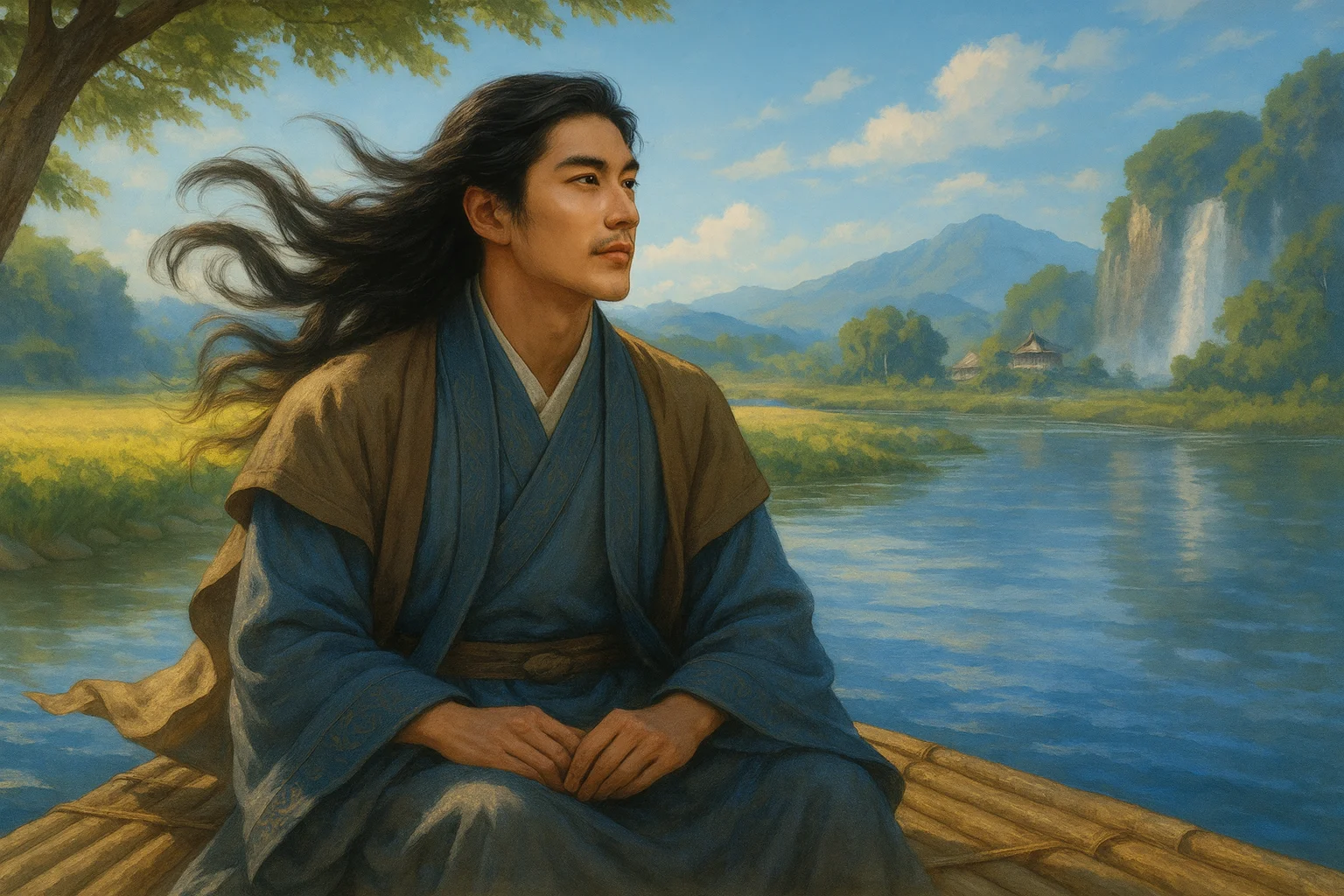
Meng Haoran (孟浩然 689 - 740), a native of Xiangyang, Hubei Province, was a renowned landscape and pastoral poet of the Tang Dynasty. In his early years, he lived in seclusion on Mount Lumen, reading for his own pleasure. At the age of forty, he traveled to the capital to take the jinshi examination but failed. Thereafter, he remained a commoner for the rest of his life, roaming the Wu and Yue regions and finding contentment in poetry and wine. He excelled in five-character verse, with a style that is light and natural, often depicting the pleasures of landscapes and reclusion. He is regarded as a representative of the High Tang landscape and pastoral poetry school. His collected works, Meng Haoran Ji, have been handed down, and his poetry exerted a profound influence on later hermitic poetic traditions.