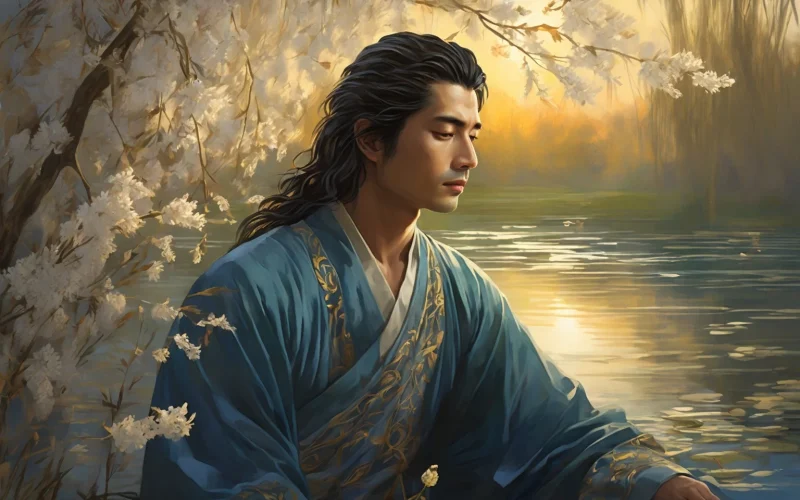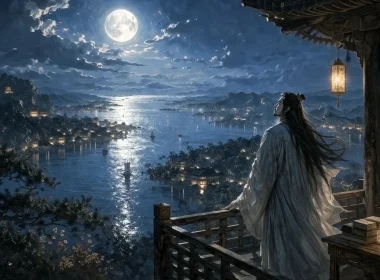
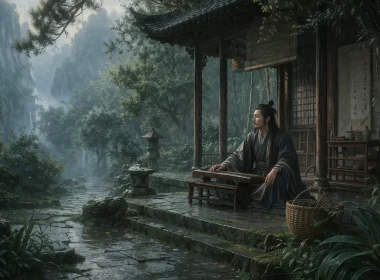
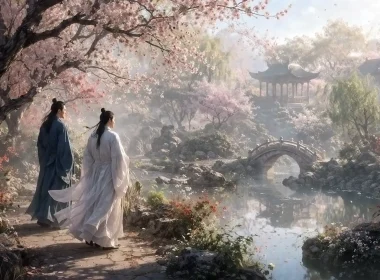
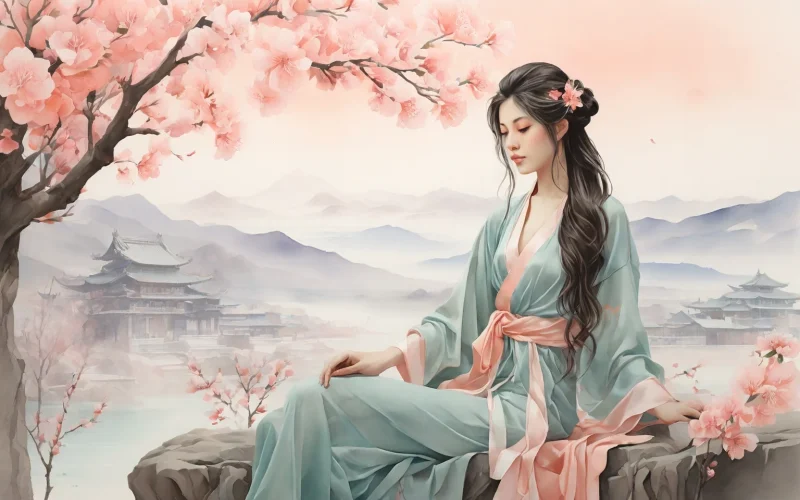
Twin peach blooms blush deeper at dusk’s call,
Peeping through bamboo by my window tall.
They must have trailed celestial scribes to earth,
To grace this scholar’s court with heaven’s mirth.
Original Poem
「题百叶桃花」
韩愈
百叶双桃晚更红,窥窗映竹见玲珑。
应知侍史归天上,故伴仙郎宿禁中。
Interpretation
This poem was composed by Han Yu during his tenure in the capital, likely after his return to court during the Yuanhe period. Han Yu's official career was marked by ups and downs, with repeated demotions, though he also briefly returned to serve in the capital. In the 8th year of Yuanhe (813 A.D.), he was promoted from Vice-Director of the Bureau of Review to Vice-Director of the Bureau of Evaluations and was appointed as a Drafter, responsible for drafting imperial edicts. This granted him access to the inner palace and overnight stays in the duty quarters on rotation. "禁中" (inner palace) refers to the deep inner quarters of the palace where only officials on duty could stay overnight. Staying in the palace overnight due to official duties, the poet happened upon the double peach blossoms by his window on a quiet night. Moved by the scene, he inscribed this poem to express his feelings.
Double peach blossoms are a precious variety of peach blossom, with overlapping, complex petals. When in full bloom, they are even more gorgeous than ordinary peach blossoms, often planted in the deep inner palace or the courtyards of the nobility, unseen by ordinary people. Alone in the palace grounds at this moment, facing this rare flower secluded in the deep palace, the poet naturally felt a complex mix of emotions: so bright and moving, yet it can only bloom in this isolated deep palace, with no one to share its beauty except for the occasional glimpse by the "immortal official" on night duty. This is just like the poet himself, full of talent. Although he could serve at court and draft edicts, he was still confined within the power structure, cautious and restrained, unable to achieve true ease and freedom. The peach blossoms that are "even redder later" and the delicate beauty of "glimpsed through the window, reflected by bamboo" seem like an encounter arranged by fate especially for the lonely night watchman.
Although Han Yu had returned to court at this time, his official career was not truly smooth. His upright and outspoken nature often clashed with powerful courtiers. Not long after, he would again almost lose his life for remonstrating against welcoming the Buddha's bone and be demoted to distant Chaozhou. This precarious position at the heart of power made him particularly sensitive to the realities of the "inner palace" and "freedom." The imagination in the lines "应知侍史归天上,故伴仙郎宿禁中" (Surely knowing the Attendant Scribe has returned to heaven, / It purposely keeps this immortal official company in the inner palace) is both a romantic thought sparked by the scene and words of self-consolation—since the celestial realm is far and returning to the realm of immortals is difficult, then having this peach blossom tree for company through the long night is also a kind of solace. This poem uses the flower to symbolize a person, using the flower as a metaphor for the poet himself. Beneath the delicate and lovely brushstrokes lies a subtle awareness of his own situation, and it reveals the poet's aesthetic sensitivity and poetic heart, which he maintained even in the most constrained environment.
First Couplet: "百叶双桃晚更红,窥窗映竹见玲珑。"
Bǎi yè shuāng táo wǎn gèng hóng, kuī chuāng yìng zhú jiàn línglóng.
The double peach blossoms, blooming late, are even redder;
Glimpsed through the window, reflected by bamboo, they appear exquisitely lovely.
The opening line, "百叶双桃" (double peach blossoms), identifies the subject—the rare peach blossom with overlapping petals. The three characters "晚更红" (blooming late, are even redder) are both a literal description and a metaphor. Some peach blossoms bloom early, others late; this tree, though late, blooms even more intensely, even more dazzlingly red. This "晚更红" (blooming late, are even redder) is a contrast in time and, more importantly, an affirmation of value: true beauty is never diminished by being late. The next line, "窥窗映竹见玲珑" (Glimpsed through the window, reflected by bamboo, they appear exquisitely lovely), describes the special setting of the peach blossoms. The two characters "窥窗" (glimpsed through the window) personify the flower, as if it is also secretly peeking at the poet inside the room, each gazing at the other without weariness. "映竹" (reflected by bamboo) depicts the beauty of the color contrast between red and green; set against the emerald bamboo, the peach blossoms appear even more delicate and lovely. "玲珑" (exquisitely lovely) describes both the exquisite beauty of the flower's form and the lively quality of the scene. This line is exquisitely composed, with movement and stillness interwoven, bringing this corner of spring within the deep palace grounds vividly before our eyes.
Second Couplet: "应知侍史归天上,故伴仙郎宿禁中。"
Yīng zhī shì shǐ guī tiān shàng, gù bàn xiān láng sù jìn zhōng.
Surely knowing the Attendant Scribe has returned to heaven,
It purposely keeps this immortal official company in the inner palace.
This couplet shifts from the concrete to the abstract, introducing celestial imagery with a turn of the brush. "侍史" (Attendant Scribe) originally referred to minor officials in charge of documents; here it alludes to celestial officials. "归天上" (returned to heaven) suggests the realm of immortals is far away, leaving only the human world behind. "仙郎" (immortal official) was an elegant term for Directors and Vice-Directors of the various Ministries in the Tang dynasty. Han Yu, then serving as Vice-Director of the Bureau of Evaluations and a Drafter, could aptly call himself a "仙郎." With a playful brush, the poet transforms the scene before him into a celestial tale left on earth: the peach blossom originally belonged to the heavens, left behind in the mortal world when the Attendant Scribe returned to heaven, and it purposely chose this very night to keep the "immortal official" on night duty company. This imagination is both romantic and lonely. Romantic, because the poet elevates an ordinary night duty into an encounter between immortal and mortal. Lonely, because the words "故伴" (purposely keeps company) reveal the solitude of staying overnight in the deep palace—only the shadow of flowers for company to console the long night.
Overall Appreciation
This is a delicately conceived poem chanting an object. In just four lines and twenty-eight characters, it starts with a peach blossom tree before the poet's eyes, gradually unfolds, and ultimately sublimates into a romantic imagination of an encounter between immortal and mortal. Beneath the delicate and lovely brushstrokes lies the poet's subtle lament about his own situation.
Structurally, the poem shows a progression from the concrete to the abstract, from reality to fantasy. The first couplet concretely describes the form, color, and setting of the peach blossoms, using "晚更红" (blooming late, are even redder) and "窥窗映竹" (glimpsed through the window, reflected by bamboo) to outline a tranquil yet lively picture. The second couplet shifts from reality to fantasy, using "应知" (surely knowing) and "故伴" (purposely keeps company) to introduce thoughts of the immortal and mortal realms, transforming the peach blossom before his eyes into a sentient being and elevating an ordinary night duty into a fated encounter. The four lines transition naturally, and the artistic conception suddenly opens up.
In terms of conception, the core of this poem lies in the profound meaning of the word "伴" (keep company). The peach blossom keeping the immortal official company is companionship by nature and also companionship by fate. That double peach blossom secluded in the deep palace, neither early nor late, happens to bloom "even redder" on the very night the poet is on duty, happens to reveal its "exquisitely lovely" form from the window—within this chance seems to hide a certain inevitability. Using personification, the poet endows the peach blossom with emotion and will, making her a confidante for his solitary nighttime vigil. And the three characters "宿禁中" (in the inner palace) are both factual and metaphorical: "禁中" (inner palace) is within the palace, also within constraint; "仙郎" (immortal official) is one who serves at court, also one who is not master of his own fate. Isn't that peach blossom "glimpsed through the window, reflected by bamboo" also a portrayal of the poet himself?—similarly situated within the palace, similarly beautiful and lonely, similarly only able to quietly bloom within limited confines.
Artistically, the most exquisite aspect of this poem is the "using the immortal to describe the mortal" imagination. The poet transforms an ordinary scene like palace night duty into a romantic legend of an encounter between immortal and mortal, enveloping the entire poem in an ethereal, elusive artistic conception. This approach avoids the superficiality of direct emotional expression and gives ordinary scenery transcendent beauty. As Han Yu wrote in "To Zhang Ji" ("调张籍"): "精诚忽交通,百怪入我肠" (When utmost sincerity suddenly connects, / A hundred marvels enter my heart). This technique of moving between reality and imagination is precisely an important source of the charm of his poetry.
Artistic Features
- Finding Wonder in Lateness, Hiding Depth in Simplicity: The three characters "晚更红" (blooming late, are even redder) seem ordinary but contain a deep understanding of value—true beauty is not diminished by being late; on the contrary, it becomes more intense through sedimentation. Deep meaning is seen within simple words.
- Exquisite Composition, Interplay of Movement and Stillness: The line "窥窗映竹见玲珑" (Glimpsed through the window, reflected by bamboo, they appear exquisitely lovely) uses "窥" (glimpse) to describe movement, "映" (reflect) to describe stillness, and "玲珑" (exquisitely lovely) to describe the whole, rendering a peach blossom tree as if before our eyes, almost coming to life. There is painting in the poetry, and poetry in the painting.
- Using an Object to Represent Oneself, Conveying Profound Emotion from Afar: Using the seclusion of the peach blossom in the deep palace to metaphorize one's own entanglement in officialdom; using the peach blossom "keeping the immortal official company" to subtly write of one's own solitude and loneliness. Every line chants the flower, yet every line represents oneself; object and self merge seamlessly.
- Using the Immortal to Describe the Mortal, Ethereal Artistic Conception: Introducing celestial imagery like "侍史" (Attendant Scribe) and "仙郎" (immortal official) transforms an ordinary night duty into a romantic scene of an encounter between immortal and mortal, giving the poem an aesthetic tension that transcends reality. Reality contains illusion; illusion contains reality.
- Concise Language, Lingering Resonance: The entire poem has not a single superfluous word, yet it blends visual beauty, subtle emotion, and the marvel of imagination. The words end, but the meaning is boundless, leaving much to ponder.
Insights
This poem, using a double peach blossom in the deep palace, speaks of the existential dilemma where beauty and constraint coexist, offering profound insights for later generations. First, it makes us contemplate the value and meaning of "late blooming." The peach blossom in the poem is "even redder" for blooming late. It does not fade for being tardy; on the contrary, it blooms even more intensely, even more dazzlingly. This reminds one of examples in life of great achievement completed late—true value never changes because of the timing; true beauty often requires a longer time to mature. It enlightens us: There is no need to be anxious about a late start, no need to feel inferior because success is delayed. As long as you persist in growing, you will eventually have your own flowering season.
Second, the quiet, solitary beauty of "glimpsed through the window, reflected by bamboo" makes us contemplate the dialectical relationship between "being seen" and "being understood." This peach blossom blooms in the deep palace grounds, unseen by anyone, yet it is fortunate to be discovered by the poet on night duty, written into a poem, and passed down through the ages. It did not receive the applause of the multitude, but it encountered a true confidant who could appreciate it. It reminds us: Rather than longing for noisy acclaim, it is better to wait for someone who truly understands. Some beauty simply does not belong to lively occasions; it belongs only to those who can discover it in silence.
On a deeper level, this poem also lets us see the poetic heart Han Yu maintained even within the constraints of officialdom. Staying overnight in the inner palace was originally a dull duty, yet he could discover poetry in a peach blossom tree, giving rise to the romantic imagination of "immortal official" and "Attendant Scribe." This ability to discover and create beauty in any circumstance is the most precious gift literature bestows upon life. It tells us: Even in the most constrained environment, the mind can still soar freely; even if one can only "stay in the inner palace," one can still have flowers for company and communicate with the spirit of heaven and earth.
About the Poet
Han Yu (韩愈, 768 - 824), a native of Mengzhou, Henan Province, he was the leader of the Ancient Prose Movement in the Tang Dynasty. He became a jinshi (presented scholar) in the eighth year of the Zhenyuan era (792 AD). His prose was vigorous and powerful, and he patronized notable poets such as Meng Jiao and Jia Dao. Regarded as the foremost of the "Eight Great Masters of the Tang and Song Dynasties," Han Yu revolutionized both poetry and prose, exerting a profound and lasting influence. Later generations honored him as the "Literary Patriarch of a Hundred Generations."