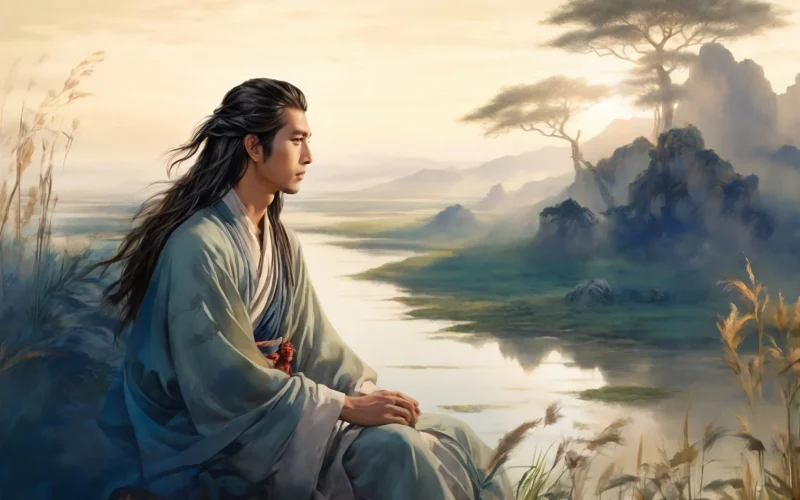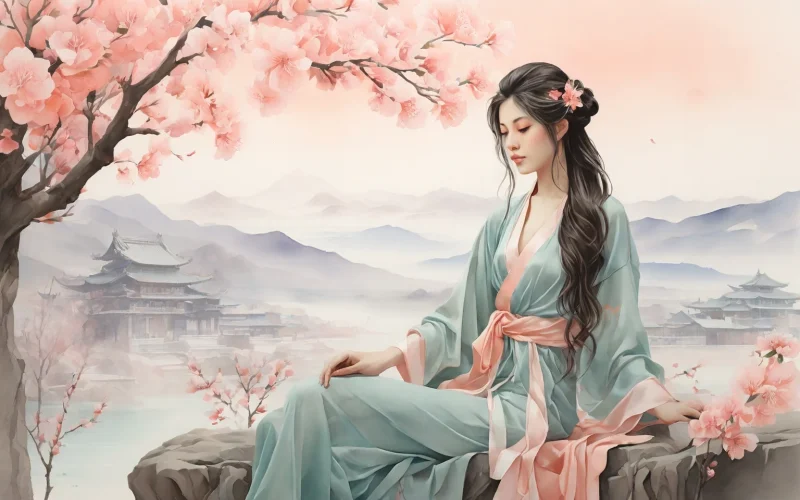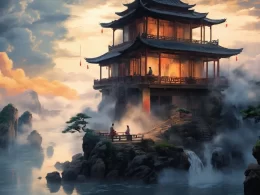
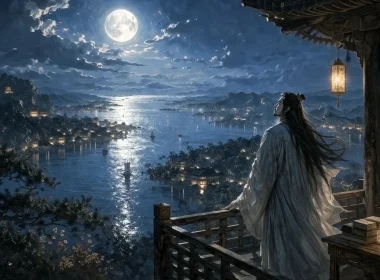
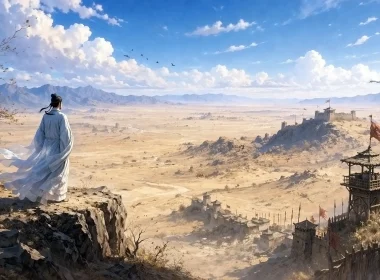
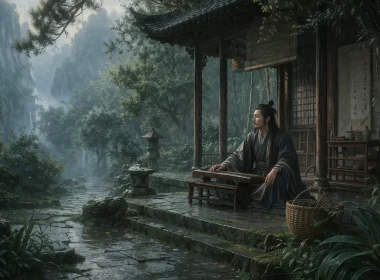
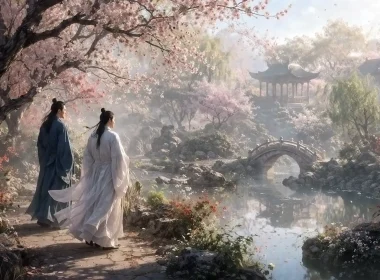
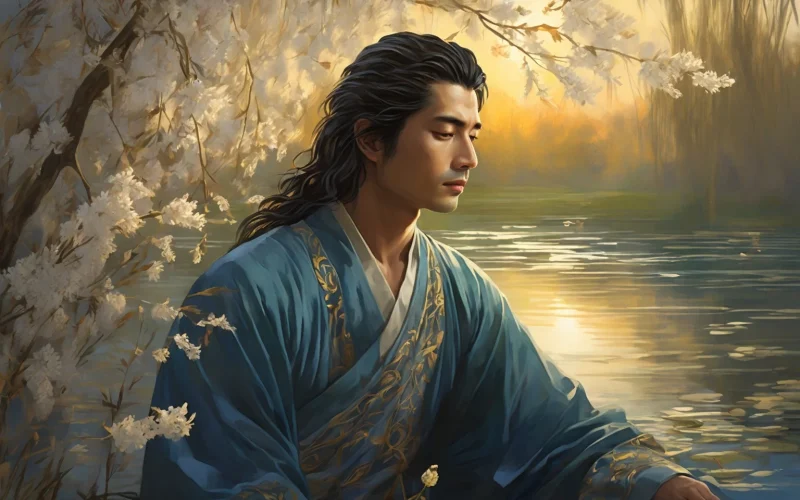
Windless pond mirrors sunset’s glow,
Willow fluff drifts where sunbeams flow.
To kiss the clear surface they dare—
Trapped in endless wet, stranded there.
Original Poem
「池上絮」
韩愈
池上无风有落晖,杨花晴后自飞飞。
为将纤质凌清镜,湿却无穷不得归。
Interpretation
This poem was composed by Han Yu during his period of exile, likely after the 14th year of Yuanhe (819 AD). That year, Han Yu submitted the "Memorial on the Buddha's Bone" to remonstrate against welcoming the Buddha's relic, enraging Emperor Xianzong. He nearly faced execution but was fortunately rescued by Pei Du and others, and was ultimately demoted to Prefect of Chaozhou. Chaozhou was far in the Lingnan region, a land of miasmic diseases. The poet, at fifty-two years of age, embarked on this perilous journey into exile; the desolation of his state of mind is easy to imagine. Whether on the journey or at his place of exile, he happened to see willow catkins flying by a pond. Moved by the scene, he wrote this poem that chants an object to express his feelings.
Willow catkins, called "poplar flowers" in ancient times, are as light as nothing, drifting with the wind, a classic image in classical poetry symbolizing a rootless, drifting existence. To Han Yu at this time, the willow catkins were precisely a reflection of his own condition—subject to the wind's whim, seemingly free, yet in reality manipulated by the hand of fate. The quiet of "池上无风有落晖" (Above the pond, no wind, only the setting sun's glow), the lightness of the poplar catkins "flying on their own," the longing in "为将纤质凌清镜" (Desiring to let its delicate substance cross the clear mirror's plane), and the sinking in "湿却无穷不得归" (Dampened, endless, unable to return)—each is a deep sigh from the poet about his own fate. Not a single word of sorrow is written in the poem, yet the feeling of personal circumstance is entirely entrusted to those willow catkins falling into the water. This precisely reflects Han Yu's late poetic style, which became "ever older, ever more stripped bare, ever more revealing true purity."
First Couplet: "池上无风有落晖,杨花晴后自飞飞。"
Chí shàng wú fēng yǒu luò huī, yáng huā qíng hòu zì fēi fēi.
Above the pond, no wind, only the setting sun's glow;
After the rain clears, poplar catkins drift, flying on their own.
The opening line juxtaposes "无风" (no wind) with "有落晖" (has the setting sun's glow) to create a quiet yet somewhat vast late spring atmosphere. No wind means the pond is mirror-like, unrippled; the setting sun's glow means dusk approaches, with shifting light and shadow. Against this tranquil backdrop, however, the poplar catkins are "flying on their own." The three characters "自飞飞" (flying on their own) use reduplication masterfully: they describe the light, drifting motion of the willow catkins and, more deeply, imply a sense of being unnoticed, coming and going of their own accord. Flying without wind may seem contrary to reason, but it precisely captures the nature of willow catkins—light, thin, and not masters of their own fate. Even without the push of wind, they must still drift in the air until their last bit of strength is spent. This couplet contains movement within stillness, and sorrow within movement, foreshadowing the sinking described later.
Second Couplet: "为将纤质凌清镜,湿却无穷不得归。"
Wèi jiāng xiān zhì líng qīng jìng, shī què wú qióng bù dé guī.
Desiring to let its delicate substance cross the clear mirror's plane,
It becomes damp, endless, unable to return home.
This couplet is the core of the entire poem, moving from scene to principle, from object to person. "清镜" (clear mirror) metaphorically refers to the calm, unrippled pond water, clear enough to reflect. The light willow catkin perhaps wished to draw near this "clear mirror" to see its own reflection, or perhaps to soar above it, continuing its flight. However, upon touching the water's surface, it becomes wet; that "纤质" (delicate substance) instantly becomes heavy, unable to fly again. "湿却无穷不得归" (Dampened, endless, unable to return)—the two characters "无穷" (endless) refer both to the fate of countless willow catkins and subtly contain the poet's lament about the endlessness of life. The three characters "不得归" (unable to return) point directly to the core: unable to go back, unable to return, it can only sink into the pond water of this alien land. This is clearly not merely about willow catkins; it is about the poet himself: because of the obsession to "凌清镜" (cross the clear mirror's plane) (perhaps a pursuit of ideals, perhaps a desire for self-contemplation), he instead became mired, from that moment losing the possibility of "returning"—returning home, returning to court, returning to his original intent, all became illusions.
Overall Appreciation
This is a typical work that uses an object to express the poet's aspirations. The entire poem, in four lines and twenty-eight characters, takes willow catkins by a late spring pond as its subject, moving from flight to sinking, from external scene to inner world, hiding the poet's personal feelings on his journey into exile within the image of the light willow catkins.
Structurally, the poem shows a clear pattern of "introduction, development, turn, and conclusion." The first line begins with "无风" (no wind) and "落晖" (setting sun's glow), establishing a quiet, vast background. The second line develops this with "自飞飞" (flying on their own), describing the drifting state of the catkins. The third line makes the turn with "为将纤质凌清镜" (Desiring to let its delicate substance cross the clear mirror's plane), describing the catkins' longing and attempt. The final line concludes with "湿却无穷不得归" (Dampened, endless, unable to return), describing the outcome of sinking and the endless regret. The four lines progress layer by layer, moving from stillness to motion, from the external to the internal, finally culminating in a heavy sigh.
In terms of conception, the core of this poem lies in the three characters "不得归" (unable to return). Willow catkins are messengers of spring, light and free, coming and going with the wind. But once dampened by water, they lose the ability to fly, sinking into the pond, never able to "return" to the sky. This word "归" (return) refers both to a physical return and, more importantly, to a spiritual homecoming. Throughout his life, Han Yu identified as a Confucian scholar, taking "transmitting the Way, teaching, and resolving doubts" as his mission. Yet he was repeatedly demoted, far from the court, far from the Central Plains, far from the cultural center with which he identified. What is "unable to return" is not only his body but also his heart; not only his geographical hometown but his spiritual homeland.
Artistically, the most exquisite aspect of this poem is "using a tiny object to convey profound meaning." The lightness and insignificance of willow catkins are ordinarily not worth mentioning, but the poet perceives in them the full weight of human life. The solitude of "flying on their own," the longing of "crossing the clear mirror's plane," the helplessness of "becoming damp," the despair of "unable to return"—each is a projection of the poet's own fate. This technique of seeing the large in the small, of using objects to metaphorize people, is precisely the highest realm of classical Chinese poetry, where "a single flower contains a world."
Artistic Features
- Observing Objects with Minute Detail, Capturing Both Form and Spirit: From the drifting state of "flying on their own" to the longing heart of "crossing the clear mirror's plane" to the pain of sinking in "becoming damp," the poet's observation of the willow catkins is extremely detailed. Yet it goes beyond mere physical resemblance, delving into the "spirit" and "soul" of the object. Both form and spirit are captured, object and self become one.
- Rich in Implied Comparison and Association, Conveying Profound Implications from Afar: Using the drifting and sinking of willow catkins to subtly metaphorize one's own exile and downfall. Every line chants the catkins, yet every line is also a description of oneself. Within the implied comparison and association, profound feelings are conveyed from afar. Not a single word of sorrow is written, yet sorrow is inherently present within.
- Concise Language, Vivid Imagery: Words like "无风" (no wind), "落晖" (setting sun's glow), "清镜" (clear mirror), and "湿却" (becomes damp) are simple yet rich in imagery. The use of the reduplicated phrase "自飞飞" (flying on their own) adds musical beauty and strengthens the sense of solitude. The entire poem has not a single superfluous word, yet the meaning is profound.
- Sharp Turn, Full of Tension: The first two lines describe the state of drifting, light and ethereal; the last two lines describe the pain of falling into the water, heavy and despairing. This turn from lightness to weight, from motion to stillness, creates strong artistic tension. Skill is seen in the turn; deep meaning is seen in the contrast.
- Philosophy Entering Poetry, Profound and Lasting Thought: From the minor event of willow catkins falling into water, the poet extracts profound reflection on the circumstances of human life—the obsession of "crossing the clear mirror's plane" and the outcome of "unable to return" contain philosophical contemplation on the relationship between "seeing oneself" and "sinking." Scene contains principle; principle contains feeling.
Insights
This poem, through the drifting and sinking of willow catkins by a pond, speaks of the deep helplessness and sorrow in the circumstances of human life, offering profound insights for later generations. First, it makes us contemplate the relationship between "fate" and "chance." Willow catkins drift without a fixed direction; becoming damp and sinking is not their own wish. Everything seems like chance, yet as if there is a predetermined order in the unseen. That momentary choice of "Desiring to let its delicate substance cross the clear mirror's plane" was perhaps an unintentional act, yet it led to the eternal outcome of "unable to return." This reminds us of many critical turns in life—often not grand decisions, but a tiny thought, an inadvertent drawing near, changes the entire trajectory. It reminds us: In the river of fate, every choice can become a watershed; every act of drawing near can mean being unable to turn back.
Second, the poignant pain of "unable to return" in the poem makes us contemplate the meaning of "homecoming" for human life. Willow catkins are born between heaven and earth, coming and going with the wind; originally, there is no concept of "returning." But once dampened and sunk, the regret of "unable to return" arises. This regret stems from the memory of "once being able to fly," from the remorse over "what could have been." The poet Han Yu, exiled far to Chaozhou, far from the Central Plains, far from the cultural center with which he identified, felt that pain of "unable to return" identical to that of the willow catkins sinking into the water. It enlightens us: The deepest sorrow in life is often not about failing to obtain, but about having been able once and being unable now.
On a deeper level, this poem also lets us see the aesthetic sensitivity and depth of philosophical thought that Han Yu maintained even in desperate straits. In exile, with an uncertain future, he could still quietly observe the spring scene by the pond, comprehending the truth of life from the rise and fall of a single willow catkin. This ability to "perceive the Way by observing things" is the last light in suffering, proof that the spirit is not utterly crushed. It tells us: Even if fate makes us as helpless as willow catkins, we can still choose how to observe, how to think, how to transform suffering into insights about life.
About the Poet
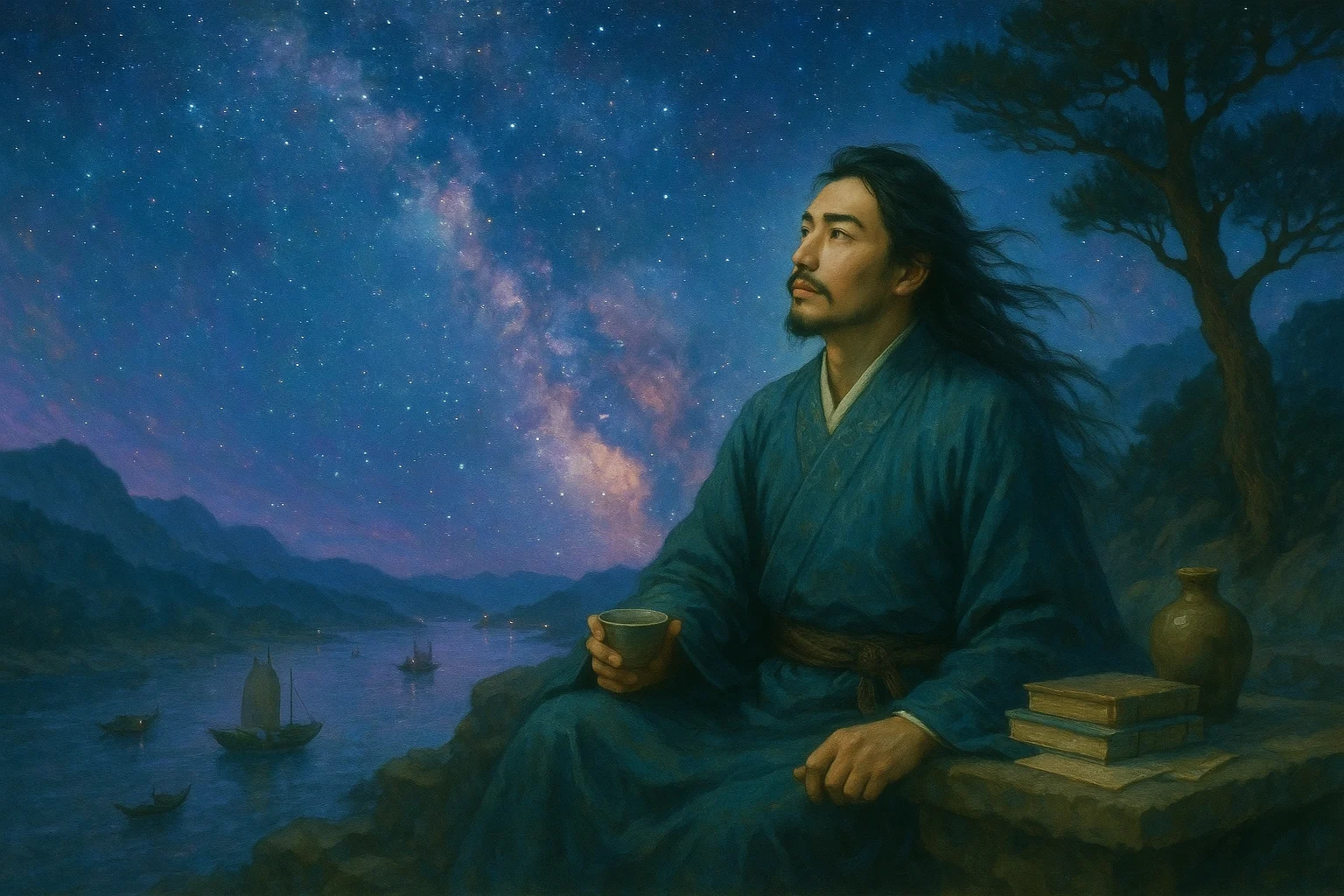
Han Yu (韩愈, 768 - 824), originario de Mengzhou en Henan, fue el líder del Movimiento de la Prosa Antigua durante la dinastía Tang. Obtuvo el título de jinshi en 792 y ascendió al cargo de Viceministro de Personal. Su prosa es vigorosa y poderosa, mientras que su poesía se caracteriza por un estilo audaz y poco convencional. Su poema Rocas de la Montaña (山石) inauguró la técnica de "prosificar la poesía". Fue mentor de poetas como Meng Jiao y Jia Dao, y es considerado el principal de los "Ocho Grandes Maestros de la Prosa de Tang y Song". Sus contribuciones revolucionarias a la literatura tuvieron una influencia profunda y duradera, lo que le valió el título honorífico de "Maestro Literario de las Generaciones".