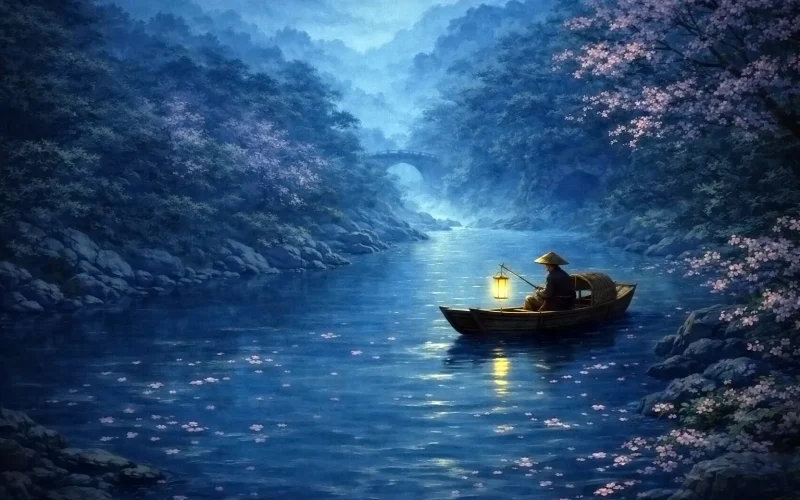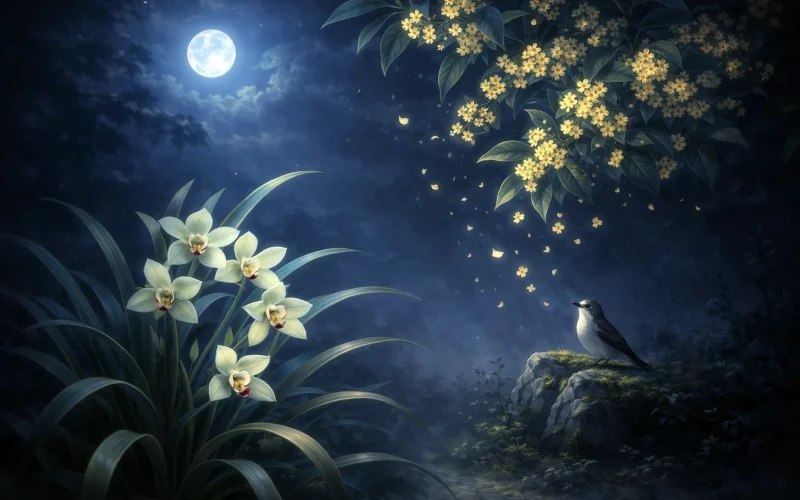
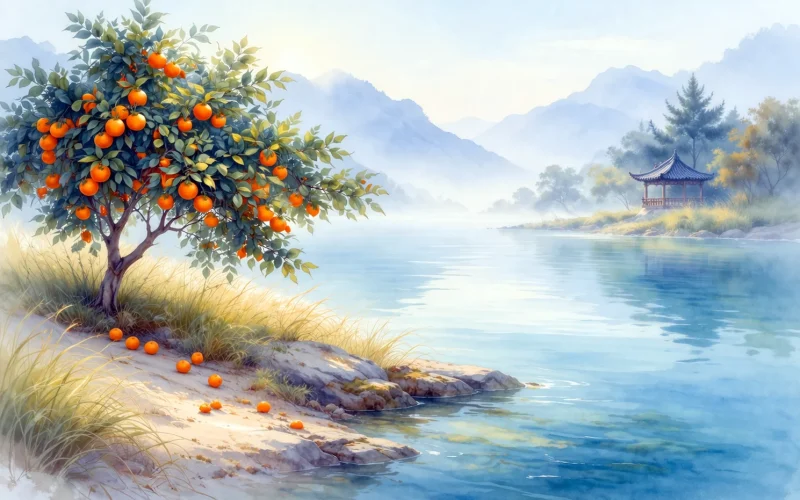
Here, south of the Yang-tsze, grows a red orange-tree.
All winter long its leaves are green,
Not because of a warmer soil,
But because its nature is used to the cold.

Though it might serve your honourable guests,
You leave it here, far below mountain and river.
Circumstance governs destiny.
Cause and effect are an infinite cycle.

You plant your peach-trees and your plums,
You forget the shade from this other tree.
Original Poem
「感遇 · 其七」
张九龄
江南有丹橘,经冬犹绿林。
岂伊地气暖,自有岁寒心。
可以荐嘉客,奈何阻重深!
运命唯所遇,循环不可寻。
徒言树桃李,此木岂无阴?
Interpretation
Reflections: Twelve Poems is a series of allegorical poems by the High Tang poet Zhang Jiuling, written after the 25th year of the Kaiyuan era (737 AD) of Emperor Xuanzong of Tang. Zhang Jiuling, a famous chancellor during the Kaiyuan era, was known for his uprightness and outspoken admonishments. His poetic style is elegant, refined, and serene, and he made important contributions to sweeping away the ornate style of the Six Dynasties poetry and ushering in the High Tang's imagery and spirit. In the late Kaiyuan period, court politics grew increasingly murky. The powerful Chancellor Li Linfu controlled the court and purged dissidents. Zhang Jiuling, due to his outspoken admonishments, fell victim to Li Linfu's slander, was dismissed from the chancellorship, and demoted to the post of Chief Minister of Jingzhou. Against the backdrop of political frustration and unrecognized talent, he composed this series of poems, using plants and trees as metaphors for himself, and through allegorical techniques, expressed his own noble sentiments and the lament of unrecognized talent. This series of poems is deeply influenced by Qu Yuan's Ode to the Orange, using fragrant plants and fine trees to symbolize the virtue of the noble man, and in the solitude of exile, upholding inner purity and independence.
This poem is the seventh in the series, with the "red orange in the southern land" as its core image, continuing the allegorical tradition of the previous poems using orchids and cassias as metaphors, and further deepening the theme of the "heart to withstand winter’s chill." The red orange grows in the southern land, remaining evergreen through the winter; it could originally be presented to honored guests, yet due to "mountain and stream" barriers, it goes unnoticed. Using the orange as a metaphor for himself, the poet expresses not only his lament of unrecognized talent but, more importantly, his self-affirmation of upholding integrity and not changing his will because of circumstances. The entire poem progresses through rhetorical questions, layer upon layer, moving from the orange's "heart to withstand winter’s chill" to the "cause and effect how can we probe" nature of fate, and concluding with the rhetorical question "Does this tree put forth no cooling shade?". It fuses criticism of the fickleness of the world with steadfastness in one's own value, making it one of the most profoundly stirring and rhythmically rich poems among Zhang Jiuling's exile works.
First Couplet: "江南有丹橘,经冬犹绿林。"
Jiāng nán yǒu dān jú, jīng dōng yóu lù lín.
In the southern land grows an orange tree red; All winter long its leaves are green.
The poem opens with the allegorical start of "In the southern land grows an orange tree red." "江南" (southern land) specifies its place of growth, also subtly aligning with the poet's place of exile, Jingzhou. "丹橘" (orange tree red), with its bright red color and sweet fruit, is a symbol of a fine tree. The next line, "经冬犹绿林" (All winter long its leaves are green), uses "经冬" (through winter) to write of its enduring wind and frost, and "犹绿" (still green) to write of its not withering or fading. The word "犹" (still) is the first "key" of the entire poem: it is not untouched by winter, but rather, after enduring winter, it remains as green as before. In this couplet, the poet uses the image of the red orange staying green through winter to metaphorize his own integrity, which he still upholds amidst the adversity of exile.
Second Couplet: "岂伊地气暖,自有岁寒心。"
Qǐ yī dì qì nuǎn, zì yǒu suì hán xīn.
Is it because the ground is warm in the south? It is heart to withstand winter’s chill.
This couplet uses a rhetorical question to progress, shifting from external causes to internal ones. "岂伊地气暖" uses a rhetorical question to negate the explanation of external environment—it is not the warmth of the land that allows it to survive, but its own resilience. "自有岁寒心" uses an affirmative statement to point out the internal root cause—the three words "岁寒心" (heart to withstand winter’s chill) allude to the Analects: "Only when the year grows cold do we see that the pine and cypress are the last to fade," using the resilience of the pine and cypress to metaphorize the unwithered orange tree. The phrase "自有" (it is) is the second "key" of the entire poem: it does not rely on external things, nor does it depend on the environment; rather, it stems from its own character. The poet uses the orange as a metaphor for himself: the reason I can persevere in exile is not because my circumstances are tolerable, but because I inherently possess this "heart to withstand winter’s chill."
Third Couplet: "可以荐嘉客,奈何阻重深!"
Kěyǐ jiàn jiā kè, nài hé zǔ chóng shēn!
Its fruit may be offered to honored guests; But how is it balked by mountain and stream?
This couplet moves from the nature of the orange tree to the use of its fruit. "可以荐嘉客" writes that the fruit of the red orange is sweet and could be used to entertain honored guests—this is the value of the orange, symbolizing the poet's talent for aiding the world. "奈何阻重深" writes that this fine fruit is, however, blocked by layer upon layer of obstacles and cannot be delivered—this is the predicament of reality, a portrayal of the poet's unrecognized talent. The phrase "奈何" (how) is the third "key" of the entire poem: it is not that it lacks value, but that its value is obstructed; it is not that it lacks talent, but that its talent has nowhere to be applied. In this couplet, the poet, through the obstructed orange fruit, exhaustively writes the helplessness and indignation of a worthy talent being buried.
Fourth Couplet: "运命唯所遇,循环不可寻。徒言树桃李,此木岂无阴?"
Yùn mìng wéi suǒ yù, xún huán bù kě xún. Tú yán shù táo lǐ, cǐ mù qǐ wú yīn?
Fate and life’s course are but by chance conjoined; Cause and effect how can we probe or tell? Men only say: "Plant peach trees and plums!" Does this tree put forth no cooling shade?
The final couplet concludes in two lines, bringing the sentiment of the entire poem to a climax. "运命唯所遇,循环不可寻" writes the poet's understanding of fate—fate is unpredictable, difficult to probe or trace, and one can only go with the flow. This is both helplessness and transcendence. However, the next line, "徒言树桃李,此木岂无阴?" uses a rhetorical question, and the brushwork turns sharply. "树桃李" metaphorizes the worldly preference for flashy talent; "此木" refers to the orange tree, metaphorizing loyal and good scholars like the poet himself. The poet questions: people only know to plant peach and plum trees, but can the orange tree not provide shade? This question is the soul of the entire poem: it is not that it lacks value, but that no one recognizes its value; it is not that it provides no shade, but that no one is willing to take shelter under the orange tree. It concludes the entire piece with a rhetorical question, condensing within it all the criticism of the fickleness of the world, the steadfastness in one's own value, and the transcendence over the unpredictability of fate—the words end but the meaning is inexhaustible.
Holistic Appreciation
This is a famous piece from Zhang Jiuling's Reflections: Twelve Poems. The entire poem consists of ten lines and fifty characters. Using the red orange of the southern land as an allegorical start, it fuses the orange tree's "heart to withstand winter’s chill" with the poet's "unrecognized talent," showcasing the poet's steadfastness in integrity and critique of worldly attitudes amidst the adversity of exile.
Structurally, the poem presents a progressive layering moving from object to person, from surface to core, from lament to question. The first couplet starts with "In the southern land grows an orange tree red; / All winter long its leaves are green," writing of the unwithered nature of the orange tree. The second couplet uses the rhetorical question "Is it because the ground is warm in the south? / It is heart to withstand winter’s chill" to point out the inner "heart to withstand winter’s chill." The third couplet turns with "Its fruit may be offered to honored guests; / But how is it balked by mountain and stream!" writing of the helplessness of fine fruit being hard to present. The final couplet concludes the lament on fate with "Fate and life’s course are but by chance conjoined; / Cause and effect how can we probe or tell?" and concludes the entire piece with the rhetorical question "Does this tree put forth no cooling shade?" Between the four couplets, the poem moves from object to person, from surface to core, from lament to question, each layer deepening, forming a seamless whole.
Thematically, the core of this poem lies in the resonance between the "heart to withstand winter’s chill" and the "put forth no cooling shade." The "自有" (it is) in "自有岁寒心" is the poet's inner steadfastness. The "岂无" (put forth no) in "此木岂无阴" is the poet's questioning of the worldly. Between this "it is" and this "put forth no" lies the poet's firm belief in his own value: I have my own value; if you cannot see it, that is your loss. This composure and confidence of being "unrecognized yet not changing his will" is precisely where Zhang Jiuling excels beyond ordinary people.
Artistically, the poem's most moving aspect lies in the argumentative technique of "advancing through rhetorical questions, deepening layer by layer." The poem frequently uses rhetorical questions, using "岂伊" (is it because) to negate external causes, "奈何" (how) to write helplessness, and "岂无" (put forth no) to conclude the questioning. Each question is a progression of emotion; each answer is a deepening of thought. This technique of incorporating argumentation into poetry and advancing through rhetorical questions gives this poem both the beauty of imagery found in poems on objects and the power of discursive reasoning found in argumentative pieces.
Artistic Merits
- Apt Allegory, Using Orange to Metaphorize Person: Using the red orange's "All winter long its leaves are green" to metaphorize the noble man not changing his will because of adversity; using the "heart to withstand winter’s chill" to metaphorize inner steadfast integrity. Object and personality are one, nature and meaning are fused.
- Advancing Through Questions, Deepening Layer by Layer: Using rhetorical questions like "岂伊" (is it because), "奈何" (how), and "岂无" (put forth no) to advance the entire poem. Each question deepens the emotion; each answer elevates the thought.
- Natural Use of Allusions, Deep Meaning: The "heart to withstand winter’s chill" alludes to the Analects; "plant peach trees and plums" alludes to the Han Shi Wai Zhuan. The allusions fit the person, the allusions fuse with the emotion, with no sense of forcedness.
- Concluding with a Rhetorical Question, Enduring Resonance: Concluding the entire piece with the rhetorical question "Does this tree put forth no cooling shade?" it condenses the criticism of worldly attitudes and the steadfastness in value into a single question, where the words end but the meaning is inexhaustible.
Insights
This poem, through a single red orange tree, speaks to an eternal theme—True value is not diminished by lack of appreciation; true steadfastness is not shaken by being in adversity.
First, it lets us see "the power of the heart to withstand winter’s chill." The red orange is "All winter long its leaves are green," not because the ground is warm, but because it "is heart to withstand winter’s chill." It tells us: True strength does not come from external protection but originates from inner steadfastness; true character is not demonstrated in favorable circumstances but persevered in adversity.
On a deeper level, this poem makes us contemplate "the relationship between value and appreciation." The red orange could originally "be offered to honored guests," yet because of "mountain and stream" barriers, it goes unnoticed. However, the poet does not thereby negate the orange's value; instead, he questions the world with "Does this tree put forth no cooling shade?" It makes us understand: Value does not exist because it is seen, nor does it disappear because it is ignored. True value exists independently of appreciation.
And what is most moving is the composure in the poem of "no complaint, no blame." The poet was demoted to Jingzhou, his talent unrecognized, yet he did not complain against heaven and man, nor was he cynical. He simply used the red orange as a metaphor for himself, writing "Fate and life’s course are but by chance conjoined; / Cause and effect how can we probe or tell?" and then lightly questioned with "Does this tree put forth no cooling shade?" This composure is the clarity attained after experiencing the vicissitudes of life, and also the ease attained after transcending gain and loss.
This poem writes of a demotion in the High Tang, yet allows everyone who remains steadfast in adversity and confident in hardship to find resonance within it. That red orange that is "All winter long its leaves are green" is every figure that remains erect amidst the winter's chill. That steadfastness of "heart to withstand winter’s chill" is every soul that does not change its will because of circumstances. That questioning of "Does this tree put forth no cooling shade?" is the final dignity of everyone who is overlooked. This is the vitality of poetry: it writes of Zhang Jiuling's reflections occasioned by experience, but one reads of people in all eras who uphold their true heart and do not abandon themselves because no one appreciates them.
Poem translator
Kiang Kanghu
About the Poet
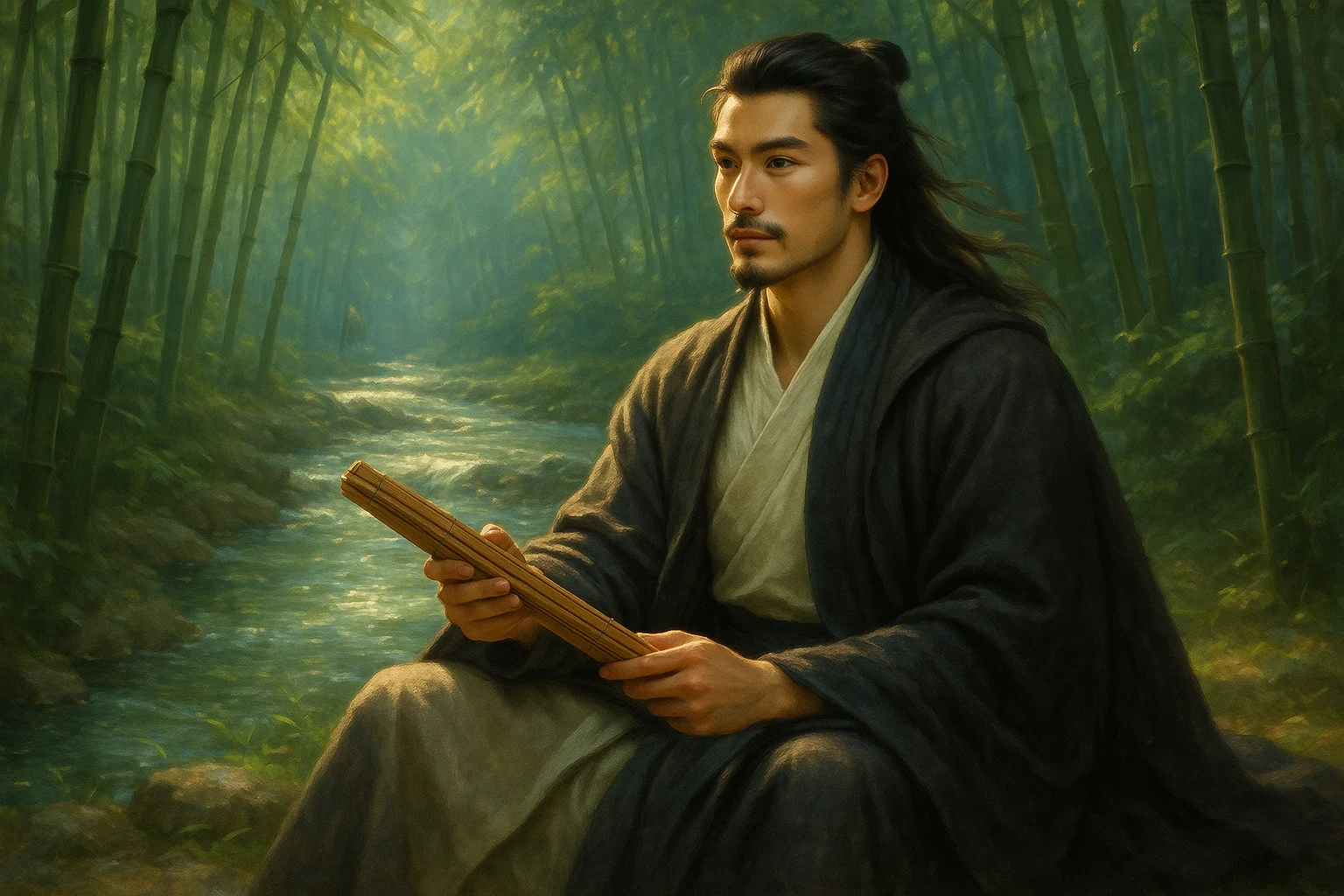
Zhang Jiuling (张九龄 678 - 740), a native of Shaoguan, Guangdong Province, was an outstanding statesman and literary figure during the transitional period from the Early Tang to the High Tang Dynasty. Born into a humble family in Lingnan, he rose to the position of Chancellor (Zhongshu Ling) during the Kaiyuan era, becoming the last virtuous chancellor of Emperor Xuanzong’s reign. He was renowned for his refined demeanor and his willingness to offer frank remonstrances. His poetic style is pure, natural, subtle, and profound, with particular excellence in five-character ancient verse. As a statesman with great vision, he mentored and promoted younger talents such as Wang Wei and Meng Haoran, holding a milestone position in the history of Tang poetry as a link between preceding and succeeding generations.