


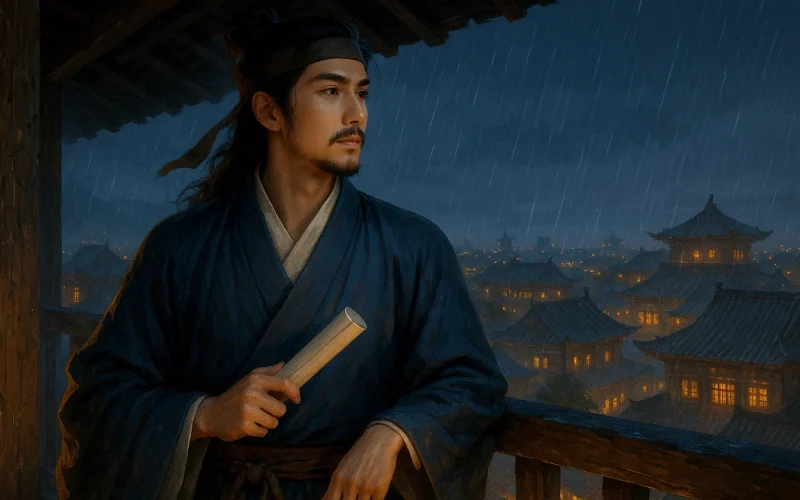
Meng Jiao (孟郊 751 - 814), a native of Deqing, Zhejiang Province, was a renowned poet of the Mid-Tang Dynasty. In his early years, he repeatedly failed the imperial examinations and only obtained the jinshi degree at the age of forty-six. He held minor posts such as Sheriff of Liyang, living a life of poverty and hardship. In his later years, he suffered the loss of his son and died while en route to a new official post. His poetry is renowned for its "bitter chanting" style, and he was often mentioned alongside Jia Dao, with Su Shi coining the famous phrase: "Jiao is lean, Jia is thin." His yuefu (Music Bureau) poems inherited the tradition of Du Fu and paved the way for Yuan Zhen and Bai Juyi, establishing a unique and distinctive place in the history of Tang poetry.
Major works


Life
Meng Jiao was born into a minor official family. His father, Meng Tingbin, served as Sheriff of Kunshan County but died early. After his father's passing, the family fortunes rapidly declined. His mother, née Pei, raised Meng Jiao and his two younger brothers through immense hardship. The poverty of his early years left a deep imprint on Meng Jiao's heart and laid the groundwork for the recurring theme of poverty that would run throughout his later poetry.
Meng Jiao spent his youth primarily in his hometown of Wukang. By nature, he was aloof and upright, unskilled in social intercourse, yet extremely diligent in reading and writing. In his early years, he lived in reclusion on Mount Song, devoting himself to study and leading a life removed from the world. This period of reclusion cultivated his quiet and introverted personality and also fostered in him a deep affection for natural landscapes.
However, studying in reclusion could not solve the problem of making a living. Pressured by family circumstances, Meng Jiao embarked on the path of imperial examinations after reaching the age of thirty. Beginning in the first year of the Jianzhong era of Emperor Dezong (780 AD), he traveled to Chang'an multiple times to take the examinations, but failed repeatedly. During his difficult years in Chang'an, he fully experienced the warmth and coldness of human relationships and the fickleness of the world—experiences that would become important material for his poetry.
In the seventh year of the Zhenyuan era (791 AD), the forty-one-year-old Meng Jiao met the person who would have the greatest influence on his life in Chang'an—Han Yu. Han Yu was only twenty-four at the time and had not yet passed the jinshi examination, but his literary reputation was already emerging. The two became fast friends at their first meeting, forming a friendship that transcended their age difference. Han Yu held Meng Jiao's poetic talent in the highest esteem, praising him with the words, "He has written three hundred poems, whose profound silence echoes the music of Xianchi." This friendship had a profound impact on Meng Jiao's subsequent literary path. Han Yu not only provided him with tremendous spiritual support but also repeatedly praised him in his writings, helping to spread his poetic reputation.
In the twelfth year of the Zhenyuan era (796 AD), the forty-six-year-old Meng Jiao finally passed the jinshi examination. Overjoyed, he wrote the famous poem "After Passing the Examination": "昔日龌龊不足夸,今朝放荡思无涯。春风得意马蹄疾,一日看尽长安花。" The wild joy expressed in these lines stands in sharp contrast to the decades of suppression and bitterness that preceded it.
However, passing the jinshi examination did not bring Meng Jiao the glory and wealth he had anticipated. After passing, he did not immediately receive an official post. After several more years of waiting, it was not until the sixteenth year of the Zhenyuan era (800 AD), at the age of fifty, that he was finally appointed Sheriff of Liyang County (present-day Liyang City, Jiangsu Province). This was a humble position, ranked at the ninth level, with duties involving assisting the County Magistrate in handling local security and capturing thieves. By nature, Meng Jiao was aloof and proud, disliking mundane affairs. After taking office, he often indulged in composing poetry about landscapes and neglected official business, leading to administrative neglect. The County Magistrate reported this to his superiors, and Meng Jiao was penalized with half his salary. Under these circumstances, Meng Jiao resigned from office in the twentieth year of the Zhenyuan era (804 AD) and returned home.
After resigning, Meng Jiao's life became even more difficult. He traveled through Jiangnan, lodging in friends' homes to scrape by. In the first year of the Yuanhe era (806 AD), at the invitation of Zheng Yuqing, the Governor of Henan, he went to Luoyang to serve as an Administrative Assistant for Water and Land Transport in Henan, and later served as an acting Collator of Pitch-Pipes. During his time in Luoyang, he had close contact with literati such as Han Yu, Jia Dao, Zhang Ji, and Li Ao, engaging in poetry and wine gatherings and spending a relatively stable period.
However, fate's blows came one after another. In the third year of the Yuanhe era (808 AD), Meng Jiao's young son died. Losing a son in old age was a devastating blow to Meng Jiao. He sank into deep grief and wrote a series of heart-wrenching poems mourning his son, including "Mourning My Young Son" and "Wounding the Apricot Blossoms." These poems, sincere in emotion and every word dripping with blood, are among the most deeply moving in his entire body of work.
In the ninth year of the Yuanhe era (814 AD), Zheng Yuqing was dispatched to govern Xingyuan and invited Meng Jiao to join him as a staff officer. Meng Jiao set out with his family, but when they reached Wenxiang (present-day Lingbao City, Henan Province), he fell suddenly ill and died abruptly on the journey at the age of sixty-four. After his death, his home was destitute, and there was no money for burial. His friends Zhang Ji and Jia Dao raised funds to bury him. Han Yu composed his epitaph, praising him: "He conducted himself according to rules, willingly enduring the ridicule of his times. He never lowered his head to curry favor." Zheng Yuqing also generously provided for his family, enabling his remains to be returned to his hometown for burial.
Looking at his life as a whole, Meng Jiao can be said to have had a fate full of misfortune: losing his father early, enduring hardship in middle age, losing his son in old age, and living in poverty throughout. Yet it was precisely these harsh experiences that forged his poetic style, enabling him to profoundly reflect life at the bottom of society and to express grief and suffering with such sincerity, making him the voice of the "impoverished scholars" of the Mid-Tang.
Stylistic Characteristics
Meng Jiao's poetry achieved its highest distinction in the five-character ancient-style verse, followed by his Music Bureau poems. His poetry is renowned for profoundly reflecting impoverished life and sincerely expressing grief and suffering. He is often paired with Jia Dao, and together they are known as the "Chill of Meng and the Thinness of Jia." Stylistically, his work is characterized by "coldness," "bitterness," "strangeness," and "ruggedness," carving out a unique place for himself in Tang poetry.
"Coldness" and "Bitterness"
The phrase "Meng's Chill" is the most accurate summary of Meng Jiao's poetic style. The so-called "coldness" refers not only to the recurring theme of poverty in his poems but also to the sorrowful and desolate emotions expressed, as well as the clear, cold, and rugged artistic conception he creates.
Meng Jiao lived in poverty all his life and had a deep experience of the living conditions of impoverished scholars. In his poems, one can see realistic descriptions of impoverished life everywhere. For example, in "Autumn Thoughts" No. 4, the lines "秋至老更贫,破屋无门扉。一片月落床,四壁风入衣" vividly depict the destitution of a poor scholar. Similarly, in "Borrowing a Cart," the lines "借车载家具,家具少于车" use self-mockery to express the predicament of having nothing but bare walls—humorous yet filled with bitterness.
However, Meng Jiao's "coldness" is not merely material poverty; it is also spiritual loneliness and desolation. His whole life was marked by unappreciated talent, and he fully experienced the fickleness of the world and the coldness of human relationships. For example, in "Presented to Cui Chunliang," the lines "食荠肠亦苦,强歌声无欢。出门即有碍,谁谓天地宽" express the feeling of "encountering obstacles upon going out," vividly capturing the reality of a poor scholar meeting obstacles at every step, giving full expression to spiritual anguish.
Strangeness and Ruggedness
In art, Meng Jiao pursued strangeness and ruggedness, striving to avoid the mediocre. Together with Han Yu, he was a representative of the strange and rugged poetic style of the Mid-Tang. However, Han Yu's strangeness lay in using prose as poetry and in his magnificent imagination, while Meng Jiao's strangeness lay in his choice of unconventional subject matter, his harsh language, and his bitter conception.
He excelled at selecting themes that others overlooked, uncovering profound meaning from the ordinary. For example, "Song of the Traveling Son" depicts the everyday scene of a loving mother sewing clothes, but uses the metaphor "谁言寸草心,报得三春晖" to express maternal love as profound and vast. Similarly, in "Ancient Lament," the lines "试妾与君泪,两处滴池水。看取芙蓉花,今年为谁死" use the pond water and lotus flowers as metaphors to express boudoir resentment. The novelty of the conception and the strangeness of the language are truly admirable.
He pursued conciseness and power in language, often expressing the deepest feelings with the fewest words. For example, in "The Chaste Woman's Lament," the lines "波澜誓不起,妾心古井水" use the water of an ancient well as a metaphor for a woman's steadfast heart. The metaphor is strange yet apt, and has become an eternal famous line. Similarly, in "Evening View from Luo Bridge," the lines "榆柳萧疏楼阁闲,月明直见嵩山雪" use the phrase "直见" to bring the distant view of snow on Mount Song vividly before the reader's eyes—concise language yet expansive conception.
Profound Praise of Maternal Love
In Meng Jiao's poetry, the works most celebrated by later generations are those that praise maternal love. This is closely related to his experience of losing his father as a child and being raised through hardship by his mother, née Pei. His gratitude towards his mother was deep and sincere, and when expressed in poetry, it becomes deeply moving.
"Song of the Traveling Son" is the representative work: "慈母手中线,游子身上衣。临行密密缝,意恐迟迟归。谁言寸草心,报得三春晖。" The entire poem takes the everyday detail of sewing clothes as its starting point, using the action of "stitching carefully" to convey the loving mother's concern and the psychology of "fearing his late return" to express her worry. The last two lines use the metaphor of the inch-long grass heart and the spring sunlight to contrast the child's filial piety with the vastness of maternal love—emotionally profound and philosophically enduring. This poem has been recited for thousands of years and has become a classic ode to maternal love in Chinese culture.
In addition, in "The Traveling Son," the lines "萱草生堂阶,游子行天涯。慈亲倚堂门,不见萱草花" use the daylily as an evocative image to depict the scene of a loving mother leaning against the door, hoping for her son's return—equally moving.
Poems on Losing a Son in Old Age
In the third year of the Yuanhe era (808 AD), Meng Jiao's young son died. The poet, nearly sixty, was plunged into immense grief. He wrote a series of poems mourning his young son, including "Mourning My Young Son" and "Nine Poems on Wounding the Apricot Blossoms." These poems, with their sincere emotion and profound grief, occupy an important place among ancient Chinese mourning poetry.
In "Mourning My Young Son," the lines "一闭黄蒿门,不闻白日事。生气散成风,枯骸化为地" use calm narration to describe the cruelty of death, yet beneath the calm lies a heart-rending pain. "Nine Poems on Wounding the Apricot Blossoms" uses withering apricot blossoms as a metaphor for the young son's untimely death, with repeated lamentations. Lines like "冻手莫弄折,弄折伤人心" use an everyday incident to express the pain of losing a son, bringing tears to the reader's eyes.
These poems integrate personal grief with philosophical reflections on life, expressing profound feelings about the impermanence of life even while mourning. For example, in "Wounding the Apricot Blossoms" No. 6, the lines "此是天上儿,来为人所怜。如何夏生春,不得到秋前" express grief through the imagination of the child as a "heavenly child," and lament the brevity of life with the exclamation "不得到秋前"—emotionally profound and philosophically enduring.
Literary Influence
Meng Jiao occupies an important position in the Mid-Tang poetic world, and his influence is profound and lasting.
The Historical Judgment of "Meng's Chill and Jia's Thinness"
Since Su Shi proposed the famous judgment of "Meng's Chill and Jia's Thinness," Meng Jiao and Jia Dao have been regarded together as representatives of the "Bitter Intoning" school of poetry. This evaluation accurately summarizes the core characteristics of his poetic style: using coldness and bitterness as the foundation, pursuing strangeness and ruggedness, and carving out a unique space after the flourishing of numerous masters in the High Tang. Together with Jia Dao, he constituted an important pole in the diverse格局 of Mid-Tang poetry. Su Shi, in his "Funeral Oration for Liu Ziyu," stated, "Yuan was frivolous, Bai vulgar; Meng chill, Jia thin." Although not entirely complimentary, it has indeed become a fixed judgment in literary history.
A Core Figure of the Han-Meng Poetry School
Meng Jiao and Han Yu together initiated the strange and rugged poetic style of the Mid-Tang, known in literary history as the "Han-Meng Poetry School." Han Yu held Meng Jiao in the highest esteem. In his poem "Recommending a Worthy Man," he praised him, saying, "His splendor rivals heaven's beauty, his swiftness surpasses echoing reports," and commented, "He distinguishes right from wrong like Meng Ke, his eyes discerning the clear from the blurred. Profound, pure, and clear, he can calm the restlessness of the age." The two influenced and appreciated each other, jointly promoting the poetic innovation of the Mid-Tang. Han Yu used prose as poetry, with magnificent imagination; Meng Jiao chose secluded subject matter and used rugged language. Although their styles differed, they were highly consistent in their pursuit of strangeness and opposition to mediocrity.
Influence on Song Poetry
Meng Jiao's poetic style had a profound influence on Song dynasty poets. Mei Yaochen and Su Shunqin of the Northern Song advocated for poetry to reflect reality and pursue ancient simplicity, a creative orientation that was in line with Meng Jiao's. Dai Fugu and Liu Kezhuang of the Jianghu Poetry School in the Southern Song also drew nourishment from Meng Jiao's poetry. Particularly, Meng Jiao's deep exploration of everyday life and his realistic depiction of impoverished situations provided inspiration for the Song poetic tendency of "using the common to achieve elegance."
The Classic Status of "Song of the Traveling Son"
The poem "Song of the Traveling Son" has become a classic ode to maternal love in Chinese culture, recited for thousands of years. Transcending the limitations of its time, with its sincere emotion and profound philosophy, it has become an inseparable part of Chinese cultural tradition. On the strength of this single poem alone, Meng Jiao's immortality is assured.
In summary, Meng Jiao is one of the most outstanding poets of the "impoverished scholar" tradition in the Tang dynasty, distinguished for profoundly reflecting impoverished life and sincerely expressing grief and suffering. His life was full of hardships and misfortunes, yet with the sincere attitude of "poetry flowing from the heart," he left behind a large body of deeply moving works. The line "谁言寸草心,报得三春晖" from "Song of the Traveling Son" has become an eternal classic celebrating maternal love in Chinese culture. The phrase "春风得意马蹄疾" from "After Passing the Examination" gave posterity the idiom "春风得意" (riding on the crest of success). The lines "冷露滴梦破,峭风梳骨寒" from "Autumn Thoughts" vividly depict the bitterness of the impoverished scholar. Together with Han Yu, he initiated the strange and rugged poetic style of the Mid-Tang. Paired with Jia Dao as "Meng's Chill and Jia's Thinness," he occupies an important position in the history of Tang poetry. His poetry and his person, even after a thousand years, still allow us to envision his upright and unyielding character and his compassionate, sorrowful spirit.