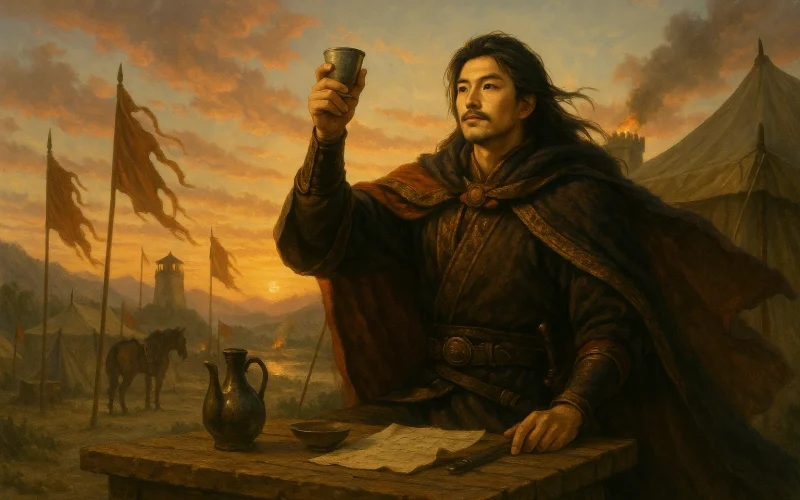
Li Qi (李颀 c. 690 – c. 751), whose ancestral home was in Zhao County, Hebei Province, was a renowned frontier fortress poet of the High Tang period. He became a jinshi (presented scholar) in the 23rd year of the Kaiyuan era (735 AD) and served as the Sheriff of Xinxiang before retiring from official life to live in seclusion. His poetry is best known for its frontier themes, and he excelled particularly in seven-character ancient verse and character portrayal. He had a gift for blending boldness with delicate emotion, and together with Gao Shi and Cen Shen, he collectively shaped the grandeur of High Tang frontier poetry.
Major Works


Life
Historical records concerning Li Qi's early years are quite sparse. He was born into a relatively affluent family and during his youth led a life of chivalrous roaming. His interests were broad; not only did he study literature, but he also once pursued Taoism, practiced martial arts, and even indulged for a time in alchemy and the quest for immortality. This diverse early experience laid the foundation for the wide range of themes later found in his poetry. He once wrote of himself: "少小好读书,亦爱论兵书", revealing a character cultivated in both civil and martial arts.
Around the thirteenth year of the Kaiyuan era (725), Li Qi, then over thirty years old, arrived in Chang'an to begin his quest for an official position. However, his path through the imperial examinations was not smooth, and he failed repeatedly. During his difficult years in Chang'an, he had the opportunity to become acquainted with many important figures of the literary world, befriending Wang Wei, Zhang Xu, Qiwu Qian, Gao Shi, Wang Changling, and others. He often drank and composed poetry with these poets, discussing affairs of the day and forging deep friendships through shared literary pursuits. These associations would later become a vital source for his exchange poems.
In the twenty-third year of the Kaiyuan era (735), Li Qi finally passed the Jinshi examination, by which time he was nearly fifty years old. After earning his degree, he was appointed Sheriff (wei) of Xinxiang County (present-day Xinxiang City, Henan Province), earning him the appellation "Li of Xinxiang." However, the post of county sheriff was humble and tedious, far removed from his youthful ambition of "harboring lofty aspirations." In his poem "放歌行答从弟墨卿", he wrote: "由是蹉跎一老夫,养鸡牧豕东城隅", revealing his dissatisfaction with the official post and his inner anguish.
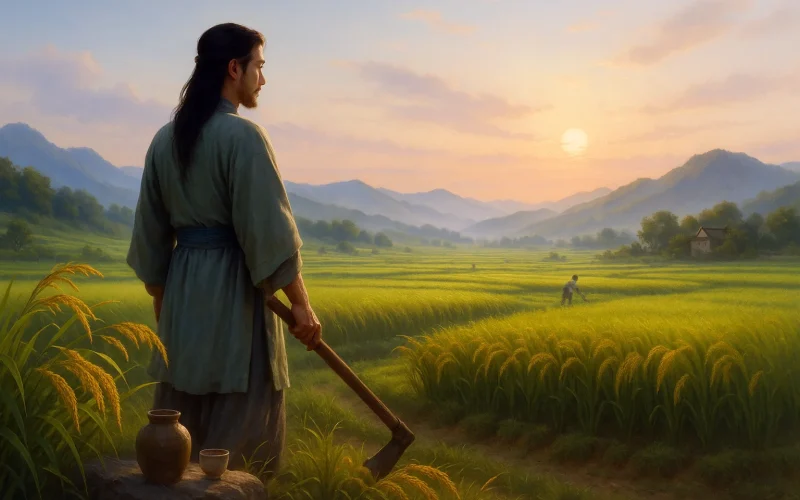
After several years as sheriff, Li Qi remained perpetually unfulfilled. Around the third year of the Tianbao era (744), he finally resolved to resign and return to a life of reclusion. After resigning, he went back to his long-time residence at Dongchuan in Yingyang, where he led a leisurely life of farming, reading, and interacting with fellow poets. Yingyang, situated south of Mount Song and along the banks of the Ying River, with its clear and secluded landscapes, was an ideal place for reclusion. He described his life in seclusion in a poem: "归卧东窗时,翛然独闲适", indicating his increasingly tranquil state of mind.
During his reclusion, he maintained close contact with his poet friends. When Gao Shi, Wang Changling, Qiwu Qian and others departed for the frontiers or took up new posts, he often composed poems to see them off; when they returned or visited him, he would welcome them with verse. These exchange poems became the most moving part of Li Qi's oeuvre. In the eighth year of Tianbao (749), when the poet Cen Shen left for Anxi and Gao Shi for Fengqiu, Li Qi composed poems to see them off, demonstrating his wide circle of acquaintances in the poetic world of his time.
Around the tenth year of Tianbao (751), Li Qi passed away at his home in Yingyang at approximately the age of sixty-one. His life spanned three phases: roaming in youth, seeking office in middle age, and reclusion in later years. This rich life experience endowed his poetry with broad vision and profound insight into human existence.
Stylistic Characteristics
Li Qi's poetry achieved its highest distinction in five-character ancient-style verse (wuyan gushi) and seven-character songs (qiyan gexing). His themes are diverse, with his frontier poems and exchange poems being particularly renowned. Stylistically, his work combines heroic and majestic grandeur with delicate and graceful subtlety, creating a unique presence in the High Tang poetic scene.
Frontier Poetry: Vehement and Heroic, with Imposing Vigor
Although Li Qi's frontier poems are not numerous, they are of exceptionally high quality and occupy an important position in the High Tang frontier poetry school. His frontier poems do not focus on detailed descriptions of specific battles, but rather on conveying the hardships of frontier life, the heroism of officers and soldiers, and the longing and suffering of those separated by war. Their style is vehement and mournful, with an imposing vigor.
He excelled at selecting typical scenes, sketching the vastness and grandeur of the frontier with concise brushstrokes. For example, in "古意": "男儿事长征,少小幽燕客。赌胜马蹄下,由来轻七尺". A few words vividly portray the heroic spirit of the Youyan warriors. He was also adept at creating artistic conception, blending personal emotions into the broad setting. For instance, the opening of "古从军行": "白日登山望烽火,黄昏饮马傍交河", uses the passage of time and space to reveal the soldiers' toil.
Especially valuable is the profound reflective spirit often found in Li Qi's frontier poems. He not only writes of the hardships of the frontier, but also of the devastation war inflicts on ordinary people. "年年战骨埋荒外,空见蒲桃入汉家", employs stark contrast to expose the bloody cost of war against the meager gains of the rulers, achieving a depth of thought surpassing many contemporary frontier poets.
Exchange Poems: Sincere and True, Vivid Portrayals
Li Qi was a master of the exchange poem in the High Tang. He maintained close relationships with numerous literati, including Wang Wei, Gao Shi, Wang Changling, Zhang Xu, Qiwu Qian, and Chen Zhangfu, and often composed poems to present to them on parting occasions. These exchange poems not only express genuine friendship but also vividly portray the images and temperaments of his friends with masterful strokes, possessing high literary and historical value.
The greatest characteristic of his exchange poems is the ability to accurately grasp the individual personality of the recipient and portray them vividly with concise language. For example, in "赠张旭", he writes of Zhang Xu: "张公性嗜酒,豁达无所营。皓首穷草隶,时称太湖精。露顶据胡床,长叫三五声。兴来洒素壁,挥笔如流星." The image of an unrestrained artist, wild after drinking, leaps vividly off the page. Similarly, in "送陈章甫", he writes of his friend Chen Zhangfu: "陈侯立身何坦荡,虬须虎眉仍大颡。腹中贮书一万卷,不肯低头在草莽." A few strokes sketch the image of a learned and proud scholar.
These exchange poems also often incorporate profound reflections on life. Both the poet and his friends were men of talent whose ambitions went unfulfilled, and at moments of parting, such sentiments were inevitable. In "送魏万之京", the lines "朝闻游子唱离歌,昨夜微霜初渡河。鸿雁不堪愁里听,云山况是客中过" not only express the sorrow of parting but also convey feelings about their own lives, subtle, evocative, and deeply meaningful.
Poems of Reflection: Deep and Subtle, Brimming with Emotion
Li Qi's poems of reflection often describe his life in reclusion and his insights into life. Stylistically, they tend towards calmness and tranquility, but often reveal depth within simplicity. In "渔父歌", he compares himself to an old fisherman, expressing his aspiration to transcend worldly affairs: "白头何老人,蓑笠蔽其身。避世常辞酒,逃名不染尘." The language is simple and understated, the artistic conception lofty and far-reaching.
His reflective poems also frequently express feelings about the vicissitudes of life. In "不调归东川别业", he writes: "寸禄言可取,托身将见遗。惭无匹夫志,悔与名山辞。绂冕谢知己,林园多后时." He gently unfolds the complex emotions surrounding his resignation and return to seclusion – the disappointment with official life, the anticipation of reclusion – sincere and unaffected.
Music Poems: Vivid Description, Opening New Vistas
Li Qi also produced a special category of poems – music poems. In depicting musical performances, he often achieves the effect of conveying the beauty of sound through words. "听董大弹胡笳声兼寄语弄房给事" and "听安万善吹觱篥歌" are his representative works.
In such poems, he employs rich imagination and vivid metaphors, transforming abstract music into concrete imagery. "空山百鸟散还合,万里浮云阴且晴", compares the undulations of a melody to changes in a natural scene. "龙吟虎啸一时发,万籁百泉相与秋", uses a symphony of various sounds to depict the rich layers of music. These works stand alongside masterpieces like Han Yu's "听颖师弹琴" and Bai Juyi's "琵琶行" as jewels of Tang-dynasty music poetry.
Literary Influence
Li Qi occupies an important position in the High Tang poetic world, and his influence is mainly reflected in the following aspects.
Outstanding Representative of the High Tang Frontier Poetry School
Li Qi, along with Gao Shi, Cen Shen, and Wang Changling, is known as one of the "Four Great Masters of High Tang Frontier Poetry." Although his frontier poems are not numerous, they stand out for their profound reflective spirit and their vigorous, mournful style. The line from "古从军行" – "年年战骨埋荒外,空见蒲桃入汉家" – with its strong critical awareness, has become one of the most profoundly thoughtful lines in all Tang frontier poetry. His contemplation of the nature of war elevates his frontier poems beyond the general heroism and pathos of the genre, reaching a deeper level of historical reflection.
Exemplary Writer of Exchange Poems
Li Qi's exchange poems are exemplary within their category in the Tang dynasty. He was skilled at creating vivid likenesses of his friends, often sketching a lively character portrait in just a few lines. These exchange poems not only possess high artistic value but also provide precious historical material for later generations studying the lives and interactions of High Tang literati. Through his poems, we can glimpse the unrestrained nature of Zhang Xu, the proud bearing of Chen Zhangfu, the heroic spirit of Wang Changling, and the vehement generosity of Gao Shi – truly a group portrait of High Tang scholars.
Pioneering Contribution to Music Poetry
With his rich imagination and outstanding artistic expression, Li Qi's music poems broke new ground in using poetry to depict sound. His "听董大弹胡笳声兼寄语弄房给事" and "听安万善吹觱篥歌" stand alongside Han Yu's "听颖师弹琴" and Bai Juyi's "琵琶行" as masterpieces of Tang music poetry. His technique of mobilizing all of nature to analogize musical effects provided valuable experience for later poets tackling similar themes.
Typical Embodiment of the High Tang Poetic Spirit
Li Qi's poetry typically embodies the vigor and spirit of High Tang poetry. His frontier poems are vehement and heroic; his exchange poems are sincere and moving; his music poems are magnificently imaginative; his reflective poems are deep and subtle. This diversity of style and breadth of vision reflects the very spirit of the High Tang era. His associations and poetic exchanges with Wang Wei, Gao Shi, Wang Changling, and others vividly illustrate the flourishing literary scene of the time.
In summary, Li Qi was an important poet with a unique character in the High Tang poetic world. His rich life experience – roaming in youth, seeking office in middle age, and reclusion in later years – endowed his poetry with both the grandeur of the frontier and the tranquility of reclusion; both the sincerity of exchange poems and the dynamism of music poetry. Through the profound reflection of "古从军行," the vivid portraiture of "送陈章甫," and the magnificent imagination of "听董大弹胡笳声兼寄语弄房给事," he left immortal masterpieces in the three realms of frontier poetry, exchange poetry, and music poetry. Alongside Gao Shi, Cen Shen, and Wang Changling, he is known as one of the four masters of frontier poetry. In association with Wang Wei, Qiwu Qian, and others through poetic exchange, he jointly composed the splendid movement of High Tang poetry. Though he did not produce a vast quantity of work, his poetry has been transmitted through the ages for its quality, and even after a thousand years, it still has the power to "shake the heart and stir the soul."