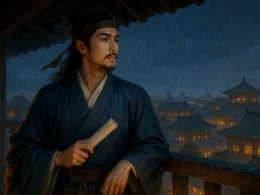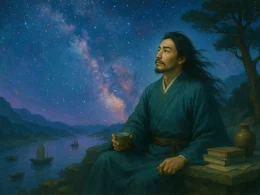



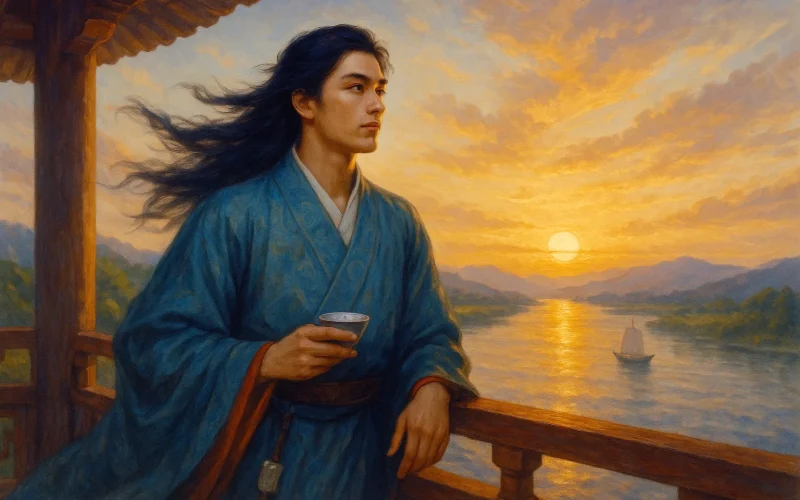
Cui Hao (崔颢 c. 704 – 754), a native of Bianzhou (present-day Kaifeng, Henan Province), was a High Tang poet. He earned the jinshi degree in the eleventh year of the Kaiyuan era (723 AD) and served as Vice Director of the Bureau of Honors. His early poetry predominantly focused on romantic and amorous themes within women's quarters. After traveling to the frontier regions, his poetic style shifted to one of vigorous boldness and unrestrained passion. The Complete Tang Poems preserves 42 of his poems. His regulated verse poem "Yellow Crane Tower," with its opening lines "The sage on yellow crane was gone amid clouds white. / To what avail is Yellow Crane Tower left here?" was praised by Yan Yu in Canglang's Remarks on Poetry as the finest example of Tang regulated verse. Legend has it that when Li Bai ascended the Yellow Crane Tower and saw this poem, he sighed, "Before the scene here I can find no words to say, / For Cui Hao has written a poem on this tower today." His poetry uniquely blends the lyrical elegance of the Six Dynasties with the robust spirit of the High Tang, securing him a distinctive place in the High Tang poetic landscape.


Life
Cui Hao, from Bianzhou (modern Kaifeng City, Henan Province), was an important poet during the Kaiyuan and Tianbao eras of the High Tang. His life and work clearly reflect how personal experience profoundly shapes artistic style, showcasing a transformation from a romantic young talent in his early years to a profound bard in his later life.
Origin and Early Years: His exact birth year is uncertain, but scholars generally speculate it was during the later years of Empress Wu Zetian's reign (around 704 AD). Bianzhou was a major transportation hub in the Central Plains. Such an environment likely nurtured his literary talent while also witnessing his early period of being "noted for frivolity."
Jinshi Degree and Reputation for "Frivolity": In the eleventh year of Emperor Xuanzong's Kaiyuan era (723 AD), Cui Hao obtained the jinshi degree, formally entering the literary and official circles. However, his early career is often portrayed negatively in historical records and poetic critiques. The Old Book of Tang biography states: "He possessed outstanding talent but lacked scholarly integrity; he was fond of gambling and drinking. When he traveled to the capital, he would choose wives for their beauty; if slightly dissatisfied, he would leave them, doing so four times in succession." His early poems mostly imitated the palace-style poetry of the Qi and Liang dynasties, focusing on boudoir sentiments and amorous themes, with ornate diction and shallow taste. This earned him early fame for talent but also a reputation for "frivolity" among scholars. Yin Fan's evaluation in Collection of Poems from the Heroes of Rivers and Mountains – "Hao in his youth wrote poetry and was noted for frivolity" – represents the prevailing contemporary literary view of him.
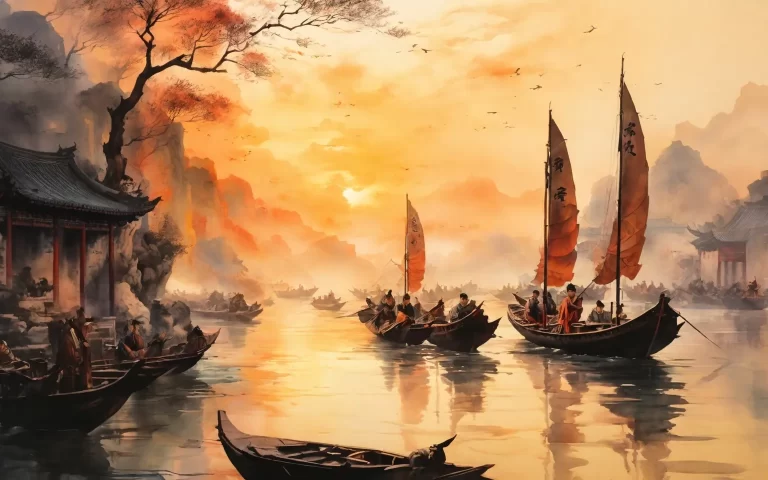
A Turning Point: Travels and Frontier Experience: Around the mid to late Kaiyuan period, Cui Hao left the capital and began extended travels. This shift was crucial. His journeys covered vast regions, particularly northward to Hedong (modern Shanxi area), where he likely served on the staff of a military garrison. This experience of "catching a glimpse of the frontier walls" completely transformed his perspective and poetic style. The vast frontier landscapes, arduous military life, and majestic natural scenery washed away the superficial embellishments from his writing. His creative themes shifted from the boudoir to mountains, rivers, and the frontier, and his style evolved from delicate and ornate to vigorous, austere, and imbued with a stern spirit. This was a phoenix-like rebirth of his artistic life.
Return to Court in Later Years and Official Career End: During the Tianbao era (around the mid-Tianbao period, c. 750 AD), Cui Hao returned to Chang'an, attaining the post of Vice Director of the Bureau of Honors in the Department of State Affairs (rank 6b, upper grade), a position responsible for evaluating meritorious service, hence his traditional title "Cui, Vice Director of the Bureau of Honors." Although not a prominent office, by this time he had gained immense reputation through his powerful poems, especially the timeless masterpiece "Yellow Crane Tower," standing alongside first-rate poets like Wang Changling, Gao Shi, Meng Haoran, and Wang Wei in the High Tang poetic scene. Cui Hao died in Chang'an in the thirteenth year of the Tianbao era (754 AD).
Stylistic Features
Bounded by his frontier experience, Cui Hao's poetic creation displays two distinct styles. The intensity and success of this transformation make him particularly representative among Tang poets.
1. Early Style: Ornate and Graceful, Focused on the Boudoir
His early works often imitated old yuefu titles or Southern Dynasty styles, dealing with themes of boudoir resentment or palace love. For example, the four "Song of Changgan" poems ("Where, sir, do you live?" etc.), though fresh and graceful, reveal a talent for capturing everyday emotions. However, a larger portion of works like "Song of Lady Lu" and "Answer of a Lady in Her Boudoir to a Frivolous Youth" focus on depicting female appearances and sentiments with elegant diction but shallow substance, reflecting the lingering influence of the Qi and Liang styles and the source of his "frivolous" reputation.
2. Late Style: Vigorous and Unrestrained, with a Stern Spirit
After the baptism of frontier life, his poetic style underwent a fundamental transformation, truly establishing his place in literary history.
- Elevation of Themes: Poetic themes turned to frontier life, military fervor, magnificent landscapes, and historical contemplation. He infused personal reflections on life, time, and space into the vast frontier scenery and grand sweep of history.
- Expansion of Imagery: He excelled at creating grand, expansive, solemn, or desolate imagery. Whether depicting frontier landscapes like "Mountains replace Jun Commandery, bordering Yan in the east; / The Hu people at Wild Goose Gate dwell near the frontier" or expressing the vast sigh toward time and space in "The yellow crane once gone does not return again; / White clouds for a thousand years in vain still float," the vision is majestic, transcending trivial personal emotions.
- Refinement of Language: His language became simple, robust, and stripped of ornamentation. Descriptions of scenes and objects are concise yet forceful; lyrical expressions and reflections are profound and impassioned. What Yin Fan called his "stern spirit" is precisely the perfect embodiment of the inner spiritual strength and outer linguistic form in his later poetry.
3. Masterpiece: The Exemplary Significance of "Yellow Crane Tower"
The poem "Yellow Crane Tower" is the concentrated expression of Cui Hao's artistic achievement and a model of how he bridged his early talent with his later forceful spirit.
"Yellow Crane Tower" stands as the concentrated embodiment of Cui Hao's artistic achievement and serves as a prime example of how he bridged the lyrical grace of his early years with the robust spirit of his later period. This poem has been revered by later generations as the finest example of Tang seven-character regulated verse (for instance, by Yan Yu in Canglang's Remarks on Poetry). Its breakthrough lies in the following aspects:
Formally, it does not rigidly adhere to the strict tonal patterns and parallelism of regulated verse (the first four lines resemble ancient-style verse or song-like poetry), yet it is unified by a vital rhythmic flow. The last four lines return to a more regular structure, creating a unique rhythmic beauty that "breaks the rules to achieve transcendent artistry."
In terms of imagery and conception, it seamlessly merges mythological legend, immediate scenery, vast expanses of time and space, and personal nostalgia. The first two couplets are filled with a sense of melancholy over the elusive traces of immortals and the eternity of time. Against the backdrop of bright yet boundless scenery in the final two couplets, the poem naturally evokes the homesickness of a wanderer adrift in the world. The entire poem expresses profound and expansive emotion in a language that is both natural and magnificently grand, completely transcending the delicate style of his early work and representing the highest realm of the integrated, sublime, and majestic poetry of the High Tang.
Legend has it that when Li Bai ascended the Yellow Crane Tower and saw this poem, he sighed in admiration: "Before such scenery, I can find no words to say; / Cui Hao's verse is written here above." While this anecdote may not be historically accurate, it sufficiently attests to the poem's lofty status.
Influence
Cui Hao occupies a unique and important position in the High Tang poetic scene and indeed in the entire history of Chinese poetry.
- A Personal Paradigm of Poetic Transformation
His life and work perfectly illustrate the ultimate significance of "reading ten thousand books and traveling ten thousand miles" for a poet. From being "noted for frivolity" to possessing a "stern spirit," he provides a classic case of a poet achieving a leap in artistic realm by expanding life experiences. Yin Fan's critique became a model for later critics analyzing a poet's developmental trajectory. - A Milestone in the Evolution of Regulated Verse
The poem "Yellow Crane Tower" holds milestone significance in the history of the seven-character regulated verse (qilu). It emerged during the period between the full maturation of the qilu form—established by poets such as Shen Quanqi, Song Zhiwen, and Du Shenyan (grandfather of Du Fu)—and its subsequent culmination under Du Fu’s craftsmanship. Cui Hao’s work boldly incorporates elements of ancient-style poetry into the regulated verse structure, prioritizing spiritual resonance and rhythmic flow over rigid formal constraints. This approach of "driving poetry with vital force" exemplifies the bold and majestic creativity characteristic of the early, formative phase of High Tang qilu, thereby paving the way for Du Fu’s later innovation of "infusing ancient style into regulated verse" and significantly broadening the expressive range of the form. - An Outstanding Representative of High Tang Spirit
His frontier poems, vigorous and expansive, were a precursor to the frontier poetry school of Gao Shi and Cen Shen. His landscape and travel poems, grand in imagery and sincere in emotion, together with the related works of Li Bai, Wang Wei, and others, helped construct the magnificent panorama of High Tang poetry. Particularly, the profound contemplation of eternity and the moment, history and the individual, the celestial and the mortal reflected in "Yellow Crane Tower" embodies the elevated yet philosophically deep spirit of the High Tang era. - Enduring Classical Status in Later Generations
Since the Tang dynasty, "Yellow Crane Tower" has been an undisputed classic. Poetic critics throughout history have held it in the highest esteem, and it is invariably included in anthologies. It is not only a model of poetic art but has also become the soulful symbol of the Yellow Crane Tower in Wuhan and even of Chinese tower culture. Cui Hao himself, through this single poem, forever retains a unique and brilliant position in the star-studded sky of Tang poetry.
n summary, Cui Hao was a poet who achieved profound self-transcendence. His early reputation for “frivolity” stands in striking contrast to the “stern and dignified spirit” that defined his later work. The dramatic evolution of his poetic style mirrors the broader High Tang literati ideal of engaging actively with the world and embracing expansive life experiences. And a single poem, “Yellow Crane Tower,” proves sufficient to allow him to transcend time and space, to converse with the greatest poets across history, and to secure an enduring place in the collective memory of Chinese literature.