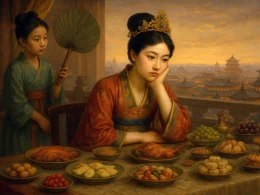




She is slim and supple and not yet fourteen,
The young spring-tip of a cardamon-spray.
On the Yangzhou Road for three miles in the breeze
Every pearl-screen is open. But there's no one like her.
Original Poem
「赠别二首 · 其一」
杜牧
娉娉袅袅十三余,豆蔻梢头二月初。
春风十里扬州路,卷上珠帘总不如。
Interpretation
This poem was composed in the spring of 835 AD during the Taihe reign of Emperor Wenzong, on the eve of Du Mu's departure from Yangzhou, where he had served on the staff of the Military Governor of Huainan. It is the first of the Two Poems on Parting. Yangzhou, regarded as the foremost metropolis in the East during the Tang dynasty, was a hub of merchants and a city of ceaseless music and revelry. The years Du Mu spent there as an assistant coincided with his youthful, talented, and romantic prime, filled with poetry and wine. However, despite the freedom and unconventional lifestyle of his post, it ultimately did not align with his original aspirations to serve the state and aid the people. As he prepared to leave Yangzhou for the capital, his future was uncertain, and his state of mind was complex. It was against this backdrop that the poet bid farewell to a singing girl with whom he shared a deep understanding. Though titled "Parting," the poem never explicitly mentions the sorrow of separation. Instead, it focuses all its artistic power on crafting an eternal poetic portrait of the beloved, elevating an instant of beauty and admiration of youth to the height of a nearly sacred hymn. This approach reflects both Du Mu's cherishing of this affection—unwilling to tarnish its brilliance with commonplace sadness—and subtly constitutes a resplendent summation and poetic farewell to his own Yangzhou years.
First Couplet: 娉娉袅袅十三余,豆蔻梢头二月初。
Pīngpīng niǎoniǎo shísān yú, dòukòu shāo tóu èryuè chū.
So fair and slender is she at thirteen odd years, Like cardamom by riverside when spring appears.
The opening couplet avoids concrete details like features or attire, capturing the essence of the person through her overall bearing and precise age. The reduplicated phrases "fair and slender" are melodious and vividly convey the unique lightness of her gait and spirited charm. The expression "thirteen odd years" is masterful: it indicates the life stage just past childhood, as her beauty begins to bloom, while preserving a perfectly measured sense of subtlety and room for imagination. The metaphor is a stroke of genius. Cardamom, grown in the south, blossoms in spikes; its tender leaves uncurl as the buds emerge, with early February being the time they are just about to open. Using this for comparison not only perfectly captures the young girl's tender freshness, purity, and loveliness but also endows her with an inherent, life-affirming beauty full of burgeoning vitality. This creative imagistic association has since become the most classic symbol in Chinese culture for referring to the bloom of a young girl's youth.
Final Couplet: 春风十里扬州路,卷上珠帘总不如。
Chūnfēng shí lǐ Yángzhōu lù, juǎn shàng zhūlián zǒng bùrú.
The splendid road in spring runs ten long miles in town; When screens are uprolled, none can surpass her fair renown.
Here, the poet's praise reaches its zenith against the grand backdrop of the city. "The splendid road in spring runs ten long miles in town" is the most poetic summation of Yangzhou, depicting both the city's charming spring scenery and vibrant life and hinting at its peak reputation for romance and pleasure. This is using the ultimate glamour and sophistication of an entire city as a foil. Against this setting, "When screens are uprolled" dynamically presents the scene of beauties vying for attention from behind pearl-adorned blinds throughout the entertainment quarters. Yet, all of this, in the poet's eyes, boils down to three words: "none can surpass." These words are decisive, employing a technique of contrast that uses the beauty of an entire city to highlight the matchless charm of one individual, elevating her allure above the entire city's aesthetic standard. This praise transcends ordinary admiration, approaching a kind of devotional adoration and affirmation, making the figure in the poem radiate with dazzling, unique brilliance.
Holistic Appreciation
This heptasyllabic quatrain is a pinnacle achievement in classical poetry for praising youth and beauty. Its artistic success lies first in achieving the supreme state of "portrayal through omission." Not a single word directly describes her appearance, dress, or talents. Instead, through her bearing ("fair and slender"), age ("thirteen odd years"), metaphor ("cardamom by riverside"), and contrast ("splendid road," "screens uprolled"), it constructs an exceptionally vivid, perfect image that invites boundless imagination. This poetic silence gives beauty its greatest space to grow.
Secondly, the poet perfectly fuses the expression of personal admiration with the imagery of a famous historical city. Yangzhou's "splendid road in spring" is not just a real scene but a symbol of prosperity, romance, and openness. To place the beloved against such a symbolic backdrop and declare her peerless is undoubtedly to proclaim personal aesthetic sentiment on a cultural and historical plane. This gives the poem's conception both breadth and depth, avoiding any sense of frivolity.
Finally, within the ultimate praise lies a faint trace of melancholy reflection. Cardamom is beautiful but brief in bloom; the spring breeze across ten miles will eventually cease. This subconscious awareness of the inherent fragility and transience of beautiful things adds a barely perceptible shadow of time to the bright foundation of the hymn, lending the entire poem, beyond its radiance, a lasting depth of flavor.
Artistic Merits
- The Canonization of a Created Image: The metaphor "Like cardamom by riverside when spring appears" is a stroke of Du Mu's genius. It selects not a flower in full bloom but the moment of "about to bloom," precisely corresponding to the unique beauty of a girl "thirteen odd years"—on the cusp of maturity, pure yet subtly charming. It has since become the definitive image in Chinese for expressing maidenly youth.
- The Ultimate Use of Foil: The poem employs a "double foil." First, the freshness of the cardamom sets off the girl's delicate beauty (object foiling person). Then, the "splendid road in spring" and the assembled charms of the entire city serve as a contrast to her peerless grace (the many foiling the one). This layered buildup, moving from near to far, from the small to the vast, is like stars surrounding the moon, pushing the central image into the spotlight of aesthetic appreciation.
- Unity of Passionate Feeling and Restrained Expression: The poet's emotion is intensely passionate and admiring ("none can surpass"), yet its expression is supremely understated and refined. The entire poem avoids all explicit emotional vocabulary, even omitting the word "parting," instead pouring all deep feeling into a pure gaze upon and supreme praise of the object's beauty. The depth of affection, the pain of parting—all reside within this unspoken contemplation and comparison.
- A Style of Refined Clarity and Brightness: The poem's diction is elegant and succinct. "Fair and slender" has a flowing rhythm; "splendid road in spring" opens up a vast scene; "screens are uprolled" creates a vivid picture. Within just four lines, one finds both the exquisite craftsmanship of late Tang poetry and Du Mu's characteristic air of distinguished elegance and bright clarity, entirely free from any hint of sentimental delicacy.
Insights
This poem is like a time capsule, preserving humanity's purest, most poetic gasp of admiration for the beauty of youth. It tells us that true praise is not an accumulation of adjectives but finding that unique metaphor, connecting an instantaneous feeling with an eternal natural image, thereby transcending the erosion of time.
It enlightens us that in emotional expression, the highest form is often not direct outpouring but reflecting the depth and purity of one's own feelings through the supreme affirmation and depiction of the beloved's value. Du Mu does not say "how reluctant I am to part," but rather "the splendor of ten-mile Yangzhou pales before you." The profound sentiment and resolute conviction contained in the latter far surpass ten thousand words.
Simultaneously, the images of "cardamom by riverside" and "splendid road in spring" form a subtle dialogue: while an individual's youth is as brief as an early spring bud, if it can be recognized and remembered within a broader world (the ten-mile road of Yangzhou), its beauty can achieve a kind of eternity within the long river of culture. This perhaps reminds us that cherishing those brief, supremely beautiful moments in life and anchoring them in a broader context of meaning (through poetry, painting, memory) is the best resistance against fleeting time.
Poem translator
Kiang Kanghu
About the poet

Du Mu (杜牧), 803 - 853 AD, was a native of Xi'an, Shaanxi Province. Among the poets of the Late Tang Dynasty, he was one of those who had his own characteristics, and later people called Li Shangyin and Du Mu as "Little Li and Du". His poems are bright and colorful.