


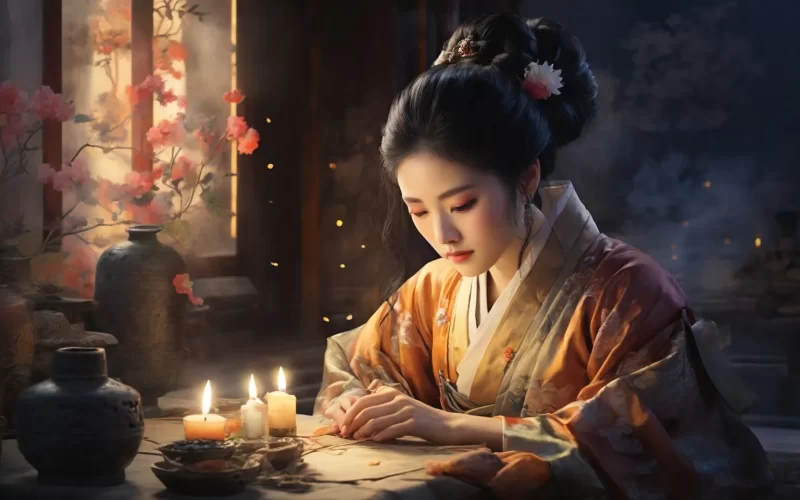
The thread in the hands of a fond-hearted mother
Makes clothes for the body of her wayward boy;
Carefully she sews and thoroughly she mends,
Dreading the delays that will keep him late from home.
But how much love has the inch-long grass
For three spring months of the light of the sun?
Original Poem
「游子吟」
孟郊
慈母手中线,游子身上衣;
临行密密缝,意恐迟迟归;
谁言寸草心,报得三春辉。
Interpretation
This is a timeless masterpiece by the Mid-Tang poet Meng Jiao. Meng Jiao’s life was marked by poverty and repeated failure in the imperial examinations; he did not attain the jinshi degree until the age of forty-six and later suffered the grievous loss of a son. His poetry often dwells on hardship, loneliness, and the fickleness of the world. Renowned for his "bitter chanting" (kuyin)—a style of intense, painstaking composition—he is often paired with Jia Dao under the critical label "Meng’s chill, Jia’s gauntness" (Jiao han Dao shou). Yet, beneath his austere and rugged poetic demeanor lay a wellspring of tender feeling, deeply concealed within his longing for his mother.
Meng Jiao was by nature filial and emotionally refined. Wandering far and wide in his early years, he endured life’s hardships. His mother, Madame Pei, remained the deepest concern of his life. This poem is believed to have been composed as Meng Jiao, in middle age, departed from home for an official post. On the eve of his departure, his mother sewed clothes for him. Within those "careful stitches" lay her myriad worries, her "fear that his return would be delayed." The poet uses no sorrowful lament, no impassioned exclamation. Beginning with this single, ordinary act, he condenses the deepest core of maternal love—that wordless giving, endless concern, and unconditional waiting—into just thirty characters. This poem is the epiphany Meng Jiao gained through a lifetime of wandering, and the total release of the gratitude and guilt he had long accumulated towards his mother.
First Couplet: "慈母手中线,游子身上衣。"
Címǔ shǒu zhōng xiàn, yóuzǐ shēn shàng yī.
From the threads a kind mother’s hand has made, Gown for parting son is sewed, stitch by stitch.
The poem opens with two of the most ordinary objects—thread and garment. Yet it is precisely these most common items that tightly connect the hearts of mother and child. "慈母手中线" ("From the threads a kind mother’s hand has made") is the starting point of action, the source of maternal love. "游子身上衣" ("Gown for parting son is sewed") is the endpoint of action, the destination of that love. This thread, departing from the mother’s hand, passing through a thousand stitches and countless stitches, is finally woven into the gown upon the wanderer’s body; this garment will accompany the wanderer over countless rivers and mountains, shielding him from the cold winds of distant lands. Ten words—no lyrical outpouring, no discourse—just the juxtaposition of two images, yet already the reader feels the invisible current of emotion flowing between them.
Second Couplet: "临行密密缝,意恐迟迟归。"
Línxíng mìmì féng, yì kǒng chíchí guī.
She fears the delays of a long, long road;
This couplet zooms in, focusing on the mother’s sewing action and her psychology. The three words "密密缝" (sewed, stitch by stitch) are intensely visual—those dense, fine stitches are both evidence of her meticulous skill and the externalization of her inner anxiety. Fearing the clothes might not be sturdy enough, fearing her child might suffer cold in a strange land, she stitches and stitches again, making them dense, ever denser. The next line, "意恐迟迟归" ("She fears the delays of a long, long road"), uses the two words "意恐" (fears/ worries) to reveal her inner thoughts. She does not say "return soon," nor "I will miss you." She hides all her concern and worry within these dense stitches. The resonance between "密密" (dense/careful) and "迟迟" (delayed/slow)—one describing action, the other psychology—captures the exquisite depth of maternal love to its utmost.
Final Couplet: "谁言寸草心,报得三春晖。"
Shuí yán cùncǎo xīn, bào dé sānchūn huī.
How could the inch-long grass, for gratitude, Require the warm light of the spring sun?
This couplet is the soul of the poem, using metaphorical imagery to elevate the emotion to its climax. "寸草心" ("the inch-long grass") uses the tender grass of early spring to metaphorize the child’s meager filial devotion—the heart of the grass turns towards the sun, yet remains small and weak. "三春晖" ("the warm light of the spring sun") uses the sunlight of spring to metaphorize the warmth and boundlessness of maternal love—sunlight shines on all, nurturing all growth, yet asks for nothing in return. The two words "谁言" (How could/ Who says) are posed as a rhetorical question, revealing at once the child’s guilt and the mother’s greatness: it is not that the inch of grass cannot repay the spring sun, but that this spring sunlight cannot be measured or repaid by anything at all. Maternal love is natural, unconditional, and transcends all calculation. The poet concludes with this question, allowing all gratitude and guilt to fall into silence within this wordless inquiry, leaving a resonance that lingers long.
Holistic Appreciation
This is the most widely circulated and deeply moving of Meng Jiao’s works. In six lines and thirty characters, using the mother sewing clothes for her wandering child as its entry point, it blends the meticulousness, depth, selflessness, and greatness of maternal love, revealing the poet’s heart-piercing gratitude and guilt towards his mother.
Structurally, the poem progresses from the concrete to the abstract, from the specific to the universal. The first couplet begins with the concrete images of "thread" and "garment," connecting the hearts of mother and child. The second couplet zooms in, focusing on the action of "careful stitches" and the psychology of "fear that his return would be delayed," materializing maternal love into a tangible scene. The final couplet concludes with the metaphorical imagery of "inch-long grass" and "spring sunlight," elevating specific emotion to universal truth. Between the three couplets, the movement is from object to person, from person to heart, from heart to principle, deepening layer by layer into a seamless whole.
Thematically, the poem’s core lies in the contrast between the words "报" (repay/require) and "晖" (sunlight/warmth). Those "careful stitches" are the material form of maternal love; that "fear of delayed return" is its profound depth; the metaphor of the "inch-long grass heart" is the child’s guilt; the image of "spring sunlight" is maternal love’s greatness. Yet the poet ultimately reveals with the words "谁言" (How could): this "repaying" is fundamentally an impossible proposition; this "sunlight" is fundamentally a kindness beyond repayment. This profound recognition of the nature of maternal love is precisely the poem’s most moving aspect.
Artistically, the poem’s most moving feature is its plain technique of "revealing the great through the small, revealing the extraordinary through the ordinary." The poet does not write of maternal love’s grand gestures, nor of parting’s tearful sobs. He writes only of this single, most ordinary action of a mother sewing clothes. Yet it is within this ordinary act that the deepest emotion lies; it is in this minute detail that the greatest love is seen. This technique of embedding the great within the平凡, concealing deep feeling within the daily, is the highest realm of classical Chinese poetry: "without using a single direct word, capturing the entire spirit."
Artistic Merits
- Revealing the Great through the Small, Moving Detail: Beginning with the daily detail of "the threads a kind mother’s hand has made," it conceals the greatness of maternal love within the most ordinary action, allowing readers to empathize deeply.
- Scene and Emotion Fused, Using Objects to Convey Feeling: Through the resonance of "thread" and "garment," "careful stitches" and "delayed return," it materializes abstract emotion into tangible imagery.
- Exquisite Metaphor, Profound Theme: Using "inch-long grass" to metaphorize the child and "spring sunlight" to metaphorize maternal love, it expresses the boundlessness of maternal love and the impossibility of repayment to the utmost.
- Simple Language, Sincere Emotion: The poem contains no ornate or flowery phrases, yet every word flows from the depths of feeling. It is precisely this unadorned, plain language that allows this poem to traverse a thousand years and still move the heart of every reader.
Insights
Through a single ordinary act, this poem speaks to an eternal theme: Maternal love is the most selfless, deepest, and most un-repayable love in this world.
First, it allows us to see "greatness within the everyday." That "threads a kind mother’s hand has made" is something countless mothers do every day; that "careful stitches" on the eve of departure is an act every mother performs as her child leaves home. Meng Jiao writes of no earth-shattering event, only this one small act, yet it allows the reader to feel the full weight of maternal love. It tells us: the greatest emotions are often hidden within the most ordinary actions; the deepest love often needs no grand, dramatic expression.
On a deeper level, the poem prompts us to contemplate the meaning of "repayment and gratitude." "How could the inch-long grass, for gratitude, / Require the warm light of the spring sun?"—the poet tells us maternal love cannot be repaid, for it is unconditional and asks for no return. Yet this very "impossibility of repayment" is precisely the child’s deepest guilt and most genuine gratitude. True gratitude is not about calculating how to repay, but about remembering this love and passing it on to the next generation.
And most moving is the poem’s "silent, deep affection." The mother does not say "I love you"; she expresses her concern only through careful stitches. The poet does not say "I am grateful"; he voices his guilt in just six short lines. Yet it is this silence that makes the emotion more profound; it is this subtlety that makes the poetic resonance longer lasting. The most profound, sincere emotions often need no words; the most moving poems often find their greatest power in wordlessness.
This poem writes of a Tang Dynasty mother, yet allows everyone who has a mother to see their own reflection within it. The warmth of the "hand holding thread" is an image in every wanderer’s memory; the worry of the "delayed return" is an eternal concern in every mother’s heart; the guilt of the "inch-long grass heart" is the deepest resonance in every child’s soul. This is the vitality of poetry: it writes of one poet’s gratitude, yet speaks to everyone’s shared longing for their mother.
Poem Translator
Kiang Kanghu
About the Poet
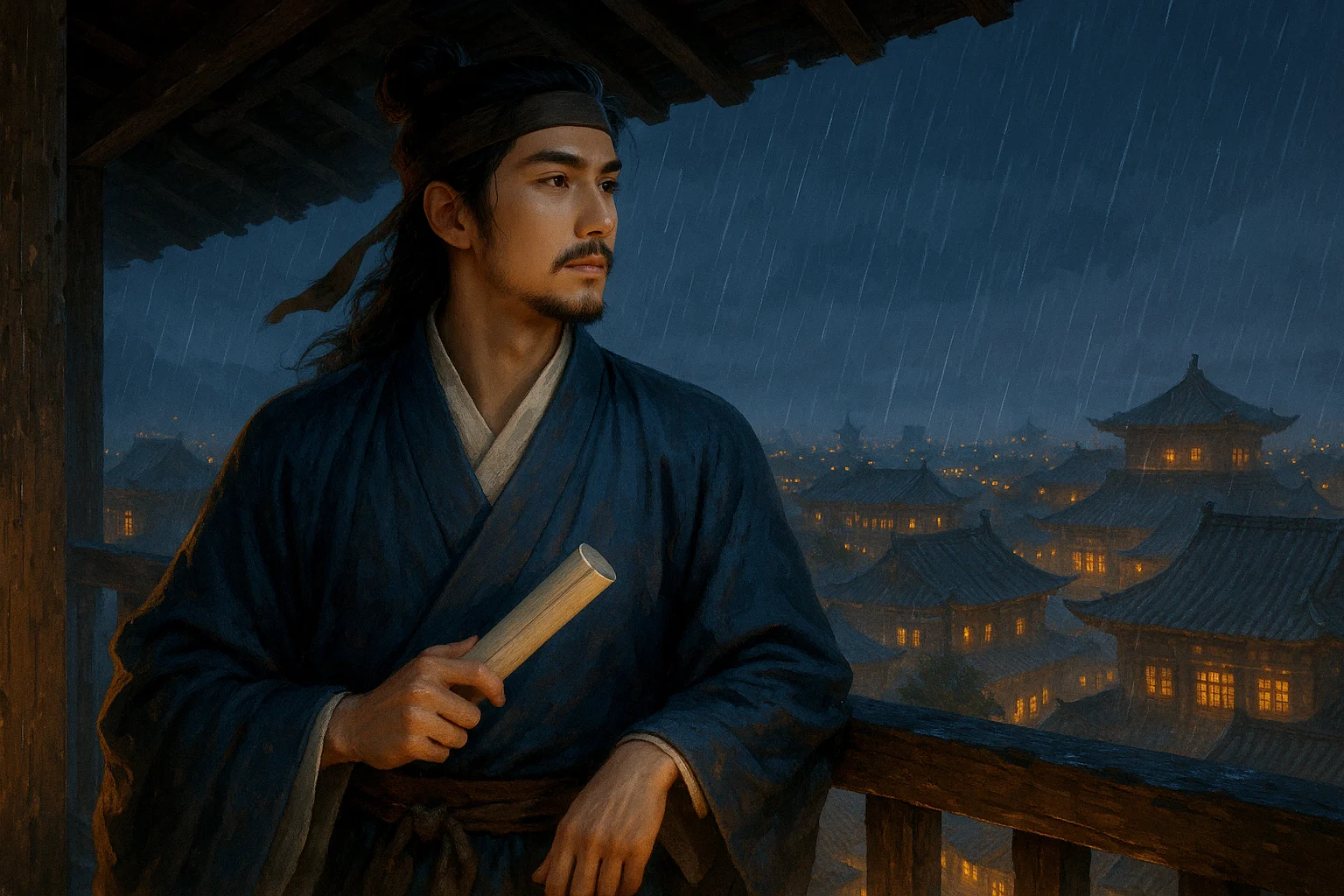
Meng Jiao (孟郊 751 - 814), a native of Deqing, Zhejiang Province, was a renowned poet of the Mid-Tang Dynasty. In his early years, he repeatedly failed the imperial examinations and only obtained the jinshi degree at the age of forty-six. He held minor posts such as Sheriff of Liyang, living a life of poverty and hardship. In his later years, he suffered the loss of his son and died while en route to a new official post. His poetry is renowned for its "bitter chanting" style, and he was often mentioned alongside Jia Dao, with Su Shi coining the famous phrase: "Jiao is lean, Jia is thin." His yuefu (Music Bureau) poems inherited the tradition of Du Fu and paved the way for Yuan Zhen and Bai Juyi, establishing a unique and distinctive place in the history of Tang poetry.