


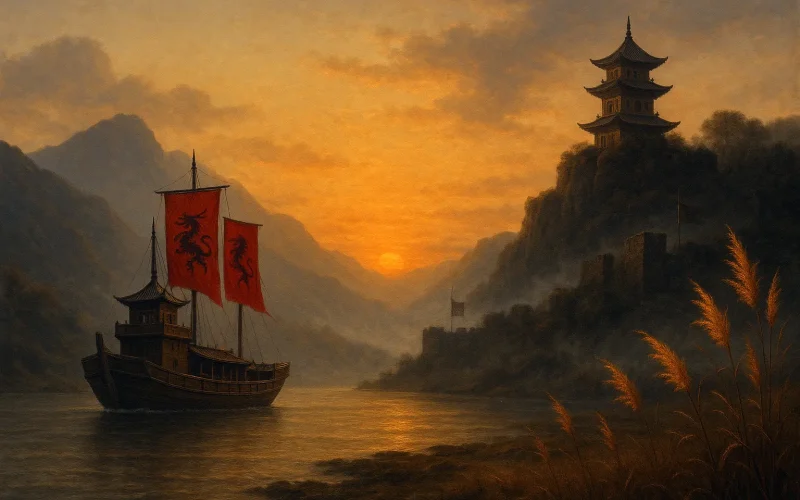
Since Wang Jun brought his towering ships down from Yizhou,
The royal ghost has pined in the city of Nanjing.
Ten thousand feet of iron chain were sunk here to the bottom --
And then came the flag of surrender on the Wall of Stone....
Cycles of change have moved into the past,
While still this mountain dignity has commanded the cold river;
And now comes the day of the Chinese world united,
And the old forts fill with ruin and with autumn reeds.
Original Poem
「西塞山怀古」
刘禹锡
王濬楼船下益州, 金陵王气黯然收。
千寻铁锁沈江底, 一片降旛出石头。
人世几回伤往事, 山形依旧枕寒流。
从今四海为家日, 故垒萧萧芦荻秋。
Interpretation
This poem was composed in 824 AD, the fourth year of the Changqing era of Emperor Muzong of Tang, when Liu Yuxi was transferred from the post of Prefect of Kuizhou to that of Hezhou. Traveling east down the Yangtze River, he passed by West Fort Mountain (Xisaishan) and was inspired by the scene to write this famous historical poem. West Fort Mountain, located in present-day Huangshi, Hubei, was a strategic military pass on the middle reaches of the Yangtze, a place contested by armies repeatedly throughout history. Facing this ancient battlefield that had witnessed countless rises and falls, the poet, moved by the setting, wrote this renowned piece. By this time, Liu Yuxi had already endured over twenty years of exile. From Langzhou to Lianzhou, from Kuizhou to Hezhou, the trajectory of his life frequently overlapped with the mighty, east-flowing Yangtze. Now, sailing on the river, passing West Fort Mountain, he naturally recalled a decisive battle that had taken place here—the campaign of the Western Jin conquering the state of Wu. In 279 AD, Emperor Wu of Jin, Sima Yan, launched a six-pronged attack against Wu. One army, led by Wang Jun, set out from Yizhou (modern Chengdu), sailed down the river, used his tower ships to break the iron chains the Wu forces had stretched across the river, and captured Jinling directly, leading to the fall of Eastern Wu.
However, Liu Yuxi's reflections were not limited to remembering the past. He was on the river, but his heart was with the empire. The Tang dynasty of his time, though it had experienced a revival under Emperor Xianzong's campaigns against the separatist military governors, saw the power of these governors resurface during Emperor Muzong's reign. The three towns of Hebei rebelled again, and the court was at a loss. Standing below West Fort Mountain, watching the rolling river, reflecting on the past and present, how could the poet not feel profound concern? The iron chains sinking to the riverbed, the flag of surrender raised from the city wall—these were not only traces of history but also warnings for the present age: division and secession are ultimately unsustainable; only national unity is the correct path.
First Couplet: "王濬楼船下益州,金陵王气黯然收。"
Wáng Jùn lóuchuán xià Yìzhōu, Jīnlíng wángqì ànrán shōu.
Down flew in crow-nest ships the arms of western force;
The ruler of the east had lost his royal might.
The poem opens with parallel couplets, magnificent in momentum. "The arms of western force" in "crow-nest ships" (tower ships) indicates the power of the attacker—tower ships were large warships; historical records state that the ones built by Wang Jun were "120 paces square, could hold over 2,000 men," veritable beasts on water. The word "Down flew" (下) describes the eastward advance with the current, an irresistible force. In contrast, "The ruler of the east had lost his royal might" refers to the imperial aura of Eastern Wu; the ancients superstitiously believed Jinling had the "imperial qi" (王气), yet at this moment it "had lost" (收)—the word "lost" (收) vividly depicts its swift dissolution and utter inability to resist. This juxtaposition of "Down flew" and "had lost" masterfully conveys the crushing advance of Western Jin and the panicked collapse of Eastern Wu. Within fourteen characters, the curtain rises on a great historical drama.
Second Couplet: "千寻铁锁沉江底,一片降幡出石头。"
Qiān xún tiě suǒ chén jiāng dǐ, yī piàn jiàng fān chū Shítou.
The iron chains failed to bar the river, sunk deep 'neath the tide;
On city wall the flag of surrender was seen in sight.
This couplet continues with details of the battle, using concrete imagery to intensify the contrast between rise and fall. "The iron chains failed to bar the river" refers to the defensive works of Wu—they stretched iron chains across the river at dangerous points and also placed submerged iron spikes, thinking this would stop the Jin fleet. However, Wang Jun first sent rafts ahead to remove the spikes, then used torches to melt the chains; the natural barrier was rendered useless. "Sunk deep 'neath the tide" (沉江底) describes not only the physical sinking of the chains but also symbolizes the complete collapse of Wu's defenses. "On city wall the flag of surrender was seen in sight"—"city wall" (石头) refers to the Stone City, the fortress protecting the Wu capital, Jianye; "the flag of surrender" once raised, the realm changed hands. The first line describes the solidity of the defense; the second, the swiftness of the surrender; the first sinks beneath the river, the second hangs from the city wall—the contrast is striking and evokes a sigh.
Third Couplet: "人世几回伤往事,山形依旧枕寒流。"
Rénshì jǐ huí shāng wǎngshì, shān xíng yījiù zhěn hán liú.
How many times have human regrets risen and gone with ease,
While the mountain still overlooks the cold river in autumn breeze!
This couplet shifts from narration to reflection, drawing the gaze from past events back to the present, from change to permanence. "How many times have human regrets risen and gone with ease"—the phrase "how many times" (几回) speaks of the cyclical nature of historical rise and fall. Not only Eastern Wu, but also the Eastern Jin, Song, Qi, Liang, and Chen dynasties that followed—how many regimes changed hands on this land, how many people came here to lament and mourn? "While the mountain still overlooks the cold river in autumn breeze"—West Fort Mountain remains impassive, still "overlook[ing]" the Yangtze, watching all the human flourishing and decay. The word "still" (依旧) contrasts with "how many times" (几回): human affairs change like flowing water, but the land is eternal like the green mountains. This couplet elevates historical melancholy to philosophical reflection, infusing the poem with a profound sense of time and space.
Final Couplet: "从今四海为家日,故垒萧萧芦荻秋。"
Cóng jīn sìhǎi wéi jiā rì, gǔ lěi xiāoxiāo lú dí qiū.
Now that the land is unified under the sun,
The ancient forts are overgrown with weeds sad and undone.
The final couplet returns from the past to the present, concluding the poem with the scene before the eyes. "Now that the land is unified under the sun" alludes to a phrase in the Records of the Grand Historian: "The Son of Heaven regards the four seas as his home," referring to the unified state of the Tang empire. However, the poet does not stop at celebrating unity. Instead, he turns his brush to "The ancient forts are overgrown with weeds sad and undone"—those old fortresses of past campaigns now lie desolate amidst autumn reeds. This is both realistic description and metaphor: unity is indeed cause for comfort, but the lessons of history must not be forgotten; those rustling reeds are witnesses to the vicissitudes of time and a silent warning for posterity. The word "autumn" (秋) bathes the entire poem in a desolate hue, leaving endless reflection.
Holistic Appreciation
This poem of historical reflection uses one battle to write of an era, one location to write of the rise and fall of millennia. The first two couplets narrate history, powerfully describing the overwhelming momentum of Western Jin's conquest of Wu and the swift, panicked collapse of Eastern Wu, with vigorous brushstrokes and strong imagery. The third couplet shifts from narration to reflection, juxtaposing "how many times" (人世几回) with "the mountain still" (山形依旧), elevating historical sentiment to philosophical thought. The final couplet concludes with the present scene, the "ancient forts… overgrown with weeds" echoing the earlier lines, offering a warning amidst the desolation.
The poem's structure is rigorous, its layers clear. The first four lines tell of the ancient event, the middle two express reflection, the last two describe the present scene—past and present interweave, abstract and concrete complement each other. The poet does not merely reflect on history; he uses history to satirize the present—the futility of the "iron chains," the humiliation of the "flag of surrender," the desolation of the "ancient forts"—all point to one theme: division is ultimately unsustainable; unity is the correct path. In the mid-Tang period, with the resurgence of separatist military governors, such a poetic reflection held strong contemporary significance.
Artistic Merits
- Vivid Contrast, Running Throughout: "Down flew" vs. "had lost"; "iron chains" vs. "flag of surrender"; "how many times" vs. "the mountain still"; "the land is unified" vs. "ancient forts overgrown"—multiple contrasts intertwine, intensifying the sense of rise and fall.
- Spatial and Temporal Breadth, Profound Conception: From Yizhou to Jinling, from Western Jin to mid-Tang, from ancient forts to cold river—time and space intertwine, history and reality reflect each other.
- Concentrated Imagery, Vigorous Brushwork: Images like "tower ships," "iron chains," "flag of surrender," "ancient forts," and "reeds" are concrete and tangible, yet rich in symbolism. A few strokes outline the grandeur and desolation of history.
- Concluding with Scene, Subtle and Evocative: The final couplet does not reason directly but concludes with the image of "The ancient forts are overgrown with weeds sad and undone." The words end, but the meaning is boundless, prompting deep thought.
Insights
This poem first prompts us to consider the value of unity and the harm of division. "Down flew in crow-nest ships the arms of western force; / The ruler of the east had lost his royal might"—that period of history tells later generations: any separatist force, no matter how strong its defenses, ultimately cannot resist the tide of unity. Liu Yuxi, living in the mid-Tang with its separatist military governors, felt this deeply. Using poetry as remonstrance, he reminded those in power: There is no way out in division; unity is the will of the people. In today's world, this insight remains universally relevant—whether at the national or organizational level, division only consumes strength; unity can achieve great things.
The couplet, "How many times have human regrets risen and gone with ease, / While the mountain still overlooks the cold river in autumn breeze!" also leads us to contemplate the dialectical relationship between change and permanence. Dynasties change, human affairs pass, yet the land remains, the rivers flow unchanged. This is both the ruthlessness and the justice of history. It reminds us: In a world of constant change, we must find what is truly enduring—perhaps the mountains and rivers, perhaps moral integrity, perhaps national identity. These enduring things are the foundation upon which we establish ourselves and pursue our lives.
This poem also teaches the wisdom of using history as a mirror. Standing below West Fort Mountain, looking at "The ancient forts… overgrown with weeds sad and undone," what welled up in Liu Yuxi's heart was reverence for history and vigilance for the present. He did not indulge in nostalgic sentimentality but drew lessons from history to reflect on his own time. This attitude of treating history as a mirror is precisely the intellectual resource we most need when facing complex realities.
Finally, the poem's sentiment, grown deeper through vicissitude, is especially moving. When Liu Yuxi wrote this, he had already endured over twenty years of exile. The vicissitudes of his personal life formed a poignant resonance with the tales of rise and fall along the banks of the Yangtze. Yet he did not drown in personal sorrow but merged his individual fate into the long river of history, seeking spiritual solace on a higher plane. This realm of transcending personal gain and loss, communing with the spirit of heaven and earth is the most precious spiritual legacy Liu Yuxi bequeaths to us.
Poem translator
Kiang Kanghu
About the poet
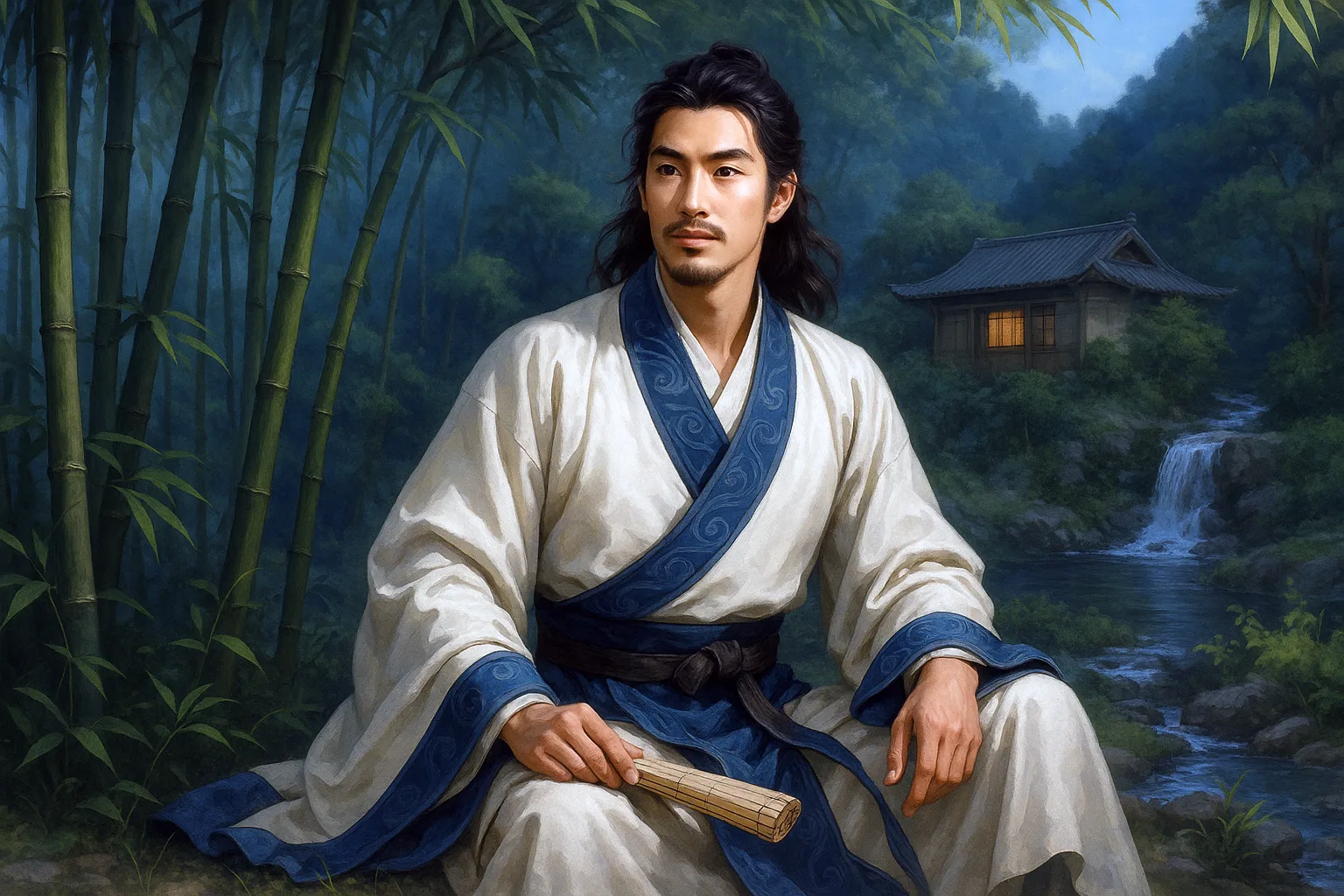
Liu Yuxi(刘禹锡), 772 - 842 AD, was a native of Hebei. He was a progressive statesman and thinker in the middle of the Tang Dynasty, and a poet with unique achievements in this period. In his compositions, there is no lack of poems reflecting current affairs and the plight of the people.