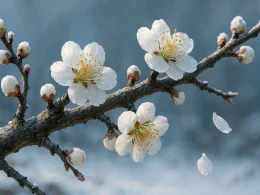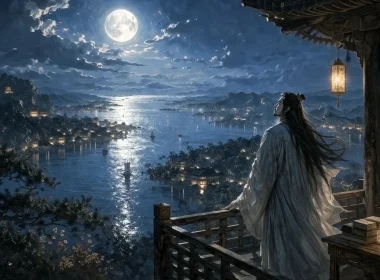

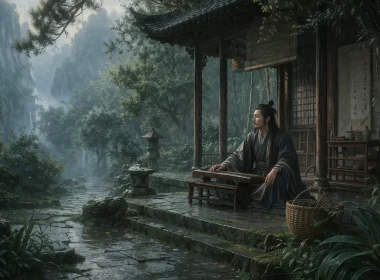
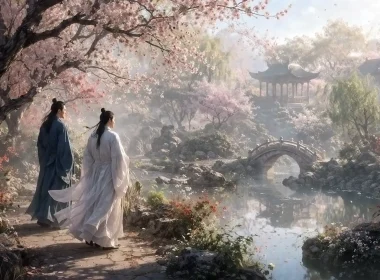
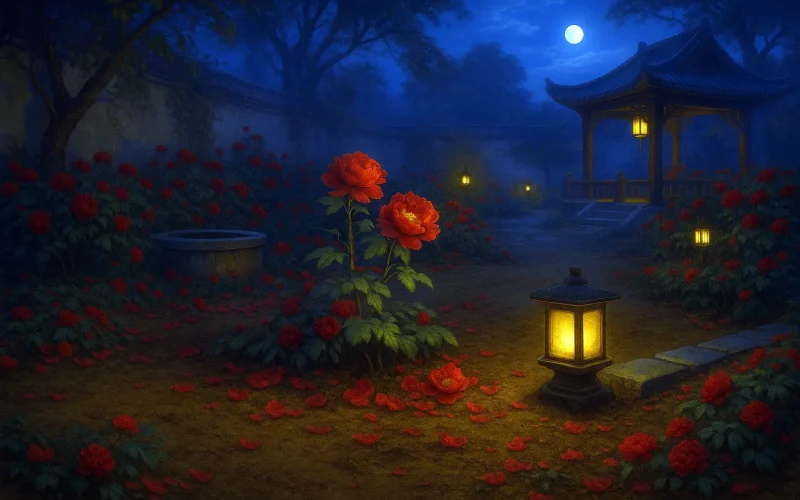
I'm saddened by the courtyard peonies brilliant red,
At dusk only two of them are left on their bed.
I am afraid they can't survive the morning blast,
By lantern light I take a look at the long, long last.
Original Poem
「惜牡丹花 · 其一」
白居易
惆怅阶前红牡丹,晚来唯有两枝残。
明朝风起应吹尽,夜惜衰红把火看。
Interpretation
This poem was composed in Bai Juyi’s mid-to-late years, a period when, having weathered the vicissitudes of official life, his understanding of life’s splendor and brevity, and of the preciousness and transience of beauty, was especially profound. Though titled "Cherishing the Peonies," its import far surpasses that of a typical poem lamenting the passing of spring through an object. With an almost obsessive attentiveness and urgency, the poet seizes and fixes upon the critical moment of the peonies' transition from "fading" to "gone." Moreover, through the astonishing act of "viewing them by lamplight at night," he pushes the emotional intensity of "cherishing" and the defiant posture against the passage of time to their extreme, creating a miniature philosophical drama about beauty, time, and the act of treasuring.
First Couplet: 惆怅阶前红牡丹,晚来唯有两枝残。
Chóuchàng jiē qián hóng mǔdān, wǎn lái wéiyǒu liǎng zhī cán.
Melancholy grips me, before the steps, gazing at crimson peonies; / As evening falls, of all their splendor, only two frail stems I see.
The opening establishes the tone with "Melancholy grips me," directly expressing the poet’s feeling and setting the poem’s poignant, focused mood. "The crimson peonies" are the object—vivid and striking, the very image of glorious bloom. Yet the poet’s gaze, like a precise lens, penetrates the overall display to focus on the fact that "only two frail stems" remain. The line’s brilliance lies in its contrast and selectivity: "As evening falls" implies time’s relentless erosion of beauty; "only" emphasizes the scarcity and preciousness of what persists; "two frail stems" is the quantified, sharply focused point of decay. The poet does not describe the full bloom but writes solely of the fading remnants, demonstrating a heightened sensitivity to and fixation upon the process of disappearance itself.
Second Couplet: 明朝风起应吹尽,夜惜衰红把火看。
Míngzhāo fēng qǐ yīng chuī jìn, yè xī shuāi hóng bǎ huǒ kàn.
Come dawn, the wind will surely rise and sweep these last traces away; / So, moved by pity for this fading red, I take a lamp to watch by night, I stay.
This couplet is the soul of the poem, with emotion and action building in powerful, interlocked layers. "Come dawn, the wind will surely rise…" is the inevitable extrapolation from the present (fading) to the future (utter ruin), a rational acknowledgment of nature’s inexorable law. The word "surely" contains a definite, grim premonition, deepening the sigh of helplessness. Yet, the poet does not stop at lament. Driven by the intense feeling of "pity for this fading red," he performs the unconventional, ritualistic act of "take a lamp to watch by night." "Night" and "lamp" form a potent symbolic opposition: night is darkness, the unknown, the end to which time consigns all beauty; the lamp is light, a human-made effort to arrest the instant, to defy obliteration. "To watch by lamplight" is not merely to see better, but to perform, before the arrival of the physical dawn, a solemn farewell and act of commemoration in psychological time. It is the highest tribute to beauty fated to vanish, and a poignant, if微小, act of defiance against time’s ruthless law.
Holistic Appreciation
The power of this heptasyllabic quatrain stems from the extreme purity of its emotion and the consummate poetry of its action. The poem’s structure follows a clear progression: "mood—observation—foreboding—deed." The first line initiates the feeling and fixes the object (melancholy before the peonies). The second line is a precise diagnosis of the present (only two stems remain at evening). The third line is the logical, grim verdict on the future (dawn's wind will finish them). The final line is the ultimate gaze and emotional culmination before the end (viewing by lamplight at night). The four lines are tightly interlocked, externalizing an anxiety over and cherishing of fading beauty from inner "melancholy" to agitated "foreboding," and finally transmuting it into a definitive, symbolic "act." What Bai Juyi achieves here is not ordinary lament for spring's passing, but a form of existential attention: Given the absolute premise that all will "surely be swept away," how does one engage with the "only" "remaining" beauty with the utmost focus and passion? The peony thus becomes a metaphor for all that is transient yet precious.
Artistic Merits
- Art of Focus: The poet forsakes the grand spectacle of full bloom, selecting only the "two frail stems" as his focus. Like a close-up shot, this renders the process and crisis of decay intensely vivid, profoundly intensifying the act of "cherishing."
- Precision in Temporal Framing: The poem contains multiple, precise time frames: "as evening falls" (the immediate present), "come dawn" (the imminent future), and "by night" (the specific, chosen moment for action). This contrasting and compression of time (from evening to dawn is but a breath) creates powerful urgency, making the act of viewing by lamplight seem desperately necessary.
- A Dramatic Action Defying Convention yet True to Feeling: "…I take a lamp to watch by night" is the poem’s most brilliant stroke. This action defies practicality (night is not for viewing flowers) yet arises utterly from profound emotion (driven by extreme pity and fear of loss). It externalizes the invisible feeling (cherishing) into a visible, ritualistic, and astonishing act, creating one of the most memorable and moving scenes in classical Chinese poetry.
- Condensed Language and Profound Tension: Words like "melancholy," "only," "surely," and "pity" are emotionally weighty. The phrase "take a lamp to watch" is remarkably succinct, containing within it action, tool, object, and state of mind—a calm statement beneath which churns a great emotional storm.
Insights
This work resonates because it touches a universal, profound human experience: Faced with the inevitable disappearance of beauty, what can we do beyond melancholy and foreboding? Bai Juyi’s answer is: "take a lamp to watch" the fading red by night. This is an act of ultimate "presence" and "attention," a commitment to experience and remember with full passion and focus before the end arrives.
In our contemporary, speed-obsessed, attention-fragmenting world, this poem offers a dual insight. First, genuine cherishing often springs from a clear-eyed recognition of "finitude" and a known "endpoint" (like knowing they will "surely be swept away at dawn"). Only the awareness of inevitable loss can ignite the most intense appreciation of the present. Second, resisting time’s erosion of beautiful memories sometimes requires an active, even deliberate, sense of ritual (like "viewing by lamplight"). The lamp in the deep night symbolizes the inner light of choosing—actively, against the current of habit—to focus, to linger, and to feel deeply.
It encourages us that for the beauties in our lives—people, moments, objects, phases—when we sense their impending end, we might light an internal "lamp" and perform a focused, heartfelt "night watch." This is not futility but a poetic effort to affirm permanence within impermanence, to find stillness within flux. This posture of maintaining fervent attention and action, even in the face of certain loss, is the most profound and moving aspect of Bai Juyi’s seemingly carefree philosophy.
Poem translator
Xu Yuanchong (许渊冲)
About the Poet
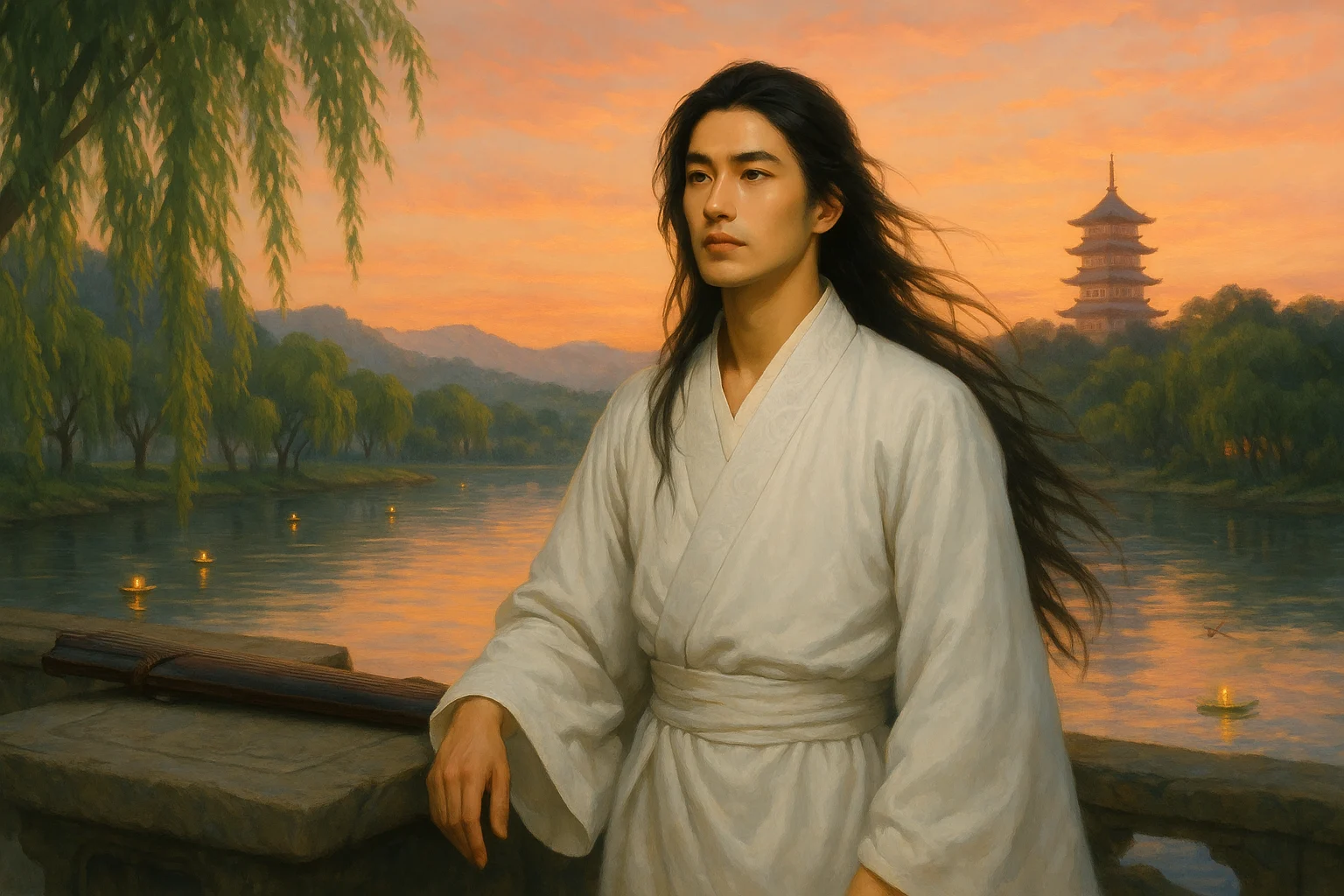
Bai Juyi (白居易), 772 - 846 AD, was originally from Taiyuan, then moved to Weinan in Shaanxi. Bai Juyi was the most prolific poet of the Tang Dynasty, with poems in the categories of satirical oracles, idleness, sentimentality, and miscellaneous rhythms, and the most influential poet after Li Bai Du Fu.