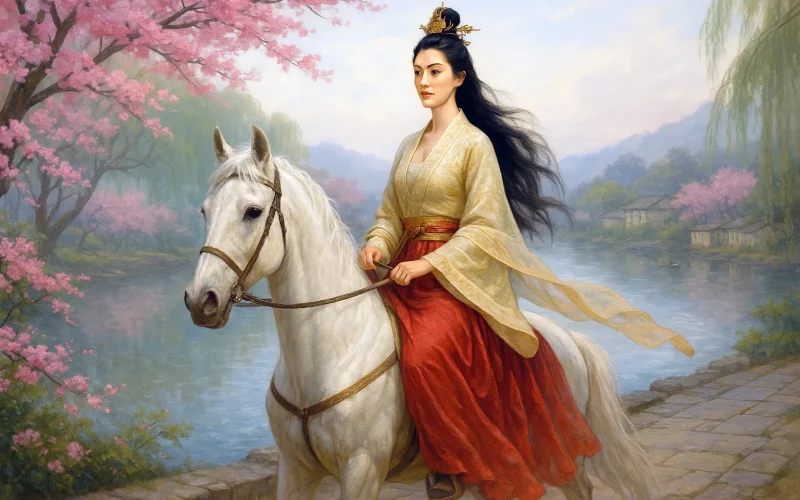
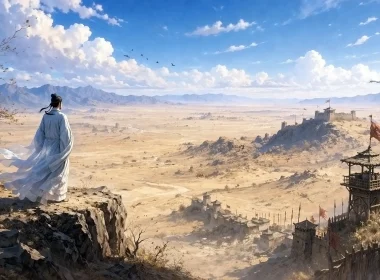


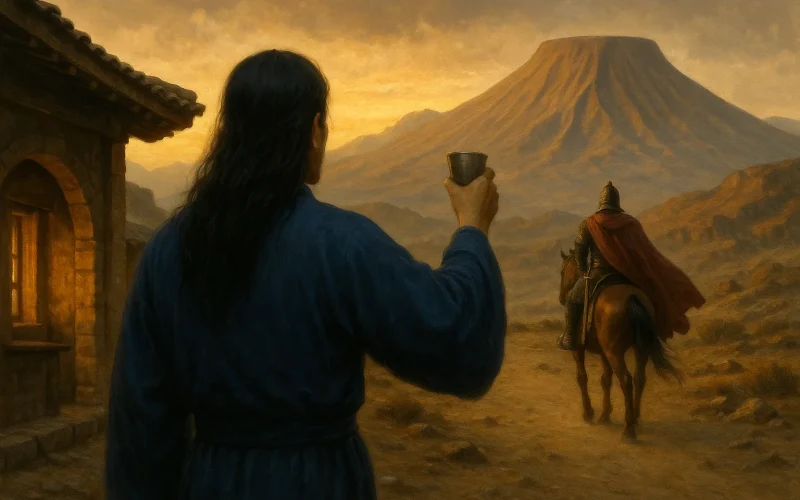
Few pass the Fire Mountains in summer’s blaze;
I see your horse fly swift as bird in haze.
The chief’s camp lies where the day-star goes down;
His horn at one blow wins a Tartar town.
Original Poem
「武威送刘判官赴碛西行军」
岑参
火山五月行人少,看君马去疾如鸟。
都护行营太白西,角声一动胡天晓。
Interpretation
This poem was composed in the fifth month of 751 AD, during the Tianbao era of Emperor Xuanzong of Tang. It was a time when Cen Shen was on his first campaign beyond the frontier, serving on the staff of Gao Xianzhi, Military Governor of Anxi. "Wuwei" (present-day Wuwei, Gansu) mentioned in the title was a crucial strategic town on the Hexi Corridor and a vital thoroughfare for westward travel. "West of the Desert" referred to the vast regions beyond the deserts of the Western Regions, the destination of Military Judge Liu's mission. This farewell took place against the grand backdrop of the High Tang's active expansion into the Western Regions. The friend was journeying not merely to a geographical distance but to the forefront of national strategy and personal achievement.
Unlike typical farewell poems, this work by Cen Shen was noted by later commentators as "kǒuzhàn" (口占), meaning it was improvised or chanted extemporaneously. This mode of creation determined the poem's characteristics of being concise and brisk, with soaring imagery and an unadorned quality. It dispenses with the minutiae of toasts and exchanges, cutting directly to the most iconic spatio-temporal moment of the frontier—the fierce heat of the Flaming Mountains and the urgency of military affairs. In this poem, the farewell is no longer a lingering expression of private sentiment but becomes a dynamic, tension-filled silhouette of a heroic departure, integrated into the vast tableau of its era, embodying the characteristically heroic tone and soaring spirit of High Tang frontier farewell poetry.
First Couplet: "火山五月行人少,看君马去疾如鸟。"
Huǒshān wǔ yuè xíngrén shǎo, kàn jūn mǎ qù jí rú niǎo.
In the Flaming Mountains' fifth month, wayfarers are few; / I watch your horse depart, swift as a bird in flight.
The poem begins by evoking the harsh environment emblematic of the frontier. "The Flaming Mountains' fifth month" establishes time and place; their heat is daunting. "Wayfarers are few" reinforces this with an objective statement. Yet, against this backdrop avoided by ordinary people, the poet focuses on a dynamic, swift movement: "I watch your horse depart, swift as a bird in flight." The word "watch" firmly fixes the gaze of the poet (and the reader) on the departing traveler. The simile "swift as a bird" is masterful; it conveys not only the speed of the galloping steed but also lends the entire scene a sense of lightness, vigor, and an unwavering forward momentum, both visually and spiritually. The stark contrast between the oppressive heat and the agile figure makes the heroic aura leap from the page.
Final Couplet: "都护行营太白西,角声一动胡天晓。"
Dūhù xíngyíng Tàibái xī, jiǎo shēng yī dòng hú tiān xiǎo.
The protector's camp lies west of the Great White Star; / A single blast of the horn will stir the alien sky to dawn.
The poet's gaze and thoughts follow the galloping hooves, reaching toward a more distant time and space. "The protector's camp lies west of the Great White Star" uses celestial imagery (the Great White Star, Venus) to indicate direction, emphasizing the camp's extreme remoteness and imbuing the line with a magnificent, imaginative quality. "A single blast of the horn will stir the alien sky to dawn" is an immortal line containing multiple layers of meaning: First, it realistically depicts the start of the army's day with the morning horn. Second, the "horn blast" symbolizes military might and command, while "stir the alien sky to dawn" subtly implies that Tang majesty and order can illuminate and awaken the distant frontier. Third, in terms of the poem's internal rhythm, the sound of the horn seems to pierce through the text and resound powerfully in the reader's ear, possessing a wake-up call force that energizes the entire poem. This line concludes the poem with sound, infinitely extending the scene of farewell, creating a vast, majestic, and profoundly resonant artistic conception.
Holistic Appreciation
This heptasyllabic quatrain can be called a divine "sketch" among High Tang frontier farewell poems. Without elaboration or embellishment, using only twenty-eight characters, it accomplishes a complete artistic creation, moving from "watching the departure" to "the spirit soaring," from a concrete scene to a grand imagination.
The poem's structure is concise and ingenious: the first two lines depict the "actual scene of farewell," the last two imagine the "distant, envisioned scene." The realistic part uses the "stillness" of the Flaming Mountains (wayfarers few) to set off the "motion" of the departing horse (swift as a bird), creating a scene rich in tension. The visionary part, through the vast space of "west of the Great White Star" and the stirring sound of "the horn stirs the sky to dawn," constructs an image of a distant military camp full of authority and hope. Between the real and the imagined, the transition is seamlessly bridged by the act of "watching," and the emotion naturally elevates from immediate admiration to a distant salute to victory and achievement.
The poem's most prominent features are its swift rhythm and soaring optimistic spirit. There is no sorrow of parting, no fear, only admiration for the friend's heroic bearing and a sublime vision of the cause he journeys toward. That figure "swift as a bird" is the embodiment of the High Tang scholar's enterprising spirit; that horn blast that "stirred the alien sky to dawn" is the magnificent echo of High Tang imperial prestige reaching far and wide. With his genius brushstrokes, Cen Shen refined and sublimated a specific farewell into an uplifting symbol of an era.
Artistic Merits
- Improvised Sketch and Focused Concentration: As an "improvised" work, the poem exhibits a sketch-like style that captures an instant and focuses on the core. The poet strips away all superfluity, selecting only four core images—"Flaming Mountains," "flying horse," "field camp," "horn blast"—and threading them together with the visual logic of "watching" and "imagining." This condenses the most powerful impression and emotion into an extremely succinct form.
- Bold Metaphor and Dynamic Sense: The metaphor "swift as a bird" is novel and apt. Unlike common metaphors for a fast horse (e.g., "shooting star," "lightning"), it imparts a sense of lightness, agility, and vibrant vitality. This contrasts yet complements the robust foundation of frontier poetry, showcasing Cen Shen's rich imagination.
- Exaggeration of Time/Space and Sublimation of Imagery: "West of the Great White Star" uses celestial bodies to poetically exaggerate distance. "A single blast of the horn will stir the alien sky to dawn" infinitely amplifies the power of sound, as if it possesses the might to alter the heavens. This exaggeration beyond reality is not fallacy but the externalization of emotional intensity and the power of conviction, vastly elevating the poem's realm.
- Lingering Resonance of a Sonic Conclusion: Ending with the "horn blast," an image profoundly symbolic and piercing, is the poet's masterstroke. It breaks the limitations of the visual tableau, allowing the poem's artistic conception to continue reverberating and expanding within the reader's imagination, achieving the enduring artistic effect of "the words end, but the sound lingers." This perfectly suits the mix of poignant longing and heroic sentiment when watching a departure, where the heart follows the sound into the distance.
Insights
This poem, like a vigorously sketched frontier drawing, reveals to us an alternative aesthetic of "farewell" and "forward journey." It teaches us that the most sublime farewell is sometimes not tearful hand-holding, but watching a figure resolutely merge into a vaster, grander landscape. The act of "watching" in the poem is a gaze filled with admiration and trust. When a friend's aspiration aligns with the call of the times, the well-wisher's emotion naturally transcends the melancholy of personal friendship, sublimating into a witness to heroic action and empathy for a grand design.
Simultaneously, the poem demonstrates how to contemplate an individual's journey against a cosmic-scale canvas of time and space. The vast distance of "west of the Great White Star" and the solemnity of "stirring the alien sky to dawn" lend an epic quality to a military expedition. This suggests that the value and brilliance of an individual life are often illuminated and immortalized in connection to grand endeavors or historical processes.
Ultimately, what Cen Shen instills in this short poem is a sense of "speed" and "dawn" unique to the High Tang spirit. "Swift as a bird" is the efficiency and passion of action; "stirring the alien sky to dawn" is the light and hope brought by conviction. It inspires all readers: facing life's journeys through "Flaming Mountains," be as swift and fearless as a bird in flight; believe that each dedicated pursuit will, with its own "blast of the horn," ultimately usher in the "dawn" belonging to both oneself and one's era.
About the poet
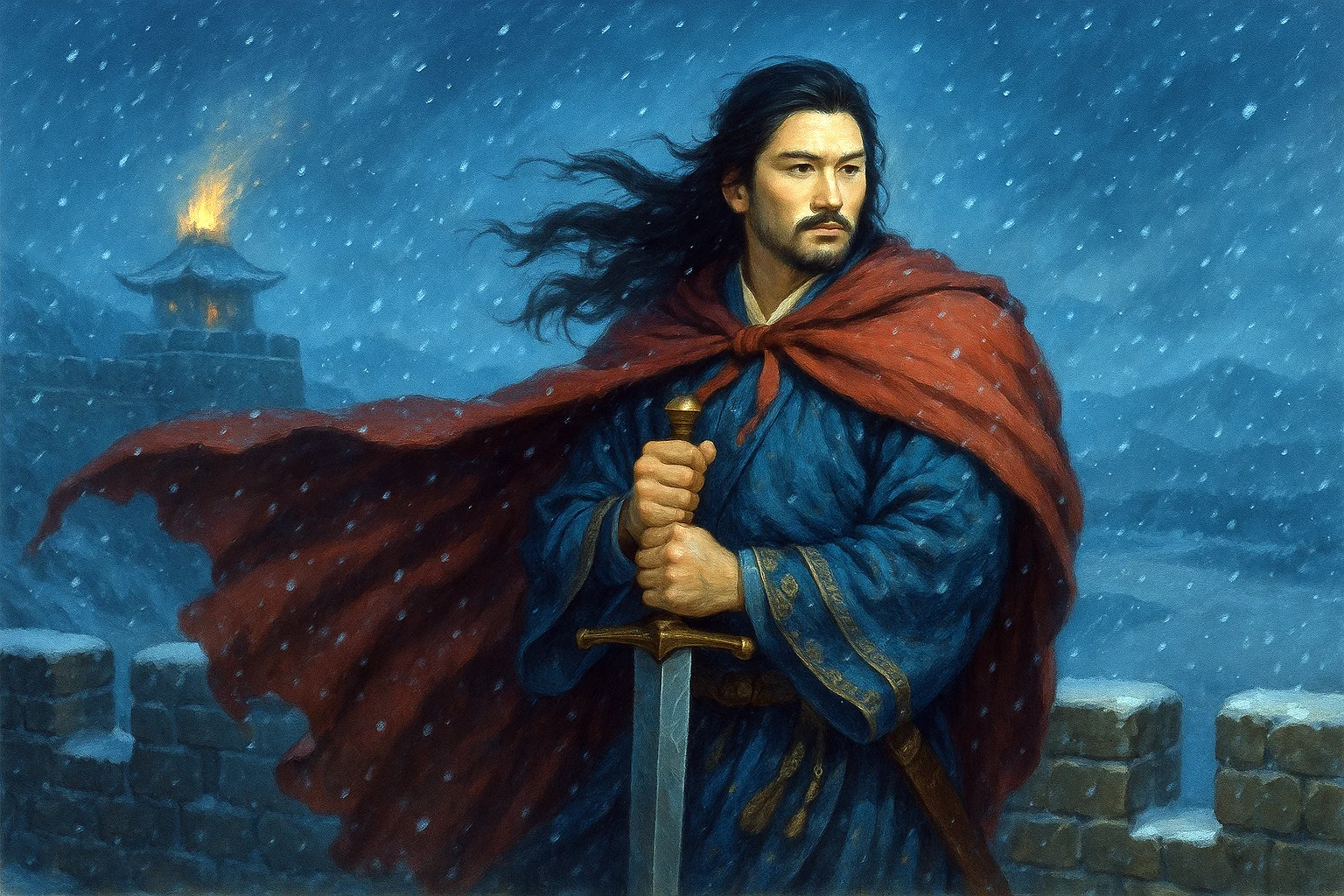
Cén Cān(岑参), 715 - 770 AD, was a native of Jingzhou, Hubei Province. He studied at Mt. Songshan when he was young, and later traveled to Beijing, Luoyang and Shuohe. Cén Cān was famous for his border poems, in which he wrote about the border scenery and the life of generals in a majestic and unrestrained manner, and together with Gao Shi, he was an outstanding representative of the border poetry school of the Sheng Tang Dynasty.