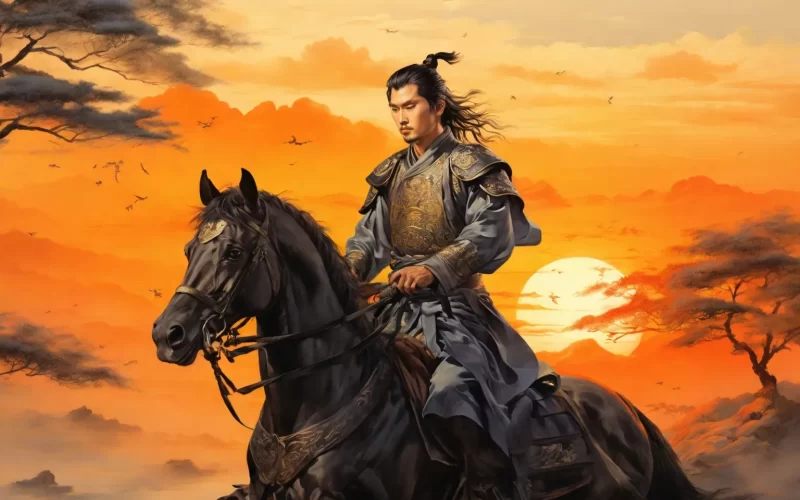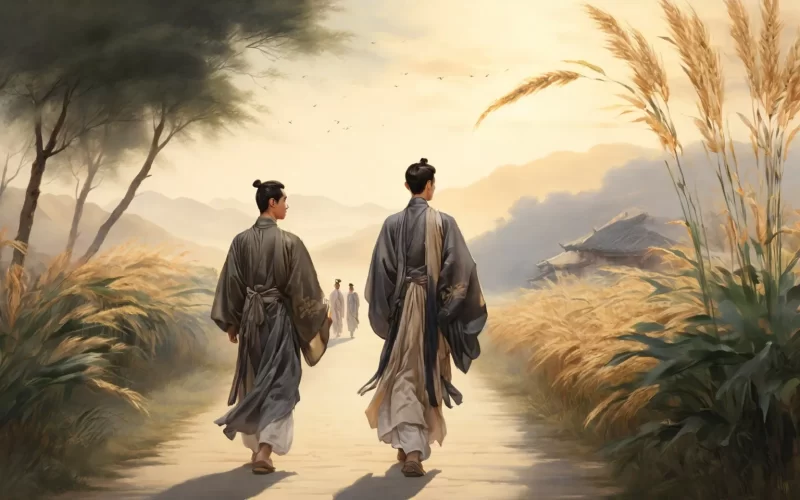
In the Fourth-month the south wind blows plains of yellow barley,
Date-flowers have not faded yet and lakka-leaves are long.
The green peak that we left at dawn we still can see at evening,
While our horses whinny on the road, eager to turn homeward.

...Ch'en, my friend, you have always been a great and good man,
With your dragon's moustache, tiger's eyebrows and your massive forehead.
In your bosom you have shelved away ten thousand volumes.
You have held your head high, never bowed it in the dust.

...After buying us wine and pledging us, here at the eastern gate,
And taking things as lightly as a wildgoose feather,
Flat you lie, tipsy, forgetting the white sun;
But now and then you open your eyes and gaze at a high lone cloud.

The tide-head of the long river joins the darkening sky.
The ferryman beaches his boat. It has grown too late to sail.
And people on their way from Zheng cannot go home,
And people from Luoyang sigh with disappointment.

...I have heard about the many friends around your woodland dwelling.
Yesterday you were dismissed. Are they your friends today?
Original Poem
「送陈章甫」
李颀
四月南风大麦黄,枣花未落桐叶长。
青山朝别暮还见,嘶马出门思旧乡。
陈侯立身何坦荡,虬须虎眉仍大颡。
腹中贮书一万卷,不肯低头在草莽。
东门酤酒饮我曹,心轻万事如鸿毛。
醉卧不知白日暮,有时空望孤云高。
长河浪头连天黑,津吏停舟渡不得。
郑国游人未及家,洛阳行子空叹息。
闻道故林相识多,罢客昨日今如何。
Interpretation
This poem was written by the Tang dynasty poet Li Qi, likely composed during the Kaiyuan or Tianbao eras. Chen Zhangfu was a friend of Li Qi's—open, upright, erudite, and talented, yet unsuccessful in his official career, remaining long in lowly posts. This poem was likely written when Li Qi saw Chen Zhangfu off in Luoyang, as Chen was returning to his hometown or departing for a new post. The poem contains both vivid characterization of the friend and profound reflection on the vicissitudes of life; it expresses the sorrow of parting as well as resignation over career disappointments. Li Qi excels at integrating observations on a person's fate into his farewell poems, elevating this work beyond a typical parting verse, making it a self-portrait and a sigh for the spirit of a scholar.
First Stanza: 四月南风大麦黄,枣花未落桐叶长。青山朝别暮还见,嘶马出门思旧乡。
Sì yuè nán fēng dàmài huáng, zǎo huā wèi luò tóng yè cháng. Qīng shān zhāo bié mù huán jiàn, sī mǎ chū mén sī jiù xiāng.
The south wind of the Fourth Month yellows the barley;
Flowers still on the date trees, the wutong’s leaves are long.
Green hills: you part at dawn, you see them again at dusk;
A whinnying horse at the gate recalls the old village.
The opening establishes the season with imagery. "The south wind of the Fourth Month yellows the barley" sets the time of parting. The ripening barley, blooming date flowers, and flourishing wutong leaves are scenes of imminent harvest, yet tinged with faint melancholy due to parting. The next two lines shift to a spatial sense: "Green hills: you part at dawn, you see them again at dusk" uses the constancy of hills to contrast the impermanence of human affairs—hills can be left at dawn and seen again at dusk, but when will people meet again after parting? "A whinnying horse at the gate recalls the old village" shifts from the horse's whinny to human homesickness; if even the horse is reluctant, how much more so for people? The four lines move from scene to emotion, building layer by layer, establishing the poem's deep yet gentle tone.
Second Stanza: 陈侯立身何坦荡,虬须虎眉仍大颡。腹中贮书一万卷,不肯低头在草莽。
Chén hóu lì shēn hé tǎndàng, qiú xū hǔ méi réng dà sǎng. Fù zhōng zhù shū yī wàn juàn, bù kěn dī tóu zài cǎomǎng.
Lord Chen, how open-hearted, how forthright a man you are!
Curling beard, tiger eyebrows, and a forehead broad and high.
Ten thousand chapters stored up within his belly,
Yet he would not bow his head in the wilderness.
The focus shifts to a direct characterization of the friend, a brilliant part of the poem. "Curling beard, tiger eyebrows, and a forehead broad and high" sketches Chen Zhangfu's features with vivid, masterful strokes—curly beard, tiger-like brows, a broad forehead. A few words, and an image of resolute, imposing, and dignified bearing leaps from the page. "Ten thousand chapters stored up within his belly" describes his erudition; "Yet he would not bow his head in the wilderness" describes his integrity. The two instances of "would not" (不肯, bù kěn)—"would not bow his head," "would not be content"—fully reveal Chen Zhangfu's proud backbone and ambition. The poet's praise for his friend is both admiration and self-encouragement.
Third Stanza: 东门酤酒饮我曹,心轻万事如鸿毛。醉卧不知白日暮,有时空望孤云高。
Dōngmén gū jiǔ yǐn wǒ cáo, xīn qīng wàn shì rú hóngmáo. Zuì wò bù zhī bái rì mù, yǒu shí kōng wàng gū yún gāo.
East Gate he buys us wine, and we drink it together,
A heart that makes light of a myriad matters, as of goose down.
Drunk, lying, he knows not the bright day is gone;
Sometimes he will stare at nothing, at a lone cloud high.
This stanza depicts a drinking scene, shifting from the person to events, from events to feelings. "A heart that makes light of a myriad matters, as of goose down" is the key line—worldly success, fame, gain, loss, glory, and disgrace are as light as goose down in their eyes. This detachment is precisely the foundation of their mutual understanding. "Drunk, lying, he knows not the bright day is gone" describes the depth of their intoxication, a forgetfulness born of joyous gathering and a temporary escape from reality. "Sometimes he will stare at nothing, at a lone cloud high" reveals a thread of sobriety within the intoxication—the lone cloud hanging high is both a scene before the poet's eyes and a projection of the aspiration in his heart: however troubled the world, that wisp of proud integrity in the heart never fades.
Fourth Stanza: 长河浪头连天黑,津吏停舟渡不得。郑国游人未及家,洛阳行子空叹息。
Cháng hé làng tóu lián tiān hēi, jīn lì tíng zhōu dù bù dé. Zhèng guó yóu rén wèi jí jiā, Luòyáng xíng zǐ kōng tànxī.
Waves on the Long River, to the very sky, are black;
The ferryman halts his boat, he cannot make the crossing.
The traveler to Zheng has not yet reached his home;
The wayfarer of Luoyang can only sigh in vain.
The scene shifts to the actual journey of parting, both real and symbolic. "Waves on the Long River, to the very sky, are black" uses the peril of the Yellow River to symbolize the hardship of an official career. "The ferryman halts his boat, he cannot make the crossing" hints at obstacles ahead and an uncertain return date. The next two lines deepen the sentiment through parallelism: "The traveler to Zheng" refers to Chen Zhangfu (Zheng was Chen's region), and "The wayfarer of Luoyang" is the poet himself. One has not yet reached home; the other can only sigh in vain. Both are souls adrift under heaven; the melancholy of parting and the disappointment in official life intertwine here, indistinguishable from one another.
Fifth Stanza: 闻道故林相识多,罢客昨日今如何。
Wén dào gù lín xiāng shí duō, bà kè zuó rì jīn rú hé.
They tell me in his old forest there are many acquaintances;
How fare now the visitors dismissed of yesterday?
The poem concludes with a rhetorical question, subtle yet profound. "In his old forest there are many acquaintances" expresses concern for the friend's circumstances upon returning home and also questions the fate of all disappointed scholars. "How fare now the visitors dismissed of yesterday?" widens the lens to a broader social context—those like Chen Zhangfu, unrecognized talents who finally retreated to forests and hills. How are they faring now? This question is directed at the friend, at himself, and at that era. The poem stops here abruptly, its resonance lingering, inviting reflection.
Holistic Appreciation
This is a superior work among Li Qi's farewell poems. Its unique value lies in fusing the feeling of parting, praise for the person, and lament for one's own life circumstances. The poem unfolds along the sequence "season—person—drinking—obstructed crossing—question," its structure tight yet its emotion fluid. The poet's portrayal of his friend is especially brilliant: the description of appearance in "Curling beard, tiger eyebrows, and a forehead broad and high"; the display of learning in "Ten thousand chapters stored up within his belly"; the revelation of integrity in "Yet he would not bow his head in the wilderness"—layered upon each other, shaping a three-dimensional, full-bodied image of a scholar.
What is especially rare is that the poet does not stop at praising his friend but projects his own feelings into it. "A heart that makes light of a myriad matters" is both Chen Zhangfu's breadth of mind and the poet's self-description. "Sometimes he will stare at nothing, at a lone cloud high" is both the scene before his eyes and the aspiration in his heart. "The wayfarer of Luoyang can only sigh in vain" describes both parting and his own life circumstances. This technique of intertwining "you" and "I" gives the entire poem a deeply autobiographical quality.
The concluding question is particularly masterful. "How fare now the visitors dismissed of yesterday?" offers not a word of direct commentary, yet contains endless meaning within—concern for the friend, reflection on an official career, discontent with the times, and a questioning of life's ultimate meaning. This technique of ending with a question adds infinite lingering flavor to the poem.
Artistic Merits
- Vivid Character Portrayal: The seven words "Curling beard, tiger eyebrows, and a forehead broad and high" sketch the person's appearance with minimal yet telling detail, revealing character through form. "Ten thousand chapters stored up within his belly" uses hyperbole realistically; "Yet he would not bow his head in the wilderness" reveals aspiration through negation. Building layer upon layer, the character image comes vividly to life.
- Skillful Use of Parallelism: The two lines "The traveler to Zheng has not yet reached his home; / The wayfarer of Luoyang can only sigh in vain" can refer to the separate states of Chen Zhangfu and the poet, or be seen as a portrayal of their shared fate—both travelers, both wayfarers, both sighing souls. This parallelism heightens the poem's emotional tension.
- Deep Exploration of Metaphor and Symbolism: "Waves on the Long River, to the very sky, are black" is both a realistic description of the Yellow River's waves and a symbol of officialdom's dangers. "The ferryman halts his boat, he cannot make the crossing" is both a realistic depiction of an obstructed crossing and a metaphor for a bewildering road ahead. "A lone cloud high" is both the scene before the eyes and, even more, a symbol of integrity of heart. The overlay of multiple meanings makes the poem's connotation extremely rich.
- The Art of the Open-ended Conclusion: Ending with a question, providing no answer, yet sparking the reader's infinite imagination. This technique of leaving space expands the poem's意境 from the finite to the infinite, from the personal to the universal, achieving a trans-temporal and trans-spatial power to move.
Insights
The core insight this poem offers contemporary readers is the wisdom of "how to maintain integrity amidst disappointment." Chen Zhangfu, with "腹中贮书一万卷,不肯低头在草莽" despite his vast learning, would not stoop or submit, choosing instead a more difficult path. This proud backbone of "would not bow his head" is precious in any era.
The state of mind captured in "心轻万事如鸿毛" is especially worth pondering. In life, gain and loss, glory and disgrace are commonplace, but to view them as "goose down" is to attain a kind of spiritual freedom. This is not passive withdrawal from the world but an active choice made after recognizing the nature of worldly affairs. Just as "Sometimes he will stare at nothing, at a lone cloud high" suggests—even if mired in the mud, the heart can soar high as a cloud.
Finally, the question "闻道故林相识多,罢客昨日今如何" still strikes the heart across a thousand years. Those who chose reclusion, those who refused to drift with the current—how did they fare? This question has no standard answer, but the asking itself is a tribute to another way of life, another choice of values. In today's world, where utility is often paramount, rereading this poem might let us, amidst our busyness, also look up at the lone cloud on the horizon and ask ourselves: Can I still maintain that openness of "would not bow his head" and that detachment of a "heart that makes light of a myriad matters"?
Poem translator
Kiang Kanghu
About the Poet
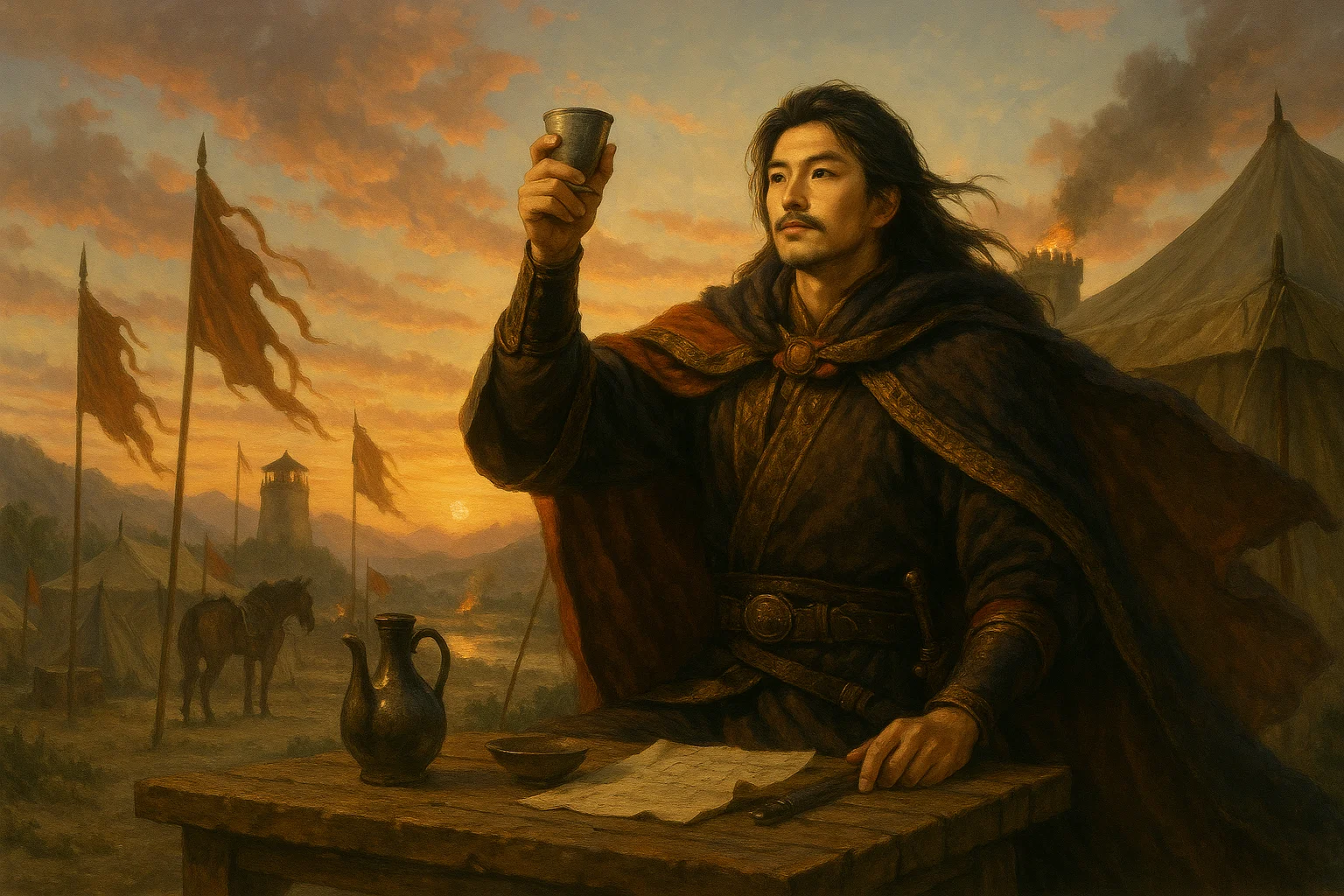
Li Qi (李颀 c. 690 – c. 751), whose ancestral home was in Zhao County, Hebei Province, was a renowned frontier fortress poet of the High Tang period. He became a jinshi (presented scholar) in the 23rd year of the Kaiyuan era (735 AD) and served as the Sheriff of Xinxiang before retiring from official life to live in seclusion. His poetry is best known for its frontier themes, and he excelled particularly in seven-character ancient verse and character portrayal. He had a gift for blending boldness with delicate emotion, and together with Gao Shi and Cen Shen, he collectively shaped the grandeur of High Tang frontier poetry.