The oriole drifts, unsure, now here, now there, astray;
O’er paths and streams it roams, not master of its way.
Can artful song spring from a heart that knows no care?
Fine days don’t promise meetings, though the world seem fair.

Through wind, through dew, through shine and shade, it flits alone;
By gates that shut like those that open, all unknown.
Spring-stricken once, I found its song too sharp to bear —
Where in the kingly town blooms a branch for its despair?
Original Poem
「流莺」
李商隐
流莺漂荡复参差,度陌临流不自持。
巧啭岂能无本意?良辰未必有佳期。
风朝露夜阴晴里,万户千门开闭时。
曾苦伤春不忍听,凤城何处有花枝。
Interpretation
This poem was written during Li Shangyin's later years, likely around 851 AD. This period marked a time of profound personal hardship and spiritual isolation for the poet. Following the death of his father-in-law Wang Maoyuan, which severed his political patronage, Li Shangyin was forced to wander from one provincial headquarters to another—from Guizhou to Xuzhou, then to Zizhou—truly embodying a state of "wandering, unsteady" existence. This work is thus a product of the twin pressures of personal destiny and the temper of the times. The poet's choice of the "wandering oriole" as the central image is deliberate: the bird's seasonal migrations mirror the poet's own drift between posts, while its beautiful yet seemingly unanswered song resonates deeply with the poet's own plight of possessing "towering talent yet never realizing his lifelong aspirations." Moreover, by this time, Li Shangyin held no more illusions about his official prospects; poetic creation had become his primary means of affirming his own existence and soothing a fragmented spirit.
First Couplet: 流莺漂荡复参差,度陌临流不自持。
Liú yīng piāo dàng fù cēn cī, dù mò lín liú bù zì chí.
The oriole wanders, drifts, falters, and veers;
By paths and streams, she cannot steer her course.
Explication: The opening immediately sketches the dynamic image of the rootless, wandering oriole. "Wanders and drifts" describes its spatial rootlessness; "falters and veers" portrays its unsteady flight; "by paths and streams" further emphasizes its aimless journey. The three words "cannot steer her course" carry particular weight, referring both to the oriole's inability to control the wind and its path, and metaphorically hinting at the poet's own profound sense of powerlessness amidst political currents and the whims of fate.
Second Couplet: 巧啭岂能无本意?良辰未必有佳期。
Qiǎo zhuàn qǐ néng wú běn yì? Liáng chén wèi bì yǒu jiā qī.
Could her exquisite songs be without thought or aim?
Fine days do not ensure a welcome all the same.
Explication: This couplet turns to a questioning reflection on the oriole's "song." The "exquisite songs" symbolize the poet's talent and inner voice; "could… be without thought or aim" is a firm affirmation of self-worth. However, the disconnect between "fine days" and "a welcome" reveals that even in seemingly opportune moments, true opportunity and understanding may forever be absent, articulating the structural gap between the scholar's ideals and reality.
Third Couplet: 风朝露夜阴晴里,万户千门开闭时。
Fēng zhāo lù yè yīn qíng lǐ, wàn hù qiān mén kāi bì shí.
Through windy dawns, dewy nights, in shine or rain;
When thousand doors and gates swing wide or close again.
Explication: The poet uses two sets of powerfully evocative temporal and spatial images to portray the incessant yet lonely nature of the oriole's song. "Through windy dawns, dewy nights, in shine or rain" describes the cyclical nature of time; "when thousand doors and gates swing wide or close" captures the daily rhythm of human life. The oriole's song persists through it all, yet seems to form a silent barrier with the surrounding world—ever-present, yet never truly received.
Final Couplet: 曾苦伤春不忍听,凤城何处有花枝。
Céng kǔ shāng chūn bù rěn tīng, fèng chéng hé chù yǒu huā zhī.
Grieved by late spring, I could not bear her song.
Where in Phoenix Town can she find a branch to belong?
Explication: The final couplet shifts from objective observation to subjective empathy. "Grieved by late spring" shows the poet's emotional identification with the oriole's cry; "could not bear" expresses an aural resistance born of shared sorrow. It concludes with a poignant question: "Where in Phoenix Town can she find a branch to belong?" Though the capital is vast, it offers the wandering oriole no place to rest. This question is both a concern for the oriole's fate and an ultimate inquiry into the living space for the poet himself, and indeed all thwarted scholars.
Holistic Appreciation
The poem constructs a metaphorical system of a double predicament: sound and space. The oriole's "wandering" is its spatial rootlessness; its "exquisite songs" are its sonic futility—no matter how it sings, it cannot truly enter the world behind the "thousand doors and gates." Through this imagery, the poet completes a poetic diagnosis of his own fate: the tragedy of a talented scholar lies not only in having no place to belong (the loss of physical ground), but also in the inefficacy of his expression (the failure of his voice to reach its aim).
The entire poem uses the oriole as the lyrical subject, yet every line is infused with the poet's self-comparison. The four couplets follow a progressive logic of "body—voice—time—question": from the wandering body, to the futile voice, to the incessant time, culminating in the unanswered question of where to perch. With supremely condensed imagery, Li Shangyin conveys an immensely rich life experience, making this regulated verse a classic model in classical Chinese poetry for expressing the fate of the disappointed scholar.
Artistic Merits
- Extended and Deepened Imagery: The oriole image runs through the entire poem, expanding layer by layer from its posture, its song, its temporal and spatial context, to its final lack of refuge, forming a cohesive and multi-dimensional symbolic whole.
- Spatio-temporal Tension within Parallelism: The parallelism in the third couplet—"windy dawns, dewy nights" against "thousand doors and gates," and "in shine or rain" against "swing wide or close"—constructs, within strict formal balance, a grand backdrop of nature versus human affairs, time versus space, setting off the oriole's insignificance and loneliness.
- The rhetorical question in the second couplet ("Could her exquisite songs be without thought or aim?") affirms the integrity of the inner voice, while the direct question in the final couplet ("Where in Phoenix Town can she find a branch to belong?") conveys the disorientation of a dead end. These two distinct forms of inquiry—one reinforcing conviction, the other expressing doubt—deepen the poem’s emotional complexity.
Insights
This work depicts not only the wandering of an individual fate but also reveals a universal spiritual dilemma: when a person's voice and value cannot be recognized and accepted by the world they inhabit, even constant expression and persistent presence result in a state of fundamental loneliness.
The oriole in the poem can be seen as a symbol for all the unrecognized, the marginalized, or the idealist. It reminds us: the true plight is often not the absence of a voice, but a voice perpetually drifting in a void where no one truly listens; it is not the absence of a path, but that all paths lead to no true destination.
Yet, the oriole’s self-affirmation—"Could her exquisite songs be without thought or aim?"—offers a precious insight: amid drifting and loneliness, sustaining an inner conviction of one’s own worth may be the essential precondition for any true dialogue with the world. Even if Phoenix Town provides no branch, the song itself, unwavering and unbroken, remains the most resilient proof of existence. This is the poet’s quiet act of self-possession, and an enduring encouragement to those who follow: in an age that offers no true place to alight, one may still refuse to fade without a voice.
About the poet
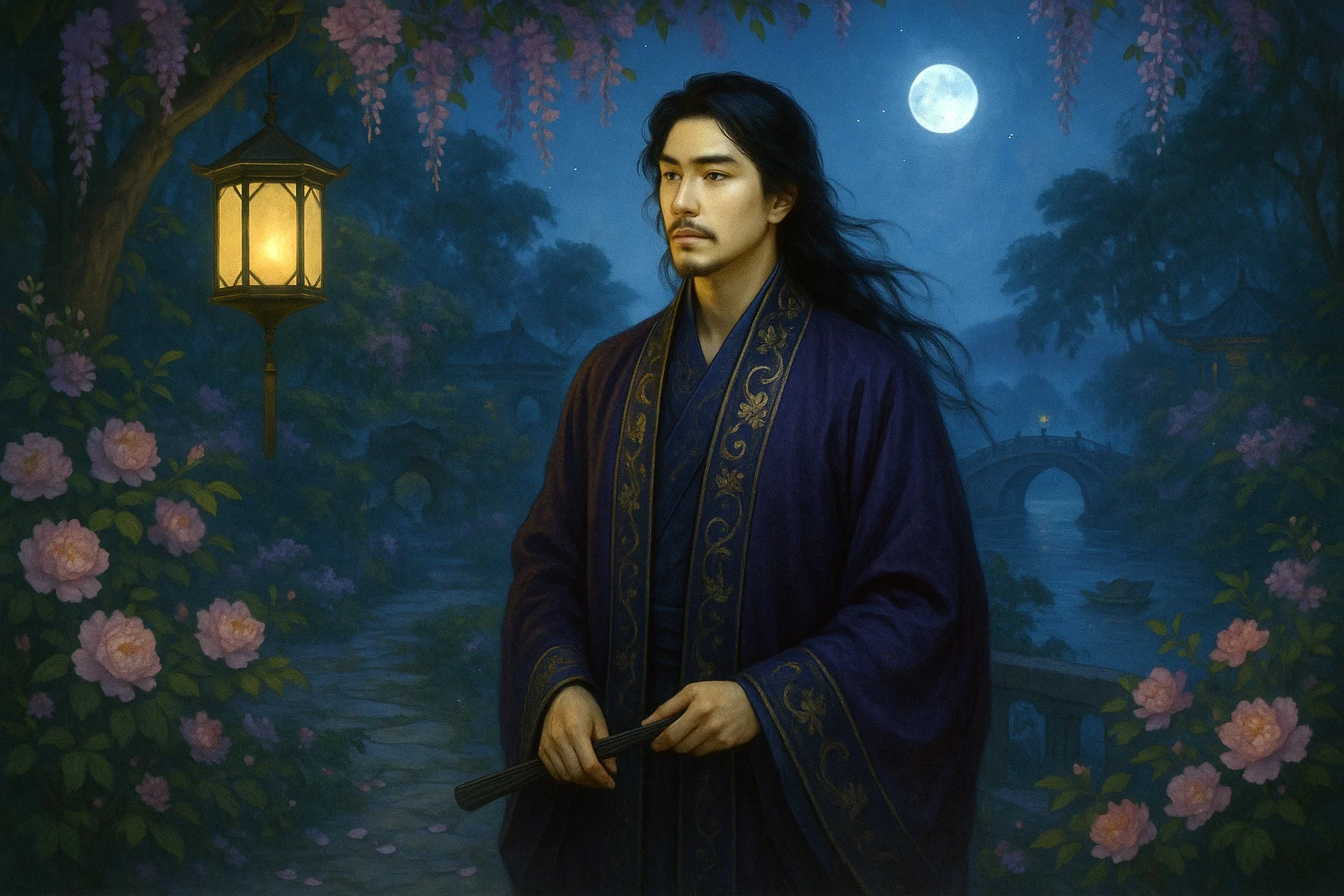
Li Shangyin (李商隐), 813 - 858 AD, was a great poet of the late Tang Dynasty. His poems were on a par with those of Du Mu, and he was known as "Little Li Du". Li Shangyin was a native of Qinyang, Jiaozuo City, Henan Province. When he was a teenager, he lost his father at the age of nine, and was called "Zheshui East and West, half a century of wandering".